Johann Sebastian Bach

Johann Sebastian Bach
Born 31 March 1685 • Died 28 July 1750
When Leipzig needed a music director in 1723, the council approached Telemann, who declined, and then Graupner, who could not be released. They took Bach third, and one councillor recorded that since the best could not be obtained, mediocre ones would have to be accepted. He worked there for twenty-seven years, produced the St Matthew Passion and the Mass in B minor while arguing with the council about money and schoolboys, and died leaving a widow who ended her life in poverty. Eighty years later Mendelssohn conducted the St Matthew Passion and the world changed its mind.
Rank
#72
Influence
77
Field
Composer
Historical Perspective
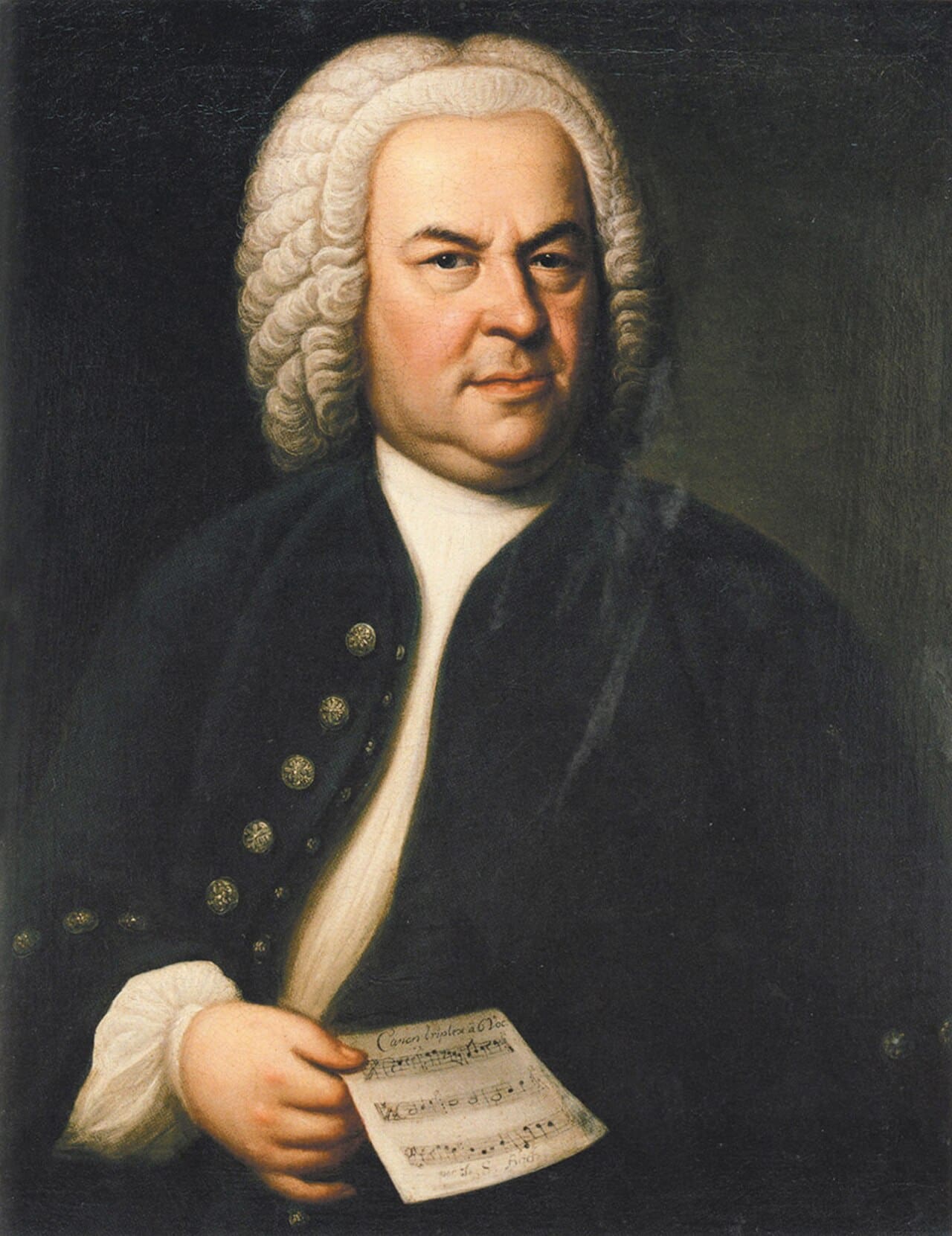
Johann Sebastian Bach was born at Eisenach on 31 March 1685 into a family that had supplied Thuringia with musicians for generations - the name was practically a job title. Orphaned at ten, he was raised by an elder brother, and walked considerable distances as a young man to hear the organists he admired, including a four-month unauthorised absence in 1705 to hear Buxtehude at Lübeck, some four hundred and fifty kilometres away, which got him into trouble on his return. He held posts at Arnstadt, Mühlhausen, Weimar - where a dispute over his release ended with a month in the duke's jail - and Köthen, before becoming Thomaskantor at Leipzig in 1723, responsible for the music of four churches and for teaching Latin to schoolboys. He married twice and fathered twenty children, of whom ten survived him and four became notable composers. In his last years he went blind, and unsuccessful eye surgery by an itinerant English oculist probably hastened his death on 28 July 1750. Michael Hart ranked him 72nd in The 100.
Influence Meter
77
Measured on a 100-point scale
The technical foundation of Western music, recovered eighty years after his death
1723-1750
A Man With a Deadline
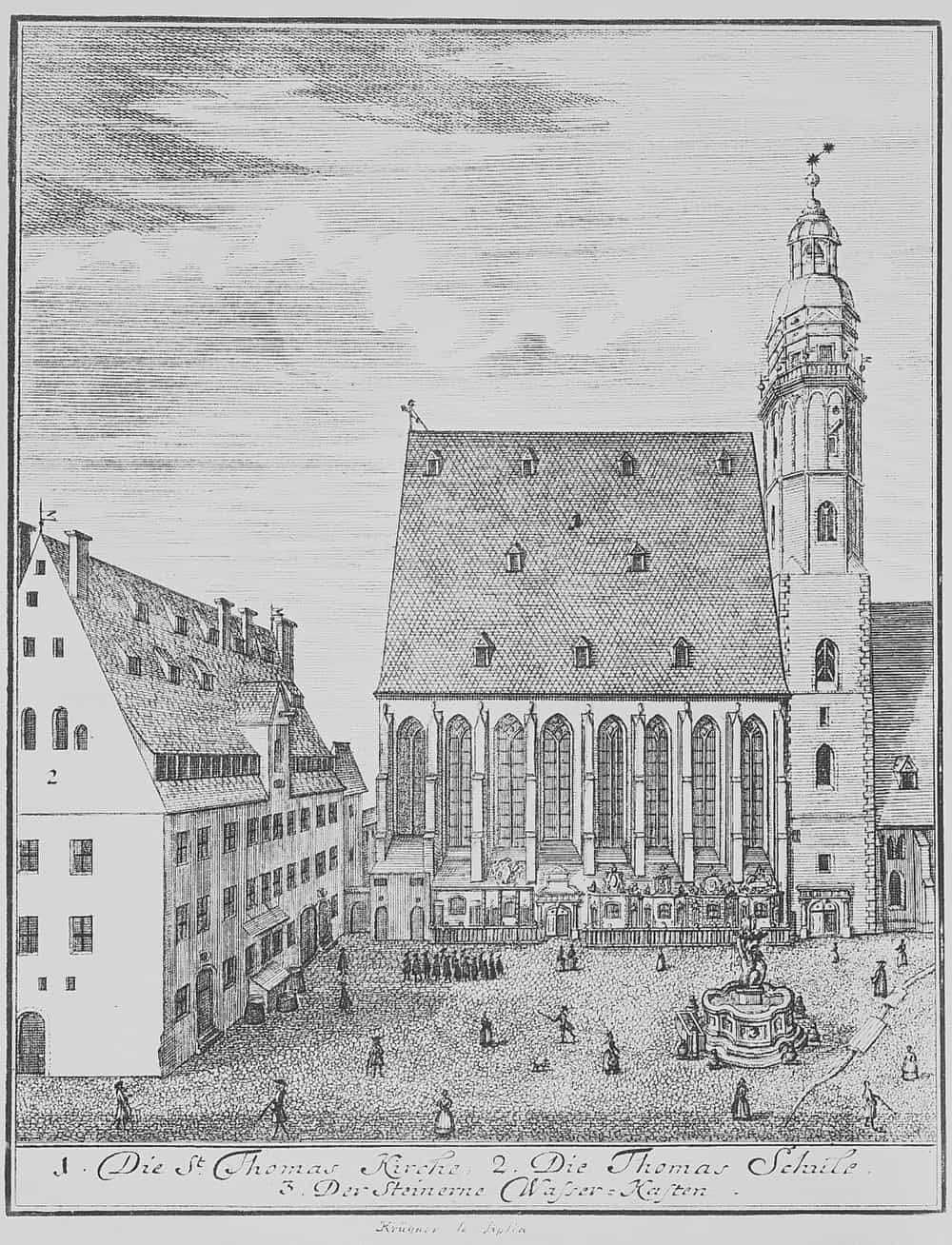
Bach's position at Leipzig required a new cantata for every Sunday and feast day of the church year - a work of perhaps twenty-five minutes for choir, soloists and orchestra, composed, copied, rehearsed and performed on a weekly cycle. He did this for years at a stretch, producing several complete annual cycles of which around two hundred cantatas survive and perhaps a hundred more are lost. He also taught, argued with the council about his salary and privileges, complained that the schoolboys sent to him could not sing, and supplemented his income with funerals - he once remarked that a healthy year cost him a hundred thalers in lost fees. Almost none of it was written for posterity or for publication; it was work, produced to order, and the fact that the Mass in B minor and the St Matthew Passion came out of that treadmill is one of the strange facts of cultural history.
On 11 March 1829, the twenty-year-old Felix Mendelssohn conducted the St Matthew Passion in Berlin - the first performance since Bach's death, seventy-nine years earlier, and heavily cut and rearranged. The score had come to him through his teacher and, according to a persistent story, his grandmother; the version about it being rescued from a cheesemonger's wrapping paper is a legend. The performance was a sensation, sold out and repeated, and it began the Bach revival. The Bach-Gesellschaft was founded in 1850 to publish everything, a task that took until 1900, and the modern catalogue, the Bach-Werke-Verzeichnis, numbers over eleven hundred surviving works. Mendelssohn's remark afterwards was that it took an actor and a Jew to give back to the people the greatest Christian music.
What Musicians Mean When They Say Bach
His reputation among composers rests less on any single piece than on a completeness that later musicians have found intimidating.
- Counterpoint at its limit: Multiple independent melodic lines that are each satisfying alone and combine without strain. The Art of Fugue takes a single theme through every contrapuntal device known and was left unfinished at his death.
- The Well-Tempered Clavier: Two books of preludes and fugues in all twenty-four keys, demonstrating that a keyboard tuned in a particular way could play in any of them. It is the technical bedrock of keyboard music and every pianist works through it.
- The Brandenburg Concertos: Six concertos of wildly different instrumentation sent in 1721 to a margrave who appears never to have had them played. Now among the most recorded orchestral works in existence.
- The St Matthew Passion: Nearly three hours for double choir and orchestra, setting the Passion narrative with interpolated commentary. Regarded by many musicians as the summit of Western sacred music.
- The Mass in B minor: Assembled at the end of his life, partly from earlier material, into a complete Latin mass no Lutheran service could use and no patron had commissioned. It seems to have been written to be complete rather than to be performed.
- The solo string works: The sonatas and partitas for unaccompanied violin and the six cello suites make a single line imply full harmony. The Chaconne from the second partita is routinely described by violinists as the hardest thing they play.
Influence
Every Composer Since Has Had to Deal With Him
The line of composers who studied him is essentially the canon. Mozart encountered the fugues in 1782 and wrote to his father in visible excitement; Beethoven was raised on the Well-Tempered Clavier and called Bach not a brook but an ocean, punning on his name. Chopin practised the preludes and fugues before concerts, Schumann and Brahms edited him, and Schoenberg traced serialism's ancestry to his contrapuntal thinking. Nineteenth-century orchestration by Stokowski and others put him in cinemas; Glenn Gould's 1955 Goldberg Variations made a Baroque keyboard cycle a best-selling record.
The reach extends well outside classical music. Jazz musicians from Dave Brubeck to Jacques Loussier have worked his material, the harmonic logic of his chorales is what most Western musicians are taught as functional harmony, and his structures are used as teaching material in composition programmes worldwide. Three of his pieces were placed on the Voyager Golden Record and launched out of the solar system in 1977, on the argument, attributed to Lewis Thomas, that sending Bach would be boasting.
The Catalogue
What Survives, and What Does Not
The Bach-Werke-Verzeichnis numbers over eleven hundred surviving works. A comparable quantity is thought to be lost, much of it dispersed among his sons after his death - Wilhelm Friedemann in particular sold or mislaid a great deal.
| Sacred cantatas | About 200 | Perhaps 100 more lost; he wrote several complete annual cycles |
| Organ works | Over 250 | The foundation of the organ repertoire, and what he was actually famous for in his lifetime |
| Keyboard works | Over 200 | Including the Well-Tempered Clavier, the Goldberg Variations and the English and French Suites |
| Passions and oratorios | 3 surviving | St Matthew and St John complete; St Mark lost apart from the libretto |
| Orchestral and chamber | About 100 | Brandenburg Concertos, orchestral suites, violin and cello solo works |
| Total catalogued | 1,128 as numbered | BWV numbers run past 1,120 and are still being revised |
He published very little in his lifetime - a handful of keyboard collections. Almost everything else circulated in manuscript, which is why so much of it disappeared.
Further Reading
Books About Bach
The documentary record is thin for a figure of his standing: no letters of consequence about music, and an obituary written by his son and a pupil.
Legacy
Why Number Seventy-Two
Michael Hart ranked Bach 72nd, below Beethoven at forty-five, and the ordering is defensible in terms of historical effect if not of musical estimation. Beethoven changed what a composer was and how music was heard; Bach, working within an idiom that was already going out of fashion when he died, changed almost nothing in his own century because almost nobody outside a few German towns heard him. Influence that has to wait eighty years for a twenty-year-old conductor to find the score is a different kind of influence.
What he supplies instead is the technical foundation. The rules of voice-leading, harmony and counterpoint taught in conservatories are largely abstracted from his chorales; the equal-tempered keyboard that all Western music now assumes was argued for by the Well-Tempered Clavier; and the fugue in its developed form is essentially his. Musicians tend to place him first among composers by a margin they find difficult to explain to non-musicians, and the reason usually offered is completeness - that he does everything the language can do, and does it while meeting a Sunday deadline for a council that thought it had settled for third choice.
Related Publications