Sigmund Freud

Sigmund Freud
Born 6 May 1856 • Died 23 September 1939
Almost nothing Freud specifically claimed has survived experimental testing. Penis envy, the death drive, dreams as disguised wish-fulfilment, the Oedipal origin of neurosis - the profession has largely abandoned them. And yet everyone reading this uses his vocabulary without noticing: repression, denial, projection, ego, Freudian slip, subconscious motive, the idea that childhood shapes the adult and that people routinely do not know why they do things. He may be the clearest case on this list of someone whose particular answers were wrong and whose questions permanently changed the subject.
Rank
#69
Influence
81
Field
Neurologist and Psychoanalyst
Historical Perspective
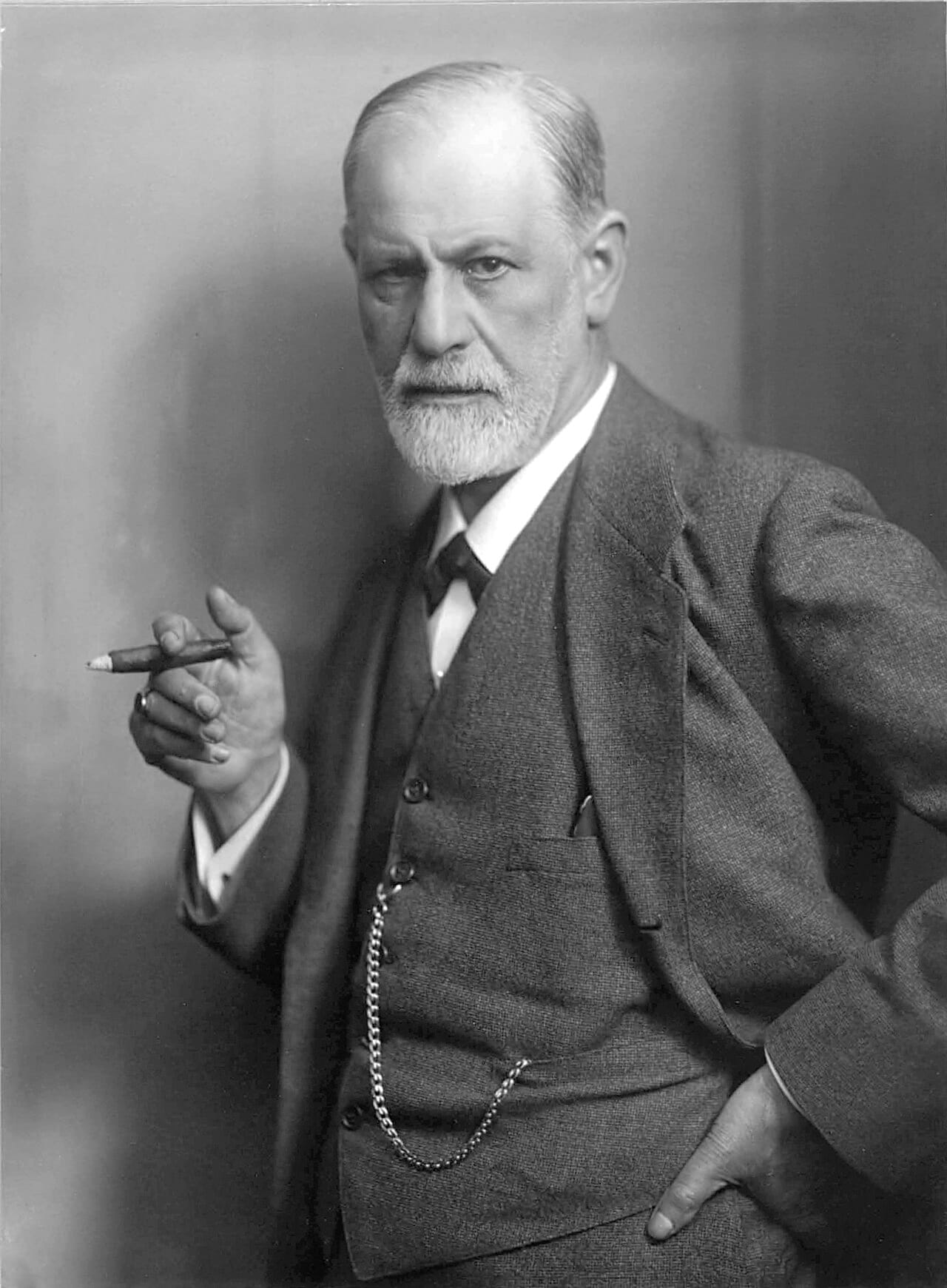
Sigmund Freud was born at Freiberg in Moravia on 6 May 1856 to a Jewish wool merchant and his much younger third wife, and the family moved to Vienna when he was four. He qualified in medicine in 1881 and worked as a neurologist, publishing on aphasia and on cocaine, whose anaesthetic properties he investigated and whose addictive ones he badly underestimated. A period in Paris with Jean-Martin Charcot in 1885 introduced him to hysteria and hypnosis, and back in Vienna he worked with Josef Breuer on the case of Anna O, whose talking cure suggested that symptoms could be relieved by recovering forgotten memories. Studies on Hysteria appeared in 1895, The Interpretation of Dreams in 1899, and the Three Essays on the Theory of Sexuality in 1905. He gathered a circle that became the Vienna Psychoanalytic Society, and lost several of its most gifted members to schism - Adler in 1911, Jung in 1914. He developed cancer of the jaw in 1923 and endured more than thirty operations. The Gestapo interrogated his daughter Anna after the Anschluss; he was allowed to leave for London in 1938 and died there on 23 September 1939. Michael Hart ranked him 69th in The 100.
Influence Meter
81
Measured on a 100-point scale
Established the unconscious as the default assumption of Western self-understanding
The Theory
What He Proposed
Freud revised constantly across forty years, so any summary flattens a moving target. These are the load-bearing claims.
The unconscious
Most mental life is inaccessible to introspection, and it is not merely forgotten material but actively kept out of awareness because it is intolerable. Everything else in the system depends on this.
- Status now: Broadly accepted, differently conceived
Repression
The mechanism by which unacceptable wishes are excluded from consciousness while continuing to exert force - emerging as symptoms, dreams, slips and jokes.
- Status now: Contested
Free association and the talking cure
The patient says whatever comes, without editing, and the analyst listens for the pattern. It replaced hypnosis and is the practical foundation of every talking therapy since.
- Legacy: All psychotherapy
Dreams as wish-fulfilment
Dreams disguise forbidden wishes through condensation and displacement; interpreting them is the royal road to the unconscious. Modern sleep science does not support the specific theory.
- Status now: Rejected as stated
Infantile sexuality and the Oedipus complex
Children pass through psychosexual stages and form desires toward the opposite-sex parent. The most scandalous of his claims at the time and among the least supported now.
- Status now: Largely rejected
Id, ego and superego
A structural model of the mind as instinctual drive, reality-negotiating self, and internalised moral authority in permanent conflict. Not a scientific model, and an extraordinarily durable metaphor.
- Status now: Metaphor, not mechanism
The scientific case against Freud is serious and should be stated plainly. His theories are difficult or impossible to falsify - resistance to an interpretation can always be read as confirming it, which Karl Popper used as his central example of a pseudoscience. His published case histories are few, and several have been shown to be substantially rewritten or to have ended badly where he implied success; Anna O, the founding case, was not in fact cured and was hospitalised afterwards. He suppressed inconvenient results and was ruthless with dissenters. Clinical psychology and psychiatry have largely moved to cognitive behavioural approaches and pharmacology, both with far stronger evidence bases. Contemporary psychoanalysis exists and some outcome studies for psychodynamic therapy are reasonably favourable, but very little of the specific theoretical apparatus is treated as established by working scientists.
Culture
Wrong in the Details, Everywhere in the Language
The gap between Freud's scientific standing and his cultural presence is the most striking thing about him. Twentieth-century literature is unimaginable without him - Joyce, Woolf, Kafka, Mann and the entire modernist interest in interior monologue and unreliable narration work in his shadow. Surrealism took dream logic directly from him. Hollywood absorbed the therapist as a character and the childhood trauma as an explanation, to the point that both are now clichés. Advertising was reshaped by his nephew Edward Bernays, who applied the theory of unconscious desire to selling and effectively invented public relations. Above all he changed the default assumption about people: that behaviour has hidden causes, that childhood is formative, that what someone says is not necessarily what they mean, and that talking about it helps. Whatever the evidence for the specific mechanisms, that framework is now simply how the West thinks about persons.

1923-1939
Sixteen Years of Cancer, and the Last Escape
Freud smoked around twenty cigars a day for most of his adult life and was diagnosed with cancer of the palate in 1923. He underwent more than thirty operations over the following sixteen years, had much of his upper jaw removed and replaced by a large prosthesis that he called the monster, which made eating and speaking difficult and painful. He continued to see patients and to write throughout.
After the Anschluss in March 1938 the Gestapo searched his apartment and interrogated his daughter Anna for a day; he expected never to see her again. Exit permits were obtained through international pressure, a substantial ransom paid largely by his patient and friend Princess Marie Bonaparte, and the family reached London in June. He was made to sign a declaration that he had been well treated, to which he is said to have added that he could heartily recommend the Gestapo to anyone. Four of his sisters, left behind, were murdered in the camps. In September 1939, in unbearable pain, he asked his physician Max Schur to keep an earlier promise, and died on 23 September after doses of morphine.
Further Reading
Books By and About Freud
He wrote exceptionally well and won the Goethe Prize for literature rather than any scientific award, which several critics have suggested is the correct classification.
Legacy
Why Number Sixty-Nine
Michael Hart ranked Freud 69th, and the entry is among the most arguable on the list precisely because so much of the specific theory has been discarded. The defence is that influence is not the same as correctness. Freud placed himself in a sequence of blows to human self-importance - Copernicus removing the Earth from the centre, Darwin removing humanity from a separate creation, and himself removing the ego from mastery of its own house. It was characteristically immodest and it is not entirely wrong: the proposition that we do not know our own motives, and that the reasons we give ourselves are often constructions after the fact, is now supported by a great deal of cognitive psychology that owes nothing to psychoanalysis and would have surprised him in its details.
The practical legacy is talking therapy. Whatever one concludes about the Oedipus complex, the idea that a person in distress might be helped by describing their history at length to a trained listener was Freud's, and tens of millions of people a year now do exactly that in forms he would only partly recognise. The linguistic legacy is larger still and completely invisible: anyone who says someone is in denial, is projecting, has an inflated ego or made a Freudian slip is speaking his language, generally without knowing whose it is.
Related Publications