Enrico Fermi

Enrico Fermi
Born 29 September 1901 • Died 28 November 1954
On a freezing afternoon in December 1942, in a squash court under the west stand of an abandoned football stadium in the middle of Chicago, Enrico Fermi watched a stack of graphite blocks and uranium go critical, held it there for about four and a half minutes, and shut it down. There was no shielding and no containment. The safety system consisted of a man with an axe standing by a rope and three young physicists on the balcony with buckets of cadmium solution, ready to throw them into the pile if everything else failed.
Rank
#76
Influence
79
Field
Physicist
Historical Perspective
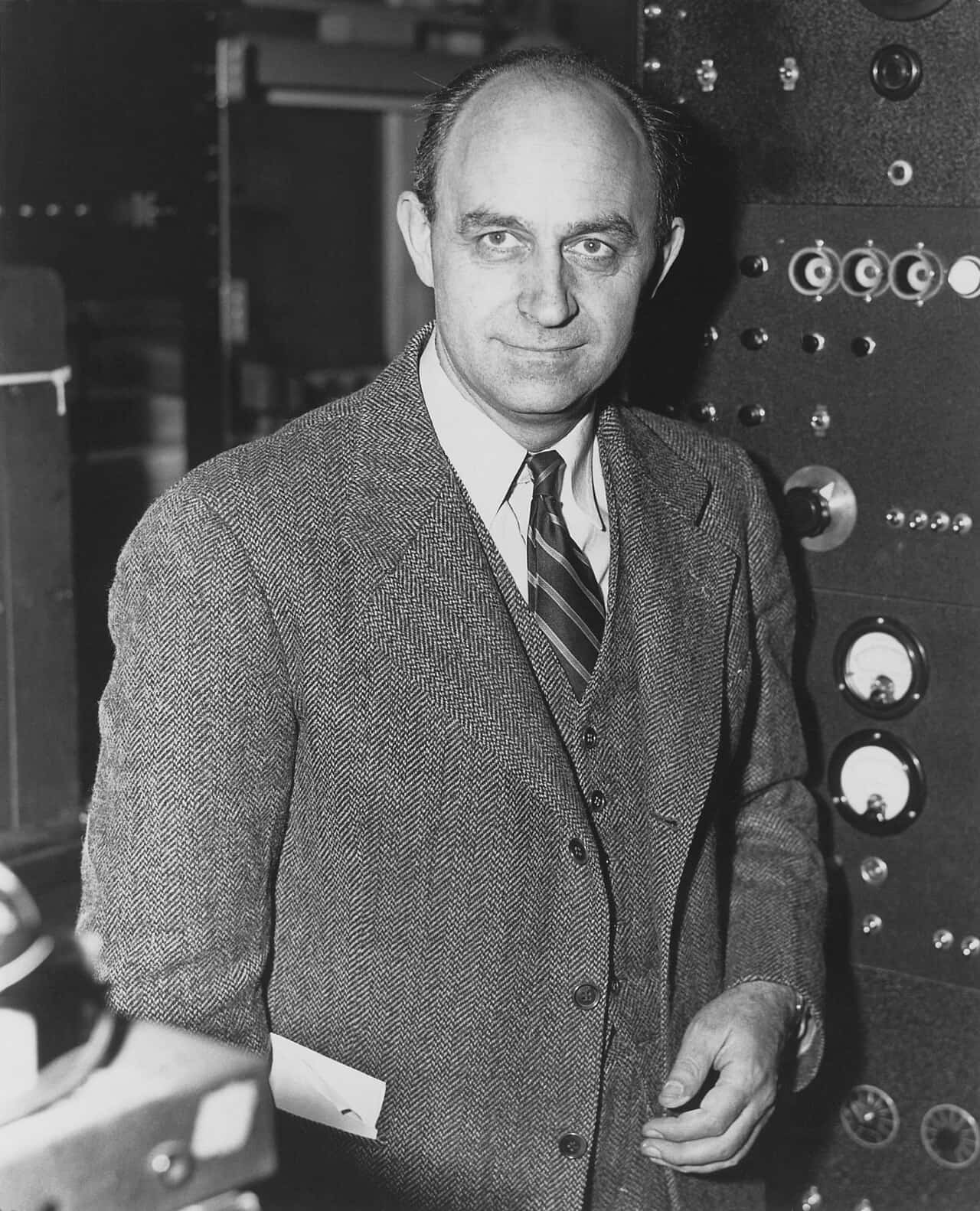
Enrico Fermi was born in Rome on 29 September 1901, the son of a railway official, and taught himself much of his physics from a second-hand Latin textbook found on a market stall after his brother's death. He took a professorship at Rome at twenty-four and assembled a group known as the Via Panisperna boys - Amaldi, Segrè, Rasetti, Pontecorvo, Majorana - which became the best physics group in Italy. In 1933 he produced the theory of beta decay, incorporating Pauli's hypothetical neutrino, which the journal Nature rejected as too speculative. In 1934 he found that passing neutrons through paraffin or water slowed them and made them enormously more effective at inducing radioactivity - the key to reactor design, discovered essentially by accident. The 1938 Nobel Prize gave him and his Jewish wife Laura the pretext to leave for Stockholm and continue to New York rather than return to fascist Italy. On 2 December 1942 he achieved the first controlled chain reaction at Chicago, and he worked at Los Alamos from 1944. He died of stomach cancer on 28 November 1954, aged fifty-three. Michael Hart ranked him 76th in The 100.
Influence Meter
79
Measured on a 100-point scale
The first nuclear chain reaction, and the physics that made both reactors and weapons
2 December 1942
Chicago Pile-1
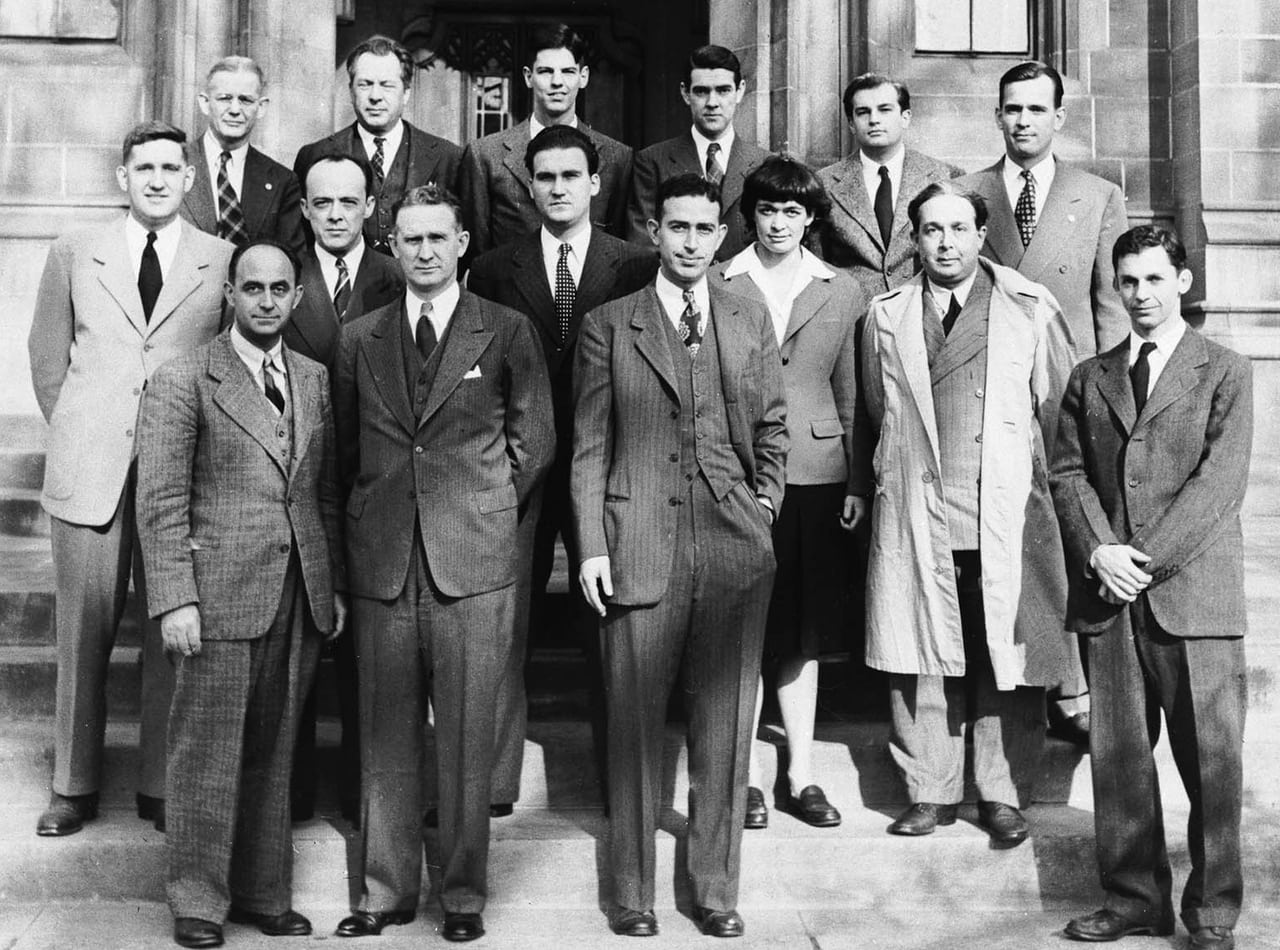
The pile was a lattice of some forty thousand graphite blocks containing about six tons of uranium metal and thirty-four tons of uranium oxide, built by hand over about six weeks in a doubles squash court beneath Stagg Field. Graphite slows neutrons enough to sustain fission; cadmium control rods absorb them. Fermi had calculated the geometry in advance and, on the day, had the rods withdrawn in stages, checking his instruments against his predictions at each step. At 3.25 in the afternoon the pile went critical and the neutron count began to climb steadily rather than levelling off. He let it run at about half a watt for four and a half minutes and ordered it shut down. Arthur Compton telephoned Washington and said, in a code invented on the spot, that the Italian navigator had landed in the New World and that the natives were friendly. There was no radiation shielding, and the site is now a lawn with a Henry Moore sculpture on it in the middle of a university campus.
The discovery that made reactors possible was, on Fermi's own account, close to an accident. In October 1934 his group was bombarding elements with neutrons and getting inconsistent results depending on what the samples were sitting on. Fermi decided to put a wedge of paraffin wax in the beam - he wrote later that he did it without any justification and with no clear reason, and that it simply occurred to him - and the induced radioactivity jumped by a factor of up to a hundred. The explanation is that hydrogen-rich material slows neutrons to speeds at which uranium nuclei capture them far more readily. It won him the Nobel Prize and it is the reason every thermal reactor in the world uses a moderator - water, heavy water or graphite - to slow its neutrons down. The group also, without realising it, split uranium in 1934, four years before Hahn and Strassmann identified fission; they thought they had made new elements beyond uranium, and Fermi's Nobel citation repeats the error.
The Range
Theory and Experiment, Both at the Top
The distinction between theorists and experimentalists had hardened by the twentieth century. Fermi is the standard example of the last person to ignore it.
Fermi-Dirac statistics
Derived independently of Dirac, describing how particles obeying the Pauli exclusion principle behave in bulk. It governs electrons in metals and semiconductors, and such particles are called fermions after him.
- Named for him: Fermions
The theory of beta decay
Explained radioactive beta emission using Pauli's proposed neutrino - a particle nobody had detected and few believed in. It was the first theory of the weak nuclear force. Nature rejected the paper as too remote from physical reality.
- Rejected by: Nature
Slow neutrons
Moderating neutrons makes them far more effective at inducing nuclear reactions. The Nobel Prize followed in 1938, and every reactor design since depends on it.
- Nobel: Physics, 1938
Chicago Pile-1
The first controlled self-sustaining nuclear chain reaction. He designed it, calculated it and ran it, and the whole thing proceeded exactly as he had predicted.
- Power: About half a watt
The Manhattan Project
Headed F Division at Los Alamos, worked on both fission and early thermonuclear ideas, and witnessed Trinity - where he estimated the yield at about ten kilotons by dropping torn paper and measuring how far the blast carried it.
- Actual yield: About 19 kilotons
The Fermi problem and the Fermi paradox
His habit of estimating quantities from almost no data - how many piano tuners in Chicago - is now a standard teaching device. Over lunch at Los Alamos he asked, of extraterrestrial civilisations, where is everybody, and the question is still named for him.
- Still asked: Where is everybody?
1945-1954
Afterwards
Fermi returned to Chicago after the war and to teaching, which he was exceptionally good at - his lecture notes circulated for decades and eight of his students or postdocs went on to Nobel Prizes. He served on the General Advisory Committee of the Atomic Energy Commission and, with I. I. Rabi, wrote a minority annex to its 1949 report opposing the crash development of the hydrogen bomb, describing it as a weapon of genocide with no limit to its destructive power and arguing on ethical as well as technical grounds. The advice was not taken. He also testified in support of Oppenheimer at the 1954 security hearing.
He was diagnosed with stomach cancer in October 1954 and died six weeks later at fifty-three, having reportedly timed the flow of his own intravenous feed out of professional habit. Element 100 is fermium; the American national accelerator laboratory is Fermilab; fermions, the Fermi surface, Fermi level, Fermi energy and the Fermi paradox all carry his name. Few physicists have their name attached to so many separate things, which is a rough index of how many different parts of the subject he worked in.
Further Reading
Books About Fermi
His wife Laura wrote the first popular account, and it remains the warmest.
Legacy
Why Number Seventy-Six
Michael Hart ranked Fermi 76th, and the entry stands or falls on 2 December 1942. Before that afternoon, a self-sustaining nuclear chain reaction was a calculation; afterwards it was a machine, and both nuclear power and nuclear weapons became engineering problems rather than open scientific questions. Roughly a tenth of the world's electricity is generated by reactors that are, in principle, Chicago Pile-1 with shielding, cooling and several decades of refinement. The weapons that have shaped every strategic calculation since 1945 come from the same result.
The other reason physicists rate him so highly is harder to convey outside the field. Rutherford was a great experimentalist who needed others for the mathematics; Einstein was a theorist who did not go near a laboratory. Fermi did both at the highest level, designed and built his own apparatus, and had an estimating instinct so reliable that his colleagues called him the Pope. He also spent his last years arguing against the hydrogen bomb he was qualified to help build, and losing.
Related Publications