Voltaire

Voltaire
Born 21 November 1694 • Died 30 May 1778
Voltaire did not write the sentence everyone attributes to him about defending to the death your right to say what he disapproved of; a biographer summarising his attitude coined it in 1906. He did spend eleven months in the Bastille for a satirical poem, get beaten by a nobleman's servants and then exiled for objecting, and spend three years of his old age overturning the conviction of a dead Huguenot whom the courts of Toulouse had broken on the wheel for a murder he did not commit. The paraphrase was fair.
Rank
#74
Influence
80
Field
Writer and Philosopher
Historical Perspective
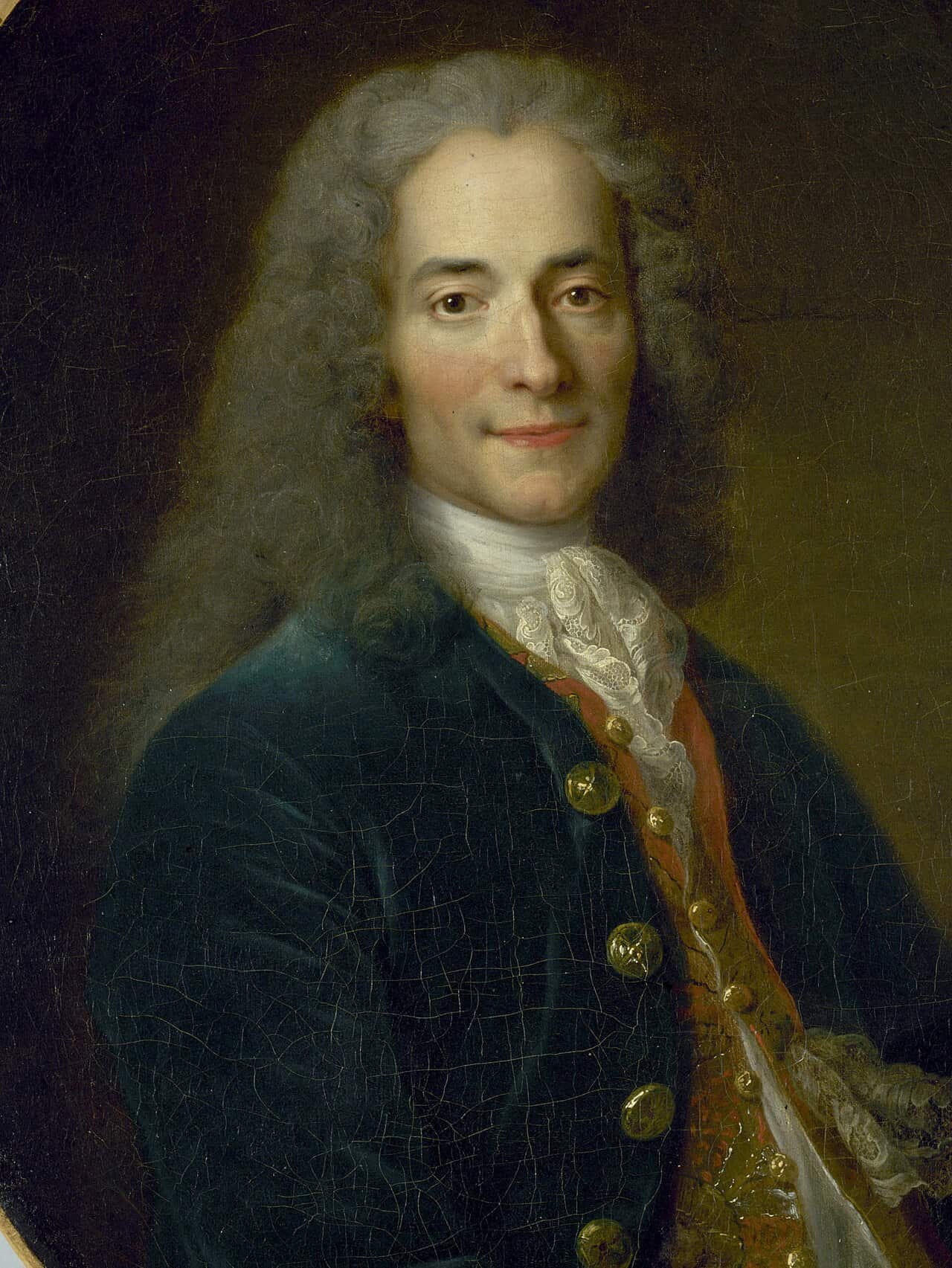
François-Marie Arouet was born in Paris on 21 November 1694 into a comfortable notarial family, educated by Jesuits, and refused to become a lawyer. He was imprisoned in the Bastille for eleven months in 1717 for verses mocking the Regent, and emerged using the name Voltaire. In 1726, after an altercation with the Chevalier de Rohan, who had him beaten by servants and then imprisoned when he demanded satisfaction, he was exiled to England for over two years - an experience that produced the Letters Concerning the English Nation of 1733, an admiring account of English religious tolerance, constitutional government and Newtonian science that was burned in France. He spent fifteen years with the mathematician Émilie du Châtelet at Cirey, three years at Frederick the Great's court, and settled finally at Ferney on the Swiss border, close enough to run if necessary. Candide appeared in 1759 after the Lisbon earthquake, and the Calas campaign began in 1762. He returned to Paris in triumph in 1778 and died there on 30 May, aged eighty-three. Michael Hart ranked him 74th in The 100.
Influence Meter
80
Measured on a 100-point scale
Made religious tolerance and free expression into causes rather than opinions
1762-1765
The Case That Changed What He Was For
Jean Calas was a Protestant cloth merchant in Toulouse whose son was found hanged in the family shop in 1761. The city, overwhelmingly Catholic and with a history of anti-Huguenot violence, concluded that Calas had murdered him to prevent a conversion to Catholicism. On no real evidence, the sixty-three-year-old was broken on the wheel in March 1762, protesting his innocence throughout, and his family was ruined. Voltaire, who initially assumed the man was guilty, investigated, concluded the son had killed himself and the father had been judicially murdered by sectarian prejudice, and spent three years mounting a campaign - pamphlets, letters to every influential person in Europe, financial support for the widow, and relentless publicity. In 1765 the verdict was annulled and the family compensated. It is generally regarded as the first modern campaign of public opinion against a miscarriage of justice, and it is the source of his slogan écrasez l'infâme - crush the infamous thing, meaning superstition and religious persecution.
Candide, published in 1759, was written in response to the Lisbon earthquake of 1 November 1755, which killed tens of thousands of people on All Saints' Day, while churches were full, in one of the most devoutly Catholic cities in Europe. The disaster made the optimistic philosophy then fashionable - Leibniz's argument that this is the best of all possible worlds, popularised by Pope's line that whatever is, is right - look obscene to Voltaire. Candide is the result: a short, extremely funny novel in which the hero and his tutor Pangloss endure earthquake, war, rape, slavery, the Inquisition and every other available catastrophe while Pangloss continues to explain that all is for the best. It was banned immediately by both church and state, sold in enormous numbers, and has never been out of print. Its closing line, that we must cultivate our garden, is among the most argued-over sentences in French literature.
What He Actually Believed
He was a deist, a monarchist, no democrat, and considerably less consistent than his reputation suggests.
- Religious tolerance: His central and most durable cause. Not atheism - he thought belief in a divine order socially necessary - but an end to persecution, torture and legal disability on grounds of confession.
- Freedom of expression: He was censored, burned and imprisoned throughout his life and argued consistently against it. The famous sentence is a paraphrase by a biographer, but it does not misrepresent him.
- Against organised religion, not against God: Écrasez l'infâme targeted the institutional church, superstition and clerical power. He built a church at Ferney and had it inscribed to God, and wrote that if God did not exist it would be necessary to invent him.
- Judicial reform: Against torture, against arbitrary imprisonment by lettre de cachet, and for proportionate punishment. The Calas case and several others were the practical arm of this.
- Enlightened monarchy, not democracy: He preferred a rational king advised by philosophers to any form of popular rule, and had a low opinion of the political capacity of ordinary people. His years with Frederick the Great tested the theory and it went badly.
- Positions that have not aged: His writings on Jews contain sustained antisemitic invective, and he held views on racial hierarchy typical of his class and period. Both are documented and are not incidental asides.
The Record
A Working Life of Being Thrown Out
Voltaire spent most of his career either in exile, under threat of arrest, or living within a short ride of a border. It is worth listing, because his campaigns for free expression were not abstract.
| 1717-1718 | Eleven months in the Bastille | Verses mocking the Regent |
| 1726 | Beaten by a nobleman's servants, then imprisoned and exiled | Answering back to the Chevalier de Rohan |
| 1726-1728 | Exile in England | The alternative to further imprisonment |
| 1734 | Warrant for his arrest; the book burned publicly | Letters Concerning the English Nation |
| 1753 | Detained at Frankfurt on leaving Prussia | A quarrel with Frederick the Great |
| 1759 | Banned by church and state; a bestseller anyway | Candide |
| 1760-1778 | Lived at Ferney, minutes from the Swiss border | So he could leave France at short notice |
He was denied Christian burial in 1778 and interred discreetly at an abbey by friends. In 1791 the Revolution moved him to the Panthéon before a crowd estimated at a million.
1733-1749
Cirey, and Émilie du Châtelet
The most productive stretch of Voltaire's life was the fifteen years he spent at the château of Cirey with Émilie du Châtelet, a mathematician and physicist who was married to someone else with his apparent indifference. She was formidably able: her translation of Newton's Principia into French, with an extensive commentary explaining it, remains the standard French version and was the vehicle by which Newtonian physics reached France. She and Voltaire worked, argued, ran a laboratory and separately entered the same Academy prize competition. She died in 1749 after childbirth, and he was devastated.
His three years at Frederick the Great's court in Potsdam from 1750 were an experiment in the enlightened monarchy he theorised about, and they ended in mutual disillusion, a financial scandal, a quarrel with the Academy president, a satirical pamphlet, and Voltaire's brief arrest at Frankfurt on his way out. He then bought Ferney, on the French side of the Swiss border, where he could cross in an afternoon if the authorities moved against him. He lived there for twenty years as the most famous man in Europe, receiving visitors from everywhere, running the village as a model estate with a watch industry he founded, and conducting his campaigns by post at the rate of several letters a day.
Further Reading
Books By and About Voltaire
The complete works run to well over a hundred volumes, of which the correspondence alone is around fifty.
Legacy
Why Number Seventy-Four
Michael Hart ranked Voltaire 74th, and the influence is diffuse in a way that makes it easy to underrate. He founded no system and made no discovery; what he did was make certain positions respectable and certain practices embarrassing. Torture, religious persecution, censorship and judicial arbitrariness had all been normal features of European government, and by the end of the eighteenth century they were things a state had to defend rather than simply do. Voltaire did more than anyone to produce that shift, mostly by making the alternative look ridiculous.
The French Revolution claimed him: his remains were moved to the Panthéon in 1791 with a crowd estimated at a million people, and the procession carried a banner saying he had prepared the way. That is only half right, since he was no democrat and would have been horrified by most of what followed. His clearest descendant is French laïcité and the broader Western settlement on religion and the state. In January 2015, after the Charlie Hebdo killings, the Treatise on Tolerance sold out in French bookshops, which is an unusual afterlife for a pamphlet written in 1763 about a cloth merchant from Toulouse.
Related Publications