Jean-Jacques Rousseau

Jean-Jacques Rousseau
Born 28 June 1712 • Died 2 July 1778
Rousseau wrote the most influential treatise on education of the eighteenth century and gave away all five of his children at birth to a Paris foundling hospital, where the mortality rate was appalling and where he made no attempt to trace them. He admitted it in his own autobiography. It is the sharpest gap between a life and a body of work on this list, and he knew it, which is part of why the Confessions exists at all.
Rank
#78
Influence
81
Field
Philosopher and Writer
Historical Perspective
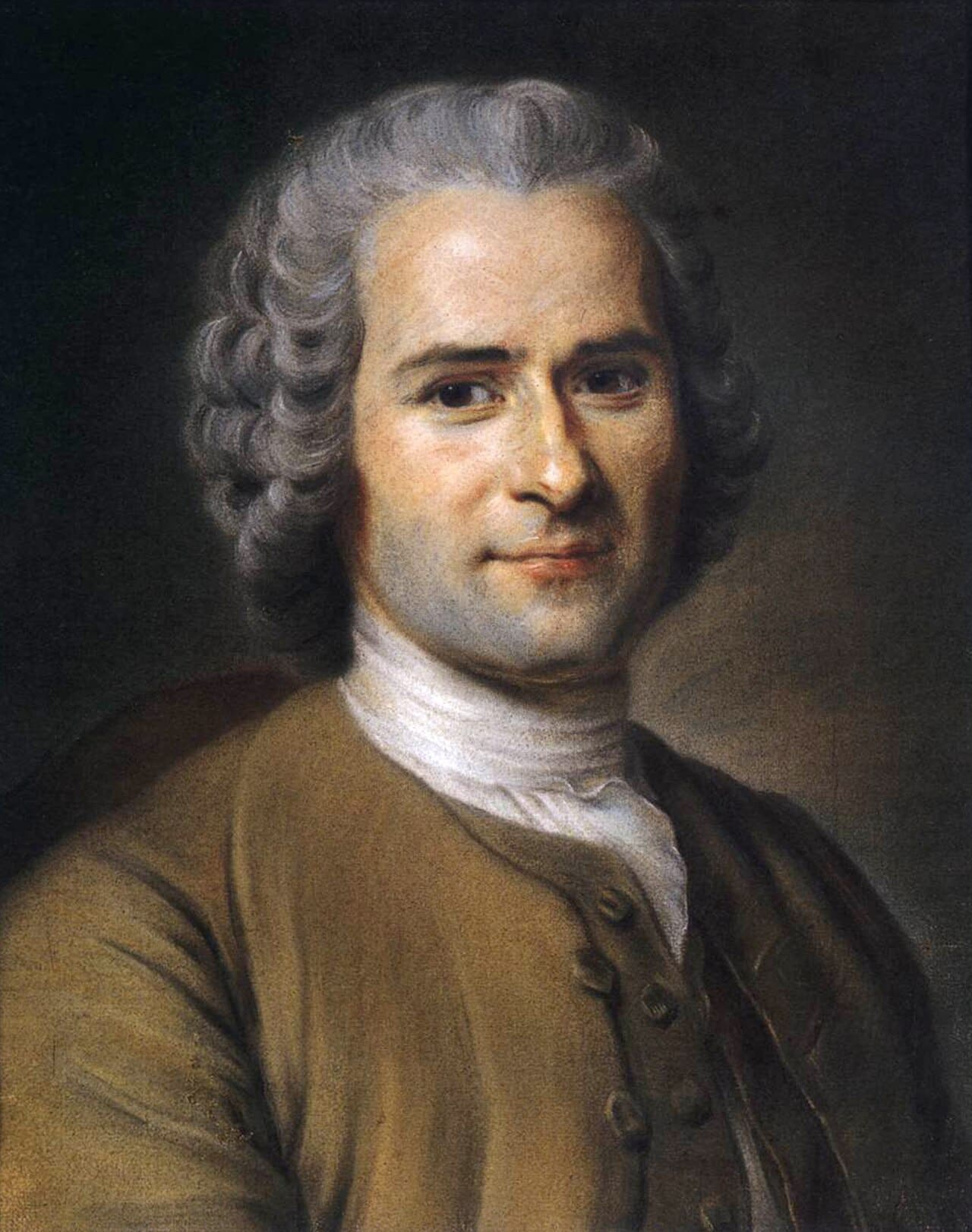
Jean-Jacques Rousseau was born in Geneva on 28 June 1712; his mother died nine days later, and his father abandoned him at ten. He ran away at fifteen and spent his twenties as an engraver's apprentice, footman, tutor, music copyist and secretary, largely under the patronage of Madame de Warens, a convert and adventuress with whom he also lived. In 1749, walking to visit the imprisoned Diderot, he read a prize question in a journal - whether the arts and sciences had improved morals - and had what he described as a kind of revelation: they had not, and civilisation had corrupted a naturally good humanity. The essay won and made him famous. The Discourse on Inequality followed in 1755, and in 1762 both The Social Contract and Emile appeared; the latter's section on natural religion had them condemned and burned in Paris and Geneva, and Rousseau spent years moving between refuges, including a disastrous stay in England that ended in a public quarrel with David Hume. He wrote the Confessions, an autobiography of unprecedented candour, and died at Ermenonville on 2 July 1778, six weeks after Voltaire. Michael Hart ranked him 78th in The 100.
Influence Meter
81
Measured on a 100-point scale
Gave revolution its vocabulary, education its child, and Romanticism its feeling
The Positions
Rousseau contradicted himself frequently and cared less about system than about being right where it mattered. These are the claims that travelled.
- Natural goodness: Human beings in a state of nature are neither vicious nor virtuous but self-preserving and compassionate. Vice, vanity, greed and cruelty are products of society, particularly of property and comparison with others.
- The origin of inequality: The first man to enclose a piece of ground and say this is mine, and find people simple enough to believe him, was the founder of civil society - and of the crimes, wars and miseries that followed.
- The general will: Legitimate law expresses what the citizen body wills as a body, aiming at the common good, rather than the sum of private interests. It is the most influential and the most dangerous idea he had.
- Popular sovereignty: Sovereignty belongs to the people, cannot be represented or alienated, and no ruler holds authority except as their agent. Man is born free and everywhere he is in chains is the opening line.
- Forced to be free: Anyone who refuses to obey the general will shall be compelled to do so by the whole body. Defenders read this as ordinary law enforcement; critics from Constant to Talmon read it as a licence for coercion in the name of the people, and the Terror did exactly that.
- Education following nature: Emile argues that a child is not a small adult, learns by experience rather than instruction, and should be protected from premature book-learning and social artifice. Almost every progressive educational movement since descends from it.
Rousseau lived for decades with Thérèse Levasseur, a laundry maid, and by his own account in the Confessions they had five children, each of whom he deposited at the Hôpital des Enfants-Trouvés in Paris shortly after birth, without recording any identifying token that might have allowed them to be traced. Mortality at such institutions in the period was extremely high - by some estimates most infants admitted did not survive childhood. He offered various defences: that he could not afford them, that his household was unsuitable, that the state would raise them better as citizens. Voltaire, who loathed him, published the fact anonymously in 1764 in a pamphlet, and it has attached to Rousseau's name ever since - inevitably, given that the author of the age's great book on how to raise a child had disposed of five of his own.
After 1789
What the Revolution Made of Him
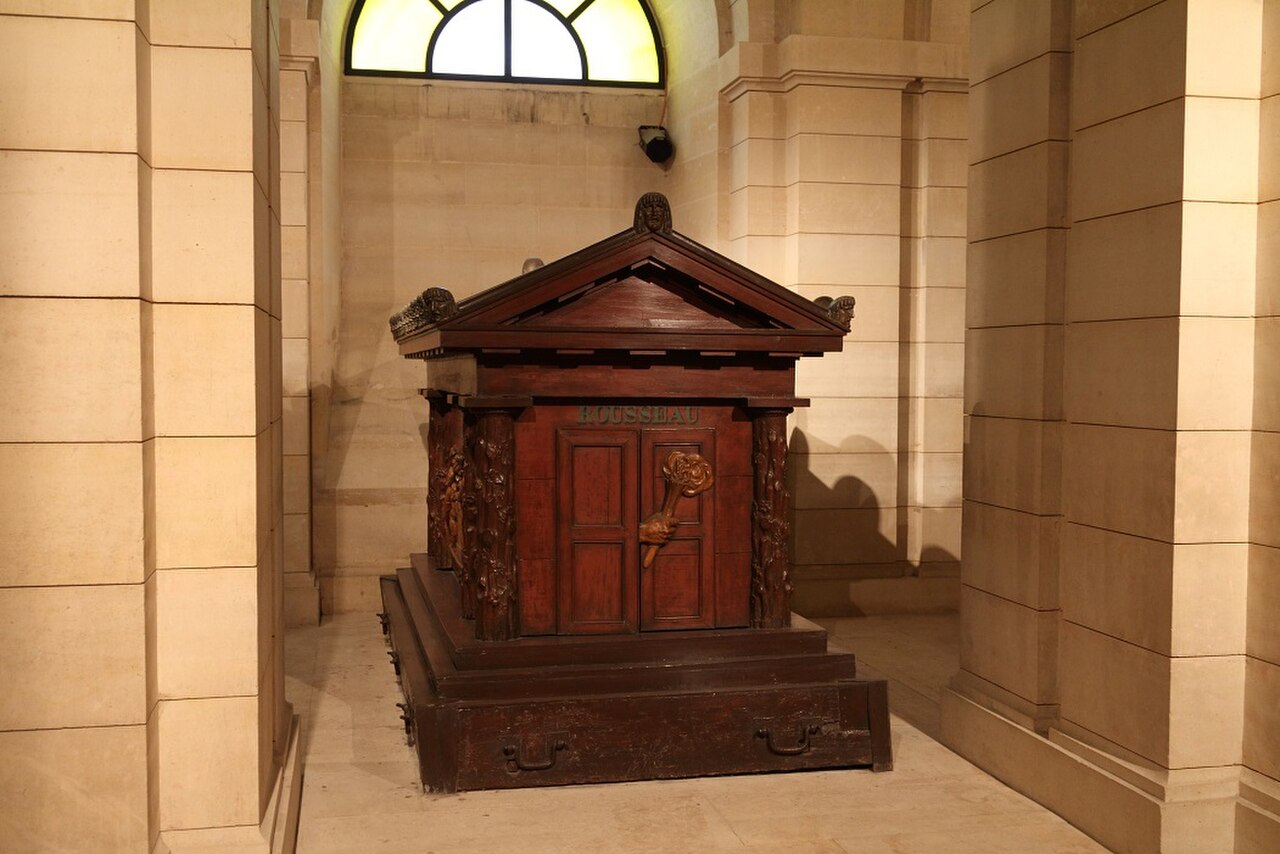
Rousseau died eleven years before the Revolution and the revolutionaries claimed him comprehensively. His remains were moved to the Panthéon in 1794; Robespierre described himself as his disciple and invoked the general will constantly; the Declaration of the Rights of Man and of the Citizen echoes the Social Contract in several articles; and the Jacobin cult of civic virtue, of the sovereign people and of the republic of virtue is his vocabulary throughout. Whether it is his politics is another question. Rousseau wrote about small city-states of the sort he came from, doubted that his scheme could work in a country the size of France, and was explicit that the general will is not the same as majority opinion. The doctrine that a minority resisting the general will can be forced to be free was nonetheless available, and the Committee of Public Safety used it. The argument about how much of the Terror is fairly laid at his door has run for two centuries and shows no sign of resolving.
Beyond politics
Feeling, Nature and the Self
Rousseau's other legacy is a change in sensibility rather than doctrine. He wrote about solitude, about walking, about the moral value of landscape and of spontaneous feeling against calculation and manners, and about the authentic self buried under social performance. Everything in that list became central to Romanticism within a generation. His novel Julie, or the New Heloise was the bestselling book of the century in France and taught a reading public how to feel about love and nature. Kant, whose daily walk was famously so regular that neighbours set their clocks by it, reportedly missed it once, on the day he was reading Emile.
The Confessions is the other durable form. Augustine had written an autobiography addressed to God; Rousseau addressed his to the reader, opened by claiming that he was undertaking something without precedent and would show a man in all the truth of nature, and then described his humiliations, his petty thefts, his sexual peculiarities and his abandonment of his children. The modern confessional memoir, and the assumption that the private and embarrassing is the most honest material a writer has, begins here.
Further Reading
Books By and About Rousseau
He quarrelled with almost every friend he ever had, and the biographical record is correspondingly rich in other people's accounts.
Legacy
Why Number Seventy-Eight
Michael Hart ranked Rousseau 78th, thirty-four places below Locke, and the two make an instructive pair. Locke's politics is about limits - rights the state cannot cross, consent that can be withdrawn, government as a trust. Rousseau's is about identity - the people as a collective sovereign whose will is the source of law. Liberal constitutional democracy descends mostly from Locke; the language of popular sovereignty, national self-determination and the republic as an expression of a people descends mostly from Rousseau, and so, less comfortably, do modern nationalism and several strands of authoritarian populism.
The educational influence is more straightforwardly benign and probably touches more lives daily. Child-centred learning, play as serious work, the idea that development has stages and that instruction should follow them, the suspicion of rote memorisation - all of it runs back to Emile. As does a change in how people regard themselves: the assumption that there is an authentic inner self which society distorts, and that recovering it is a worthwhile project, is now so ordinary that it is hard to see as an idea at all. It was his.
Related Publications