Johannes Kepler

Johannes Kepler
Born 27 December 1571 • Died 15 November 1630
Kepler spent about six years trying to make the orbit of Mars fit a circle. He got it down to a discrepancy of eight minutes of arc - a thirtieth of the moon's width, well inside what any previous astronomer would have called agreement. Tycho Brahe's observations were the first in history accurate enough to make eight minutes a problem, and Kepler decided it was one. He threw away two thousand years of assumption that heavenly motion must be circular, and out of those eight minutes came the laws that Newton would explain.
Rank
#75
Influence
81
Field
Astronomer and Mathematician
Historical Perspective
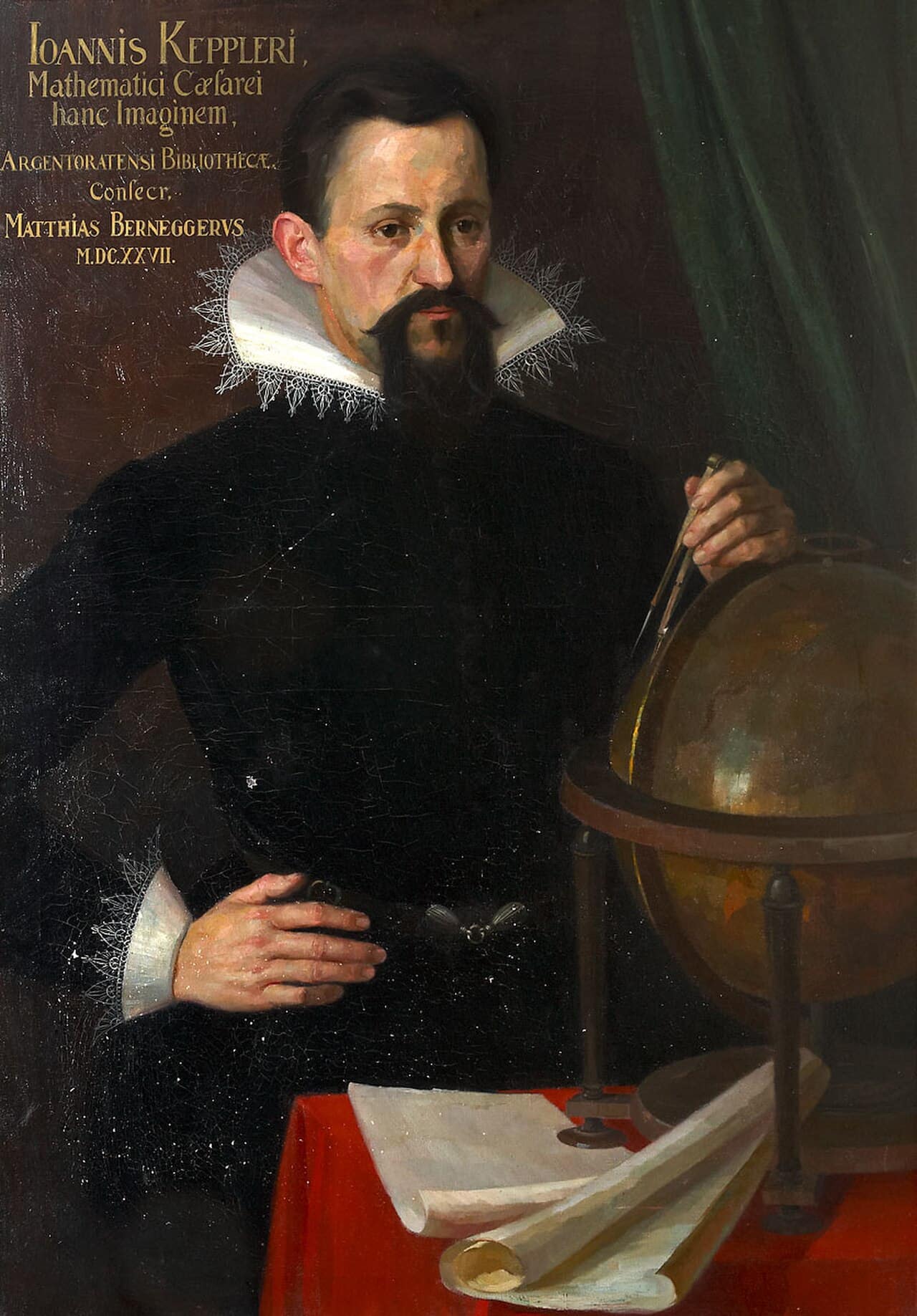
Johannes Kepler was born on 27 December 1571 at Weil der Stadt, into a family he described in unflattering detail: a mercenary father who abandoned them and a mother later tried as a witch. Childhood smallpox left him with poor eyesight and damaged hands, which ruled out observational astronomy and pushed him toward mathematics. He trained for the Lutheran ministry at Tübingen, learned Copernican astronomy from Michael Maestlin, and took a teaching post at Graz, where in 1596 he published the Mysterium Cosmographicum, arguing that the spacing of the planets was determined by the five Platonic solids nested inside one another - a beautiful theory that is entirely wrong and that brought him to Tycho Brahe's attention. He joined Tycho at Prague in 1600 and inherited both his post as imperial mathematician and his observations when Tycho died the following year. Astronomia Nova in 1609 contained the first two laws, Harmonices Mundi in 1619 the third, and the Rudolphine Tables of 1627 put them to work. He died at Regensburg on 15 November 1630 while trying to collect unpaid salary. Michael Hart ranked him 75th in The 100.
Influence Meter
81
Measured on a 100-point scale
Described how the planets actually move, and handed Newton the problem he solved
The Three Laws
They are descriptive rather than explanatory - Kepler could say what the planets do but not why, and he suspected some force from the sun without being able to specify it.
- First law: orbits are ellipses: Each planet moves on an ellipse with the sun at one focus. Copernicus had kept circles and needed epicycles to make them fit; Kepler's ellipses removed the need for any.
- Second law: equal areas in equal times: A line from the sun to a planet sweeps out equal areas in equal intervals, which means planets move faster when closer to the sun. It was actually discovered before the first law.
- Third law: periods and distances: The square of a planet's orbital period is proportional to the cube of its mean distance from the sun. Found in 1618 after years of searching for a harmonic relationship, and the one that fixes the whole system to a single scale.
- Why they mattered: For the first time, planetary positions could be predicted accurately without a machinery of epicycles, and the solar system had a single mathematical description.
- What he could not do: He proposed that the sun exerts some kind of magnetic influence driving the planets, and had no way to formalise it. Newton showed in 1687 that all three laws follow from an inverse-square gravitational force.
- Where they still apply: Every satellite, every space probe trajectory and every exoplanet detected by the transit method is described by Kepler's laws. The NASA telescope that found thousands of exoplanets was named after him.
The specific quantity that broke the circle was eight minutes of arc. Kepler had a model of Mars's orbit built on circles that matched Tycho's observations everywhere except at two points, where it was off by that amount - roughly a quarter of the apparent width of the moon, and smaller than the error in any observation made before Tycho. Ptolemy would not have noticed it; Copernicus could not have measured it. Kepler wrote that because these eight minutes could not be ignored, they alone had pointed the way to reforming the whole of astronomy. It is among the cleanest examples in science of a small discrepancy, honestly refused, destroying a large and comfortable theory - and it depended entirely on someone else having spent twenty years making observations to an accuracy nobody had demanded.
1600-1601
The Data He Had to Inherit to Use
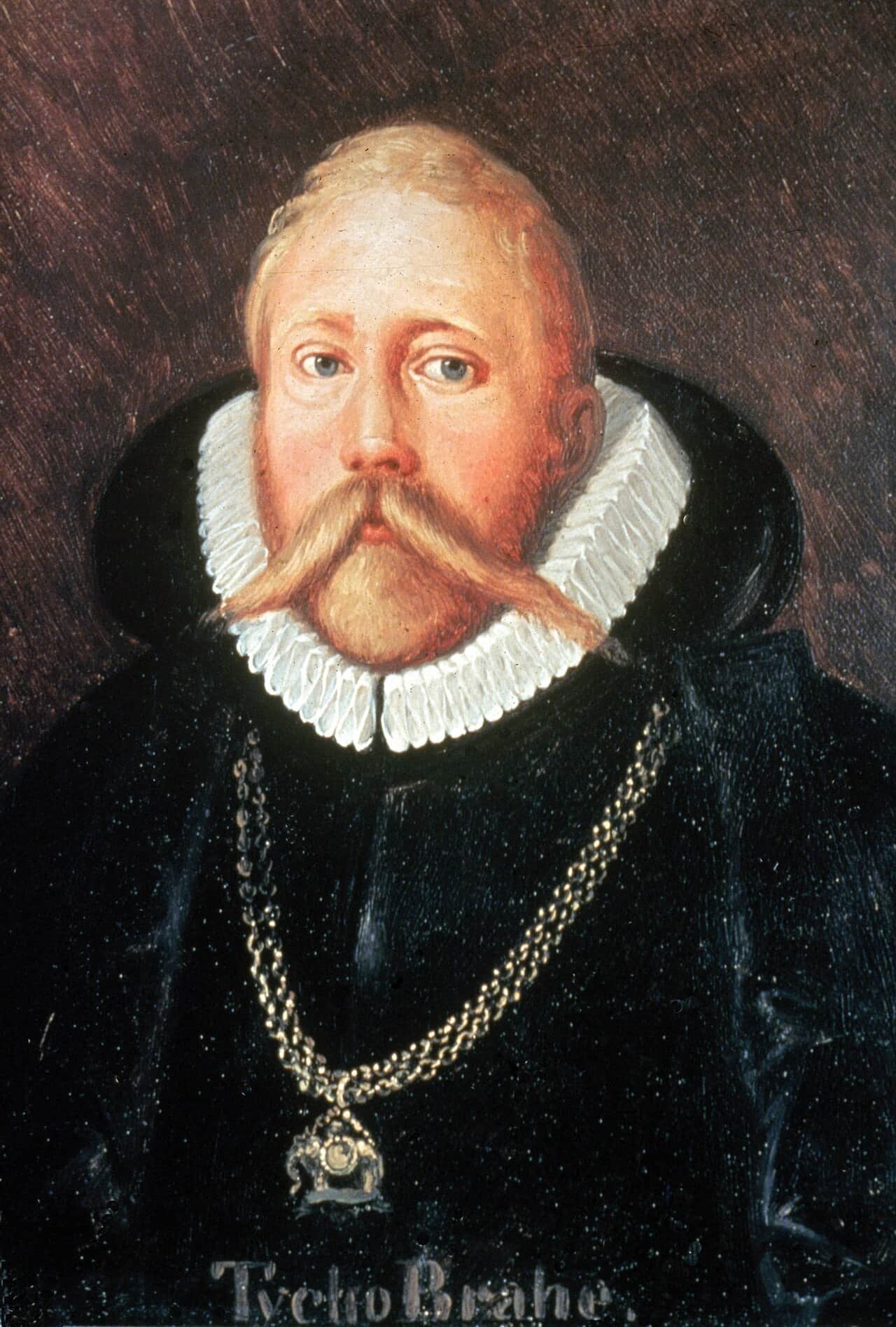
Tycho Brahe was the finest observational astronomer before the telescope, a Danish nobleman with a metal nose - he had lost the original in a duel over mathematics - who had spent decades measuring planetary positions to about one minute of arc, an order of magnitude better than anyone before him. He was also secretive, and would release his data to Kepler only in fragments, setting him the intractable problem of Mars partly to keep him occupied. Their working relationship was difficult and lasted barely eighteen months before Tycho died suddenly in October 1601 after a banquet. Kepler succeeded him as imperial mathematician and, by his own later admission, took possession of the observations from the heirs in a manner he described as usurping them. Without Tycho's data the laws were unreachable; without Kepler's persistence the data would have been a table of numbers. Neither man could have done it alone and they did not much like each other.
The Rest
What Else He Did
Astronomy occupied him, and he made major contributions to several other fields while casting horoscopes to pay the rent.
Modern optics
Astronomiae Pars Optica explained how the eye forms an inverted image on the retina, how spectacles correct vision, and how light intensity falls with the square of distance. Dioptrice analysed lenses and telescopes.
- Called: Father of modern optics
The Keplerian telescope
Two convex lenses rather than Galileo's convex-and-concave arrangement, giving a much wider field of view at the cost of an inverted image. It became the standard astronomical design.
- Trade-off: Wider field, upside down
The Rudolphine Tables
Planetary tables based on his laws and Tycho's data, using the newly invented logarithms. They were roughly fifty times more accurate than anything before and were the practical proof of the theory.
- Accuracy: About 50x better
The Kepler conjecture
That the densest way to stack spheres is the arrangement greengrocers use for oranges. Obvious, and not proved until 1998, with a formal computer verification completed in 2014.
- Proved: 1998
Somnium
A description of the Earth as seen from the moon, framed as a dream. Carl Sagan and others have called it the first work of science fiction; it may also have contributed to his mother's prosecution as a witch.
- Possibly: The first science fiction
Defending his mother
Katharina Kepler was accused of witchcraft, imprisoned and threatened with torture. Kepler suspended his work, moved to Württemberg and conducted her defence for six years. She was acquitted and died the following year.
- Outcome: Acquitted
Further Reading
Books About Kepler
He documented his own false starts at length, which is rare and makes him unusually visible as a working scientist.
Legacy
Why Number Seventy-Five
Michael Hart ranked Kepler 75th, which is low relative to how astronomers regard him and reflects the fact that he supplied the description rather than the explanation. Copernicus at nineteen put the sun at the centre; Kepler worked out how the planets actually move around it; Newton at two explained why. Of the three, Kepler's contribution is the least famous and arguably the most laborious - years of arithmetic done by hand, with no logarithms for most of it, on data he had to prise out of a dying man's heirs.
The result is still in use in a completely literal sense. Every orbital calculation - satellites, the International Space Station, interplanetary probes, the transfer windows to Mars - runs on Kepler's laws as refined by Newton. The telescope NASA launched in 2009 to find planets around other stars was named after him and found thousands, identified by exactly the periodic dimming his third law lets you turn into an orbit. He died on a journey to chase unpaid wages, his grave was destroyed in the Thirty Years' War, and his own epitaph, which he wrote, says that he measured the skies and now measures the shadows.
Related Publications