Leonhard Euler

Leonhard Euler
Born 15 April 1707 • Died 18 September 1783
Euler went completely blind in 1771 and his production of mathematics roughly doubled. He dictated to assistants, held enormous calculations in his head, and in 1775 was averaging a research paper a week. The Swiss Academy began publishing his collected works in 1911; more than eighty volumes have appeared and the project is not finished. If you have written a function as f of x, summed with a sigma, used e or i, or drawn a network of dots and lines, you were using his notation.
Rank
#77
Influence
80
Field
Mathematician
Historical Perspective
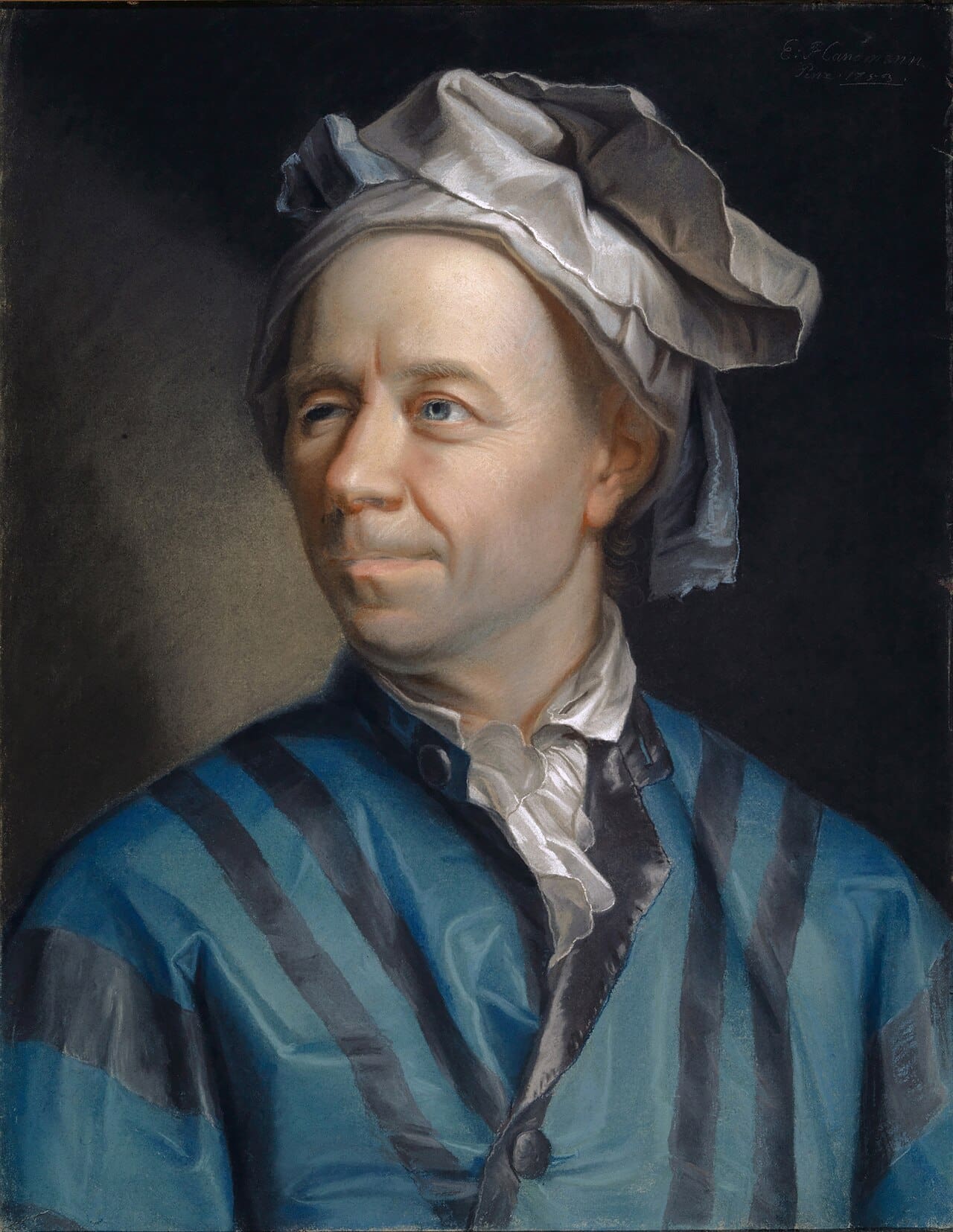
Leonhard Euler was born at Basel on 15 April 1707, the son of a pastor who wanted him in the ministry and who happened to have studied mathematics under Jacob Bernoulli. Johann Bernoulli recognised the boy's ability and persuaded the father to let him follow it. Euler took his master's degree at sixteen and, with no academic post available in Switzerland, went to the newly founded St Petersburg Academy in 1727, where he stayed fourteen years before moving to Frederick the Great's Berlin Academy for twenty-five, and then returning to St Petersburg in 1766 under Catherine the Great. He lost the sight of his right eye around 1738, probably from illness rather than the overwork legend attributes it to, and a cataract took the left by 1771. He married Katharina Gsell in 1734 and had thirteen children, of whom five survived infancy; he is said to have done mathematics with a child on his lap. He died in St Petersburg on 18 September 1783, having spent the afternoon calculating the orbit of the newly discovered Uranus. Michael Hart ranked him 77th in The 100.
Influence Meter
80
Measured on a 100-point scale
Wrote a third of a century's mathematics, and most of the notation everyone still uses
The Symbols He Fixed
Much of what makes modern mathematics legible is his. Notation seems trivial until you try reading anything written before it settled.
- f(x): The notation for a function of a variable, introduced in 1734. It is difficult to overstate how much this single convention organises mathematical thinking.
- e: The base of natural logarithms, roughly 2.71828, named and used systematically by him. It turns up in compound interest, radioactive decay, population models and probability.
- i: The square root of minus one. Naming it made complex numbers tractable rather than embarrassing.
- Sigma for summation: The capital Greek S for adding a series. Introduced in 1755 and universal since.
- Pi: He did not invent the symbol, which William Jones used in 1706, but his adoption of it made it standard.
- Euler's identity: e to the power of i pi, plus one, equals zero - linking five fundamental constants in five symbols. Regularly voted the most beautiful equation in mathematics, and a special case of his more general formula.
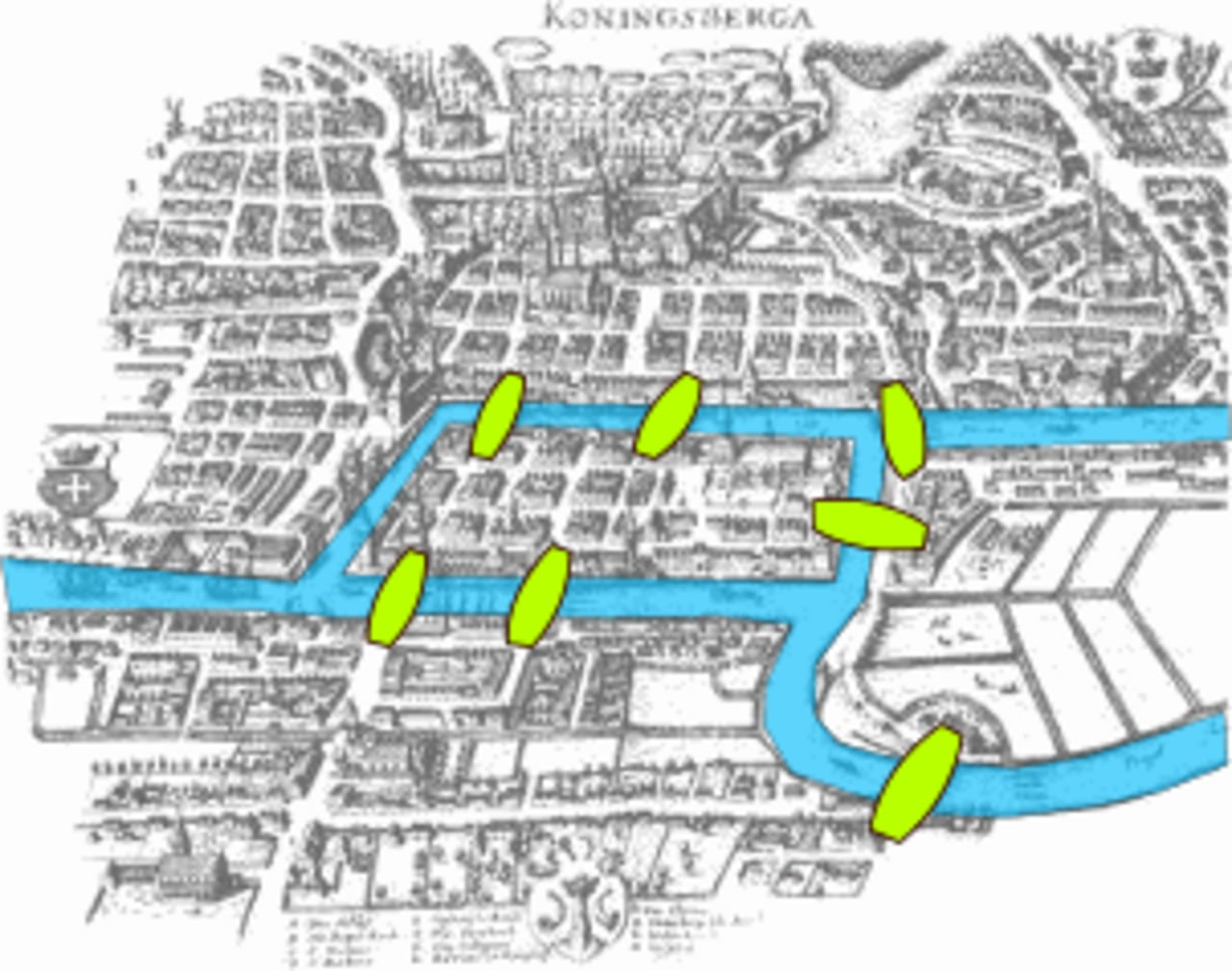
The city of Königsberg sat on both banks of a river with two islands, connected by seven bridges, and its citizens amused themselves with the question of whether one could walk a route crossing every bridge exactly once. In 1736 Euler proved it impossible - and proved it in a way that mattered far more than the puzzle. He observed that the distances and the shapes of the landmasses were irrelevant; all that counted was which pieces of land connected to which, and how many bridges met at each. Reducing the map to points and lines, he showed that such a walk requires either zero or exactly two landmasses with an odd number of bridges, and Königsberg had four. That paper founded graph theory, which now underlies network routing, social network analysis, logistics, circuit design and the algorithms behind satellite navigation, and it was also the first result in topology - the study of properties that survive stretching and bending.
The Range
Fields He Either Founded or Reorganised
The problem with summarising Euler is that he worked in essentially all of contemporary mathematics and much of physics, and left substantial results in each.
The Basel problem
The sum of the reciprocals of the squares - one plus a quarter plus a ninth and so on - had defeated the best mathematicians in Europe for ninety years. Euler showed it equals pi squared over six, which nobody expected to involve pi at all, and made his reputation across the continent.
- Answer: π²/6
Graph theory and topology
The Königsberg bridges, and the polyhedron formula that vertices minus edges plus faces equals two - two results that opened entirely new branches of mathematics.
- Formula: V − E + F = 2
Analysis
He systematised calculus into something recognisable as a modern subject, largely through his textbooks, which were the standard for a century. The word analysis in its modern sense is substantially his doing.
- Key text: Introductio in analysin infinitorum, 1748
Number theory
Proved several of Fermat's conjectures, introduced the totient function, and did the early work on what became analytic number theory by connecting prime numbers to infinite series.
- Function named for him: Euler's totient
Mechanics and fluid dynamics
Recast Newtonian mechanics in analytical form, formulated the rigid body equations, and derived the Euler equations for inviscid fluid flow, still used in aerodynamics.
- Still used in: Aerodynamics
Practical work
Ship design and naval architecture, artillery ballistics, lens design, cartography, the mechanics of the Prussian royal fountains, lotteries and insurance mathematics.
- Also did: Frederick the Great's plumbing
1766-1783
Seventeen Years Without Sight
A cataract operation in 1771 restored a little vision briefly and then infection took it entirely; he had already lost the other eye decades earlier. He reportedly remarked that now he would have fewer distractions. He had a prodigious memory - he could recite the Aeneid and say which lines began and ended each page of his edition - and could carry very long calculations mentally, once settling a dispute between two students who differed in the fiftieth decimal place of a difficult sum by computing it in his head. He dictated to his sons and to assistants, and produced roughly half his total output after going blind, including a major textbook on algebra dictated to a servant who had been a tailor. The St Petersburg Academy went on publishing his backlog of papers for about fifty years after his death.
Further Reading
Books About Euler
His own textbooks are unusually readable and several remain in print in translation.
Legacy
Why Number Seventy-Seven
Michael Hart ranked Euler 77th, which is low for a mathematician of his standing and reflects the difficulty of assessing pure mathematics as historical influence. He made no single discovery that changed how people live in the way that Watt's engine or Jenner's vaccine did. What he supplied is infrastructure: the notation, the textbooks, the systematisation of calculus into a usable subject, and a body of results that later physicists and engineers simply picked up and used.
The practical downstream is nonetheless enormous once you look for it. The Euler equations are in every aerodynamics package; graph theory routes every packet on the internet and every delivery van; his work on rigid body mechanics is in every simulation of a moving structure; and e appears in every model of growth or decay. Laplace's instruction to his students was to read Euler, who is the master of us all, and Gauss said that studying his works remained the best school for the different fields of mathematics and could not be replaced by anything else. Both were said by people well placed to judge.
Related Publications