Ernest Rutherford

Ernest Rutherford
Born 30 August 1871 • Died 19 October 1937
Rutherford's students fired alpha particles at a sheet of gold foil expecting them to pass straight through, because the atom was then thought to be a diffuse pudding of charge. A very small fraction bounced almost straight back. He said afterwards that it was about as credible as firing a fifteen-inch shell at a piece of tissue paper and having it come back and hit you. The only explanation was that nearly all an atom's mass is packed into a tiny dense core. The atom, it turned out, is mostly nothing.
Rank
#56
Influence
81
Field
Physicist
Historical Perspective
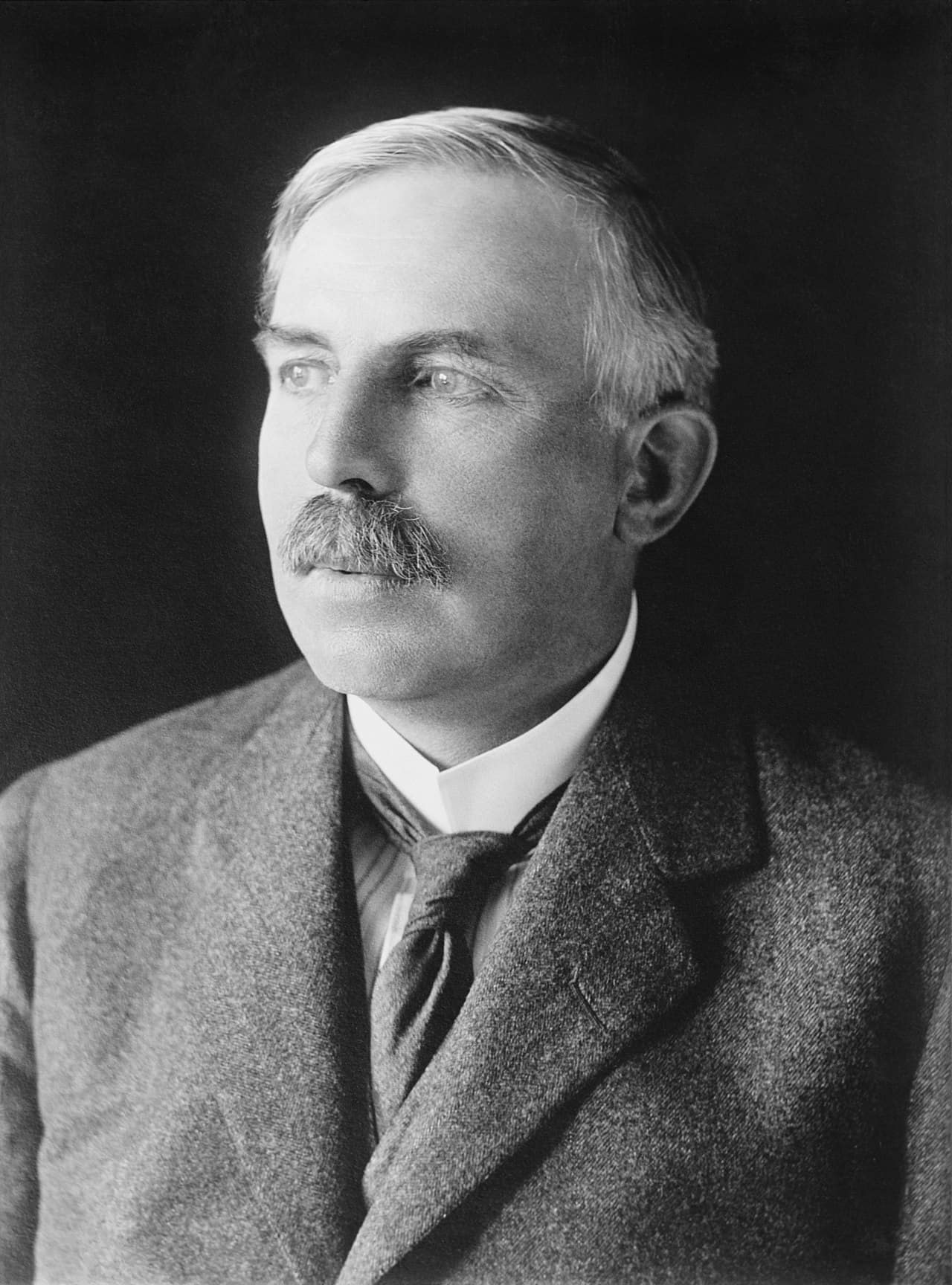
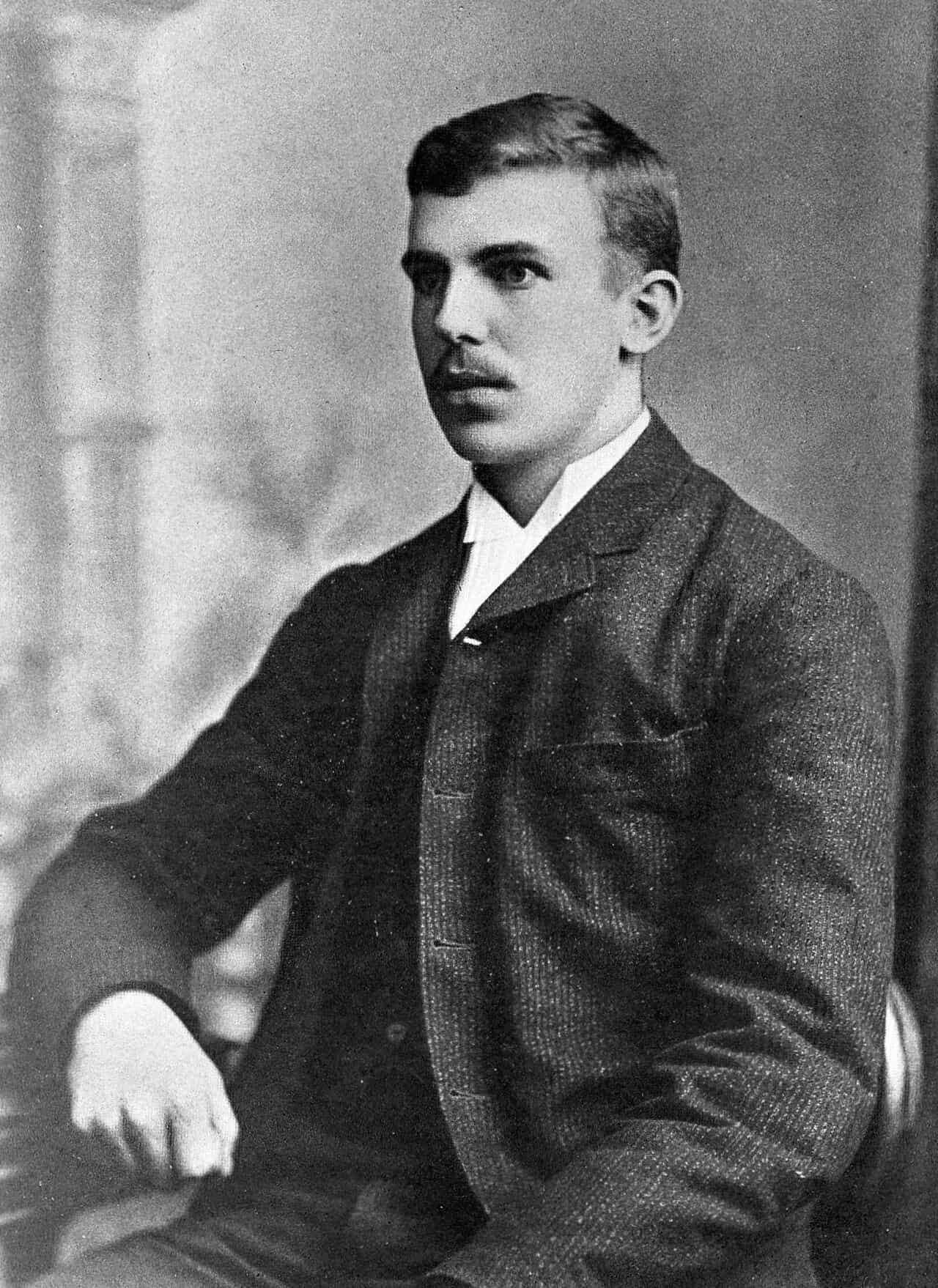
Ernest Rutherford was born on 30 August 1871 at Brightwater near Nelson, New Zealand, the fourth of twelve children of a flax farmer and a schoolteacher, and won his way to Cambridge in 1895 on a scholarship - reportedly putting down his spade in the family potato field on hearing the news and saying that was the last potato he would dig. At the Cavendish under J. J. Thomson he distinguished alpha from beta radiation. At McGill in Montreal from 1898 he showed with Frederick Soddy that radioactivity is the spontaneous transmutation of one element into another, which won him the 1908 Nobel Prize in Chemistry - to his lasting amusement, since he regarded chemistry as inferior to physics. At Manchester, Hans Geiger and Ernest Marsden performed the gold foil experiment in 1909, and in 1911 Rutherford published the nuclear model of the atom. In 1917 he split nitrogen with alpha particles, the first artificial nuclear reaction, and named the proton in 1920. He directed the Cavendish from 1919 until his death in Cambridge on 19 October 1937, and is buried in Westminster Abbey near Newton and Darwin. Michael Hart ranked him 56th in The 100.
Influence Meter
81
Measured on a 100-point scale
Found the nucleus, split the atom, and trained the people who did the rest
1909-1911
The Experiment That Emptied the Atom
The accepted picture in 1909 was J. J. Thomson's: an atom was a diffuse sphere of positive charge with electrons distributed through it, the plum pudding. Rutherford set Geiger and the undergraduate Marsden to a routine task - firing alpha particles at thin gold foil and measuring the small deflections - largely to give Marsden something to do. They found that roughly one in eight thousand alphas was deflected by more than ninety degrees, and some came straight back. A diffuse pudding cannot do that; only a concentrated mass and charge can. Rutherford worked on it for over a year and published in 1911: the atom's positive charge and nearly all its mass occupy a central nucleus perhaps a hundred-thousandth of the atom's diameter, with electrons somewhere outside. If an atom were the size of a cathedral, the nucleus would be a fly. Everything else is empty space, which is a genuinely disquieting thing to be told about the chair you are sitting on.
Rutherford and Frederick Soddy established at McGill between 1901 and 1903 that radioactivity is not a chemical process at all but the spontaneous disintegration of atoms, in which one element becomes another. Soddy is said to have exclaimed that it was transmutation, and Rutherford to have replied that for Mike's sake he should not call it transmutation, or they would have their heads off as alchemists. The alchemical resonance was real: the indivisible, immutable atom had been the bedrock of chemistry for a century, and here were atoms turning into other atoms unprompted. The pair also introduced the concept of half-life, the fixed period in which half a sample decays, which became the basis of radiometric dating and eventually of the timescale for the age of the Earth and the geological record.
The Record
What Came Out of His Laboratories
Rutherford worked at three institutions and left each one with a discovery attached to it.
Alpha and beta radiation
Distinguished two components of uranium radiation by their penetrating power and named them; gamma followed. He later proved with Thomas Royds that an alpha particle is a helium nucleus.
- Named: Alpha and beta
Transmutation and half-life
With Soddy, that radioactive decay converts one element into another at a statistically fixed rate. It won him the 1908 Nobel Prize in Chemistry.
- Nobel: Chemistry, 1908
The nuclear atom
From the gold foil results, an atom with a minute massive nucleus and mostly empty space. Bohr added quantised electron orbits two years later.
- Nucleus is: About 1/100,000 of the atom
The first artificial nuclear reaction
Bombarding nitrogen with alpha particles produced oxygen and hydrogen nuclei - deliberately turning one element into another. Done, characteristically, while he was supposed to be working on submarine detection.
- Reaction: Nitrogen to oxygen
The proton
He identified the hydrogen nucleus as a fundamental constituent of all nuclei and gave it the name, and in the same lecture predicted a neutral particle of similar mass.
- Predicted: The neutron
The Cavendish under his direction
Chadwick found the neutron in 1932; Cockcroft and Walton split the lithium nucleus with an accelerator the same year; Blackett photographed nuclear transmutations. Eleven of his students or colleagues won Nobel Prizes.
- Nobel laureates trained: At least eleven
Scale
How Empty an Atom Is
The nuclear model's most counter-intuitive consequence is dimensional. These are order-of-magnitude figures, which is the only way the comparison is comprehensible.
| A hydrogen atom | About 0.1 nanometres across | The whole building |
| Its nucleus | About 0.0000017 nanometres | A fly at the centre |
| Ratio of diameters | Roughly 60,000 to 1 | Everything else is empty |
| Share of the atom's mass in the nucleus | More than 99.9 per cent | The fly weighs almost everything |
| Alpha particles deflected past 90 degrees | About 1 in 8,000 | How rarely anything hits the fly |
Rutherford's own comparison was a fifteen-inch naval shell rebounding from tissue paper, which conveys the surprise better than the numbers do.
1933
Moonshine
In September 1933 Rutherford told the British Association that anyone who looked for a source of power in the transformation of atoms was talking moonshine. The energy released in individual nuclear events was real and large, he pointed out, but the reactions had to be driven by bombardment that cost far more energy than they returned, and he could see no way round it. It was a reasonable judgement on the evidence then available and it is the most quoted wrong prediction in physics.
The Hungarian physicist Leo Szilard read the report in a London newspaper the next morning, and while waiting to cross Southampton Row conceived the idea that answers it: a reaction in which one neutron produces more than one, so that the process sustains itself and the input cost disappears. He patented the concept in 1934. Chadwick's discovery of the neutron in Rutherford's own laboratory in 1932 had supplied the particle that made it possible, since a neutron is uncharged and can enter a nucleus without being repelled. Rutherford died in 1937, two years before fission was identified and eight before Hiroshima, and never had to decide what he thought about it.
Further Reading
Books About Rutherford
He was a loud, cheerful, unpretentious man who sang Onward Christian Soldiers badly around the laboratory, and the biographies enjoy him.
Legacy
Why Number Fifty-Six
Michael Hart ranked Rutherford 56th, and the case is that he opened the interior of the atom. Before 1911 the atom was a featureless unit; after him it had a structure with a nucleus at the centre, which is the object all of nuclear physics, nuclear power, nuclear weapons, radiometric dating and nuclear medicine addresses. Bohr's quantised orbits, which made quantum theory concrete, were built directly on Rutherford's model, and Bohr worked in his laboratory.
The other legacy is institutional and often understated. He was among the most effective teachers in the history of science: Bohr, Chadwick, Geiger, Marsden, Blackett, Cockcroft, Walton, Soddy, Hahn and Kapitza all worked under him, and at least eleven people connected to his laboratories took Nobel Prizes. He was famously ungifted with his hands and had a gift for asking the right question of the right person, which is a different and rarer talent. Comparisons with Faraday were made in his lifetime, and both men were experimenters of enormous physical intuition and limited mathematics who nonetheless changed what physics was about.
Related Publications