St. Augustine

St. Augustine
Born 13 November 354 • Died 28 August 430
Augustine wrote a book about himself in which he tells God that as a boy he stole pears he did not want, from a tree he did not care about, purely for the pleasure of doing wrong - and then spends pages examining what that says about the human will. Nobody had written anything like it. Before the Confessions, ancient autobiography recorded public deeds; Augustine turned the attention inward and found a self that is divided, self-deceiving and opaque even to itself. Western literature and Western psychology both start, in a real sense, from that pear tree.
Rank
#54
Influence
84
Field
Theologian and Bishop
Historical Perspective
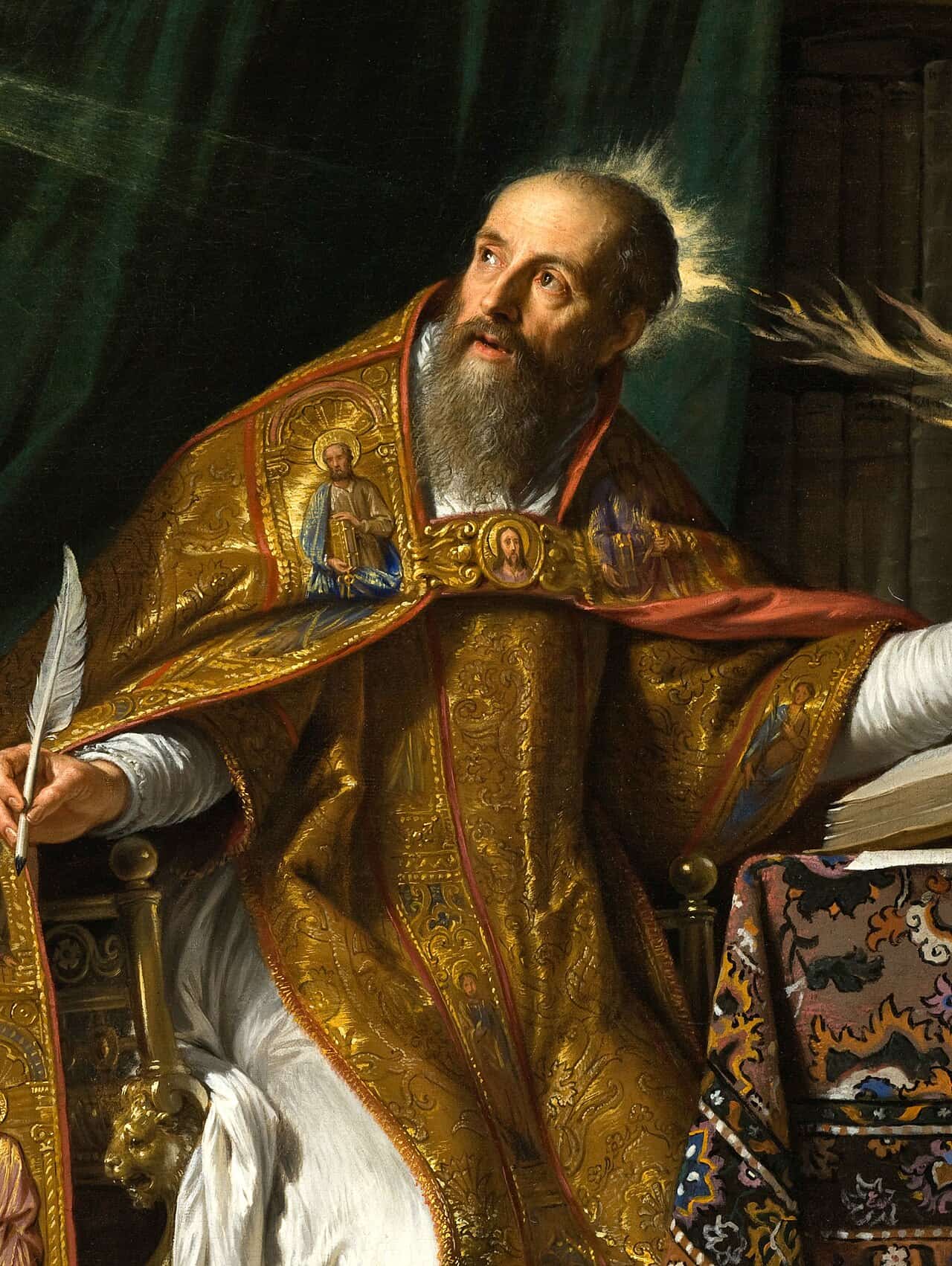
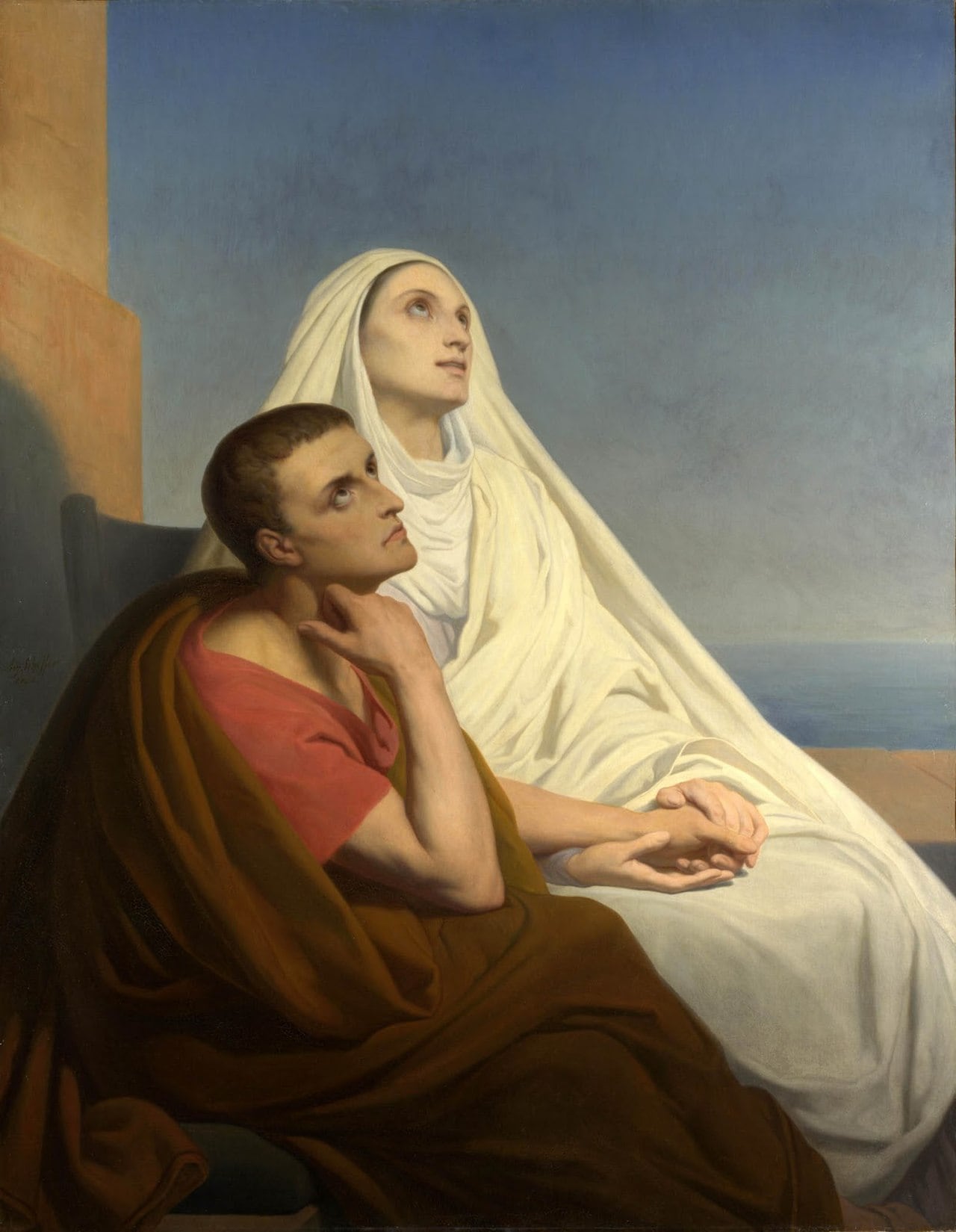
Augustine was born on 13 November 354 at Thagaste in Roman North Africa, to a pagan father, Patricius, and a devoutly Christian mother, Monica, whose persistence is one of the through-lines of his own account. He was educated at Carthage, took a concubine with whom he lived for some fifteen years and had a son, Adeodatus, and spent about a decade as an adherent of Manichaeism before losing confidence in it. He taught rhetoric at Carthage, Rome and then Milan, where he encountered the preaching of Ambrose and the philosophy of the Neoplatonists. In a garden in Milan in the late summer of 386 he heard a child's voice chanting take up and read, opened Paul's letter to the Romans at random, and converted; Ambrose baptised him at Easter 387. Monica died on the journey home. He was ordained at Hippo Regius in 391 and became its bishop in 395, remaining for thirty-five years and producing an enormous body of work - over a hundred books, three hundred letters and several hundred surviving sermons. He died on 28 August 430 while the Vandals besieged his city. Michael Hart ranked him 54th in The 100.
Influence Meter
84
Measured on a 100-point scale
Shaped Western Christianity for a millennium, and invented writing about the self
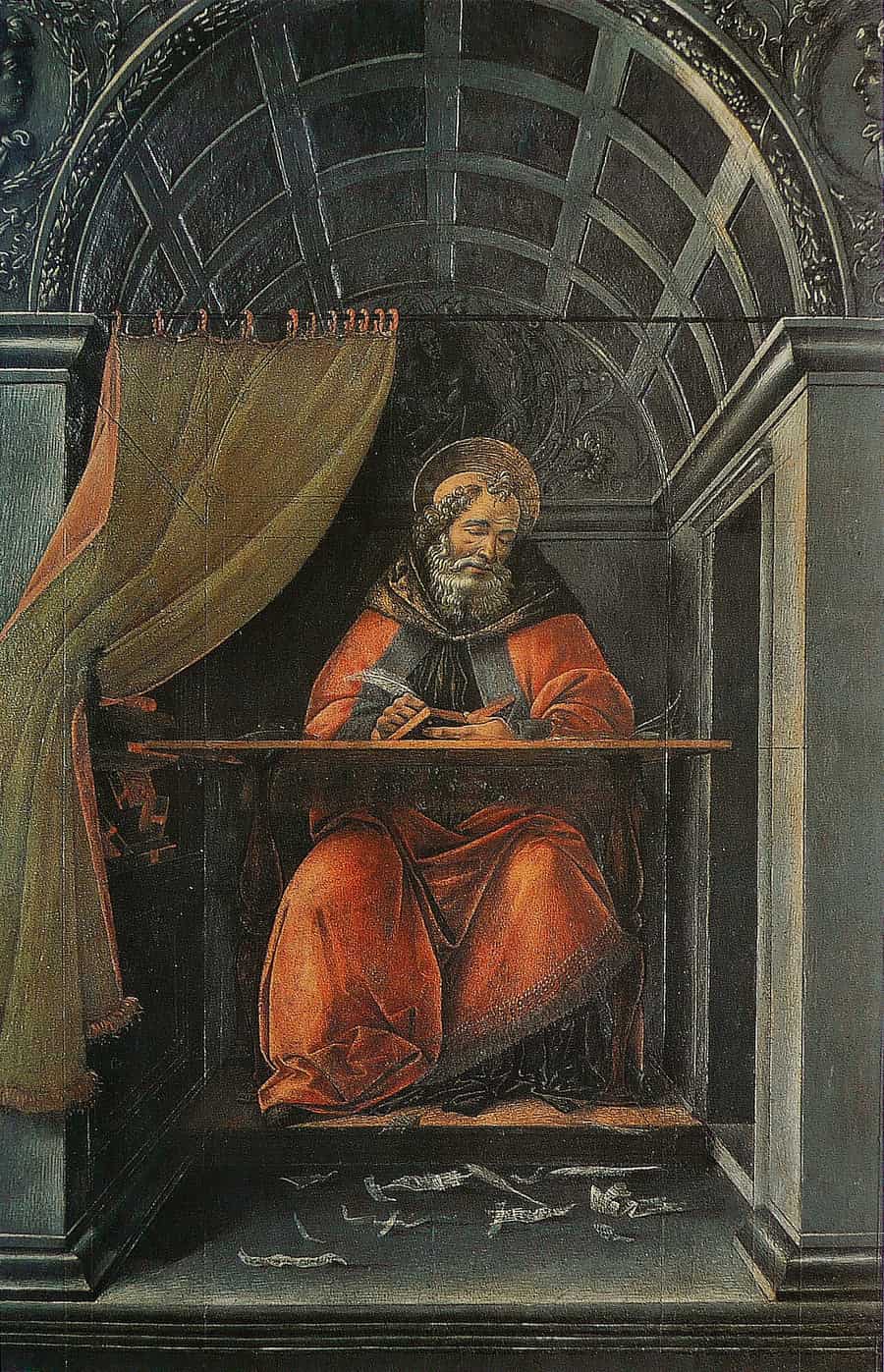
c. 397-400
The First Book About Being a Person
The Confessions is addressed to God rather than to a reader, which is part of what makes it strange and part of what makes it work: Augustine is not performing for an audience but examining himself in front of someone he believes already knows. He describes his infancy, his theft of the pears, his years with a woman he loved and dismissed when a respectable marriage was arranged, his intellectual restlessness, his prayer asking for chastity but not yet, and his mother's death - and treats all of it as material for understanding how a will can want what it does not want. Memory, time and desire get whole books to themselves; the discussion of what time actually is, in Book XI, is still cited by philosophers. Nothing in classical literature is comparable. Marcus Aurelius wrote notes to himself, and Cicero wrote about his career, but the interior, self-suspicious, narrative self is Augustine's invention, and it runs through Rousseau, the novel, and psychoanalysis.
In August 410 Alaric's Goths sacked Rome. The city had not fallen to a foreign enemy in eight hundred years, and the shock across the empire was enormous; pagans argued that the disaster had come because Rome had abandoned its old gods for Christianity. Augustine's answer took thirteen years and twenty-two books. The City of God separates two communities that are mixed together in this world - the earthly city, founded on self-love and pursuing power, and the city of God, founded on love of God and destined for eternity. No empire, Rome included, is identical with the divine order or guaranteed by it; states are necessary, worth obeying and inherently provisional. The argument gave Christianity a way to survive the collapse of the Roman order rather than being buried with it, and supplied medieval Europe with its basic framework for thinking about the relation between church and secular power.
Theology
The Positions the West Inherited
Augustine's arguments were mostly forged in controversy, against opponents whose names are now known chiefly because he refuted them.
Original sin
Human nature is damaged from birth by Adam's fall, so that the will is not free to choose the good unaided. Pelagius held that people could keep God's commands by their own effort; Augustine's view prevailed and became Western orthodoxy.
- Opponent: Pelagius
Grace and predestination
Salvation is a gift given by God rather than earned, and given to those God chooses. The doctrine is the direct source of Calvin's predestination eleven centuries later.
- Reappears in: Luther and Calvin
The validity of the sacraments
Donatists held that sacraments administered by clergy who had lapsed under persecution were void. Augustine argued the sacrament's power comes from Christ, not the priest's merit - which is why the Catholic Church has never had to audit the private lives of its clergy to validate its baptisms.
- Opponent: Donatists
Just war
He set out conditions under which a Christian may fight - legitimate authority, just cause, right intention - which Aquinas systematised and which underlies international law on armed conflict to this day.
- Developed by: Aquinas, and modern law
Evil as privation
Evil is not a substance or an opposing power but the absence or corruption of good. It let Christianity reject Manichaean dualism while still accounting for a world that plainly contains suffering.
- Rejected: Dualism
Time and creation
God did not create the world in time but created time with the world, so asking what he was doing beforehand is incoherent. A genuinely subtle answer that still appears in discussions of cosmology.
- In: Confessions, Book XI
430
Dying in a Besieged City
Augustine's last years were spent watching the western empire come apart. The Vandals crossed from Spain into North Africa in 429, and by the summer of 430 they were besieging Hippo. He was seventy-five, and spent his final months, according to his biographer Possidius, with the penitential psalms written out and pinned to the wall where he could see them from his bed. He died on 28 August, before the city fell; it held out another year, and the Vandals eventually burned much of it, though the cathedral and his library survived. Within a century Roman Africa - the province that had produced Tertullian, Cyprian and Augustine himself, and had been among the most Christianised in the empire - had been detached from the Latin world, and after the Arab conquests of the seventh century it was permanently so. His works survived because copies had already travelled to Europe.
Further Reading
Books By and About Augustine
He is one of the most voluminous authors of the ancient world, and unusually, nearly all of it survives.
Legacy
Why Number Fifty-Four
Michael Hart ranked Augustine 54th, and the influence runs along two separate tracks that rarely intersect. Theologically he is the most important Christian writer between Paul and Aquinas, and arguably including Aquinas. Medieval Catholicism was built on him; then the Reformation was fought largely between Augustinians, since Luther was an Augustinian friar and Calvin's predestination is Augustine's, so that both sides in the sixteenth century's central conflict were quoting the same North African bishop against each other. Any account of Western Christianity that leaves him out is unintelligible.
The literary track may reach further. The Confessions established that a person's interior life - doubts, appetites, self-deceptions, the gap between what one wants and what one wants to want - is a legitimate and serious subject. Rousseau titled his own book Confessions in explicit response; the novel as a form depends on the assumption Augustine introduced; and psychoanalysis works in a register he opened. He was a provincial bishop in a city that no longer exists, in a province that left the Christian world entirely within three centuries of his death, and he is still being argued with.
Related Publications