Gregor Mendel

Gregor Mendel
Born 20 July 1822 • Died 6 January 1884
Mendel did the thing that almost nobody in nineteenth-century biology was doing: he counted. Instead of describing what offspring looked like, he crossed pea plants by the thousand, sorted the results into categories, and wrote down how many fell into each. The numbers came out as clean ratios - three to one, nine to three to three to one - which meant inheritance was not a blending of fluids but the shuffling of discrete units. He published, and the paper sat unread for thirty-four years while Darwin, who badly needed exactly this result, died without seeing it.
Rank
#58
Influence
80
Field
Friar and Botanist
Historical Perspective
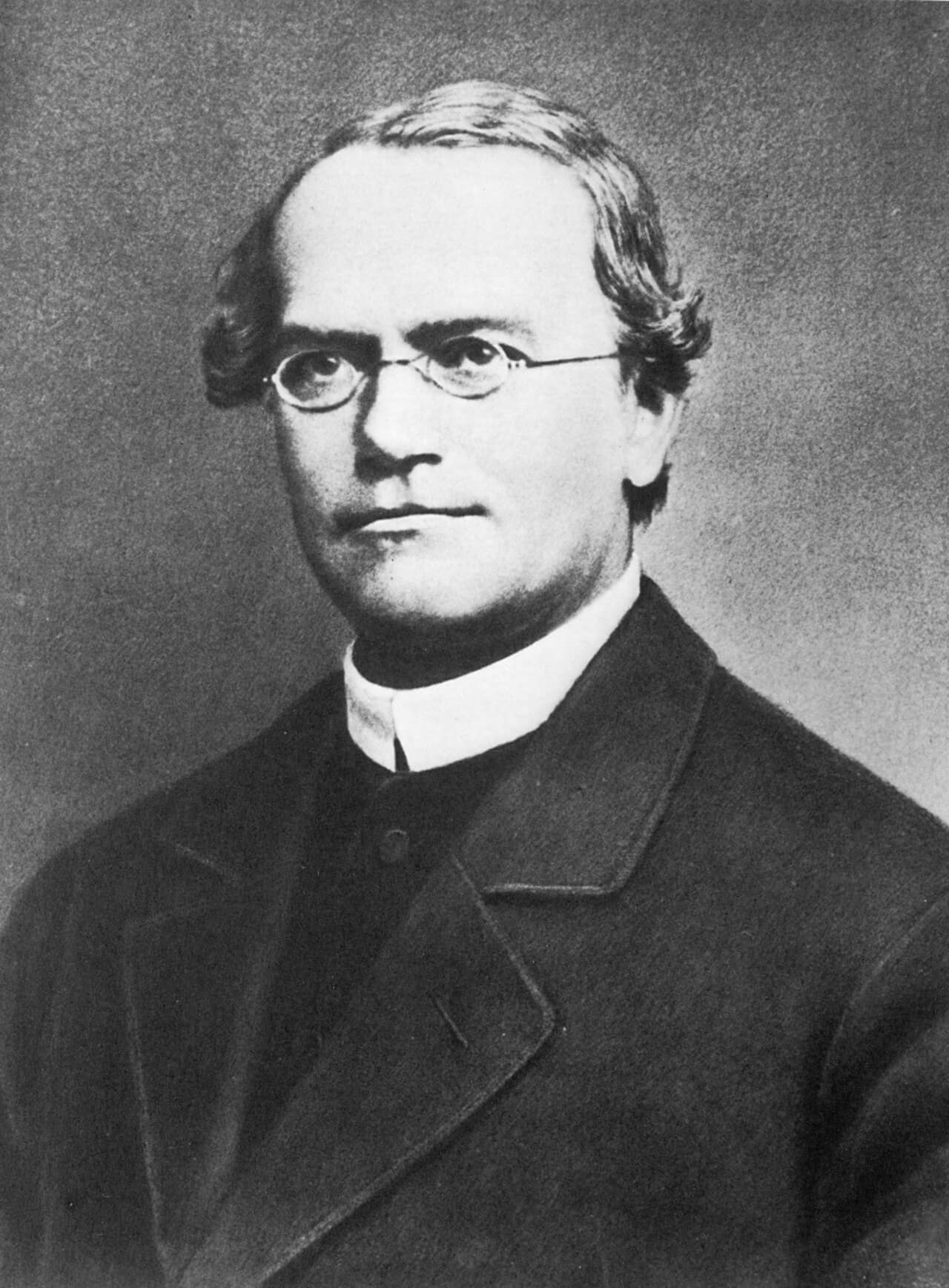
Johann Mendel was born on 20 July 1822 at Heinzendorf in Austrian Silesia, into a peasant farming family, and took the name Gregor on entering the Augustinian abbey of St Thomas at Brno in 1843 - a decision made, by his own frank admission, largely because it was the only route to an education he could not otherwise afford. The abbey was an unusual place, a centre of scientific and agricultural research with a substantial library, and it sent him to the University of Vienna from 1851 to 1853, where he studied physics under Christian Doppler and, importantly, learned to think about natural phenomena in terms of statistics. He failed his teaching examination twice. Between 1856 and 1863 he grew and crossed something like twenty-eight thousand pea plants in the abbey garden, tracking seven contrasting characteristics. He read the results to the Brno Natural History Society in February and March 1865 and published them in its proceedings in 1866. He was elected abbot in 1868, after which administration and a long dispute with the government over monastery taxation consumed his time, and he did little further research. He died on 6 January 1884. Michael Hart ranked him 58th in The 100.
Influence Meter
80
Measured on a 100-point scale
Found the mathematical laws of heredity, and was ignored for a generation
1856-1863
Why Peas, and Why Seven Characteristics
Mendel's choice of organism and traits was the decisive piece of experimental design, and it is why he succeeded where earlier hybridisers had produced only confusion. The garden pea self-fertilises, so pure-breeding lines can be established and maintained; it can also be cross-pollinated by hand with tweezers, giving complete control of parentage; it grows quickly, produces many offspring, and comes in varieties with sharply contrasting forms. He selected seven characteristics that each appear in two clearly distinguishable states with nothing in between - seed round or wrinkled, seed colour yellow or green, flower purple or white, pod inflated or constricted, pod green or yellow, flowers along the stem or at the tip, plant tall or short. Traits that vary continuously, like height in most species, would have shown him nothing. He then did what nobody had done: he counted every plant in every generation and applied arithmetic to the totals.
What the Numbers Showed
The ratios are the whole discovery. They are only visible if you count large numbers, which is why seven years of tedious garden work were necessary.
- Traits do not blend: Crossing a tall plant with a short one gives tall offspring, not medium ones. The short characteristic disappears in the first generation and reappears intact in the second, so it was never diluted - it was hidden.
- Dominant and recessive: His terms. One form masks the other when both are present, which is why the second generation shows the hidden form again in a quarter of cases.
- The 3:1 ratio: Self-fertilising the first generation gives three dominant to one recessive - the signature of two discrete factors per plant, one from each parent, separating at random.
- The law of segregation: Each parent contributes one of its two factors to each offspring, chosen at random. Nothing mixes; the units stay intact through the generations.
- The law of independent assortment: Different characteristics are inherited independently of one another, giving a 9:3:3:1 ratio when two traits are tracked at once. True for his seven, and not universally true, as later work on linkage showed.
- Inheritance is particulate: The units - now called genes - are discrete, do not blend, and are shuffled by simple probability. This is the result, and everything in genetics since is an elaboration of it.
Mendel's paper was published in the proceedings of the Brno Natural History Society in 1866 and sent to something like a hundred and twenty libraries, with forty reprints distributed to individual scientists. It was cited a handful of times over the following three decades and understood by essentially nobody. The reasons are several and none of them are that the journal was too obscure to find. Biology in 1866 had no framework for a mathematical, probabilistic account of heredity; the prevailing assumption was blending inheritance, and Mendel's ratios looked like a curiosity about peas rather than a general law. He also corresponded with the botanist Carl Nägeli, an eminent figure who advised him to repeat the work on hawkweed - a plant that, unknown to either of them, reproduces asexually in a way that makes Mendelian ratios impossible. Mendel spent years failing to confirm his own laws on the wrong organism, and concluded he might be mistaken.
1900
Three People, Independently, in One Year
In 1900 Hugo de Vries in the Netherlands, Carl Correns in Germany and Erich von Tschermak in Austria each published results on inheritance and each, in the process of searching the literature, found Mendel's paper - and found that a Moravian friar had established their conclusions thirty-four years earlier and stated them more clearly. The rediscovery is one of the strangest episodes in the history of science, and it happened when it did because biology had finally caught up: chromosomes had been observed dividing, and there was now something visible for Mendel's abstract factors to correspond to. William Bateson in England took up the cause aggressively, coined the word genetics in 1905, and translated the paper. Within two decades Thomas Hunt Morgan's fruit flies had located genes on chromosomes, and within fifty years Watson and Crick had the molecule.
The Awkward Question
Were the Results Too Good?
In 1936 the statistician and geneticist Ronald Fisher analysed Mendel's published figures and reported an uncomfortable finding: the results fit the expected ratios more closely than chance should allow. Applying a chi-squared test across the experiments, Fisher calculated that data this well-behaved would occur by chance only about once in fourteen thousand times. He suggested, carefully, that Mendel had perhaps been assisted by a gardener who knew what was expected.
The controversy has run ever since without resolution. Proposed explanations include unconscious bias in classifying ambiguous seeds - some peas are genuinely hard to call round or wrinkled - the discarding of trials that looked anomalous, sequential stopping when the numbers looked right, and errors in Fisher's own assumptions about how the experiments were structured; several later statisticians have argued the case is weaker than Fisher made it. What nobody disputes is that Mendel's conclusions are correct, confirmed exhaustively since by people with no access to his peas. It is a useful illustration that the reliability of a scientific result and the tidiness of the original data are separate questions.
Further Reading
Books About Mendel
His successor as abbot burned his papers after his death, so the personal record is thin and the argument about him rests on the published paper.
Legacy
Why Number Fifty-Eight
Michael Hart ranked Mendel 58th, and the counterfactual is unusually sharp: had the paper been read in 1866, evolutionary biology would have been forty years further along by 1900. Darwin's principal difficulty was that he had no mechanism of inheritance, and the blending model then assumed would have diluted any advantageous variation out of existence within a few generations - a genuine objection that troubled him. Mendel's particulate inheritance answers it exactly, and Darwin owned a book that cited Mendel's paper, with the relevant pages uncut. The two theories were not brought together until the modern synthesis of the 1930s and 1940s.
Everything in genetics rests on him. Chromosomes carrying genes, the mapping of genes to traits, the discovery of DNA's structure, the diagnosis and prediction of heritable disease, the plant breeding that underlies modern agriculture and the entire biotechnology industry all start from the observation that inheritance is discrete and behaves probabilistically. He worked it out alone, with tweezers and a notebook, in a monastery garden roughly the size of a tennis court, and died believing his time would come - which is what he is reported to have said, and which turned out to be right by sixteen years.
Related Publications