William Harvey

William Harvey
Born 1 April 1578 • Died 3 June 1657
Galen's account of the blood had stood since the second century: the liver manufactured it continuously from food, it seeped outward through the veins and was consumed by the body, and some of it passed through invisible pores in the wall between the two sides of the heart. Harvey killed the whole system with a multiplication. He measured roughly how much the heart holds, counted the beats, and worked out that in a single hour it expels several times a person's body weight in blood. Nothing could manufacture that. Therefore it must be the same blood, going round.
Rank
#55
Influence
77
Field
Physician and Anatomist
Historical Perspective
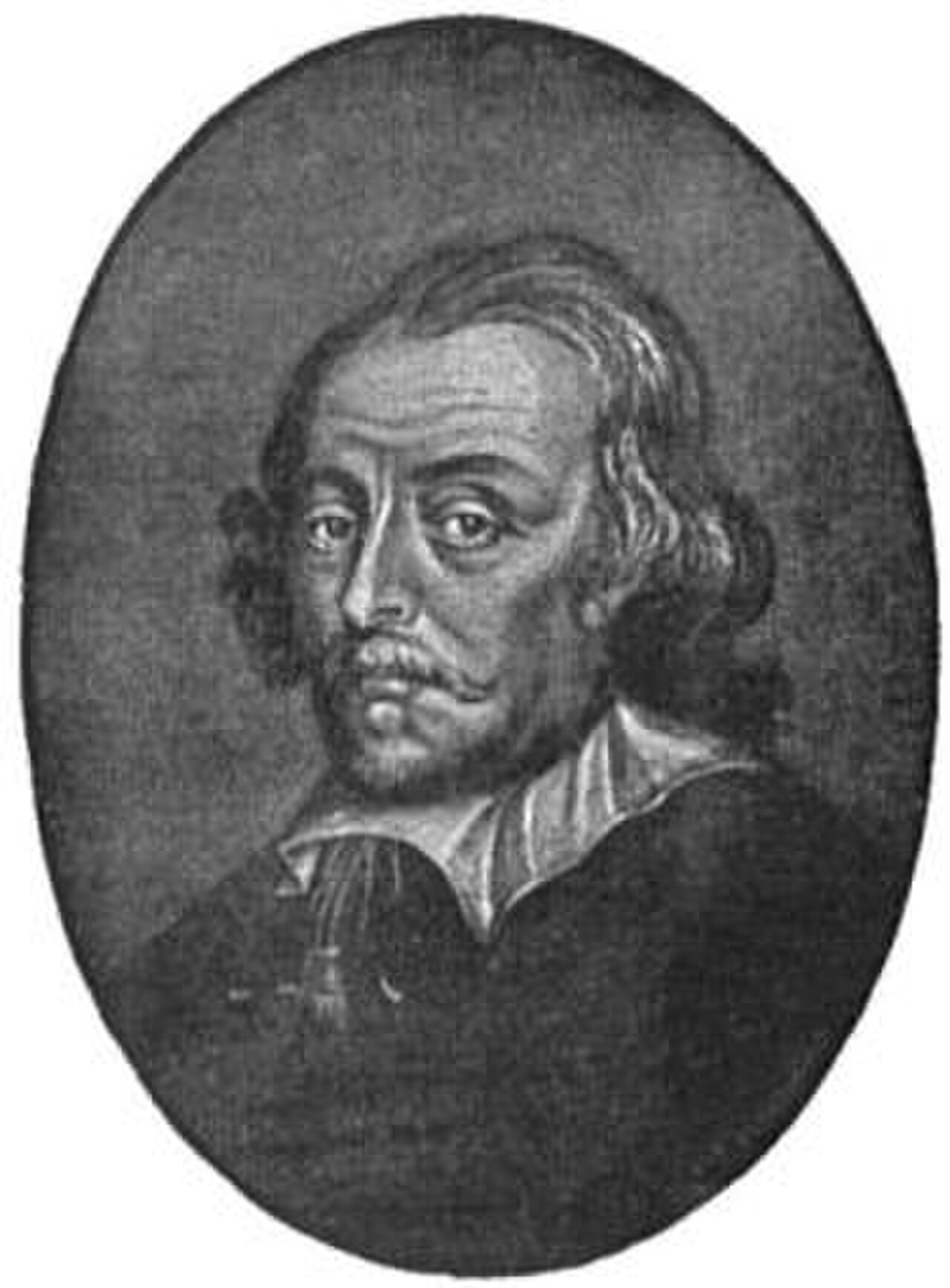
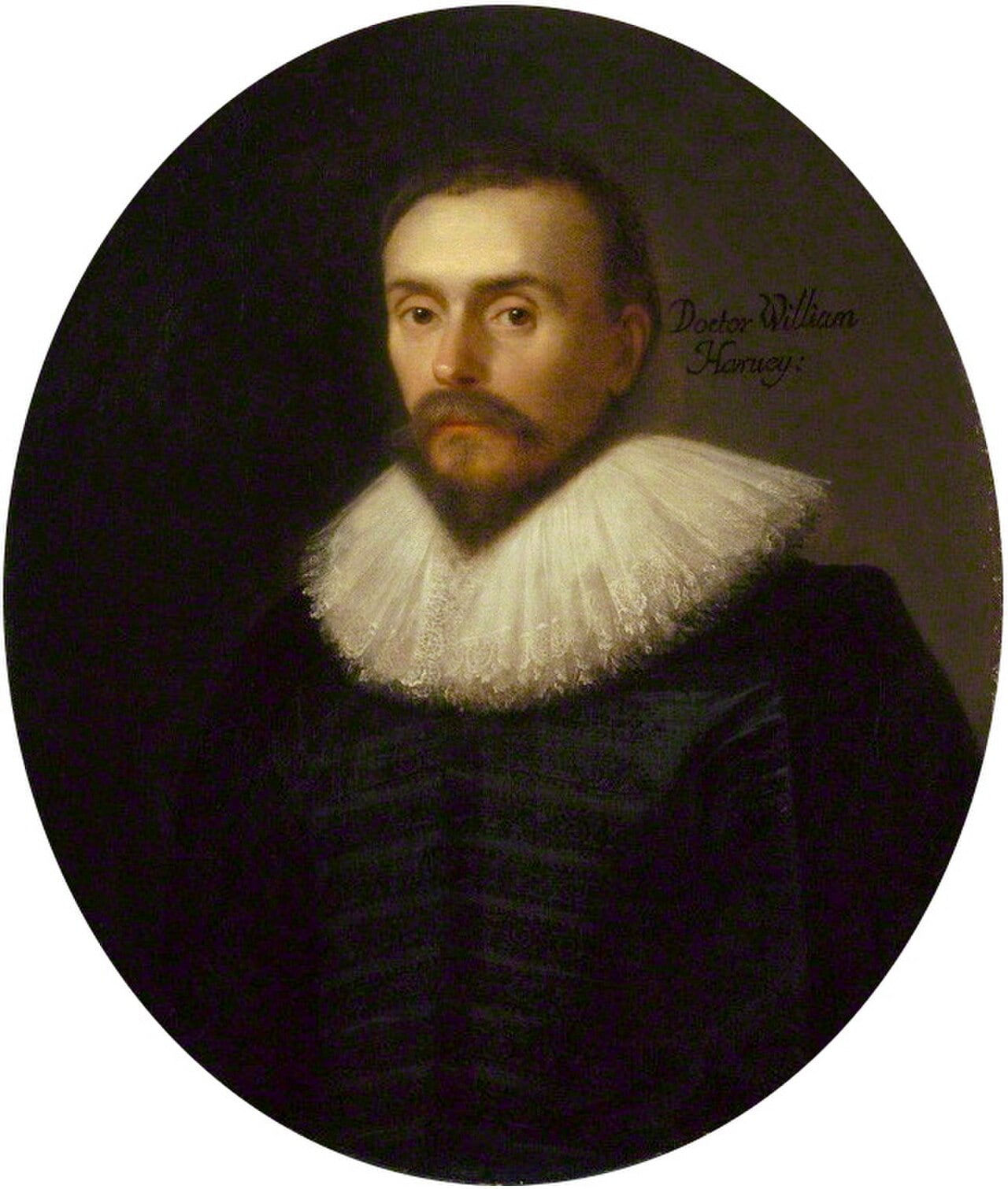
William Harvey was born at Folkestone in Kent on 1 April 1578, the eldest son of a prosperous merchant, and educated at Canterbury and Gonville and Caius College, Cambridge. He then went to Padua, the leading medical school in Europe, and took his doctorate in 1602 under Hieronymus Fabricius, who had described the valves in the veins without understanding what they were for - an observation that turned out to be the key. Back in London, Harvey became a fellow of the College of Physicians in 1607, physician to St Bartholomew's Hospital from 1609, and physician to James I and then to Charles I, whose interest in the work was genuine and who supplied him with deer from the royal parks for dissection. He first taught the circulation in lectures from about 1616 and published De Motu Cordis in 1628. He remained loyal to Charles through the Civil War, was present at Edgehill in charge of the royal children, and lost his lodgings and papers when Parliament took London. He died at Roehampton on 3 June 1657. Michael Hart ranked him 55th in The 100.
Influence Meter
77
Measured on a 100-point scale
Overturned fifteen centuries of medicine, and did it with measurement
Before 1628
What Everyone Had Believed Since the Second Century
Galen's physiology was not stupid; it was a coherent system built on real dissection, and it fitted the observations available to someone without a microscope. Blood was made in the liver from digested food, carried outward through the veins, and consumed by the tissues as nourishment - a one-way system with no return. There were two distinct kinds: venous blood from the liver, and a brighter arterial blood carrying vital spirit from the heart and lungs. Some blood was supposed to seep from the right side of the heart to the left through pores in the dividing septum, which nobody had ever seen.
The system had begun to crack before Harvey. Vesalius, dissecting carefully in the 1540s, reported he could not find the pores in the septum. Michael Servetus described the pulmonary circulation - blood passing from the right heart through the lungs to the left - in a theological book in 1553, for which he was burned at the stake, and Realdo Colombo published the same finding independently in 1559. Fabricius, Harvey's teacher, described the valves in the veins in 1603 and concluded they existed to slow the outward flow. Every one of those pieces pointed toward circulation, and nobody assembled them, because the framework said blood was consumed rather than returned.
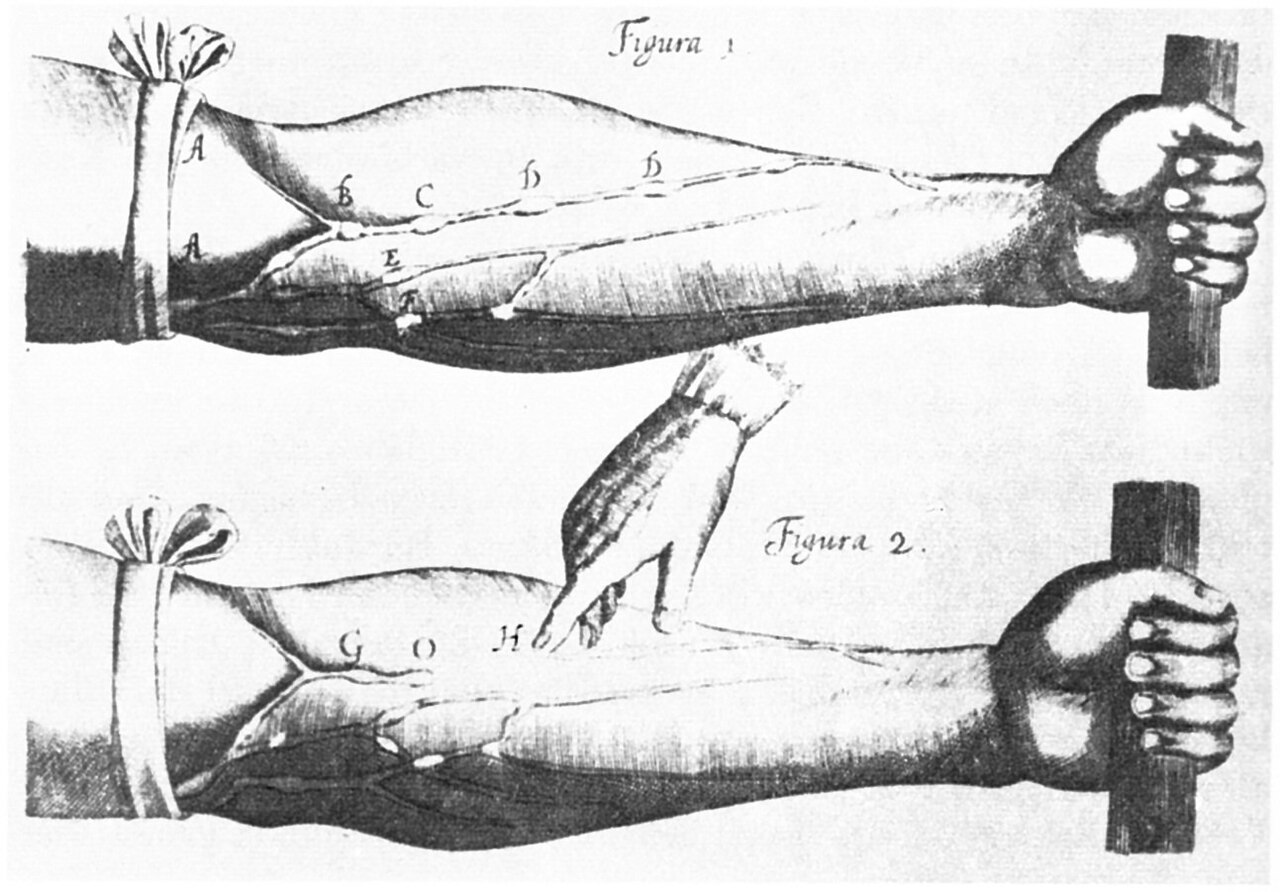
Harvey's decisive move was quantitative, and it is the first time in the history of physiology that a measurement settles an argument. He estimated the capacity of the left ventricle at around two ounces, took a pulse rate of some seventy-two beats a minute, and calculated the output: even on deliberately conservative assumptions, the heart expels many times the body's total weight of blood in an hour. No liver could manufacture that from food, and no tissue could consume it. There was only one possibility left - the same blood is passing through the heart repeatedly, which requires a closed circuit. He backed it with experiment: ligature the arm tightly and the artery below swells while the veins empty; loosen it and the veins fill from below, and pressing along a vein shows the blood will only move toward the heart, because the valves stop it going the other way.
After 1628
The Cost of Being Right
De Motu Cordis was seventy-two pages, printed cheaply in Frankfurt on poor paper with numerous misprints, and it made Harvey enemies immediately. He wrote later, in his own account, that after it appeared he fell greatly in his practice, that it was believed he was crack-brained, and that all the physicians were against him. The hostility is easy to understand: Galen was not merely a theory but the entire structure of medical training, and circulation invalidated the standard therapeutic rationale for bleeding a patient at a particular site to draw off corrupt humours. Jean Riolan in Paris led the opposition for years. Harvey answered his critics in two published letters and otherwise left the argument to the evidence, which was sufficient - by the time he died in 1657 the circulation was accepted by most of the profession, and he had lived to see it, which is not the usual fate of people who overturn a fifteen-hundred-year consensus.
What He Proved, and What He Could Not
Harvey's argument was complete except at one point, and he was candid about it.
- The heart is a pump: Not a source of heat or spirit but a muscular organ that contracts to expel blood - which sounds obvious now and was not then.
- Blood moves in a circle: Out through the arteries, back through the veins, through the lungs and round again, continuously, in one direction.
- The valves enforce direction: Fabricius had described them; Harvey worked out that they exist to stop blood flowing away from the heart, which only makes sense in a circulatory system.
- There is only one kind of blood: Not the venous and arterial kinds Galen described, but the same fluid at different points in one circuit.
- He could not see the connection: Arteries and veins had to join somewhere at the far end, and no lens available to him could show it. He argued they must connect through pores in the flesh, and left it as the acknowledged gap in the proof.
- Malpighi closed it in 1661: Four years after Harvey died, Marcello Malpighi observed capillaries in a frog's lung under a microscope. Leeuwenhoek later watched blood actually pass through them.
1651
The Second Book, and the Chickens
Harvey's other major work, De Generatione Animalium, appeared in 1651 when he was seventy-three, and is much less read than the first. It is the product of decades of opening chicken eggs at daily intervals and dissecting deer at known points in pregnancy, and it advances a position captured by the phrase associated with its frontispiece, ex ovo omnia - everything from an egg. Against the prevailing view that a new animal arises from the mixture of male seed with menstrual blood, or that it exists preformed in miniature and merely grows, Harvey argued from observation that the embryo develops progressively from a simple beginning, part by part. He could not see the mammalian egg, which was not observed until 1827, and the theory has plenty in it that is wrong. But the method - watch, record, at intervals, and let the sequence tell you - is the same one he had used on the heart, and it founded experimental embryology.
Further Reading
Books About Harvey
Much of his personal archive burned or was looted during the Civil War, so the record is thinner than his standing suggests.
Legacy
Why Number Fifty-Five
Michael Hart ranked Harvey 55th, and the case is that he did for physiology what Copernicus did for astronomy - replaced a coherent, ancient, wrong system with the correct arrangement, and thereby made everything downstream possible. Nothing in modern medicine works without circulation: blood pressure, transfusion, anaesthesia delivered intravenously, cardiac surgery, drug pharmacokinetics, dialysis. All of them presuppose a closed loop with a pump in it.
The methodological legacy is at least as important. Harvey's demonstration is the first in medicine where a quantitative argument overturns an authority - not a better dissection or a cleverer reading of Galen, but a sum showing the old account was impossible. Combined with his experiments on ligatures and valves, it set a standard for what counted as proof in the life sciences. He was a court physician in a country sliding into civil war, working with no microscope and a gap in his own argument he could not close, and he was right, and he knew how to show it.
Related Publications