Francis Bacon

Francis Bacon
Born 22 January 1561 • Died 9 April 1626
Bacon made almost no scientific discoveries. He rejected Copernicus, ignored Kepler, and was dismissive of the mathematics that turned out to be the real engine. What he did was describe how the thing should be done - patiently, experimentally, collectively, in public, with results written down whether they flattered the theory or not - and describe it so persuasively that a generation of people who could do the work took him as their charter.
Rank
#90
Influence
76
Field
Philosopher and Statesman
Historical Perspective
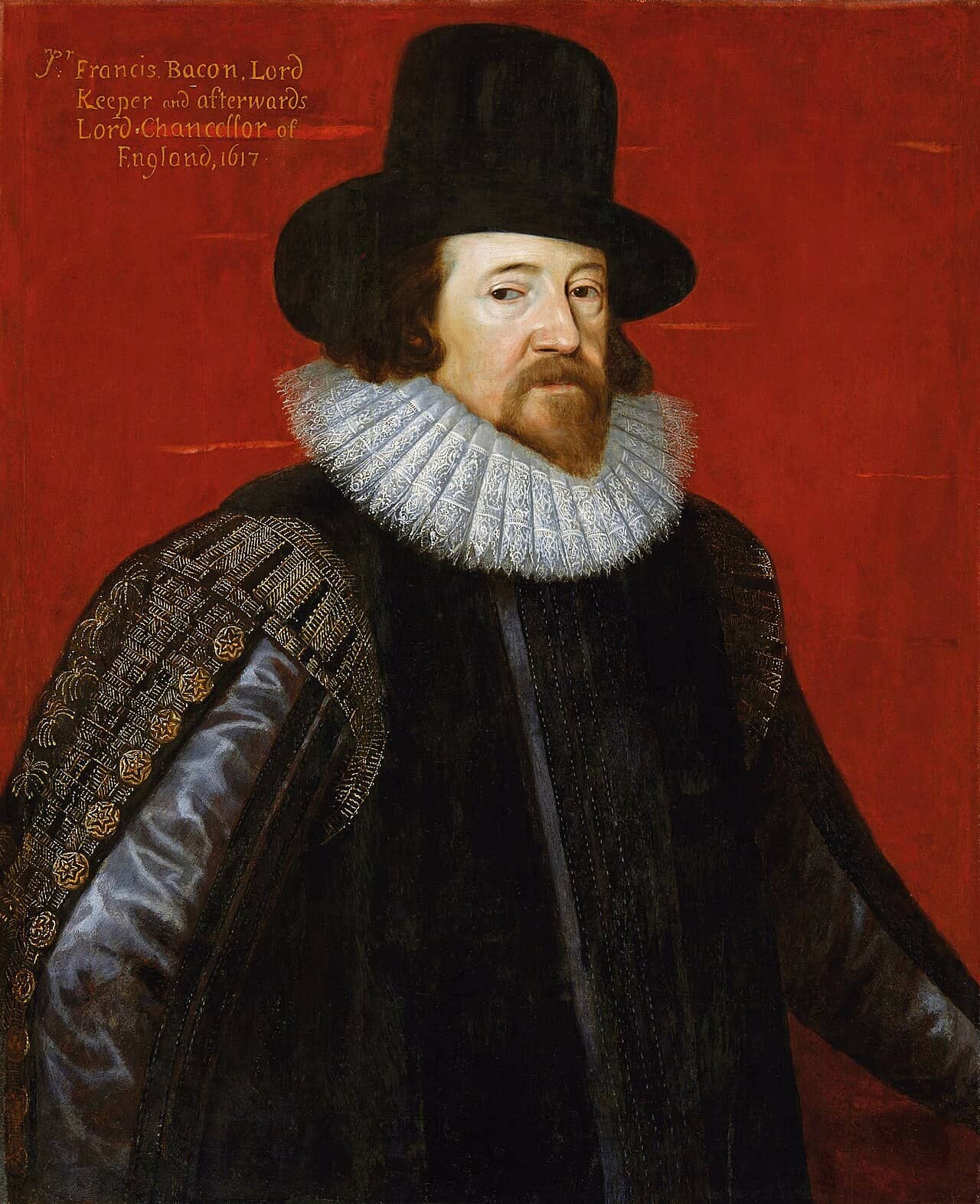
Francis Bacon was born in London on 22 January 1561, the son of Elizabeth I's Lord Keeper of the Great Seal, and spent his life in the pursuit of high office and the pursuit of a philosophical programme that had nothing to do with it. He entered Parliament at twenty-three, was passed over repeatedly under Elizabeth, and rose fast under James I: Attorney General in 1613, Lord Chancellor in 1618, Viscount St Alban in 1621. Weeks after the last of these he was accused of taking bribes from litigants, confessed, was fined forty thousand pounds and briefly imprisoned, and was barred from office for life. He spent his last five years writing. The Advancement of Learning appeared in 1605 and the Novum Organum - the new instrument, meant to replace Aristotle's Organon - in 1620, as part of an unfinished six-part plan called the Instauratio Magna, the Great Renewal. He died on 9 April 1626, reportedly of a chill caught while stuffing a chicken with snow to test whether cold preserved meat, which if true is the only experiment he is known to have performed and the one that killed him. Michael Hart ranked him 90th in The 100.
Influence Meter
76
Measured on a 100-point scale
Wrote the charter of experimental science, and the Royal Society took him at his word
The Four Idols
Book One of the Novum Organum is a catalogue of the ways the mind reliably deceives itself. It is the part of Bacon that has aged best, and it reads like a list of cognitive biases three and a half centuries early.
- Idols of the Tribe: Errors built into human nature itself: we see more order than there is, we notice confirmations and forget the misses, and we let what we wish were true colour what we conclude. Bacon's own example is that people remember the prayers that were answered.
- Idols of the Cave: The private distortions of the individual - training, temperament, a favourite author, the discipline one happens to have studied. Each of us reasons from inside a personal den that shapes the light.
- Idols of the Marketplace: The mischief done by words. Language is fixed by common usage, so it encodes the crude distinctions of ordinary people, and disputes about things turn out to be disputes about terms. Bacon thought this the most troublesome of the four.
- Idols of the Theatre: Whole systems accepted on authority - Aristotelian, Platonic, alchemical - which he called stage plays: coherent, elegant, and representing worlds of their own making rather than the one that exists.
- The remedy: Not cleverness but procedure: deliberately look for the instances that would refute you, record negative results, use instruments to extend the senses, and let many people check each other. Method compensates for minds that cannot be trusted individually.
Bacon's last work, the unfinished New Atlantis published in 1627, describes an imaginary island whose central institution is Salomon's House - a state-funded research establishment with a division of labour among its researchers. Some collect experiments from abroad, some from books; some try new ones, some tabulate results, some draw out general axioms, and some are set to work on practical applications. It has laboratories, botanical gardens, furnaces, engine-houses for testing machines, and instruments for observing the heavens. It is, in outline, a modern research university crossed with a national laboratory, imagined more than three decades before any such thing existed. When the Royal Society was chartered in 1662, its early members - Boyle, Hooke, Sprat, Wilkins - cited Bacon explicitly as their model and New Atlantis as the design. Whatever Bacon failed to discover, he specified the institution that would go on to do the discovering, and it was built.
A Life in Two Halves
Office, Then Philosophy
The books that mattered were written in the gaps between offices, and the greatest concentration of them came after the fall.
Further Reading
By and About Bacon
He also wrote the first essays in English, which are shorter than anything else here and better company.
Legacy
Why Number Ninety
Michael Hart ranked Bacon 90th, and the case for including him at all is that method is transferable in a way that individual discoveries are not. Galileo and Harvey did science before Bacon told anyone how; what Bacon supplied was the argument that it should be systematic, public, cumulative, institutionally supported and directed at the relief of man's estate rather than at contemplation. The Royal Society adopted it as a programme, the French Encyclopédistes dedicated their project to him, and the idea that useful knowledge is produced by organised collective inquiry rather than by individual genius reading old books traces directly to his pages.
The objections are real. His own method, with its tables of presence and absence, is not how science is actually done; he underrated mathematics and hypothesis; and he missed the two greatest scientific developments of his own lifetime. The phrase usually given as knowledge is power is his, and it captures the shift he was arguing for: knowledge justified by what it lets you do. That instrumental view of inquiry, for better and worse, is the one the modern world runs on.
Related Publications