Peter the Great

Peter the Great
Born 9 June 1672 • Died 8 February 1725
The tsar of Russia went to Holland in 1697 under a false name, took lodgings in a shipwright's cottage, and worked for four months as a labourer in the Dutch East India Company's yard at Zaandam and Amsterdam, learning to build ships with his own hands. He was six foot eight and travelling with a suite of two hundred and fifty, so the disguise fooled nobody, but he insisted on it and on doing the work. No other European monarch has done anything remotely like it.
Rank
#88
Influence
79
Field
Tsar and Emperor
Historical Perspective
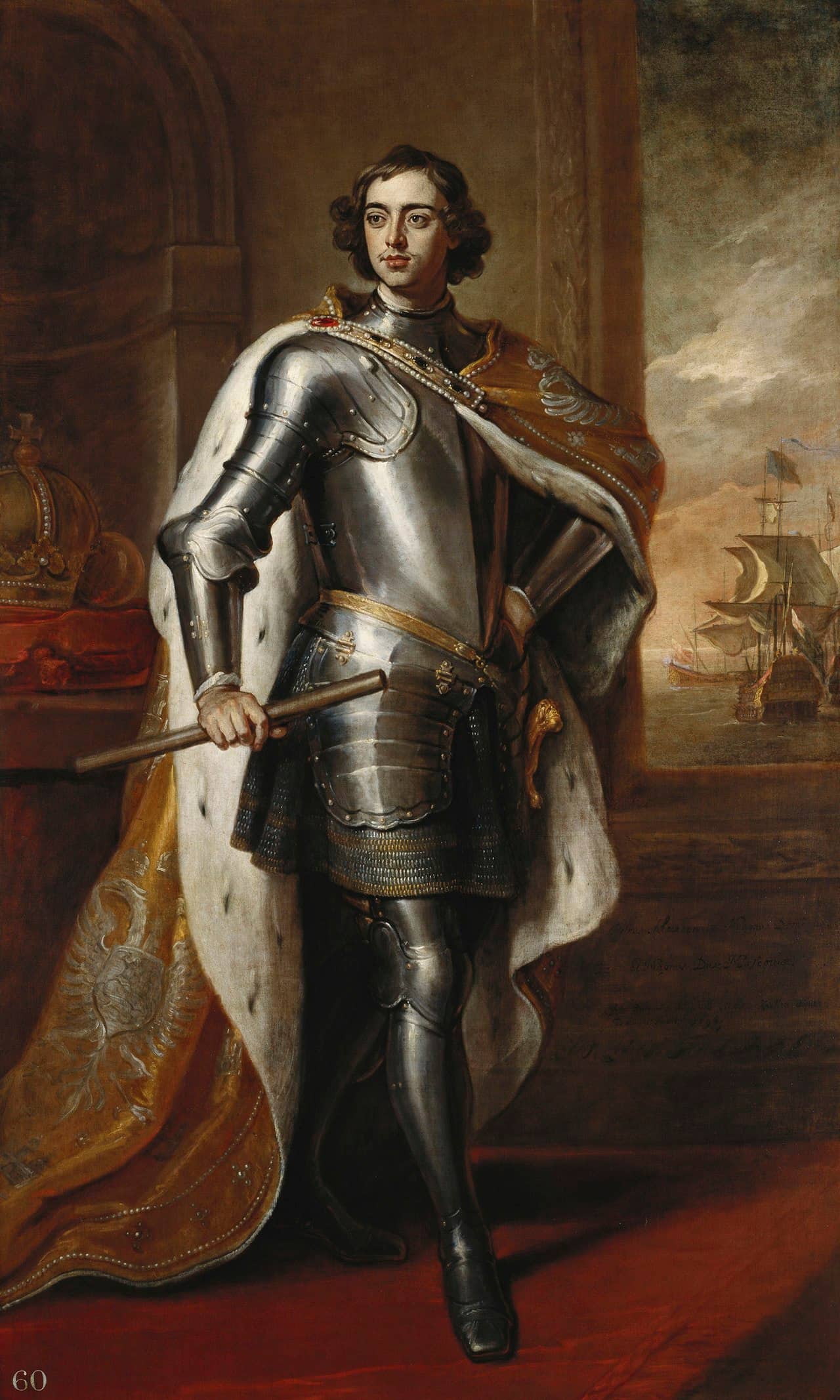
Peter was born in Moscow on 9 June 1672 and came to the throne as a child in a contested succession, spending his early years in a village outside the capital playing at soldiers with a company that became the nucleus of the Russian guards. He took full power in 1689. Russia at that point had no navy, no warm-water port, a church-dominated culture that regarded Western practices with suspicion, and an army that had been beaten repeatedly. In 1697 he set out on the Grand Embassy, the first Russian ruler to leave the country in over a century, and spent eighteen months in Holland, England, Prussia and Austria studying shipbuilding, gunnery, anatomy, printing and manufacturing. He returned in 1698, put down a revolt of the streltsy with mass executions, and began cutting nobles' beards personally. The Great Northern War against Sweden ran from 1700 to 1721 and turned on the victory at Poltava on 8 July 1709. He founded Saint Petersburg on captured Baltic marshland on 27 May 1703 and moved the capital there in 1712. He took the title Emperor in 1721 and died on 8 February 1725. Michael Hart ranked him 88th in The 100.
Influence Meter
79
Measured on a 100-point scale
Turned Russia into a European great power, by force and at enormous cost
What He Changed
Almost everything, and almost all of it by decree, against resistance, and with the state as the instrument.
- A navy from nothing: Russia had essentially no seagoing fleet in 1695 and a substantial Baltic navy within twenty years, built in yards he had studied abroad and partly designed himself.
- The army: Conscription on a systematic basis, European drill and artillery, and a standing force that beat the best army in northern Europe at Poltava - after which Russia was a great power and Sweden was not.
- The Table of Ranks: Introduced in 1722, it graded every military, civil and court post in fourteen parallel ranks and made advancement depend on service rather than birth, with commoners ennobled on reaching a certain grade. It structured Russian society until 1917.
- The church subordinated: On the patriarch's death he simply did not replace him, and in 1721 abolished the office, substituting a Holy Synod of clerics under a lay official appointed by the tsar. The Orthodox Church became a department of state.
- Beards, dress and the calendar: Nobles were required to shave or pay a tax and carry a token, to wear Western clothing, and to allow women into mixed social gatherings. The year 1700 was made to begin in January rather than September.
- Education and the Academy: Compulsory schooling for the nobility, technical and navigation schools, a simplified alphabet, the first Russian newspaper, and the Academy of Sciences chartered in 1724.
Saint Petersburg was founded on 27 May 1703 on marshy, flood-prone ground at the mouth of the Neva that Peter had just captured from Sweden and did not yet securely hold. It was built by conscripted labourers - peasants, soldiers, Swedish prisoners - working in conditions that killed them in numbers nobody recorded; contemporary estimates ran to a hundred thousand dead, and modern historians regard that as too high while accepting the toll was severe. Stone construction was banned everywhere else in Russia so that masons would have to come. Nobles were ordered to build houses there at their own expense and to live in them. The capital moved from Moscow in 1712, and the city became the seat of Russian government for two hundred years - a deliberately European city, laid out on a grid with canals and Italian architects, facing west, which is precisely what it was for. Pushkin called it a window cut through to Europe.
1718
The Son
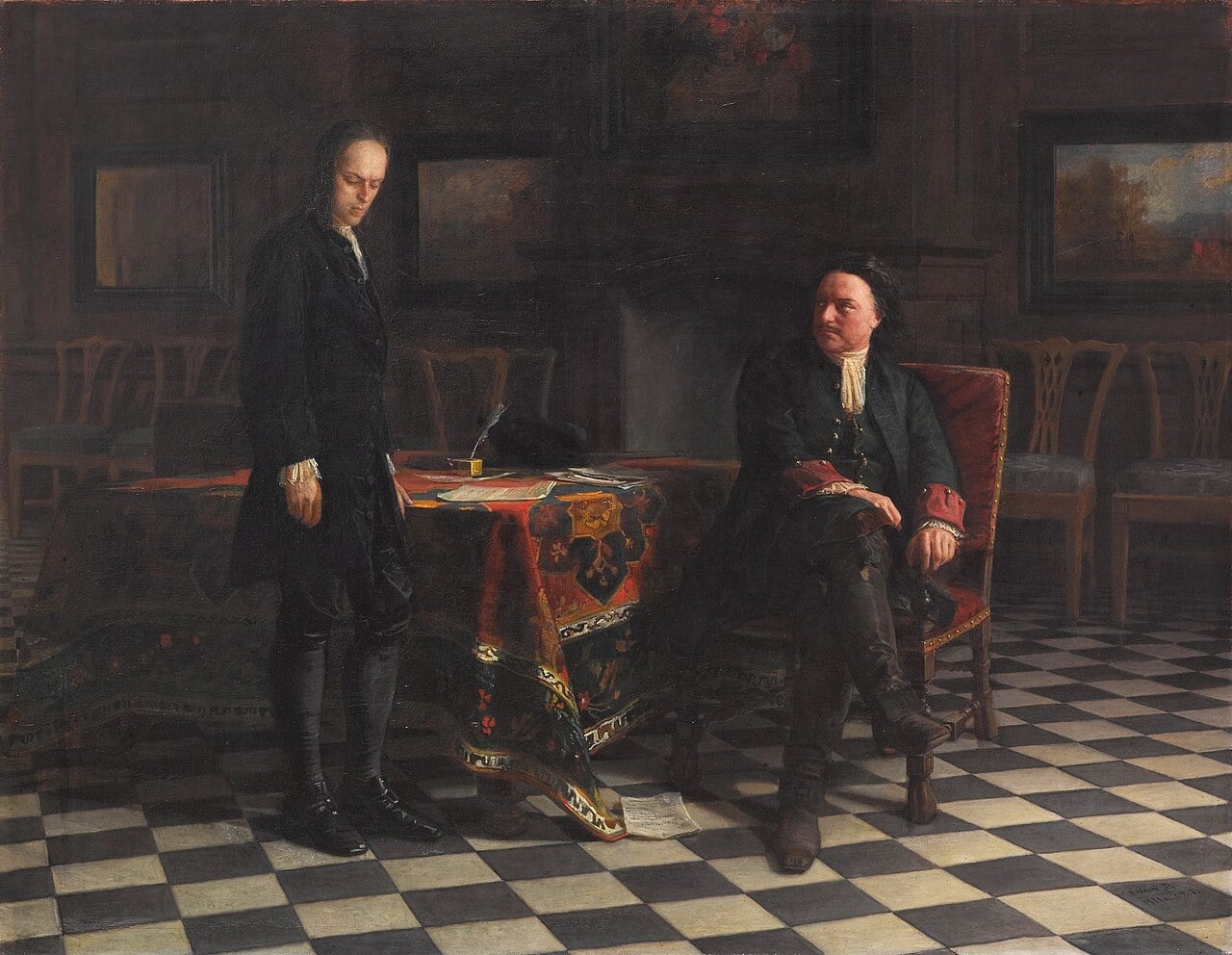
Peter's eldest son Alexei, born of a first marriage Peter had ended by confining his wife to a convent, was pious, unmilitary and closely associated with the traditionalist opposition to everything his father was doing. In 1716 he fled abroad; Peter had him lured back with promises of pardon, then had him interrogated. Alexei was tortured with the knout - the accounts are explicit that Peter was present - confessed to a conspiracy, was condemned to death by a court of officials who understood what was required, and died in the Peter and Paul Fortress on 26 June 1718, two days after sentence and before any execution, almost certainly from the beatings. The episode is not a footnote to the reforms; it is the clearest illustration of them. Peter's Russia was modernised by a state that would use any degree of force against anyone, including the tsar's own heir, and that pattern outlived him by a very long way.
Further Reading
Books About Peter
The debate about whether he saved Russia or deformed it has been running among Russian intellectuals since the nineteenth century and is not over.
Legacy
Why Number Eighty-Eight
Michael Hart ranked Peter 88th, and the case is that he converted a peripheral, inward-facing state into a European great power within a single reign, and that Russia has been a major factor in world affairs continuously since. Poltava in 1709 removed Sweden from the ranks of the powers and installed Russia in its place; the Baltic ports, the navy, the army and the administrative machinery he built are what made possible everything from Catherine's expansion to the defeat of Napoleon to the Soviet Union.
The costs are the other half. He did nothing to reduce serfdom and a great deal to deepen it, since the labour for his projects and the recruits for his army came from it; taxation roughly trebled; and the westernisation applied to the nobility and not to the peasantry, opening a cultural gulf between the classes that lasted until 1917. The pattern he established - modernisation imposed from above by a state that treats its own population as a resource - recurs unmistakably under Stalin, and Russian thinkers from the Slavophiles onward have argued about whether he rescued the country or broke something in it. Both readings have a great deal of evidence.
Related Publications