Mencius

Mencius
Born c. 372 BCE • Died c. 289 BCE
Anyone who suddenly sees a child about to fall into a well, Mencius says, feels alarm and distress - not because he knows the parents, not to earn a reputation, not because he dislikes the noise, but immediately and before any calculation. From that one observation he built an entire moral psychology: the impulse is already there in everybody, and the work of ethics is to grow it rather than to install it.
Rank
#92
Influence
74
Field
Philosopher
Historical Perspective
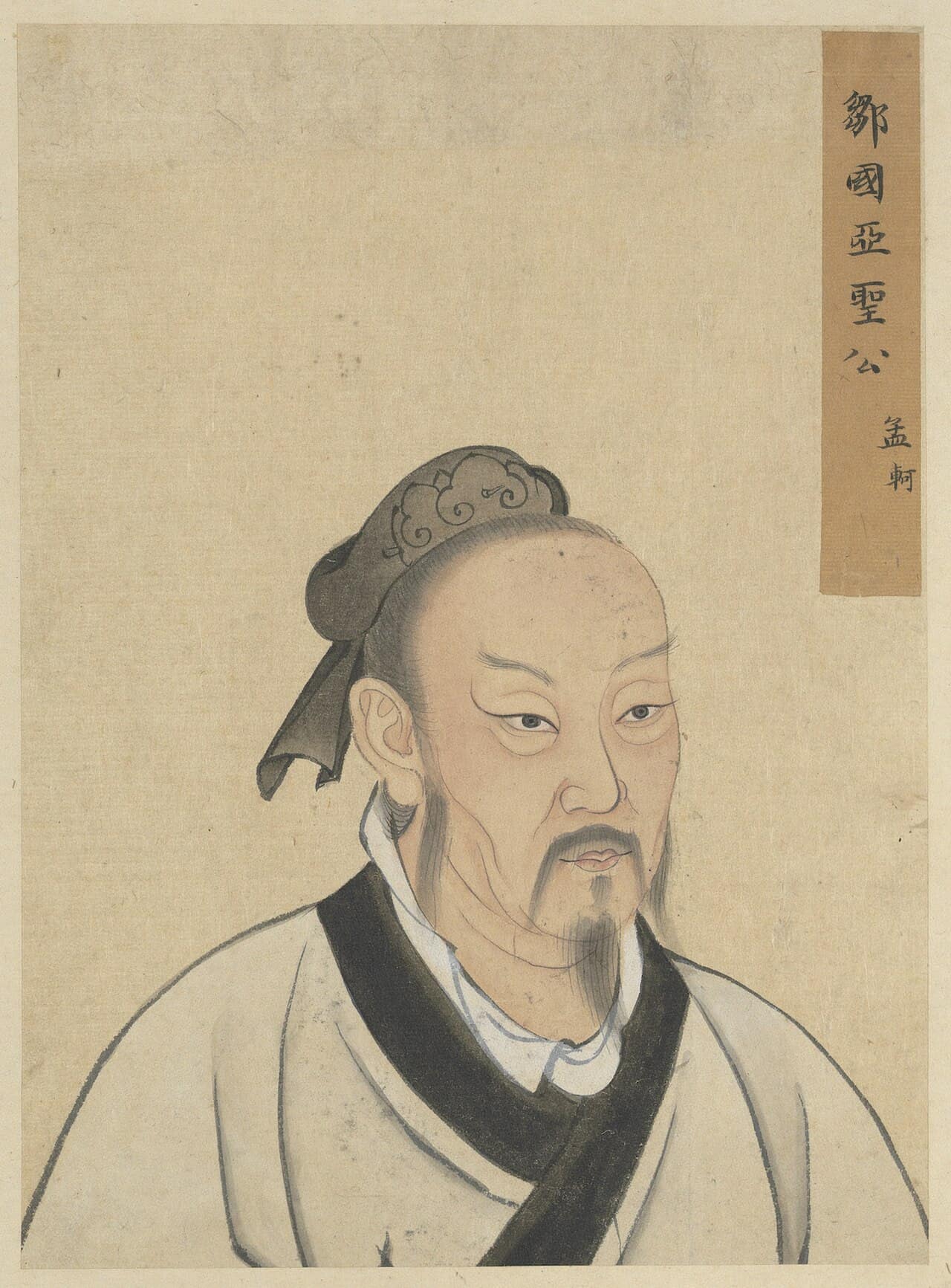
Mencius - the Latinised form of Mengzi, Master Meng - was born around 372 BCE in the small state of Zou in what is now Shandong, close to Confucius's own birthplace and about a century after his death. Tradition holds that he was raised by a widowed mother who moved house three times to find surroundings that would form him well, a story every Chinese schoolchild still learns. He studied in the Confucian line said to run through Confucius's grandson Zisi, and spent decades travelling between the courts of the Warring States - Qi, Liang, Teng - trying to persuade rulers to govern benevolently at a time when every one of them was preoccupied with survival and conquest. None of them took the advice. He retired to teaching, and the seven books of the Mencius, recording his conversations and arguments, were compiled by him or his disciples. He died around 289 BCE. Roughly fourteen centuries later, Zhu Xi placed the Mencius among the Four Books at the centre of the Neo-Confucian curriculum, which is how a set of rejected policy proposals became required reading for the government of China. Michael Hart ranked him 92nd in The 100.
Influence Meter
74
Measured on a 100-point scale
Gave Confucianism its theory of human nature and its argument for rule by consent
The Arguments
Five Positions Worth Knowing
Mencius argues rather than pronounces - he is one of the earliest Chinese thinkers who can be seen constructing a case against a named opponent and answering objections.
Human nature is good
Everyone has four beginnings: compassion, shame, deference and a sense of right and wrong. They are sprouts, not achievements - real but small, and they grow or wither depending on circumstance and cultivation. His opponent Xunzi took the opposite view, that nature is bad and morality is imposed by training, and the argument between them ran for two thousand years.
- Image: Sprouts, not seeds sown
The people come first
In his own ordering, the people are the most important element in a state, the altars of grain and land come next, and the ruler is the least important. It is the most quoted sentence in the book and the most subversive.
- Order: People, state, ruler
A tyrant may be removed
Asked whether it was regicide when King Wu killed the last Shang king, Mencius answered that he had heard of the execution of a mere fellow, not the killing of a sovereign. A ruler who robs and injures his people has ceased to be a ruler. This is a right of rebellion, stated plainly, in the fourth century BCE.
- Doctrine: Loss of the Mandate of Heaven
Benevolent government is practical
His advice to rulers is unexpectedly concrete: light taxes, secure land tenure so a family knows what it will hold, no conscription during planting and harvest, relief granaries, and schools. His point was that a population with a settled livelihood can be governed and one without it cannot.
- Test: Does the old man have silk and meat?
Cultivate the flood-like qi
A moral energy accumulated by repeated right action, which cannot be seized by a single grand gesture. He mocks the farmer of Song who pulled at his shoots to help them grow and killed the crop - a warning about forcing moral progress that became a Chinese proverb.
- Proverb: Pulling up the shoots
The Mencius spent its first thousand years as one respected text among many. Its promotion came in the twelfth century CE, when Zhu Xi selected four short works - the Analects, the Mencius, the Great Learning and the Doctrine of the Mean - as the core of Confucian education, ahead of the older and longer Five Classics, and wrote the commentaries that fixed how they were to be read. From 1313 until the abolition of the examinations in 1905, the imperial civil service examinations were based on the Four Books in Zhu Xi's interpretation. That means that for very nearly six hundred years, every man who held office in the largest bureaucracy on earth - and every one of the far greater number who tried and failed - had memorised the Mencius, including the passages saying that the people matter more than the ruler and that a tyrant may be removed. It is difficult to think of another case of a specific philosophical text being installed so directly at the centre of a state's selection of its officials for so long.
Further Reading
Reading Mencius
The book is short, conversational and frequently funny, and reads far more easily than its reputation as a classic suggests.
Legacy
Why Number Ninety-Two
Michael Hart ranked Mencius 92nd, far below Confucius at fifth, on the reasonable ground that he was elaborating a tradition rather than founding one. But the elaboration decided what the tradition became. Confucius said very little about human nature; Mencius supplied the answer that Neo-Confucianism adopted, and through the examination system that answer became the default assumption about people held by the educated classes of China, Korea, Japan and Vietnam for centuries - that people are improvable by education, and that a government's job is to create the conditions in which they improve.
The political doctrine travelled with it. The idea that heaven's mandate is conditional on a ruler's conduct, and that the people's welfare is the test, gave East Asian political thought a principled basis for judging governments that did not depend on any notion of individual rights. It was cited by rebels and by reformers, it made some emperors uneasy enough that the Ming founder had passages deleted from the examination edition, and it is still the reference point when Chinese writers argue about the legitimacy of power. For a man whose actual policy advice was rejected by every ruler he met, that is a considerable afterlife.
Related Publications