Henry Ford

Henry Ford
Born 30 July 1863 • Died 7 April 1947
In 1908 a Model T cost 850 dollars, which was roughly two years of an average worker's wages. In 1925 it cost 260 dollars, which was about three months. Nothing about the car had got more expensive to make; the price fell because Ford kept finding ways to build it faster, and he passed the savings on rather than taking them as margin. That is the whole industrial revolution of the twentieth century compressed into one product line.
Rank
#91
Influence
78
Field
Industrialist
Historical Perspective
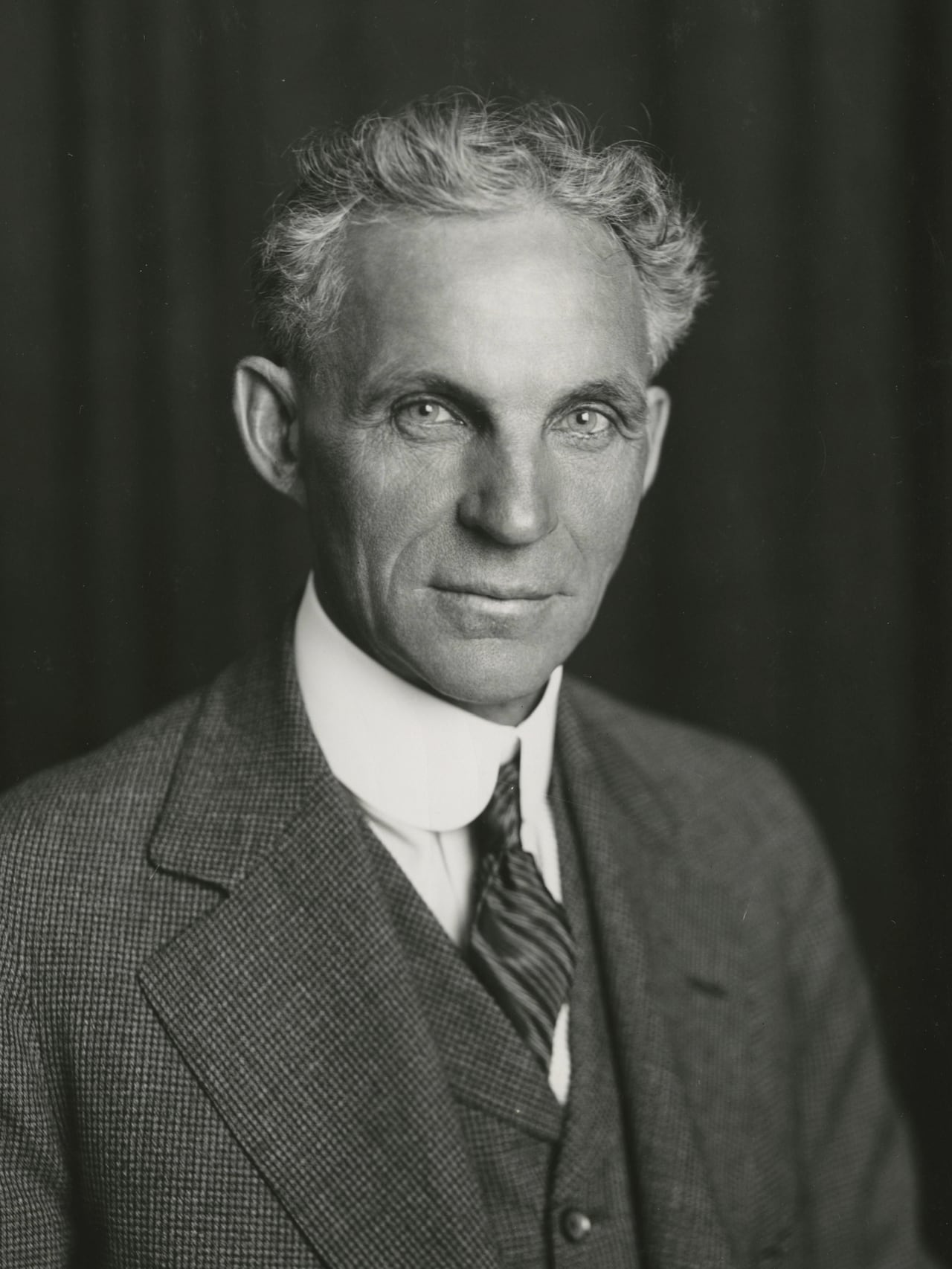
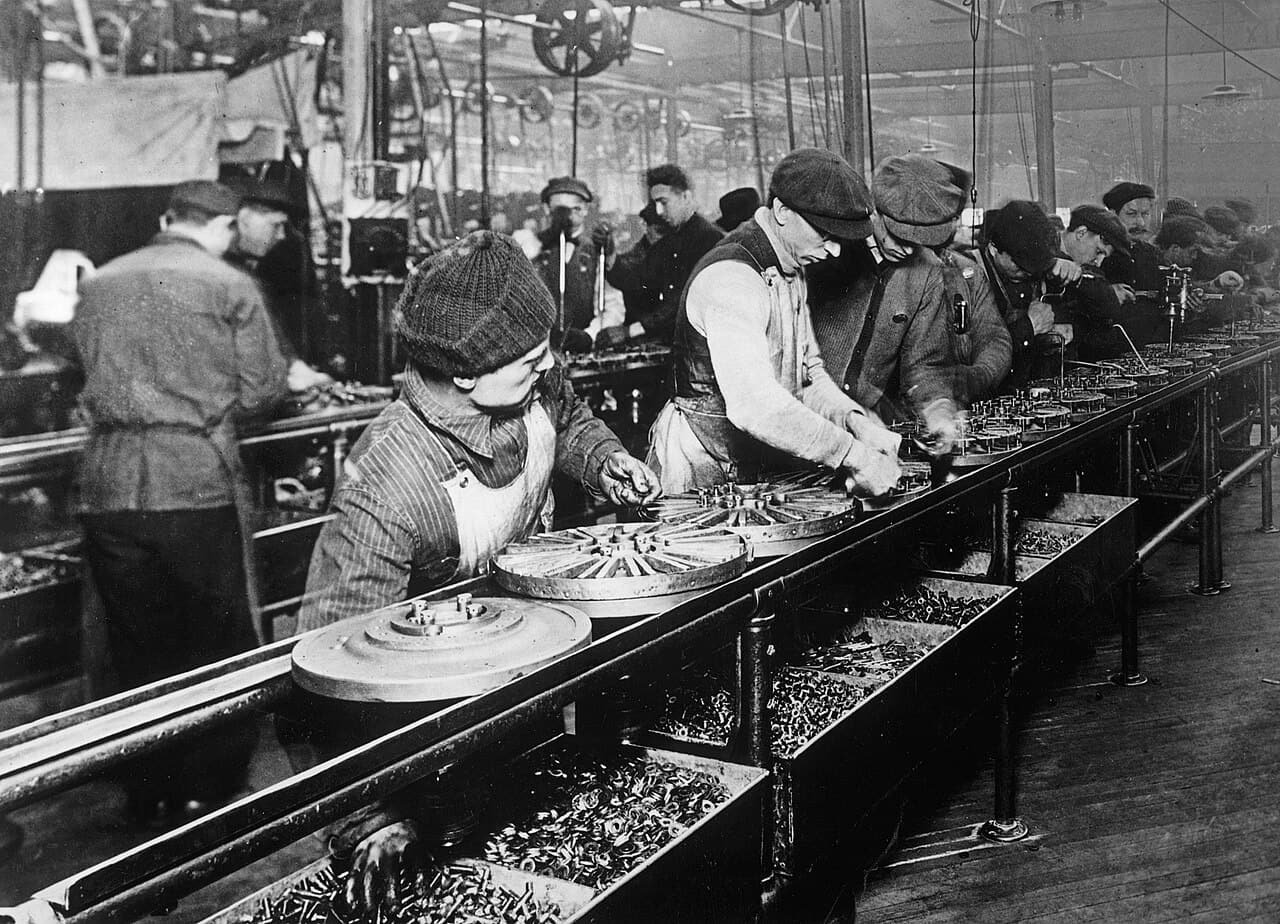
Henry Ford was born on a Michigan farm on 30 July 1863, disliked farming, and left at sixteen to work as a machinist in Detroit. He was chief engineer at the Edison Illuminating Company when he built his first vehicle, the Quadricycle, in 1896. Two early car companies failed before the Ford Motor Company was founded in 1903. The Model T was introduced on 1 October 1908, deliberately designed to be simple, durable, easily repaired and cheap. The moving assembly line was installed at Highland Park in 1913 and cut the time to assemble a chassis from around twelve and a half hours to about ninety-three minutes. On 5 January 1914 Ford announced a wage of five dollars a day, roughly double the going rate, together with an eight-hour shift. By 1925 a Model T left the line every twenty-four seconds. Production ended in 1927 after just over fifteen million cars. He died on 7 April 1947. Michael Hart ranked him 91st in The 100.
Influence Meter
78
Measured on a 100-point scale
Made mass production and mass consumption into one system, and put the world on wheels
The Numbers
What the Assembly Line Did to a Price
Prices are for the touring car and vary slightly by source and by year within the model year; the trajectory is not in dispute.
| 1909 | $850 | About 10,000 | First full year of production, built in batches at Piquette Avenue |
| 1912 | $600 | About 78,000 | Static assembly, moved to Highland Park |
| 1914 | $490 | About 308,000 | First full year of the moving line; the five-dollar day begins |
| 1916 | $360 | About 585,000 | Ford now building roughly half the cars in America |
| 1920 | $395 | About 1,250,000 | Post-war inflation nudges the price back up briefly |
| 1925 | $260 | About 1,900,000 | The cheapest it ever was; one car every 24 seconds |
Sources: Ford Motor Company production records and the Benson Ford Research Center.
1914
The Five-Dollar Day
The wage announcement is remembered as philanthropy and was nothing of the kind. The moving line had made the work so monotonous that Ford's annual labour turnover reached something like three hundred and eighty per cent - he was hiring more than fifty thousand people a year to keep about fourteen thousand jobs filled, and training every one of them. Doubling the wage stopped that almost immediately, and the savings in hiring and training more than covered the cost. What made it historically important was the second-order effect nobody had planned: a worker on five dollars a day could buy the car he was building. Ford said as much afterwards, and the idea that mass production requires mass purchasing power - that wages are demand as well as cost - became one of the organising assumptions of the twentieth-century economy. The conditions attached were less admired. Eligibility was policed by a Sociological Department whose inspectors visited employees' homes to check on drinking, thrift, cleanliness and family arrangements, and the payment could be withheld from those who failed.
From 1920 Ford's own newspaper, the Dearborn Independent, ran a sustained antisemitic campaign, publishing ninety-one articles later collected as The International Jew and serialising the fabricated Protocols of the Elders of Zion, which had already been exposed as a forgery by The Times of London in 1921. Dealers were required to distribute the paper with the cars. The material was translated widely; Hitler kept a portrait of Ford in his office in Munich, praised him by name in Mein Kampf, and Ford accepted the Grand Cross of the German Eagle from the Nazi government in 1938. A libel suit forced a retraction in 1927 which Ford's associates drafted and which he claimed not to have read, and the campaign stopped, but he never disowned the content in any convincing way. This is not a footnote to be balanced against the assembly line. It is a separate fact about the same man, and it did measurable harm at a moment when that particular propaganda was doing the most damage it has ever done.
Further Reading
Books About Ford
The best of these treat the manufacturing genius and the bigotry as belonging to one person rather than choosing a side.
Legacy
Why Number Ninety-One
Michael Hart ranked Ford 91st for the system rather than the car. Interchangeable parts existed before him, and so did moving lines in meatpacking; his contribution was to combine them at scale with a single unvarying product and a deliberately low price, and to demonstrate that the resulting volume made everyone in the chain richer. The word Fordism entered several languages, and admirers included Lenin and Stalin, who imported Ford engineers and equipment to build the Soviet automobile industry.
The physical consequences are still around us. Cheap cars produced suburbs, road networks, motels, supermarkets, commuting and a settlement pattern across North America and much of the world that is organised around private vehicles - along with the fuel consumption and emissions that came with it. Ford himself was outmanoeuvred commercially by General Motors, which offered colours, credit and annual model changes while he insisted on one car; and his particular production system was superseded from the 1950s by the Toyota approach, which valued flexibility over sheer volume. Both of those were arguments about how to do the thing he had established that anyone could do at all.
Related Publications