George Washington

George Washington
Born 22 February 1732 • Died 14 December 1799
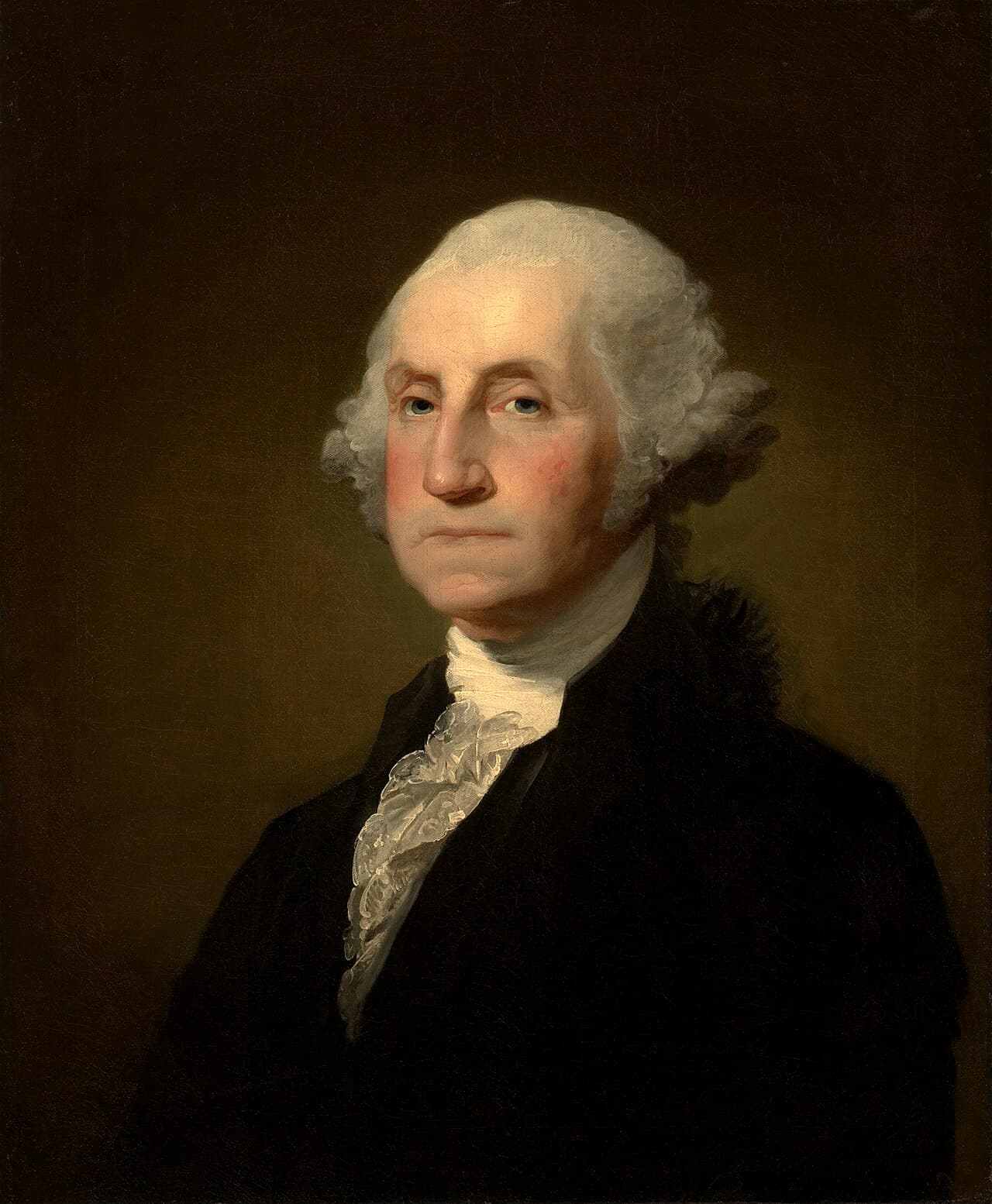
George Washington (1732-1799) lost more battles than he won. He was not the finest strategist of the Revolution, nor its best political thinker, nor its most gifted writer. What he possessed was the ability to keep an unpaid, underfed, disintegrating army in the field for eight years, and a quality far rarer than generalship: when the war ended and he could have taken the country, he handed his commission back to Congress and went home. Told that Washington intended to do exactly that, George III reportedly said that if he did, he would be the greatest man in the world.
Rank
#26
Influence
83
Field
General and Statesman
Historical Perspective
George Washington was born on 22 February 1732 in Westmoreland County, Virginia, into the lower ranks of the planter gentry. His father died when he was eleven, cutting off any prospect of an English education; he trained instead as a surveyor, and inherited Mount Vernon in 1761. His early military career was not distinguished - he began the French and Indian War by ambushing a French party at Jumonville Glen in 1754 and was forced to surrender at Fort Necessity that July - but he acquired a reputation for physical courage, having two horses shot from under him at the Monongahela in 1755. Appointed commander of the Continental Army on 15 June 1775, he spent eight years losing New York, holding the army together through Valley Forge, and waiting for the opening that came at Yorktown in 1781. He resigned his commission on 23 December 1783, presided over the Constitutional Convention in 1787, was elected first President unanimously and inaugurated on 30 April 1789, and left office after two terms in 1797. Michael Hart ranked him 26th in The 100.
Influence Meter
83
Measured on a 100-point scale
Won a republic, and then twice refused to keep it for himself
1749-1775
A Surveyor Who Wanted a Commission
Washington's first profession was surveying, which in colonial Virginia was less a technical trade than a route to land, and land was the route to standing. He surveyed the Shenandoah at sixteen and bought western tracts with the proceeds. At twenty-one he was sent by the governor of Virginia to warn the French out of the Ohio Country; the following year he was back with troops, and the skirmish he fought at Jumonville Glen in May 1754 helped ignite a war that spread to Europe and became the Seven Years' War. He surrendered Fort Necessity that July, on his twenty-second birthday's eve, having signed a French document he could not read admitting the assassination of an officer.
He spent the next four years commanding the Virginia Regiment on a brutal frontier, repeatedly petitioning for a regular British commission and repeatedly refused - colonial officers ranked below regulars of any grade, a humiliation he never forgot and which shaped his view of imperial condescension. He resigned in 1758, married the widow Martha Dandridge Custis in January 1759, and settled into two decades as a Virginia planter, magistrate and member of the House of Burgesses, expanding Mount Vernon to some 6,500 acres worked by an enslaved population that passed a hundred before the Revolution began.
1775-1777
Commanding an Army That Kept Dissolving
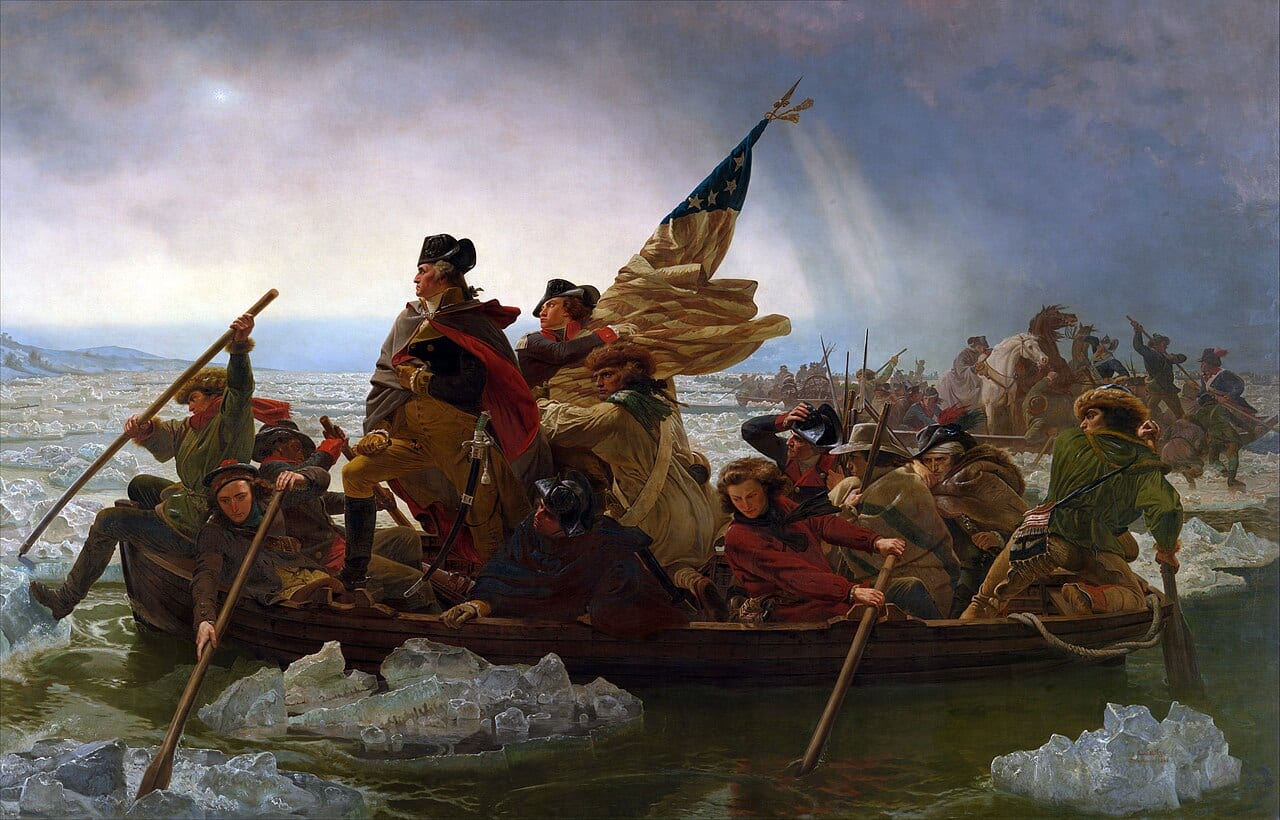
Washington was chosen to command in June 1775 for reasons that were as much political as military: he was a Virginian, and a war begun in Massachusetts needed the southern colonies bound into it. He arrived to find an army of short-enlistment militia with no supply system, no uniforms and, at points, almost no gunpowder. He forced the British out of Boston in March 1776 by hauling captured cannon three hundred miles from Ticonderoga, then lost New York comprehensively across the second half of that year and retreated across New Jersey with an army melting away as enlistments expired. On the night of 25 December 1776 he crossed the ice-choked Delaware and took the Hessian garrison at Trenton, following it with Princeton a week later. Militarily these were small actions. Politically they were the difference between a rebellion and a collapse.
Washington's essential achievement was not a victory but a refusal to be finished. He fought roughly nine major engagements and lost most of them - Long Island, Brandywine, Germantown, White Plains - and at several points had fewer than five thousand effective troops. His strategy, learned the hard way after New York, was to preserve the army rather than the ground: as long as a Continental force existed in the field, the British had not won, whatever territory they held. It is a strategy that requires a commander willing to be thought a coward and to be criticised in Congress for inaction, and it is the reason the Revolution outlasted eight years of occupation of every major American port.
Winter 1777-1778
Valley Forge
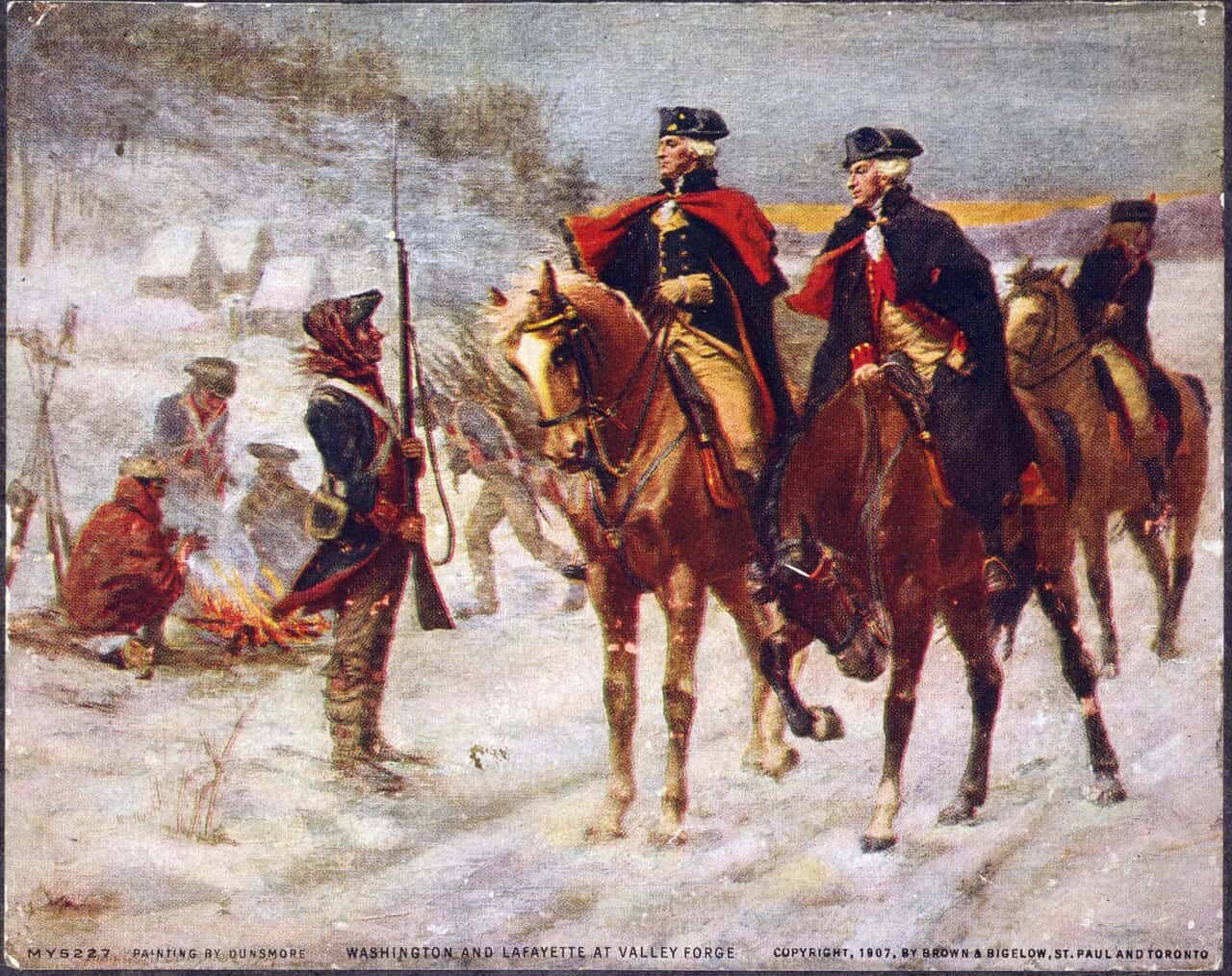
The encampment at Valley Forge has become shorthand for endurance, and the reality was worse than the shorthand: some two thousand men died of disease, exposure and malnutrition over the winter while Congress failed to supply an army twenty miles from the comfortable British occupation of Philadelphia. Men without shoes left blood on the frozen ground. What makes the episode significant rather than merely grim is what came out of it. The Prussian officer Friedrich Wilhelm von Steuben arrived in February 1778 and drilled the army into something that could manoeuvre and hold a line under fire, writing the drill manual the United States Army used for decades. The force that emerged in the spring fought the British to a standstill at Monmouth in June. Meanwhile the French, persuaded by the American victory at Saratoga, entered the war - which is ultimately what made Yorktown possible.
The War
Eight Years, In Order
A record with more defeats than victories, which is the wrong measure for the war he was actually fighting.
Siege of Boston
Cannon dragged from Fort Ticonderoga were placed on Dorchester Heights overnight, making the British position untenable. They evacuated on 17 March 1776 without a battle.
- Outcome: Victory, bloodless
New York campaign
A comprehensive defeat. Washington lost Long Island, Manhattan and Fort Washington, along with nearly three thousand prisoners, and retreated across New Jersey with the army near collapse.
- Outcome: Severe defeat
Trenton and Princeton
The Delaware crossing and two sharp winter victories that restored enlistments, credit and morale at the moment the cause looked lost.
- Outcome: Decisive politically
Brandywine and Germantown
Two defeats that cost Philadelphia, the rebel capital. Congress fled; Washington kept the army intact and withdrew to winter quarters.
- Outcome: Defeat, army preserved
Valley Forge
Not a battle but the turning point: von Steuben's training, the French alliance, and roughly two thousand dead of disease and cold.
- Outcome: Army rebuilt
Monmouth
An inconclusive engagement in brutal heat, notable because the Continentals stood and manoeuvred against British regulars for the first time.
- Outcome: Draw, proof of competence
Yorktown
Washington marched his army and Rochambeau's French troops four hundred miles south while the French fleet sealed the Chesapeake, trapping Cornwallis. His surrender on 19 October effectively ended the war.
- Outcome: Decisive victory
Chronology
Up, and Deliberately Down Again
Drawn as an arc, because the shape of the career is a rise to supreme power followed twice by a voluntary descent from it.
23 December 1783
The Most Important Thing He Ever Did
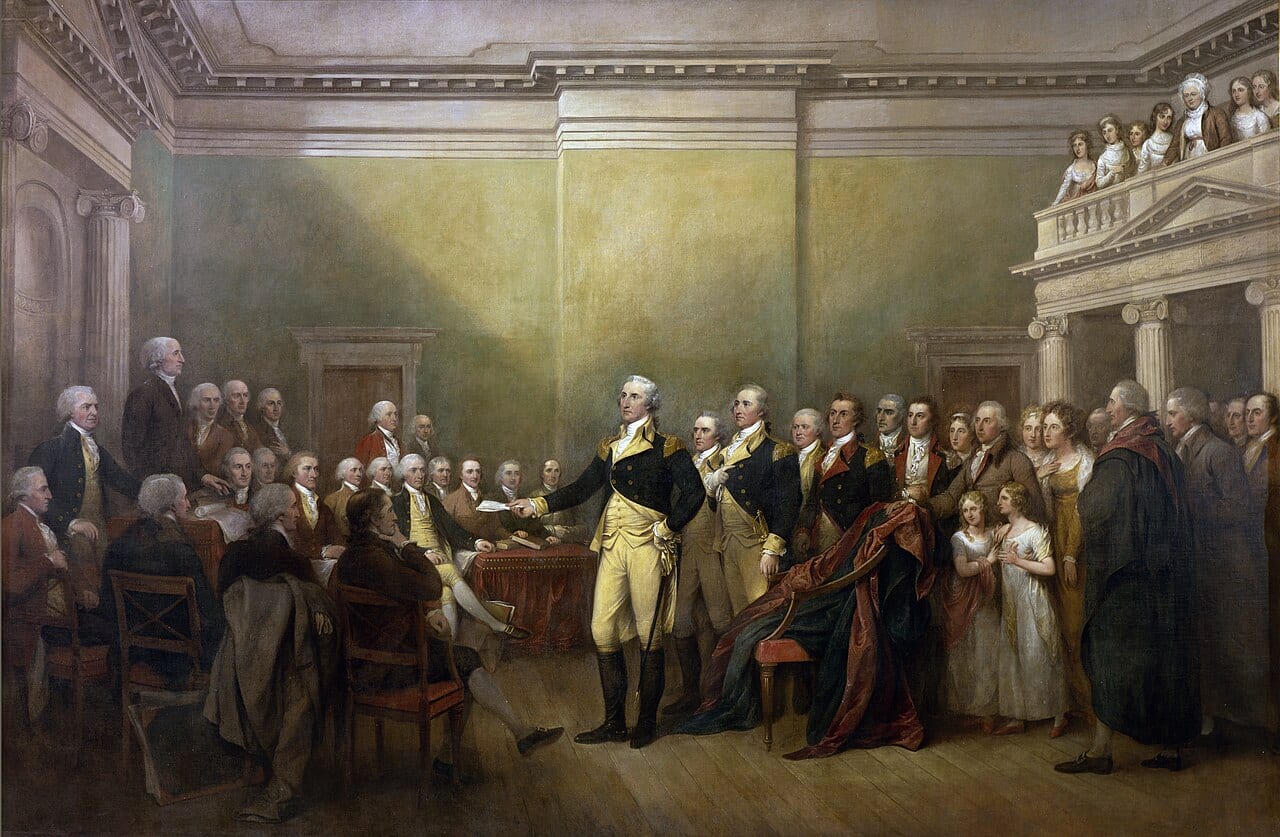
In March 1783, with the war effectively over and the army unpaid, officers at Newburgh circulated an anonymous address proposing to march on Congress. Washington appeared unannounced at their meeting, spoke, and then fumbled for his spectacles, remarking that he had grown grey and now nearly blind in the service of his country. Officers wept; the conspiracy dissolved. Nine months later, on 23 December, he stood before Congress at Annapolis and formally returned his commission, resigning as commander-in-chief to become a private citizen. There was no modern precedent. Every comparable figure in living memory - Caesar, Cromwell, and shortly afterwards Napoleon - had converted military success into personal rule. When Benjamin West told George III that Washington intended to resign and return to his farm, the king is said to have replied that if he did so he would be the greatest man in the world. He then did it a second time, leaving the presidency in 1797 when he could plainly have held it for life, and thereby inventing the peaceful transfer of executive power.
The Precedents He Set on Purpose
Washington understood that a first president does not merely govern but defines the office, and he said so repeatedly - that he walked on untrodden ground, and that there was scarcely an action which might not be drawn into precedent.
- Two terms, then leave: Nothing in the Constitution limited him. He stepped down in 1797 anyway, and the custom held for 144 years until Franklin Roosevelt broke it, after which it was written into the Twenty-Second Amendment.
- Mr President, not Your Highness: The Senate proposed elaborate titles. Washington accepted the plainest one on offer, fixing the republican tone of the office.
- A cabinet of rivals: He kept Hamilton and Jefferson in the same government despite their loathing for each other, and created the cabinet as an institution though the Constitution barely mentions it.
- Civilian control of the army: By resigning in 1783 and by personally leading troops against the Whiskey Rebellion in 1794 only under civil authority, he established that the military answers to the government.
- Neutrality and no permanent alliances: His 1793 neutrality proclamation and the 1796 Farewell Address warned against entangling foreign attachments and against the spirit of party, shaping American foreign policy for a century.
- The office outranks the man: The cumulative precedent, and the one that mattered: that power in the republic is lent to a temporary occupant, not held.
Mount Vernon
The Part That Does Not Reconcile
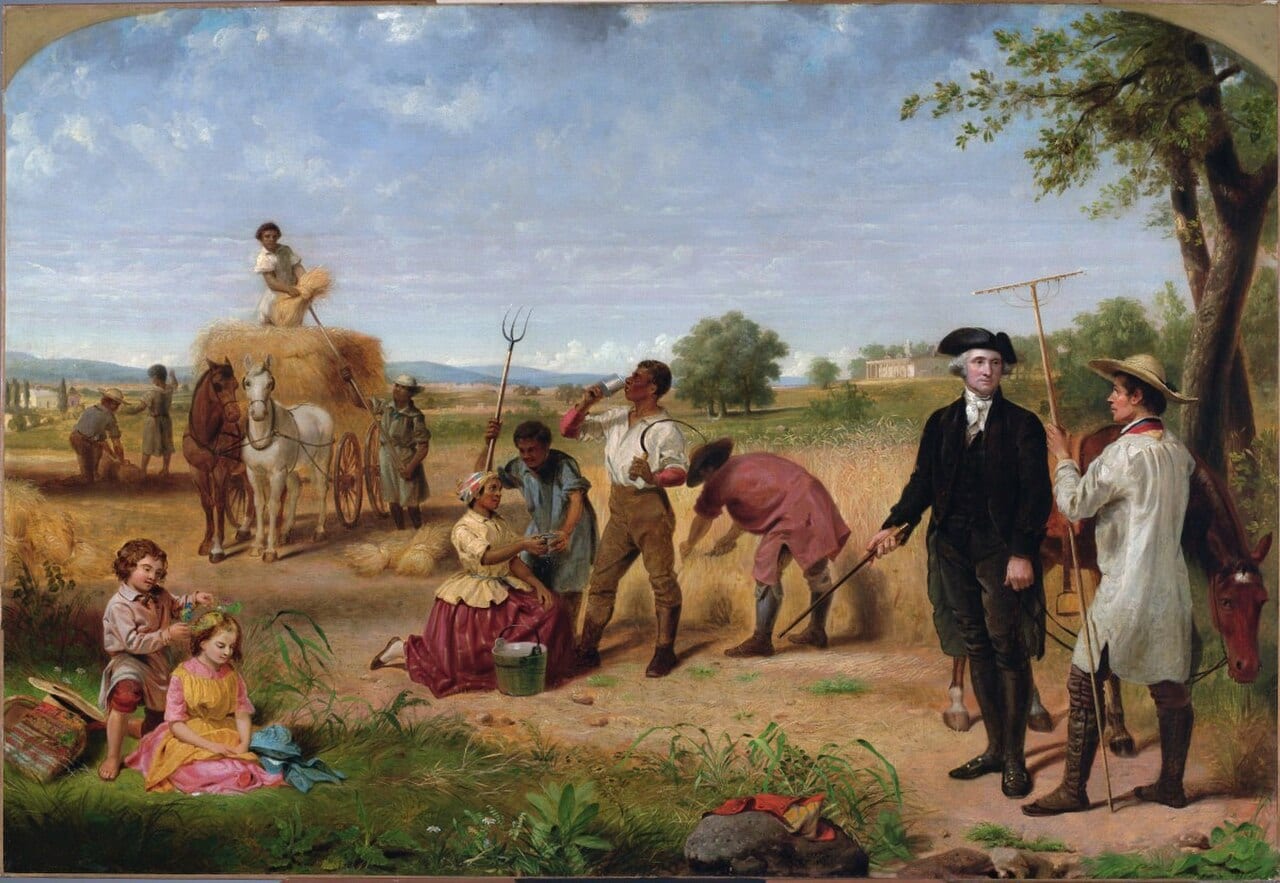
Washington held people in slavery from the age of eleven, when he inherited ten of them, until his death. By 1799 there were 317 enslaved people at Mount Vernon, 123 of them his outright and most of the remainder dower slaves belonging to the Custis estate whom he had no legal power to free. He pursued at least one escapee, Ona Judge, who fled to New Hampshire in 1796, using federal officials in the attempt; she was never recaptured and lived free. His private views moved: he wrote in 1786 that he wished to see a plan adopted for the abolition of slavery, he never publicly opposed it, and he took no political action against it while holding the only office that might have mattered. His will directed that the 123 people he owned be freed on Martha's death - she freed them a year after his - and provided for the aged and for the education of the young. He was the only slaveholding founder to free his slaves. That is both the most that can be said and considerably less than the man was capable of.
Further Reading
Books About Washington
He published almost nothing but the Farewell Address; the record is his letters, his diaries, and two centuries of biography.
Legacy
Why Number Twenty-Six
Michael Hart ranked Washington 26th, and the case does not rest on generalship. As a battlefield commander he was competent rather than brilliant, and the decisive victory at Yorktown depended on a French fleet he did not control. The case rests on the two moments when he declined power that was available to him, and on the fact that the American republic - the model that constitutional governments across the world subsequently imitated - required someone at its head who would let go. That the first occupant of the office set the precedent of leaving it is the reason the office survived.
The comparison that makes the point is Napoleon, who took command of a revolution fifteen years later and crowned himself emperor, or the succession of Latin American liberators who freed their countries and then governed them for life. Simon Bolivar admired Washington precisely for the thing he could not himself manage. What Washington contributed was not an idea - Jefferson and Madison supplied those - but a demonstration that the idea could be inhabited by a person, once, at the start, when it might have gone the other way and nobody could yet have stopped him.
Related Publications