Martin Luther

Martin Luther
Born 10 November 1483 • Died 18 February 1546
Martin Luther (1483-1546) meant to start an academic debate about a fundraising practice. He was a professor at a small new university in an unimportant Saxon town, and the document he produced in 1517 was written in Latin for other theologians. Within two months it was circulating in German across the Empire; within four years he had been excommunicated, outlawed, and hidden in a castle by a prince who did not much care about theology but did care about Rome taking German money. The Church of the West has been divided ever since.
Rank
#25
Influence
88
Field
Theologian and Reformer
Historical Perspective
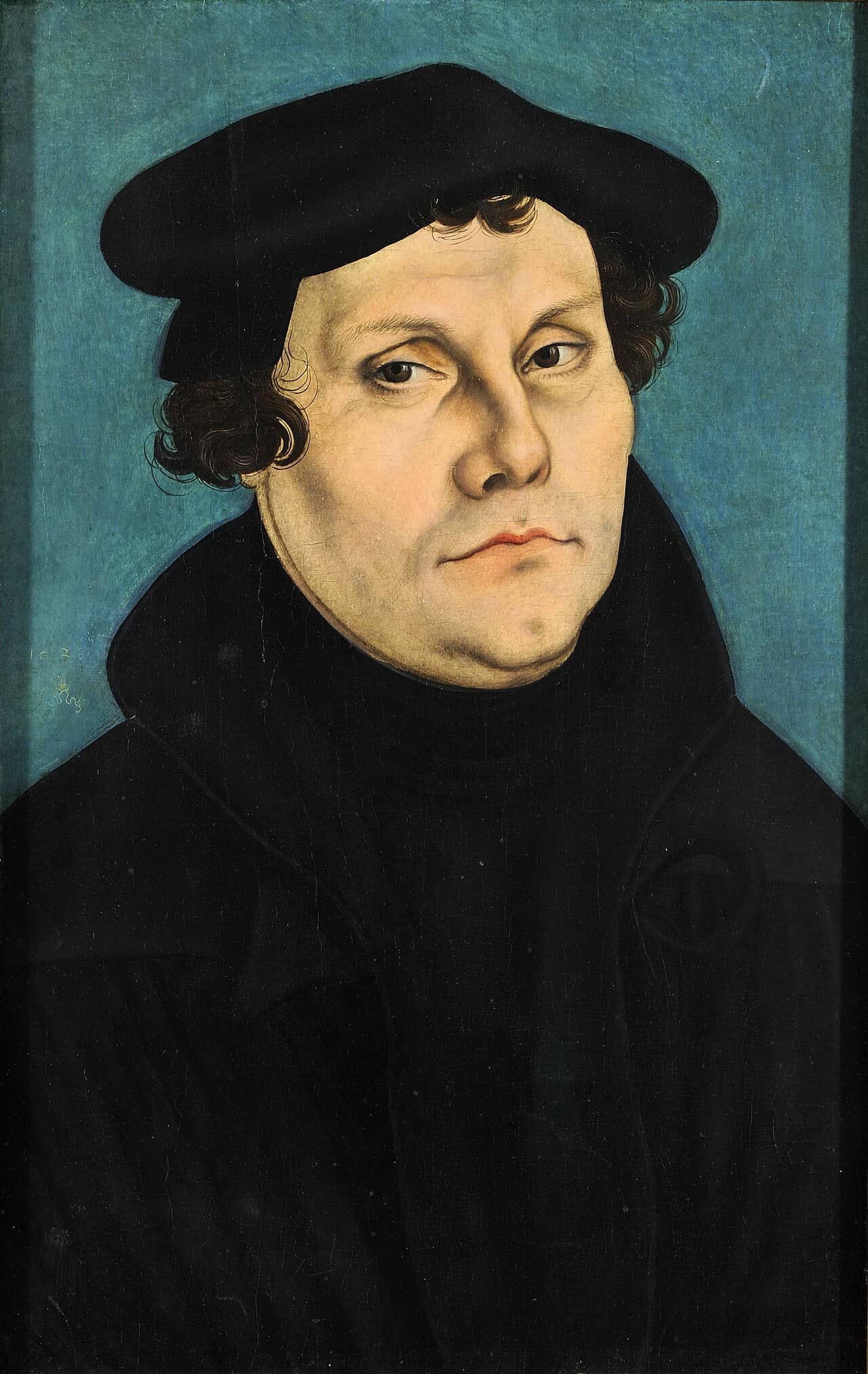
Martin Luther was born on 10 November 1483 at Eisleben, the son of a copper miner who had risen to own smelting works and who intended his son for the law. Caught in a thunderstorm near Stotternheim in July 1505, Luther vowed to become a monk if he survived, and entered the Augustinian monastery at Erfurt on 17 July, to his father's lasting anger. He was ordained in 1507, took his doctorate in theology in 1512, and taught scripture at Wittenberg. He was, by his own account, a monk tormented by the impossibility of being righteous enough for God - until reading Paul's letter to the Romans convinced him that righteousness is not earned but given, received by faith alone. That conviction made the sale of indulgences intolerable, and on 31 October 1517 he sent his Ninety-five Theses to the Archbishop of Mainz. What followed was excommunication in 1521, condemnation at the Diet of Worms, ten months in hiding at the Wartburg translating the New Testament, and twenty-five years building a church. Michael Hart ranked him 25th in The 100.
Influence Meter
88
Measured on a 100-point scale
Broke the religious unity of Western Europe, and gave German its literary form
1505-1517
A Monk Who Could Not Feel Forgiven
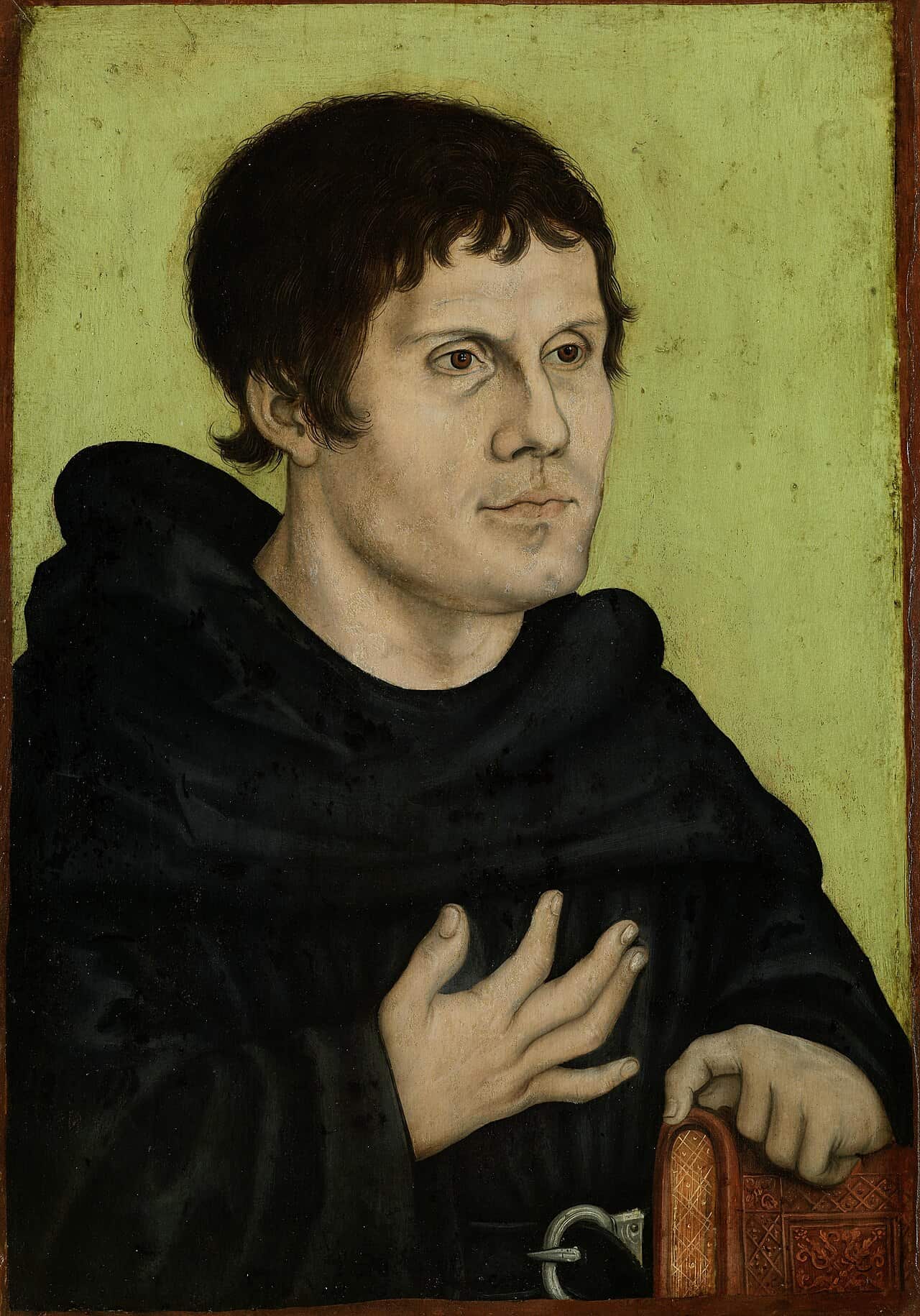
Luther was, by the standards of his order, an exemplary monk and a miserable one. He fasted, kept vigils, and confessed so exhaustively - once for six hours at a stretch - that his superior Johann von Staupitz told him to come back when he had committed something worth confessing. The problem was not laxity but arithmetic: if salvation depends on being righteous, and no honest accounting of oneself finds righteousness, then the system offers no exit. Staupitz redirected him into academic study of the Bible, which was in its way the most consequential piece of pastoral advice in European history. Lecturing on Psalms and then on Romans between 1513 and 1516, Luther arrived at the reading that undid the problem: the righteousness God requires is the righteousness God supplies, credited to the believer through faith rather than accumulated by effort.
1517
What an Indulgence Was, and Why He Objected
An indulgence remitted the temporal punishment owed for sins already forgiven - time in purgatory, in the popular understanding. By 1517 they were being sold, and the campaign running near Wittenberg was a financial instrument of unusual cynicism: the Dominican preacher Johann Tetzel was raising money split between the rebuilding of St Peter's Basilica in Rome and the debts Albert of Brandenburg had incurred buying the archbishopric of Mainz. Tetzel's marketing was blunter than the theology permitted, and the jingle attributed to him - that a soul springs from purgatory the moment the coin hits the box - is the version Luther attacked.
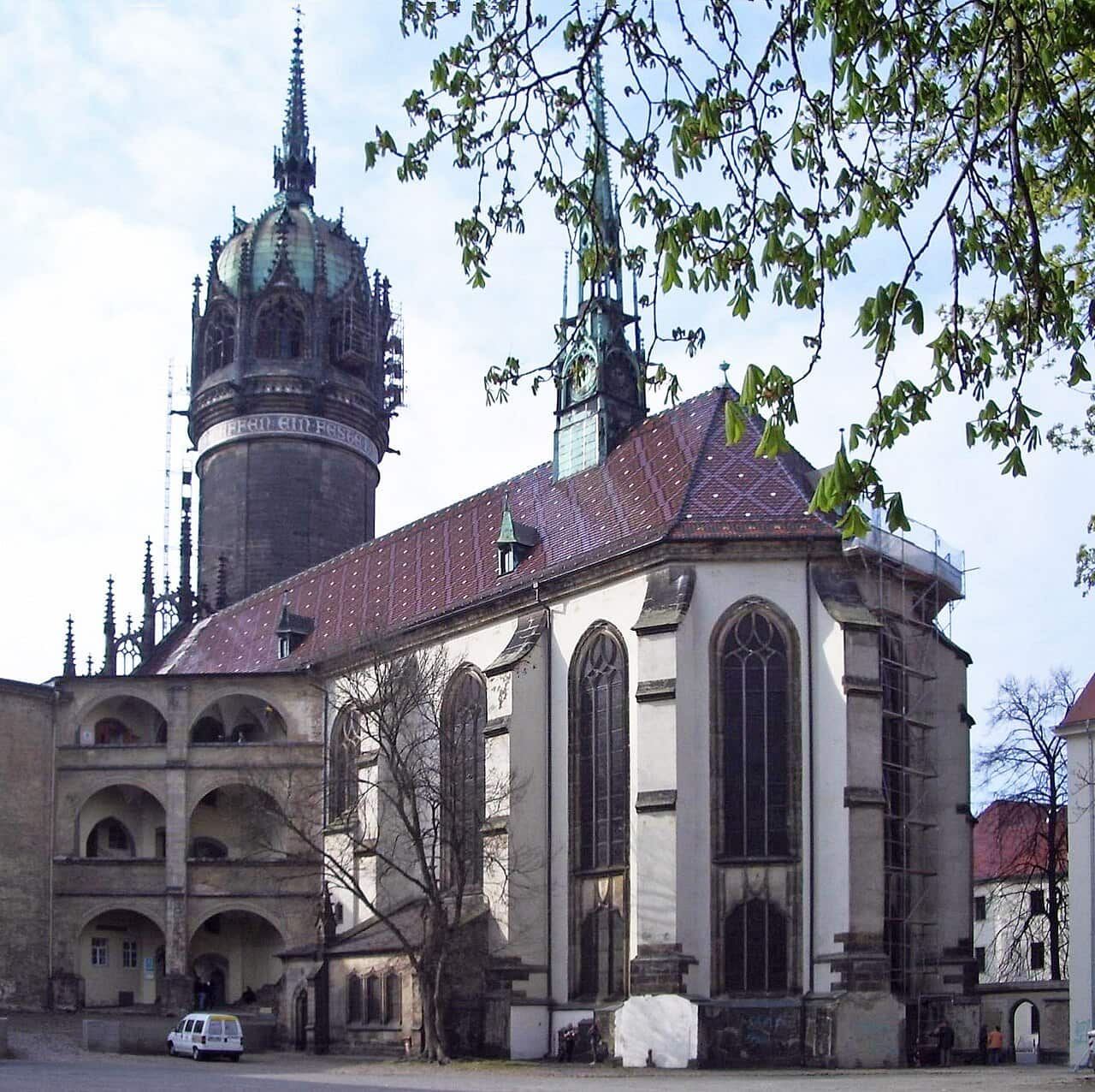
The Ninety-five Theses are not a manifesto for a new church. They are ninety-five debating propositions in Latin, several of them respectful of the Pope, arguing that indulgences cannot remit guilt, that they endanger buyers by offering false assurance, and that if the Pope has power to empty purgatory he should do it out of charity rather than for a basilica. Luther sent them to Albert of Mainz on 31 October 1517. Whether he also nailed a copy to the door of the Castle Church that day is disputed by historians; the door served as the university noticeboard, so posting a disputation there would have been routine rather than dramatic.
Wittenberg
The Door, and the Press
The Castle Church at Wittenberg has borne bronze doors since 1858 with the Theses cast into them, which is a monument to a scene that may not have happened as described. What certainly happened is faster and less picturesque. Within weeks the Theses had been translated into German, printed, and distributed across the Empire; Luther himself said he had not intended them for a general readership and was startled at the speed. This was the first controversy in European history conducted through mass printing, and Luther turned out to be extraordinarily good at it - writing short, in German, in a plain and often crude style, and pairing with the Wittenberg printers and with Lucas Cranach's workshop for woodcuts. He became the most published author in Europe. Roughly a third of everything printed in German between 1518 and 1525 was written by him.
The Reformation is inseparable from the printing press, and the timing is the whole argument. Jan Hus made comparable objections a century before Luther and was burned at the stake in 1415, and his movement stayed regional. Luther made his in 1517, roughly sixty years after Gutenberg's press had spread across Europe, and could not be contained: by the time the Church reacted, thousands of copies were in circulation in a language ordinary people read, and suppressing the author no longer suppressed the argument. Luther understood the instrument he had. He wrote for the pamphlet, not the treatise, and made Wittenberg - a town of some two thousand people with a university eighteen years old - into one of the publishing centres of Europe.
Chronology
From the Thunderstorm to Eisleben
Sixty-two years that began and ended in the same small mining town.
April 1521
The Diet of Worms
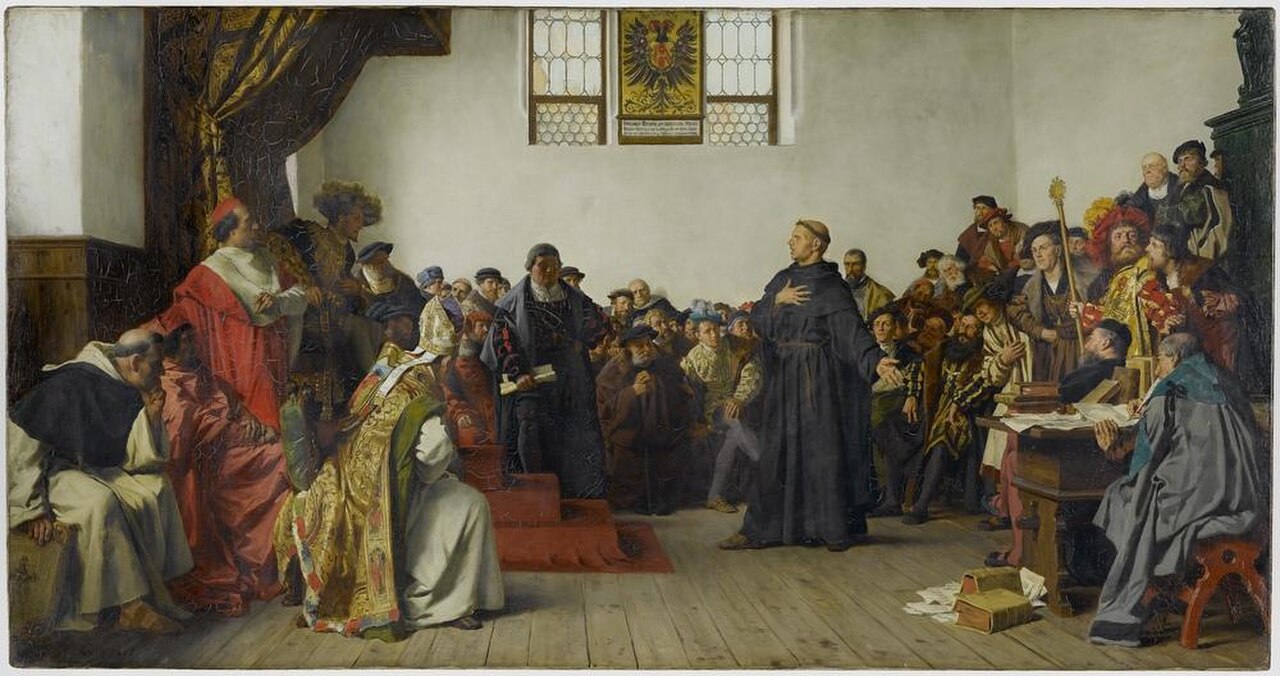
Summoned before Charles V and the imperial estates at Worms under a safe conduct, Luther was shown a table of his own books and asked whether he would recant. He asked for a day to consider, and returned to say that unless he were convinced by scripture and plain reason he could not and would not retract anything, because acting against conscience is neither safe nor right. The famous conclusion - here I stand, I can do no other - appears in the printed version but not in the earliest transcripts, and most historians treat it as an addition. The Edict of Worms declared him an outlaw whom anyone might kill without consequence. On the road home he was ambushed by horsemen sent by Frederick the Wise of Saxony, who carried him to the Wartburg for his own protection. Luther grew a beard, took the name Junker Jorg, and in eleven weeks translated the entire New Testament into German.
TL;DR
Why one monk's objection did not stay an objection
Luther's argument was not new. The conditions that let it spread were, and he was unusually good at using them.
! Why This Matters:
- • The theology: Salvation comes by faith alone, through grace alone, on the authority of scripture alone - not by works, purchase, or priestly mediation.
- • The accelerant: Printing. A third of all German-language output between 1518 and 1525 was written by him.
- • The politics: German princes resented money and jurisdiction flowing to Rome, and several protected him for reasons that were not religious.
- • The lasting artefact: A German Bible that ordinary people could read, which fixed the literary form of the language.
? Key Data:
- • Theses posted or sent: 95, on 31 October 1517
- • Weeks to translate the New Testament: About 11, at the Wartburg
- • Years between excommunication and death: 25
- • Hart's rank: 25th of 100
Continue reading below for the full detailed article →
1522-1534
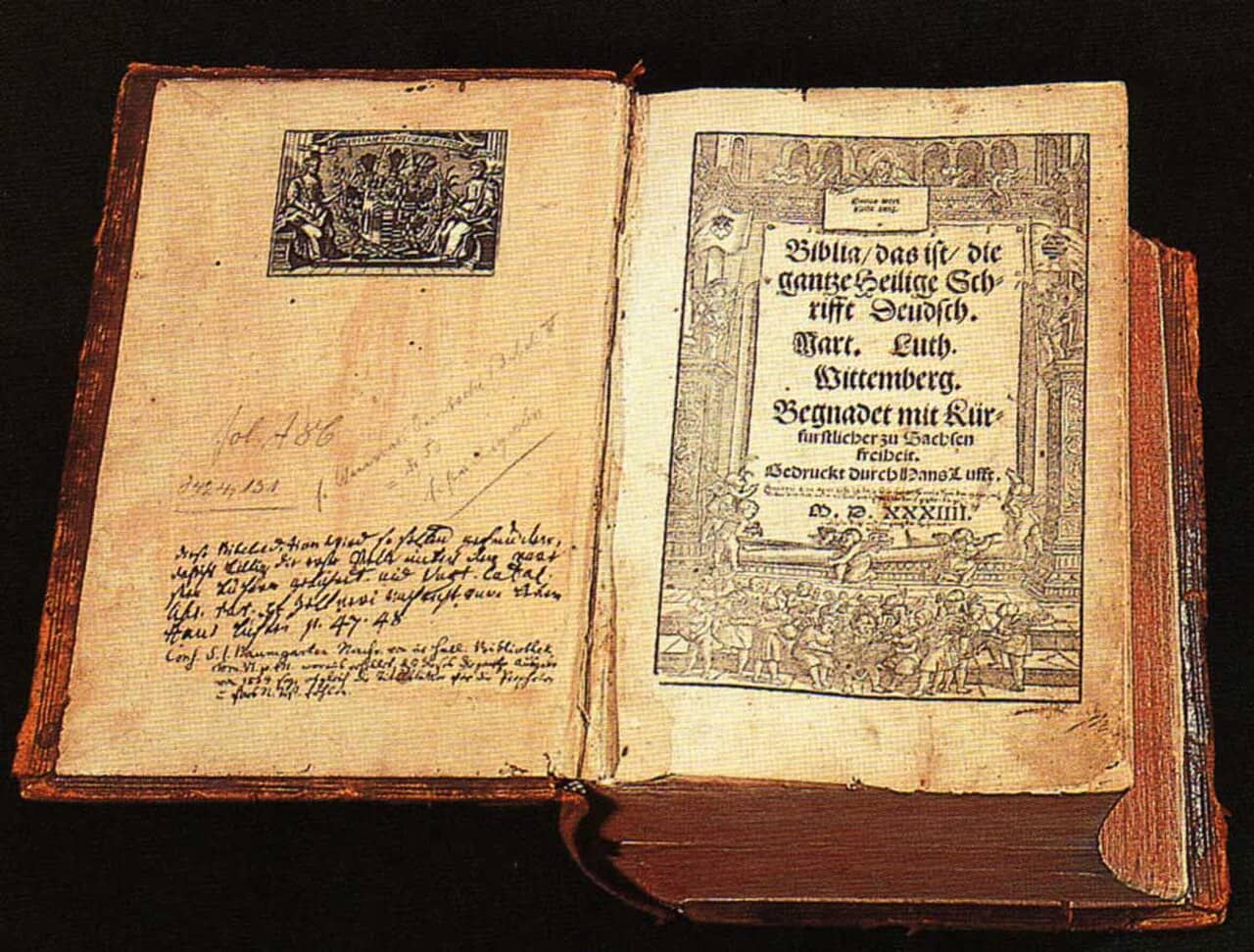
A Bible in the Language of the Marketplace
Luther's translation principle was that one must not ask the Latin how to speak German, but ask the mother in the house, the children in the street and the common man in the market, and translate accordingly. He worked from the Greek and Hebrew rather than the Latin Vulgate, published the New Testament in September 1522 and the complete Bible in 1534, and revised it for the rest of his life. Its effect on the German language is comparable to the King James Bible's on English, and arguably larger: German was then a collection of divergent dialects, and Luther's choice of an East Central German register, carried everywhere by print and read aloud in church, did more than any other single work to give the language a standard written form. He married Katharina von Bora, a former nun who had escaped her convent in a fish barrel, in 1525; their household at the Wittenberg Augustinian priory became the model for the Protestant parsonage.
1520
The Year He Wrote the Reformation
Between the Theses and his excommunication, Luther published three treatises in a single year that between them dismantled the structure of medieval church authority.
To the Christian Nobility of the German Nation
Argued that all baptised Christians are priests, denying any special spiritual status for clergy, and called on the German princes to reform the Church since its own hierarchy would not.
- Doctrine: Priesthood of all believers
On the Babylonian Captivity of the Church
Reduced the seven sacraments to two or three and denied that the Mass is a sacrifice offered by a priest, cutting away the theological basis of clerical power.
- Target: The sacramental system
On the Freedom of a Christian
The gentlest and most widely read of the three, arguing that a Christian is a free lord subject to none by faith, and a dutiful servant of all by love.
- Tone: Conciliatory
On the Bondage of the Will
His reply to Erasmus, denying free will in matters of salvation. Luther considered it, with the catechisms, the only one of his books worth preserving.
- Against: Erasmus
The Small Catechism
Written after a visitation found parish clergy who could not recite the Lord's Prayer. A short question-and-answer summary of the faith for households, and the most used Lutheran text ever produced.
- Audience: Families and children
A Mighty Fortress Is Our God
The best known of the roughly thirty-six hymns he wrote, and the sound of the Reformation - congregational singing in the vernacular was itself part of the argument.
- German title: Ein feste Burg ist unser Gott
Two parts of Luther's record are frequently omitted and should not be. When the German Peasants' War broke out in 1524, partly in his name, he first urged the princes to hear the peasants' grievances and then, as the revolt spread, published Against the Murderous, Thieving Hordes of Peasants, urging the nobility to strike them down without mercy; perhaps a hundred thousand were killed. And in 1543, near the end of his life, he wrote On the Jews and Their Lies, calling for synagogues and Jewish homes to be burned, their books seized and their rabbis forbidden to teach. Earlier he had written sympathetically of Jews and blamed the Church for their refusal to convert; the later work is a reversal, and it was reprinted and cited by the Nazi regime four centuries afterwards. Lutheran bodies including the Evangelical Lutheran Church in America have formally repudiated these writings. Historians differ on how much continuity runs from Luther's rhetoric to modern antisemitism; none dispute the texts.
Written Works
Books and Writings by Luther
The Weimar edition of his collected works runs to more than a hundred volumes.
Further Reading
Books About Luther
Four centuries of biography, with the modern tendency running toward a more difficult figure than the heroic one.
Here I Stand
The classic popular biography, sympathetic and superbly written, and still the usual first book on the subject.
- Published: 1950
- Subtitle: A Life of Martin Luther
Martin Luther: Renegade and Prophet
A psychological biography by a leading historian of the Reformation, attentive to Luther's body, temper and contradictions rather than only his doctrine.
- Published: 2016
Brand Luther
Treats the Reformation as a publishing phenomenon, showing how Luther and the Wittenberg printers invented the pamphlet and made a small town a media centre.
- Published: 2015
Luther: Man Between God and the Devil
Places Luther firmly inside the late-medieval world he actually inhabited, with its devils and its apocalyptic expectation, rather than treating him as an early modern.
- Published: 1982; English 1989
Legacy
Why Number Twenty-Five
Michael Hart ranked Luther 25th on the scale of the division he caused. Before 1517 Western Europe had one church; after him it had many, and the consequences were not confined to belief. The wars of religion that followed - culminating in the Thirty Years' War, which killed perhaps a third of the population of the German lands before the Peace of Westphalia settled it in 1648 - reshaped the map and produced, almost accidentally, the modern principle that states tolerate more than one religion because the alternative is ruinous.
The second-order effects run further than the theology. A faith in which every believer must read scripture for themselves creates a powerful argument for teaching everyone to read, and Protestant regions pushed literacy rates upward for centuries afterwards. Max Weber's argument connecting the Protestant ethic to the development of capitalism is contested but has never gone away. And the German language itself carries his fingerprints: a schoolchild in Berlin today writes a standard descended in large part from the choices one outlawed monk made in a castle room in 1521, working at speed, trying to render Greek into something a woman in a market would recognise.
Related Publications