Max Planck

Max Planck
Born 23 April 1858 • Died 4 October 1947
When Planck was choosing a subject in 1874, a Munich professor advised him against physics on the ground that almost everything in it had already been discovered and only a few holes remained to be filled. Planck went into it anyway, saying he did not wish to discover new things, only to understand the known fundamentals of the field. Twenty-six years later, trying to fill one of those few remaining holes, he was forced to an assumption that destroyed the physics he had wanted to consolidate. He disliked it for a decade and it turned out to be true.
Rank
#59
Influence
81
Field
Theoretical Physicist
Historical Perspective
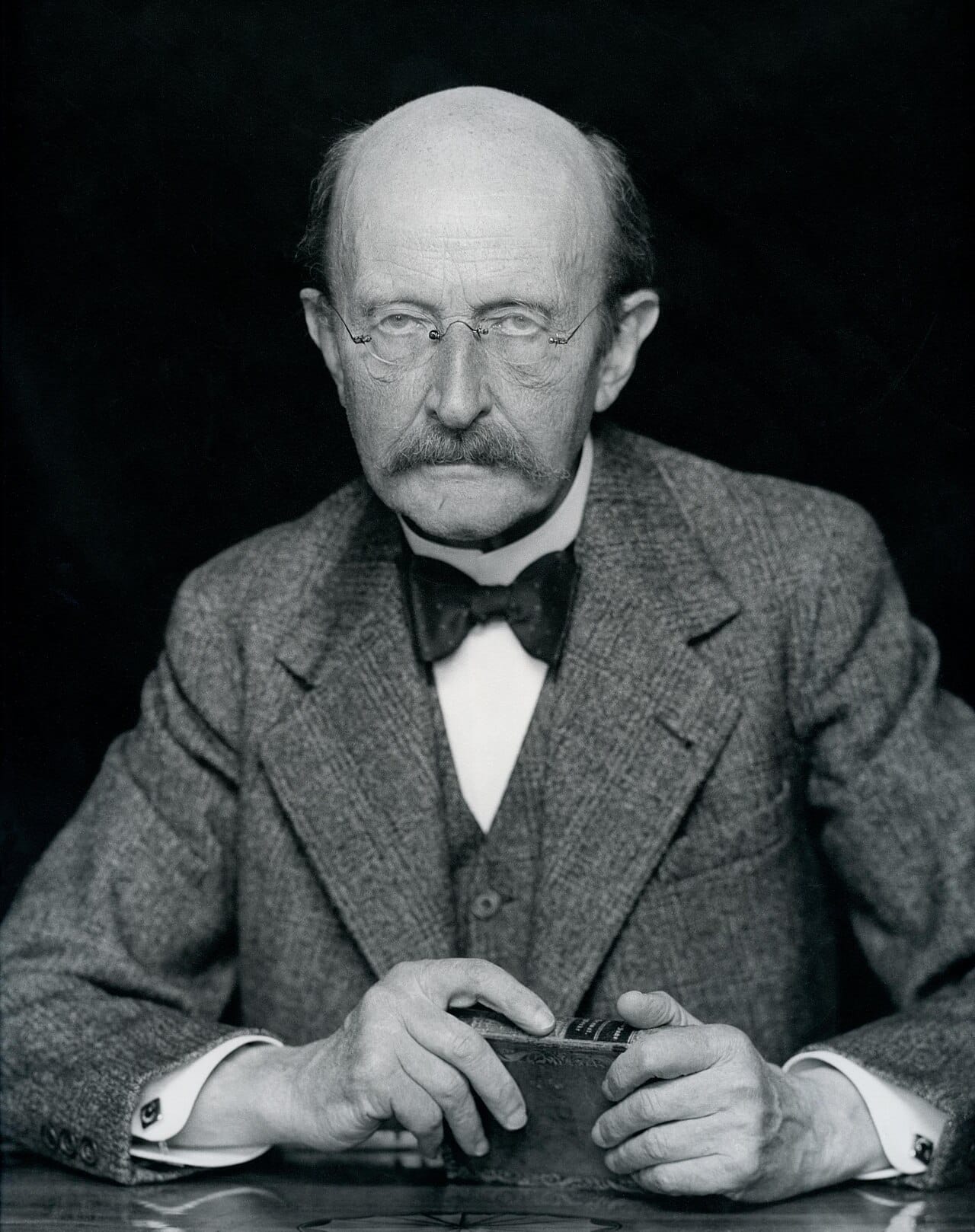
Max Planck was born at Kiel on 23 April 1858 into an academic and legal family of considerable social conservatism, and was a gifted enough musician to have considered it as a career. He studied at Munich and Berlin under Helmholtz and Kirchhoff, took his doctorate on thermodynamics at twenty-one, and became professor at Berlin in 1889. The problem that occupied him from the mid-1890s was black body radiation: the distribution of energy across frequencies emitted by a heated object, which classical physics could describe at long wavelengths or short but not both - the failure at short wavelengths being the so-called ultraviolet catastrophe. On 14 December 1900 he presented to the German Physical Society a formula that fitted the whole curve, at the cost of assuming that energy is emitted only in discrete amounts proportional to frequency, E equals h times nu. He called it an act of desperation. Einstein took the quanta literally in 1905, Bohr built an atom from them in 1913, and Planck received the Nobel Prize in 1918. He remained in Germany through the Nazi period, and died at Göttingen on 4 October 1947. Michael Hart ranked him 59th in The 100.
Influence Meter
81
Measured on a 100-point scale
Introduced the quantum, reluctantly, and ended classical physics
1859-1900
Why a Hot Object Was a Crisis
A black body is an idealised object that absorbs all radiation falling on it and re-emits according to its temperature alone. Kirchhoff had posed the problem in 1859: what is the exact distribution of emitted energy across frequencies? It sounds narrow and it was in fact a test of whether classical physics was complete. Wien's law fitted the high-frequency end and failed at low; the Rayleigh-Jeans law, derived rigorously from classical thermodynamics and electromagnetism, fitted the low-frequency end and at high frequencies predicted infinite energy - the ultraviolet catastrophe. Since a warm object does not emit infinite ultraviolet, something in the foundations was wrong.
Planck found a formula that fitted the entire measured curve, and then spent eight weeks trying to derive it from first principles. The derivation only worked if he assumed the oscillators emitting the radiation could take energy in discrete portions rather than continuously - packets of size h times the frequency, with h an extremely small new constant of nature. He presented it on 14 December 1900, and regarded the discreteness as a formal device that a better analysis would eventually remove. He wrote much later that it had been an act of desperation, that he had been ready to sacrifice any of his previous convictions about physics, and that a theoretical interpretation had to be found at any price, however high.
Planck's constant, h, is roughly 6.626 times ten to the minus thirty-four joule-seconds - a number so small that the graininess of energy is invisible at any ordinary scale, which is why classical physics works perfectly well for bridges and planets. It is nonetheless one of a handful of fundamental constants that define the structure of reality, and since the 2019 redefinition of SI units it is fixed by definition, with the kilogram now derived from it rather than from a metal cylinder in a vault near Paris. The Planck length, Planck time and Planck mass, formed by combining h with the speed of light and the gravitational constant, mark the scale at which quantum effects and gravity must both matter and at which no existing theory works - which is where the search for quantum gravity is aimed.
1900-1913
The Man Who Did Not Want to Have Discovered It
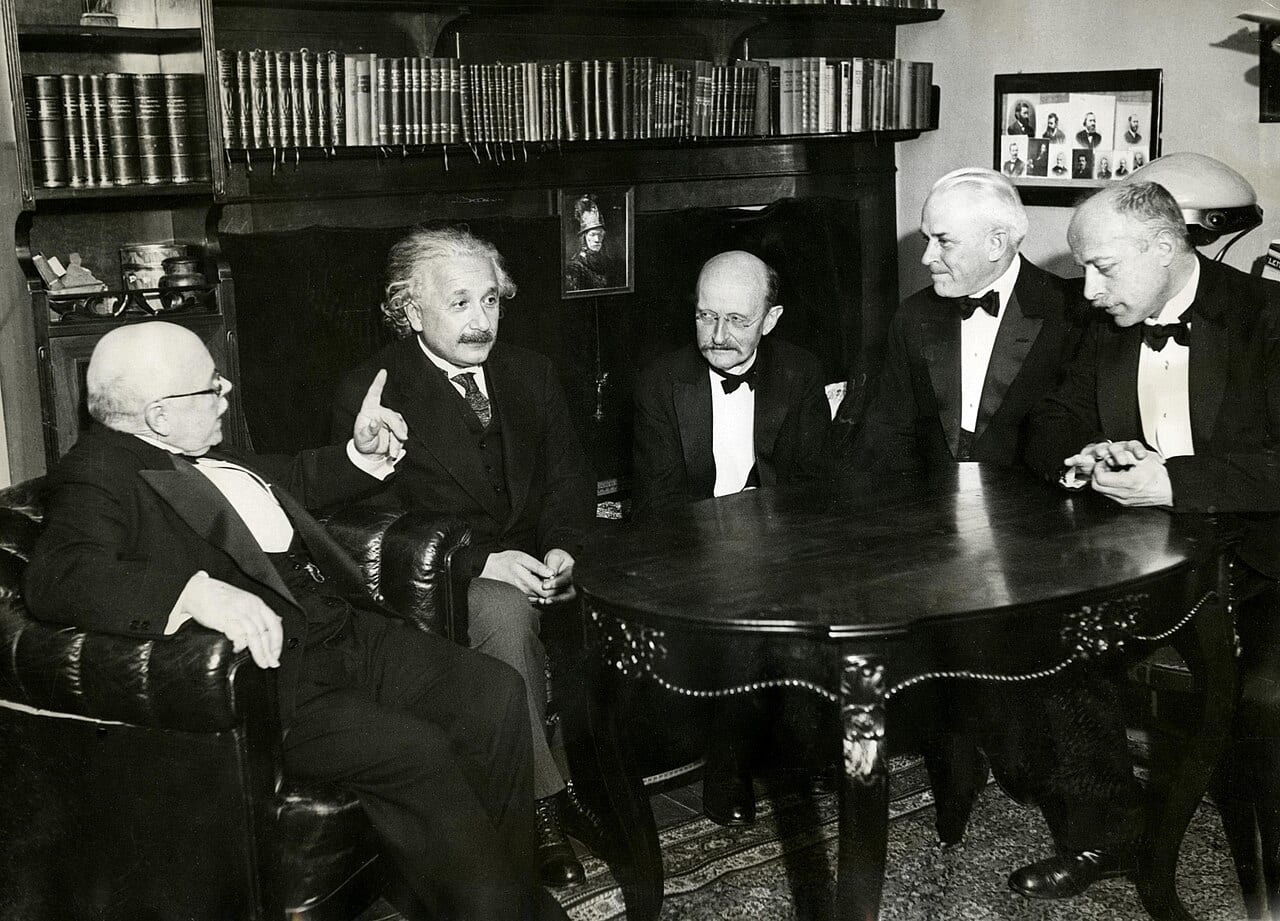
Planck's temperament was the opposite of revolutionary. He was formal, devout, socially conservative, a man who wore the same style of dark suit for decades and believed deeply in the continuity of German scientific culture. His stated ambition had been to understand the absolute in physics - the fixed and universal - and quantisation looked to him like an artefact of an incomplete derivation rather than a property of nature. He spent roughly a decade trying to find a classical route to his own formula and failed. It was Einstein who in 1905 took the quanta seriously as real, using them to explain the photoelectric effect, and Bohr who in 1913 built an atom whose electrons occupied quantised orbits. Planck was among the first to recognise Einstein's relativity and championed it in Germany when almost nobody else did, and the two became close friends who played music together - Planck at the piano, Einstein on violin - which is a pleasant image of the two men who ended classical physics between them, one of whom would rather not have.
1933-1947
Staying, and What It Cost
Planck was seventy-five when the Nazis took power and was president of the Kaiser Wilhelm Society, the central institution of German science. He chose to stay and to try to preserve it, a decision he defended as protecting German scholarship and which critics have judged as accommodation. He requested a meeting with Hitler in May 1933 to argue against the dismissal of Jewish scientists, and got nowhere - Hitler responded with a tirade about Jews and communism. Planck presided over an institution that expelled its Jewish members, gave the Hitler salute at official functions, and defended Einstein's physics while conceding on the personnel. He also delivered a memorial address for the chemist Fritz Haber in 1935 in defiance of a government ban.
What Happened to His Family
Planck lived to eighty-nine and outlived four of his five children.
- Karl: His eldest son, killed at Verdun in 1916.
- Grete: A daughter, died in childbirth in 1917.
- Emma: Her twin sister, who married Grete's widower and died in childbirth herself two years later, in 1919.
- His first wife Marie: Died in 1909 after twenty-two years of marriage.
- His house and papers: The Berlin home was destroyed by Allied bombing in 1944, taking his correspondence and library with it.
- Erwin: His surviving son, implicated in the 20 July 1944 plot against Hitler, tortured by the Gestapo and executed on 23 January 1945. Planck petitioned Hitler for his life without success, and said afterwards that Erwin had been his most precious possession and the sun of his life.
Further Reading
Books About Planck
His scientific autobiography is short and his correspondence largely destroyed, so the literature leans on institutional records.
Legacy
Why Number Fifty-Nine
Michael Hart ranked Planck 59th, and the argument is that 14 December 1900 is as clean a starting point as the history of science offers for anything. Quantum mechanics - which underwrites semiconductors, lasers, magnetic resonance imaging, nuclear power, LEDs and the whole of chemistry's account of the bond - begins with his constant. The estimates sometimes quoted for the share of developed economies dependent on quantum-based technology run to a quarter or more, and however loose such figures are, the direction is not in dispute.
The other thing he left is an observation about how science actually changes, offered late and without illusion: a new scientific truth does not triumph by convincing its opponents and making them see the light, but rather because its opponents eventually die and a new generation grows up that is familiar with it. It is usually quoted as cynicism. Coming from a man who spent ten years resisting his own discovery, it reads more like a confession. The Kaiser Wilhelm Society was renamed the Max Planck Society in 1948, the year after he died, and remains Germany's principal research organisation.
Related Publications