Homer

Homer
Born c. 8th century BCE • Died c. 8th century BCE
The Iliad does not tell the story of the Trojan War. It covers about fifty days in the tenth year of it, and its subject, announced in the first word, is the anger of one man. The war does not end within the poem, Troy does not fall, and the last scene is an old enemy king kissing the hands of the man who killed his son, so that he can take the body home. Whatever else European literature was going to be, it started at a level that has not often been reached since.
Rank
#98
Influence
73
Field
Poet
Historical Perspective
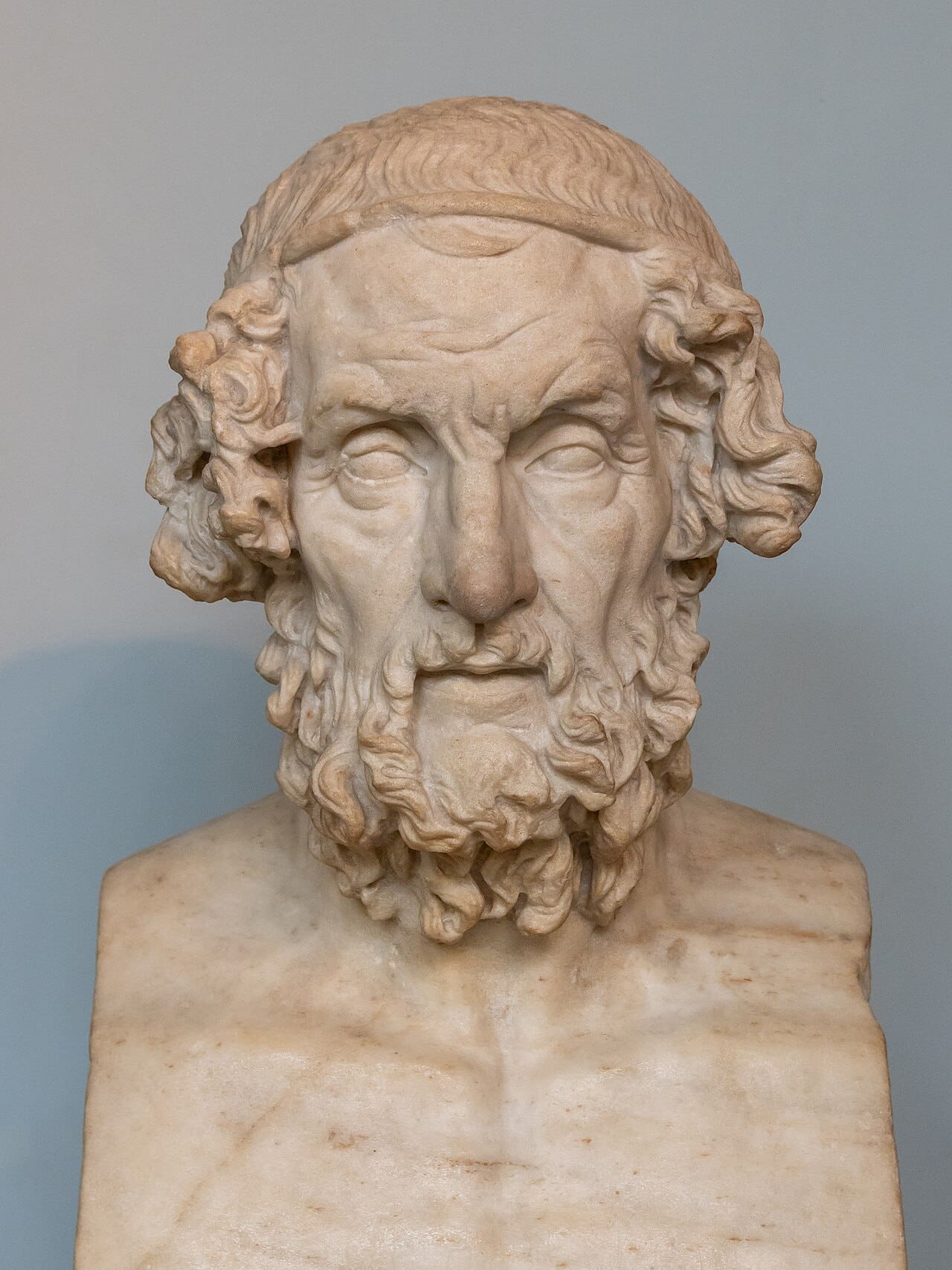
Nothing is known about Homer, and antiquity knew no more than we do: seven cities claimed him, the tradition that he was blind derives from a poem he probably did not write, and dates offered by Greek writers ranged across four centuries. Modern consensus places the composition of the Iliad in the eighth or early seventh century BCE, in the Ionian Greek of the Asia Minor coast, with the Odyssey somewhat later and probably by a different hand. What the poems describe - bronze-age palaces, boar's-tusk helmets, chariot warfare - belongs to a Mycenaean world that had collapsed some four hundred years earlier and survived only in song. In the 1920s and 1930s Milman Parry showed that the poems' fixed epithets and repeated formulae are the working equipment of oral composition, by comparing them with living illiterate bards in Yugoslavia; the poems were built to be performed and improvised, not written. Whether a single poet gave the Iliad its shape at the moment writing became available, or whether it accumulated, is the Homeric Question, and it is not settled. Michael Hart ranked him 98th in The 100.
Influence Meter
73
Measured on a 100-point scale
The foundation text of Greek education, and the model for Western literature ever since
Two Poems, Two Kinds of Story
They are so different in temper that the ancient scholar Longinus suggested the Odyssey was the work of Homer in old age. Modern scholars mostly think it is a different poet altogether.
- The Iliad: about mortality: Achilles knows he will die young and chooses it, and everyone else in the poem dies without choosing. The battle scenes name obscure men and give each a father, a hometown and sometimes a wife before killing him in a line and a half. It is the oldest and still one of the most unsparing accounts of what war does.
- The Odyssey: about getting home: A different genre - travel, monsters, disguise, a wife holding a household together against suitors, a son looking for a father. It invented the shape of the adventure narrative and the returning-stranger plot that fiction has been reusing for twenty-eight centuries.
- The gods are not consoling: They are powerful, partisan, undignified and unjust, and their immortality is what makes them shallow. The poems put the moral weight on the people who can die.
- The similes: The famous extended comparisons open a window from the battlefield onto a world of shepherds, snowfall, harvests and mothers brushing flies from a sleeping child. They are how peace stays present in a poem about slaughter.
- The enemy is not a villain: Hector is the most sympathetic figure in the Iliad and he is on the other side. The poem does not take the Greek view of the Trojans, which is an extraordinary thing for a foundational national epic to decline to do.
- They were meant to be heard: Performed by rhapsodes, probably in episodes, to audiences who knew the story already. The pleasure was never suspense; it was the telling.
For most of the nineteenth century, educated opinion held that Troy was as fictional as Atlantis. Then Heinrich Schliemann, a wealthy amateur with more conviction than method, excavated the mound of Hisarlik in north-western Turkey from 1871 and found a fortified city - in fact nine cities stacked on top of each other, and he dug straight through several of the relevant ones to reach a level a thousand years too early. Subsequent professional excavation, particularly by Carl Blegen and later Manfred Korfmann, established that the layer called Troy VIIa was a substantial fortified settlement destroyed by fire around 1180 BCE, at roughly the right period, and that the site controlled the entrance to the Dardanelles - a location worth fighting over. This does not vindicate the Iliad as history. There is no evidence of a ten-year Greek siege, of Achilles, or of a wooden horse. What it establishes is that the poems preserve, across four centuries of oral transmission through a period with no writing, the memory of a real place and a real destruction. That is a remarkable fact about how oral tradition works, and it is not the same as the poems being true.
Further Reading
Translations and Studies
There is no correct translation. Each generation makes new ones because each generation wants something different from them.
Legacy
Why Number Ninety-Eight
Michael Hart ranked Homer 98th, and the standing objection to including poets at all is that literature changes what people feel rather than what they can do. But the Homeric poems were not, in the Greek world, entertainment. They were the curriculum. Boys learned to read on them and memorised large stretches; orators quoted them as authority; philosophers from Plato onward argued with them as one argues with a rival account of how to live. Greek identity was in large part the possession of these poems in common, and Greek education - paideia - was built on them for a thousand years, which means the Romans, who took their education from the Greeks, got them too.
The line of descent is unbroken and easy to follow. Virgil wrote the Aeneid as a deliberate answer to both poems; Dante made Virgil his guide; Milton wrote Paradise Lost in conscious competition with all three; Joyce mapped one Dublin day onto the Odyssey; Walcott moved it to the Caribbean. Beyond the direct imitations, the conventions Homer set - beginning in the middle of things, the invocation, the catalogue, the extended simile, the descent to the underworld, the hero whose flaw is the source of his greatness - are the furniture of Western narrative. Whoever composed the Iliad, one poet or a tradition, produced the oldest surviving thing in European literature and did not leave much room for improvement at the start.
Related Publications