Justinian I

Justinian I
Born c. 482 • Died 14 November 565
The reconquest was lost within a lifetime. The plague of 541 killed a share of his empire that no policy could offset. The Hagia Sophia still stands. And the four books his commission produced between 529 and 534 are the reason that a contract dispute in Brazil, France, Japan or Louisiana is decided by reasoning that descends, in a traceable line, from jurists who died before Constantine was born.
Rank
#99
Influence
75
Field
Emperor and Lawgiver
Historical Perspective
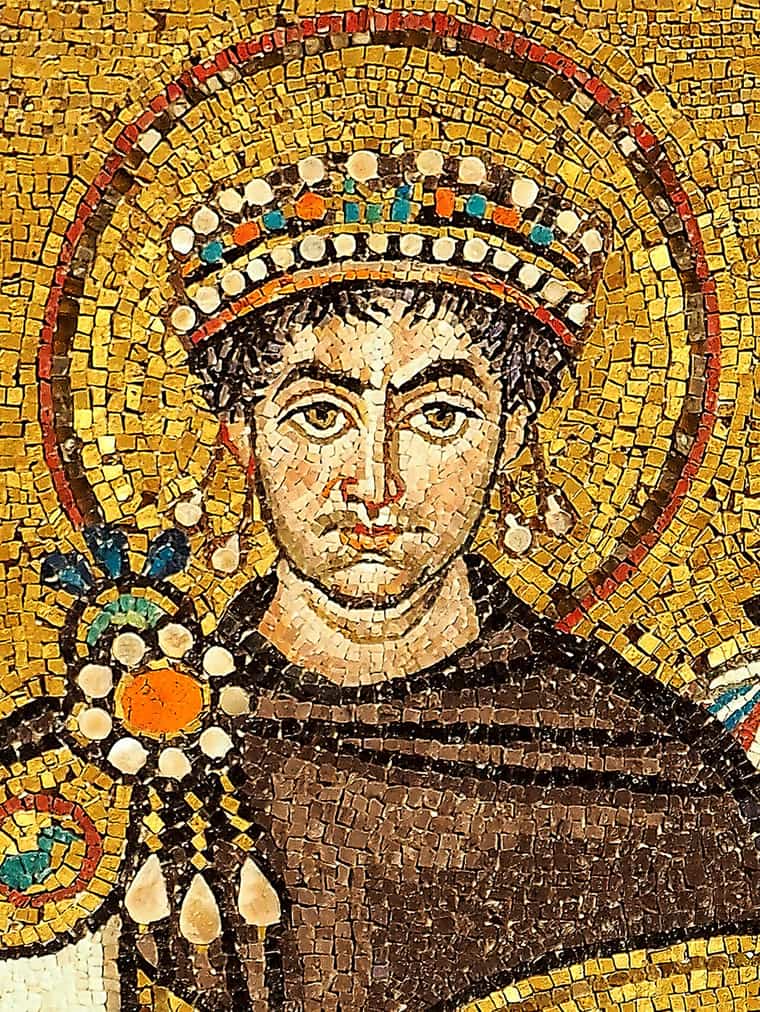
Justinian was born a Latin-speaking peasant in Illyria around 482, and was brought to Constantinople by his uncle Justin, a soldier who became emperor. He succeeded him in 527, and married Theodora, a former actress whose influence on his reign was substantial and openly acknowledged. In 532 the Nika riots nearly destroyed him - by the account of the historian Procopius he was preparing to flee when Theodora refused, and some thirty thousand people were killed in the hippodrome when the guards were finally sent in. He rebuilt the burned city, including the Hagia Sophia, completed in five years and holding the largest dome in the world for nearly a millennium. His general Belisarius took North Africa from the Vandals in 534 and began a campaign in Italy against the Ostrogoths that ground on for eighteen years. The legal codification ran from 529 to 534. Bubonic plague reached Constantinople in 542 and killed a large fraction of the empire's population, wrecking the finances and the manpower on which everything else depended. He died on 14 November 565. Michael Hart ranked him 99th in The 100.
Influence Meter
75
Measured on a 100-point scale
Codified Roman law, and through it shaped the legal systems of most of the world
The Codification
Four Books, and What Each Did
Roman law by the sixth century was a thousand years of statutes, imperial rulings and juristic opinion, much of it contradictory and some of it lost. Justinian gave a commission under the jurist Tribonian the authority to cut.
The Codex
All imperial legislation still in force, arranged by subject, with obsolete and contradictory enactments removed outright. Everything omitted ceased to have legal effect - the first time a state had cleared its own statute book by decree.
- Scope: Imperial constitutions from Hadrian on
The Digest
The heart of the thing. Nearly two thousand books of classical juristic writing were read and reduced to about a twentieth of their bulk, preserving the reasoning of Ulpian, Paulus, Gaius, Papinian and others. It is the reason we have any substantial body of classical Roman legal thought at all; the originals are lost.
- Compression: About 5% of what was read
The Institutes
A textbook for first-year law students, issued with the force of law, and modelled on Gaius. Short, orderly and clear, it taught the structure - persons, things, obligations, actions - that most civil codes still use.
- Audience: Students, given statutory force
The Novels
The new laws issued after the codification, mostly in Greek rather than Latin - a quiet acknowledgement that the empire's working language had changed and that the Roman west was already receding.
- Language: Mostly Greek
The rediscovery
A manuscript of the Digest surfaced in Italy in the eleventh century and was taken up at Bologna, where teaching it produced the first European university and a profession of trained jurists. From there it spread into the law of nearly every continental state.
- Consequence: The civil law tradition
532-537
The Great Church
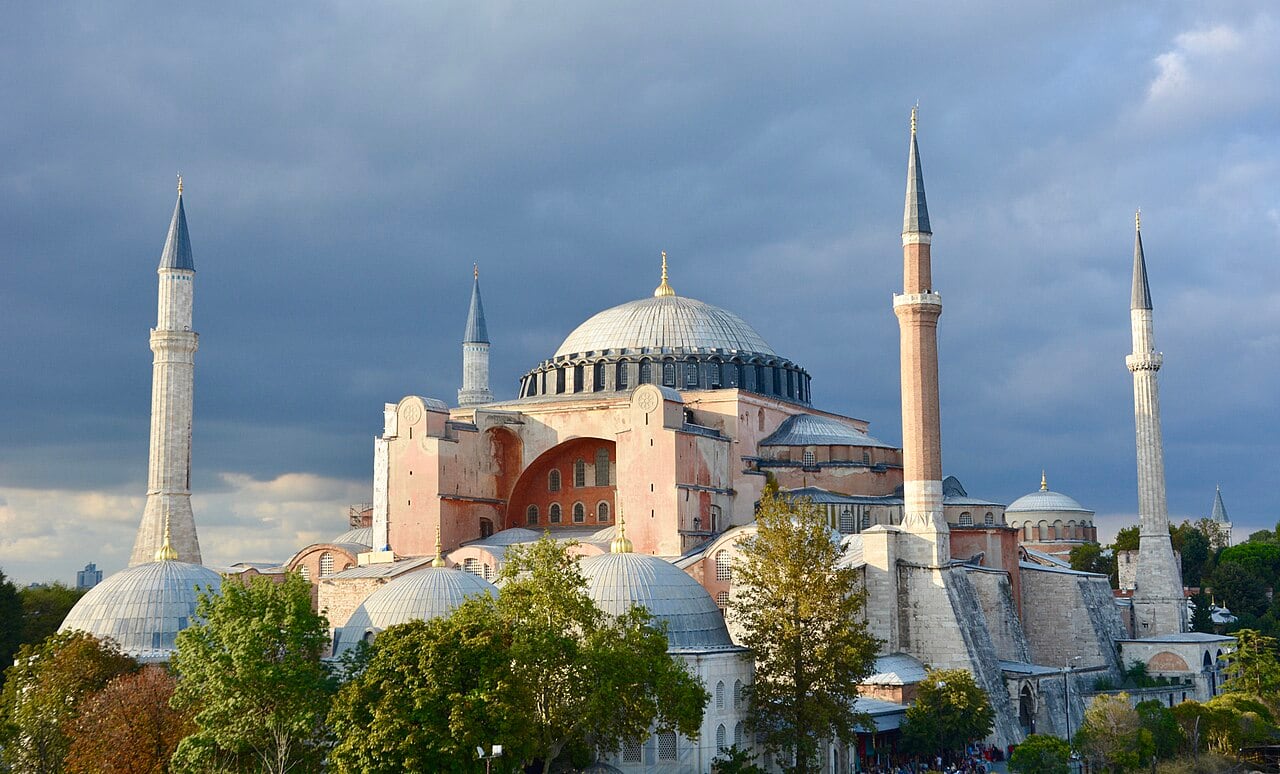
The Hagia Sophia was built in five years, which for a building of that size is close to unbelievable, and it was designed by two men described as mechanikoi rather than architects - Anthemius of Tralles and Isidore of Miletus were mathematicians, and one of them had written on conic sections. The problem they solved was how to set a circular dome on a square plan, and their answer, the pendentive, became standard for domed architecture afterwards. Forty windows around the dome's base cut the mass of masonry that appears to support it, so that from below the dome reads as floating on light; Procopius wrote that it seemed suspended from heaven rather than resting on anything. The first dome was too shallow and collapsed after an earthquake in 558; the replacement, steeper and still standing, has survived fourteen centuries of seismic activity in one of the world's more active zones. It was the largest enclosed space on earth for something like eight hundred years, served as the cathedral of eastern Christianity for nine centuries, became a mosque in 1453, a museum in 1935, and a mosque again in 2020.
The Plague of Justinian arrived at Constantinople in 542 and is the first documented pandemic of bubonic plague - confirmed in 2013 when Yersinia pestis DNA was recovered from sixth-century burials in Bavaria. Procopius, who was in the city, describes ten thousand deaths a day at its height and bodies stacked in the towers of the walls because there was nowhere left to bury them; the figure is not reliable, but the collapse it describes is corroborated by the tax records, the abandoned villages and the sudden shortage of soldiers. Estimates of the total mortality across the Mediterranean range from fifteen to fifty per cent of the population, and the disease recurred in waves for two centuries. Justinian caught it himself and survived. The reconquest of Italy was still in progress when it hit, and the empire never afterwards had the men or the revenue to hold what it had taken: within four years of his death the Lombards were in Italy, and within a century Islam had taken Syria, Egypt and North Africa from an empire that had not recovered. The plague is the main reason his achievements look, in retrospect, like the end of something rather than the beginning.
Further Reading
Books About Justinian
His own court historian wrote two accounts of him: one official, and one, discovered centuries later, so hostile that scholars spent a long time refusing to believe it was by the same hand.
Legacy
Why Number Ninety-Nine
Michael Hart ranked Justinian 99th essentially for the law. The reconquests were reversed, the treasury was ruined paying for them, and the empire he left was weaker than the one he inherited. But the Corpus Juris Civilis, once rediscovered at Bologna around 1070, became the object of study of the first European universities and the training of the first professional lawyers, and its categories and reasoning were absorbed into the law of Italy, France, Spain, Germany, the Netherlands and everywhere those states carried their law.
The Napoleonic Code of 1804 was drafted by men trained in it, and that code was in turn adopted or adapted in Belgium, Italy, Spain, Portugal, Latin America, Egypt, Turkey, Japan and Louisiana. Something like two-thirds of the world's population lives under a legal system in the civil law family, whose distinguishing feature - a comprehensive written code from which decisions are reasoned deductively - is the shape Justinian's commission gave it. English common law took the other path and is the reason the figure is not higher. It is a strange kind of influence: not the empire, not the buildings, but a filing job done well enough that it survived the loss of everything around it.
Related Publications