Mahavira

Mahavira
Born c. 599 BCE • Died c. 527 BCE
A Jain monk sweeps the path in front of him so as not to step on an insect, strains water, eats nothing after dark to avoid killing what he cannot see, and will not farm because ploughing kills what lives in the soil. Most people find this excessive. But it is the only tradition that took non-violence to its logical end and then organised a whole life around it, and when Gandhi looked for a principle that could be turned against an empire, this is where it came from.
Rank
#100
Influence
71
Field
Religious Teacher
Historical Perspective
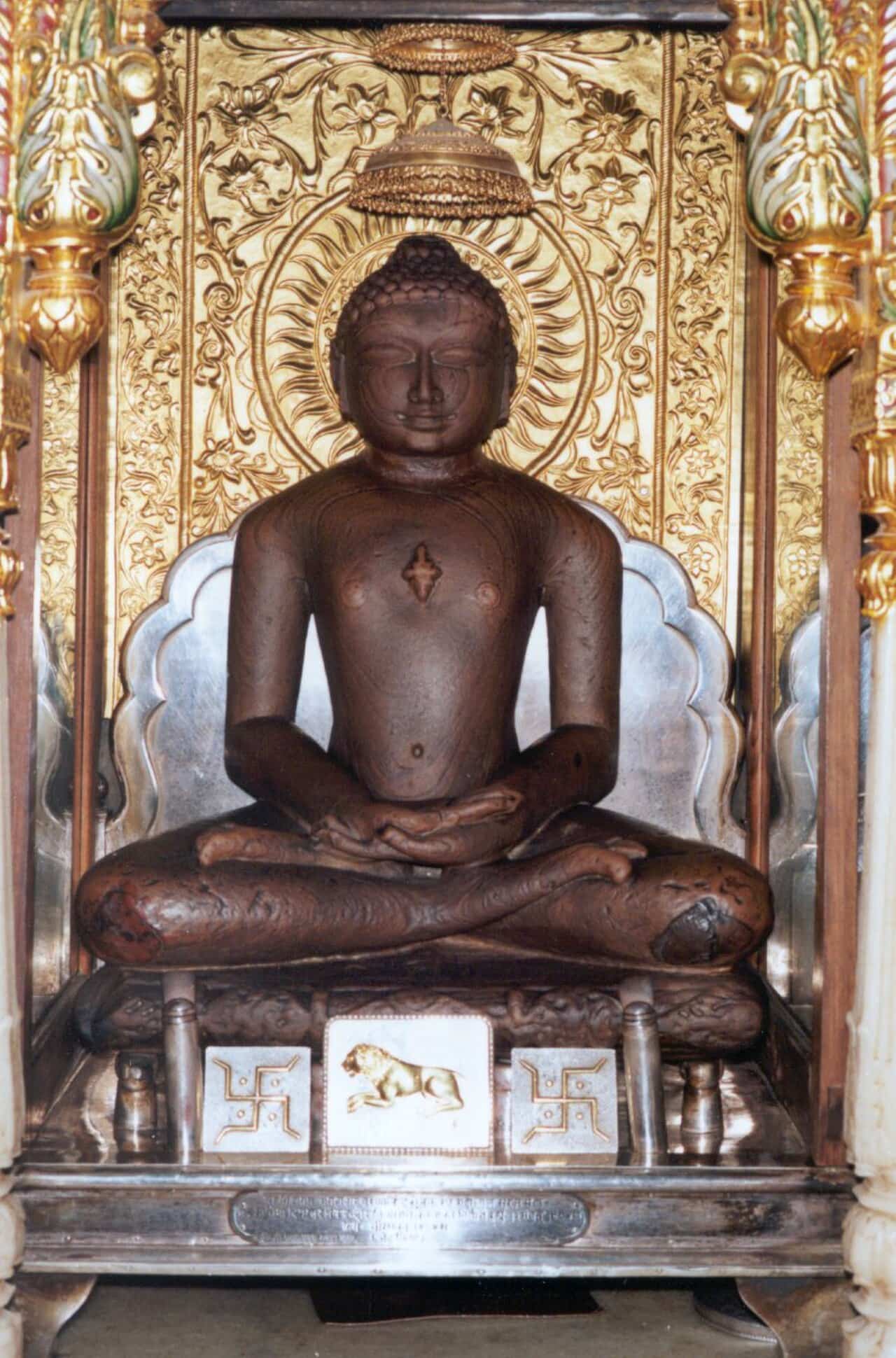
Mahavira - the Great Hero, an epithet; his given name was Vardhamana - was born to a ruling family of the Jnatrika clan near Vaishali in what is now Bihar. Jain tradition dates him 599 to 527 BCE, while many modern scholars place him somewhat later, roughly contemporary with the Buddha in the fifth century BCE, and the two men taught in the same region among the same audiences; each is mentioned in the other's scriptures. At about thirty he renounced his position, gave away his possessions and, in the Digambara account, his clothes, and spent twelve years in wandering asceticism and meditation, enduring what the texts describe in considerable detail. He attained kevala jnana, omniscient knowledge, and taught for the remaining thirty years of his life, organising a community of monks, nuns and lay followers. He is the twenty-fourth and last Tirthankara - ford-maker, one who builds a crossing over the river of rebirth - of the present cycle; the twenty-third, Parshvanatha, appears to have been a genuine historical figure of the ninth or eighth century BCE, so Mahavira reformed an existing tradition rather than founding one. He died by voluntary fasting at Pavapuri. Michael Hart ranked him 100th in The 100.
Influence Meter
71
Measured on a 100-point scale
Took non-violence further than anyone, and the idea outgrew the religion
The Doctrine
Three Ideas Worth Taking Seriously
Ahimsa - non-violence - is the first and governing vow, and Jainism differs from every neighbouring tradition in refusing to bound it. Every living thing has a soul, including insects, plants and, in the Jain analysis, beings in earth, water, fire and air; harm to any of them binds karma to the soul. This produces the visible practices - the mouth cloth, the broom, the strained water, the vegetarianism that excludes root vegetables because harvesting them kills the plant - and it also produces the less visible ones: the prohibition on agriculture, which pushed Jains into trade and finance and made a small community disproportionately prosperous, and a rule against intentional harm in speech and thought as well as in action.
Anekantavada - the doctrine of many-sidedness - is the philosophical contribution and the one most likely to interest a reader with no interest in the religion. Reality has infinite aspects; any statement is made from a standpoint and captures only one of them; therefore every assertion should be qualified by syat, in some respect. The traditional illustration is the blind men and the elephant, which is a Jain story before it is anyone else's. Applied to argument, it means an opponent's position is normally partly right rather than simply wrong, and Jain writers made a habit of stating rival views accurately before qualifying them - which is why Jain texts preserve philosophical positions whose own literature is lost.
Aparigraha - non-attachment - is the third, and the least comfortable. Possessions bind, so monks own a bowl, a broom and, in one of the two great divisions of the community, nothing else at all: the Digambara, the sky-clad, go naked, while the Shvetambara wear white. The most demanding expression is sallekhana, a voluntary fast to death undertaken by someone whose life is ending, which Jains distinguish sharply from suicide and which Indian courts have considered more than once. Mahavira himself is held to have died this way.
The line from Mahavira to the twentieth century runs through Gujarat. Gandhi grew up in Porbandar and Rajkot among a substantial Jain population; his mother's religious practice included Jain elements, and the man he described as his closest spiritual adviser in his formative years, Raychandbhai Mehta, was a Jain poet and jeweller whom Gandhi consulted by letter from South Africa on the questions that shaped his thinking. Gandhi's own account credits Jainism with two of his central commitments: ahimsa taken as an absolute rather than a preference, and anekantavada, which he explicitly cited as the reason he could regard his opponents' positions as partly true and as the philosophical basis of his readiness to negotiate with people he was resisting. From there it reached the American civil rights movement through King, the anti-apartheid campaign, and the general twentieth-century repertoire of non-violent resistance. Jains number around four to five million, almost all in India - a rounding error in a country of 1.4 billion. The idea they preserved has had a career entirely out of proportion to the size of the community that kept it.
Further Reading
Books on Jainism
The scriptures were transmitted orally for centuries and the two main branches do not accept the same canon, which is worth knowing before starting.
Legacy
Why Number One Hundred
Michael Hart placed Mahavira last on the list, and the arithmetic behind that is straightforward: Jainism has never had more than a few million adherents and has never held political power anywhere. Compared with the Buddha at fourteen, teaching in the same decades in the same district, the difference in reach is enormous, and it is largely because Buddhism proselytised and travelled while Jainism, whose demands were harder, stayed at home.
The case for including him at all is that ideas do not stay inside the communities that generate them. Vegetarianism as a religious obligation is far more widespread in India than Jain numbers can explain, and the Jain insistence on it is a substantial part of why; ahimsa became a shared value of Indian religion generally. The many-sidedness doctrine is a genuine and unusual philosophical position, arrived at two thousand years before anything comparable in Europe. And the absolute reading of non-violence, preserved by a small community that took it more seriously than anyone else was willing to, was available in Gujarat in the 1890s when a young lawyer went looking for a principle he could build a life on. Last on a list of a hundred is still on the list.
Related Publications