Menes

Menes
Born c. 3150 BCE • Died c. 3050 BCE
Every Egyptian king list begins with him, and none of them agrees with the archaeology. Menes may be Narmer, may be Hor-Aha, may be a composite of several rulers whose separate achievements were bundled into one founder, and may be a title rather than a name - the word means, roughly, he who endures. The unification is real, the date is roughly right, and the man in the middle of it is the least certain thing about the earliest event on this list.
Rank
#96
Influence
72
Field
King
Historical Perspective
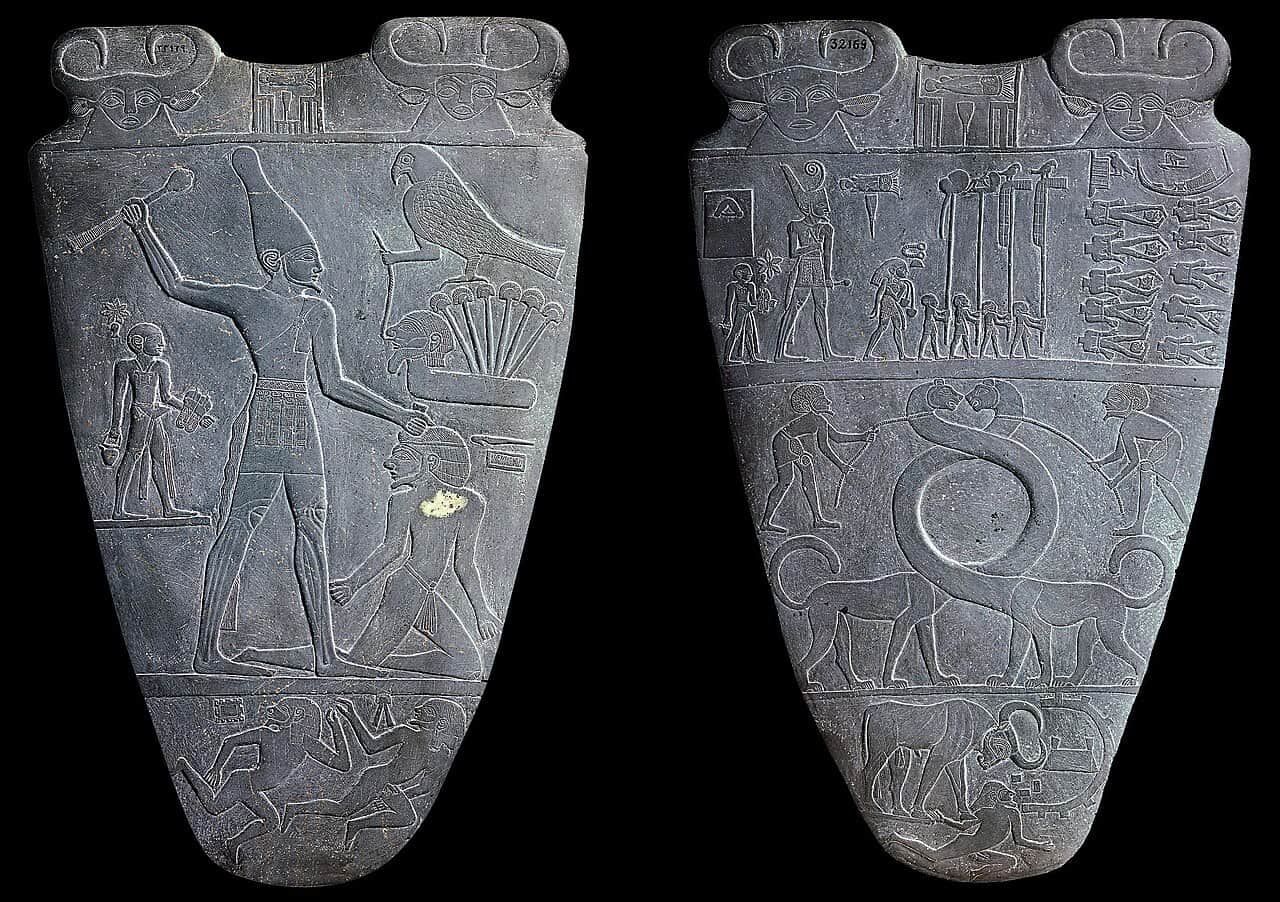
Egyptian tradition, preserved in the Turin King List, the Abydos king list carved for Seti I, and the Greek-language history written by the priest Manetho in the third century BCE, holds that a king named Menes from Thinis in Upper Egypt conquered the delta, unified the Two Lands, founded the city of Memphis at the junction between them by diverting the Nile with a dyke, ruled for around sixty years, and was killed by a hippopotamus. The archaeological record, which is contemporary rather than written centuries later, shows a series of Upper Egyptian rulers extending control northward across the fourth millennium BCE, culminating around 3100 in a single kingdom. The Narmer Palette, found at Hierakonpolis in 1898, shows a king wearing the white crown of Upper Egypt on one face and the red crown of Lower Egypt on the other - which is either a record of the unification or a claim to it. Most Egyptologists identify Menes with Narmer; a substantial minority argue for his successor Hor-Aha, and some for both, the tradition having merged them. Michael Hart ranked him 96th in The 100.
Influence Meter
72
Measured on a 100-point scale
Stands for the founding of the first great territorial state, and the longest-running one
The Evidence
What There Actually Is
For a man who appears at the head of every list of Egyptian kings, the primary evidence is a handful of objects, none of which says what we would like it to.
The Narmer Palette
A shield-shaped slate about sixty-four centimetres high, carved on both faces. One side shows Narmer in the white crown of the south striking a kneeling captive; the other shows him in the red crown of the north reviewing decapitated enemies. It is the earliest surviving object to show a single king wearing both crowns, and it is the closest thing to a founding document Egypt has.
- Found: Hierakonpolis, 1898
The Abydos king list
A wall carved for Seti I showing seventy-six royal cartouches in order, beginning with Menes. It is a religious document listing legitimate predecessors, not a history, and it silently omits rulers the New Kingdom preferred to forget.
- Position: Cartouche number one
The Naqada label
A small ivory tag from the tomb of a queen, bearing the sign mn alongside the name of Hor-Aha. It is the piece most often cited by those who identify Menes with Hor-Aha rather than Narmer, and it is about the size of a postage stamp.
- Reading: Contested
Manetho
An Egyptian priest writing in Greek for the Ptolemies, some 2,800 years after the events, and the source of the dynasty numbering everyone still uses. His work survives only in quotations by later authors who disagree with each other about the numbers.
- Distance: Further from Menes than we are from him
Herodotus
Reports that the first king, whom he calls Min, dammed the Nile to found Memphis on reclaimed ground. Egyptian priests told him this; whether it describes an engineering work or explains a city's existence after the fact is unknowable.
- Source: Priests at Memphis
The Achievement
Why Joining Two Places Mattered
Egypt is a river a thousand kilometres long with desert on both sides, and it divides naturally into two very different regions: the narrow valley of the south, and the wide marshy delta of the north. Joining them created something that had not existed anywhere before - a large territorial state, as against a city and its hinterland. Sumer at the same period was a set of competing city-states that would not be unified for another eight hundred years. The Egyptian unification produced a single authority controlling the entire course of the river within its territory, which meant it could organise irrigation and flood management along the whole length, redistribute grain between regions whose harvests failed in different years, and raise labour and taxes on a scale no city-state could approach.
The apparatus that followed is what makes the date matter. Within a few generations Egypt had hieroglyphic writing used for administration, a nationwide system of officials, a calendar, standard measures, and enormous state building projects - the pyramids begin only about six centuries later. The pattern of divine kingship established at the founding proved so stable that, with interruptions, it survived for three thousand years and thirty dynasties, outlasting the Hittites, Assyria, Babylon, Persia, and the Greek and Roman conquests as an identifiable Egyptian civilisation. No other state has ever managed anything close to that continuity.
A caution about the whole subject: it is genuinely possible that Menes never existed as a single person. Unification appears in the archaeological record as a process spread over at least a century and probably several, with Upper Egyptian rulers named Scorpion, Ka and Narmer all extending control northward in stages, and with the delta showing Upper Egyptian material culture before any of them. Founding figures who complete in one reign what actually took generations are a recurring feature of early historical traditions - Romulus, Yu the Great, Theseus - and later Egyptian scribes had good institutional reasons to want a clean beginning for a list that legitimised their own king. Michael Hart included Menes anyway, on the reasonable ground that the unification did happen, that it was the decisive act in forming the first great state, and that the tradition assigns it to one name. The honest position is that the entry is really about an event, and the name is the handle history supplied for it.
Further Reading
Books on Early Egypt
There is no biography of Menes and there cannot be one. These are about the period and the problem.
Related Publications