Michael Faraday

Michael Faraday
Born 22 September 1791 • Died 25 August 1867
Michael Faraday (1791-1867) was the son of a blacksmith, left school at about thirteen, and was apprenticed to a bookbinder. He never learned algebra. He held no degree, and for most of his career held no title beyond a professorship endowed by a private institution. He also discovered how to generate electricity from motion, which is how essentially all of the world's electrical power has been produced ever since, and he introduced the concept of the field, which is the language modern physics is written in. Einstein kept a portrait of him on his study wall.
Rank
#23
Influence
87
Field
Physicist and Chemist
Historical Perspective
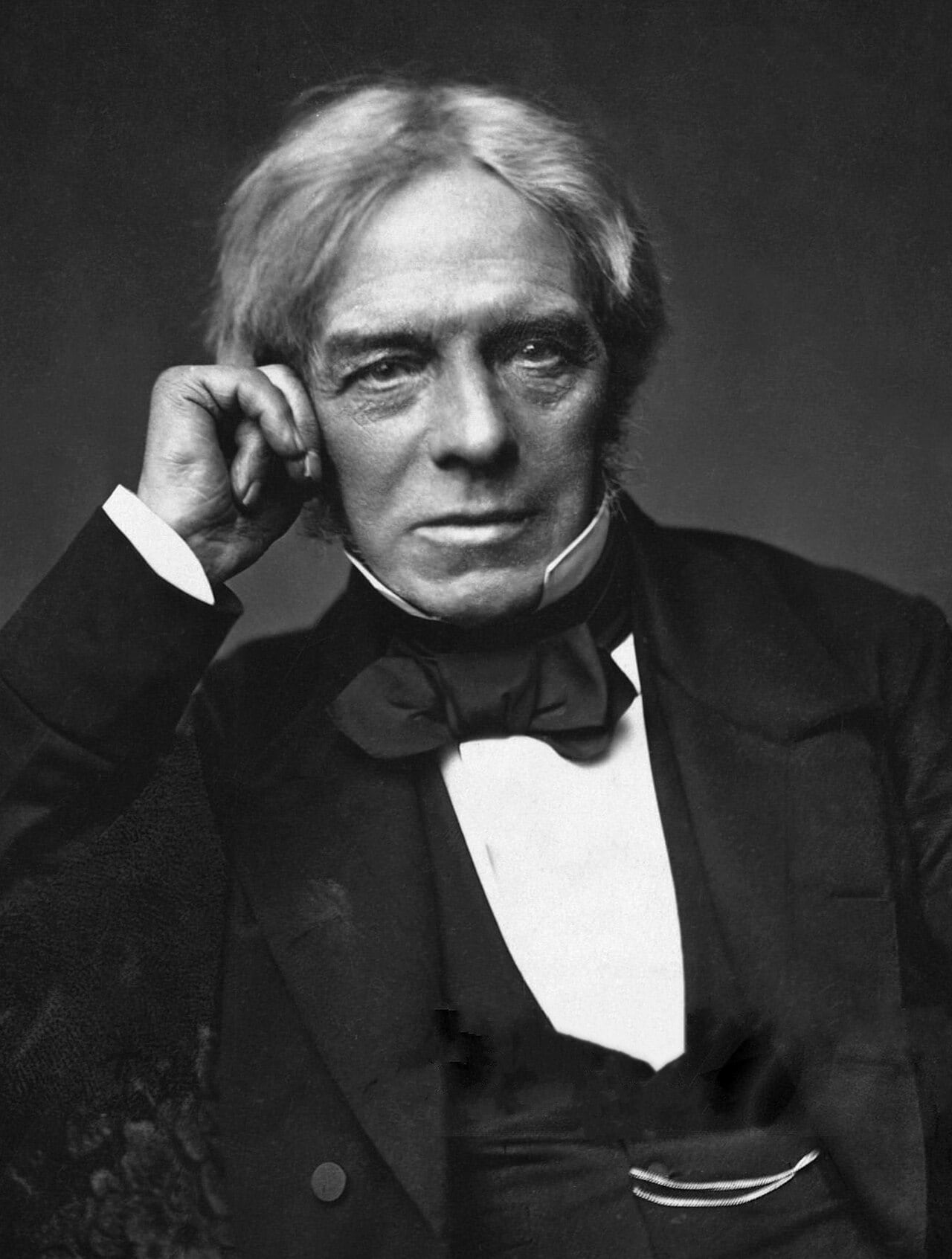
Michael Faraday was born on 22 September 1791 at Newington Butts, then just outside London, the third of four children of a blacksmith who had come south from Westmorland and struggled to find steady work. The family belonged to the Sandemanians, a small and strict Christian sect whose beliefs shaped his entire life. His formal education amounted to a few years of elementary schooling; at fourteen he was apprenticed to the bookbinder George Riebau in Blandford Street, and there he did the thing that made his career possible - he read the books he was binding. An article on electricity in an encyclopaedia and Jane Marcet's Conversations on Chemistry set him experimenting in his spare time. A customer gave him tickets to hear Humphry Davy lecture at the Royal Institution; Faraday took careful notes, bound them handsomely, and sent them to Davy with a request for employment. On 1 March 1813 he was appointed chemical assistant at the Royal Institution, where he remained for fifty-four years. Michael Hart ranked him 23rd in The 100, on the strength of a single discovery in 1831 that made the electrical age technically possible.
Influence Meter
87
Measured on a 100-point scale
Discovered how to turn motion into electricity, and gave physics the concept of the field
TL;DR
Why one 1831 experiment matters more than most centuries
Faraday showed that a changing magnetic field creates an electric current. Every practical means of generating electricity still relies on it.
! Why This Matters:
- • The discovery: Move a magnet near a coil - or change the current in a neighbouring coil - and current flows. Motion becomes electricity.
- • The machines it created: The generator, the transformer, the induction motor, and therefore the entire electrical supply industry.
- • The idea behind it: Lines of force filling space: the field, which replaced action at a distance and became the framework of modern physics.
- • Who wrote it down: James Clerk Maxwell turned Faraday's pictures into equations, and Faraday's law is one of the four.
? Key Data:
- • Date of the induction ring experiment: 29 August 1831
- • Years at the Royal Institution: 54 (1813-1867)
- • Christmas Lecture series delivered: 19, between 1827 and 1860
- • Hart's rank: 23rd of 100
Continue reading below for the full detailed article →
1805-1812
An Education Made of Other People's Books
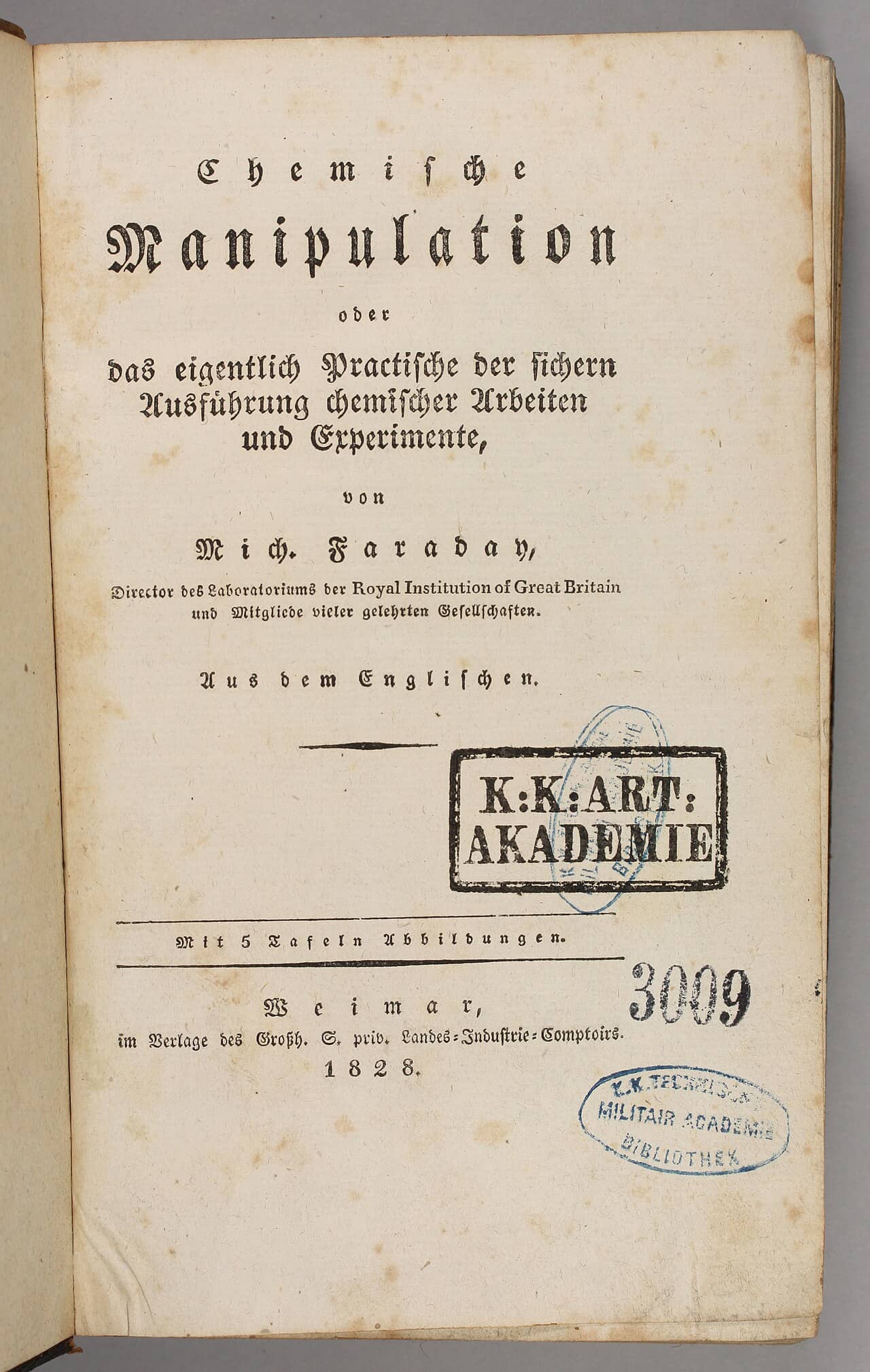
Riebau's shop was an unusually good place to be a curious apprentice. Faraday later said he read whatever passed through his hands, and two items in particular set the direction of his life: the article on electricity in the third edition of the Encyclopaedia Britannica, which he read while stitching the volume, and Jane Marcet's Conversations on Chemistry, a book written to explain the subject to women excluded from formal education. He built a crude electrostatic generator and a voltaic pile from scrap, joined the City Philosophical Society to hear lectures on natural philosophy, and taught himself to write clear scientific prose by copying out and criticising his own notes. He was, in the exact sense, an autodidact - and he stayed one. He never acquired mathematics beyond simple arithmetic, which turned out to matter enormously: unable to hide behind equations, he had to think in pictures, and the pictures he invented became the field concept.
1812-1813
The Job Application That Worked
In 1812 a customer of Riebau's, the musician William Dance, gave Faraday tickets to a series of lectures by Humphry Davy - then the most celebrated scientist in Britain and a magnificent public performer - at the Royal Institution in Albemarle Street. Faraday attended, took three hundred pages of notes, illustrated and bound them himself, and sent the volume to Davy along with a letter asking for any scientific position at all. It was, on the face of it, hopeless: an apprentice tradesman with no education writing to the Institution's star.
What made it work was an accident. Davy had been experimenting with nitrogen trichloride, a violently unstable compound, and an explosion had temporarily damaged his eyesight; he needed someone to take dictation and handle apparatus. He employed Faraday briefly as an amanuensis, and when a laboratory assistant was dismissed after a fight, offered him the post. Faraday started on 1 March 1813, at a wage lower than he had earned as a binder, with a room in the attic and access to the best-equipped laboratory in the country. He would be its director within twelve years and hold the Fullerian Professorship of Chemistry there from 1833 until his death.
From 1813 to 1815 Faraday accompanied Davy and his wife on an eighteen-month tour of the Continent, meeting Volta in Milan, Ampère in Paris and working in improvised laboratories along the way. It was an extraordinary scientific education and a personal humiliation: Davy's valet had refused to travel, so Faraday was required to double as a servant, and Lady Davy treated him as one. He considered abandoning science and going home. The episode is worth remembering because of what it says about the social distance he crossed - and because in later life, when he was the most admired scientist in Britain, he consistently refused the honours that would have marked the crossing.
Chronology
From Blandford Street to Albemarle Street
One of the steepest social climbs in the history of science, drawn as the flight of steps it effectively was.
1820-1830
Ten Years as a Chemist
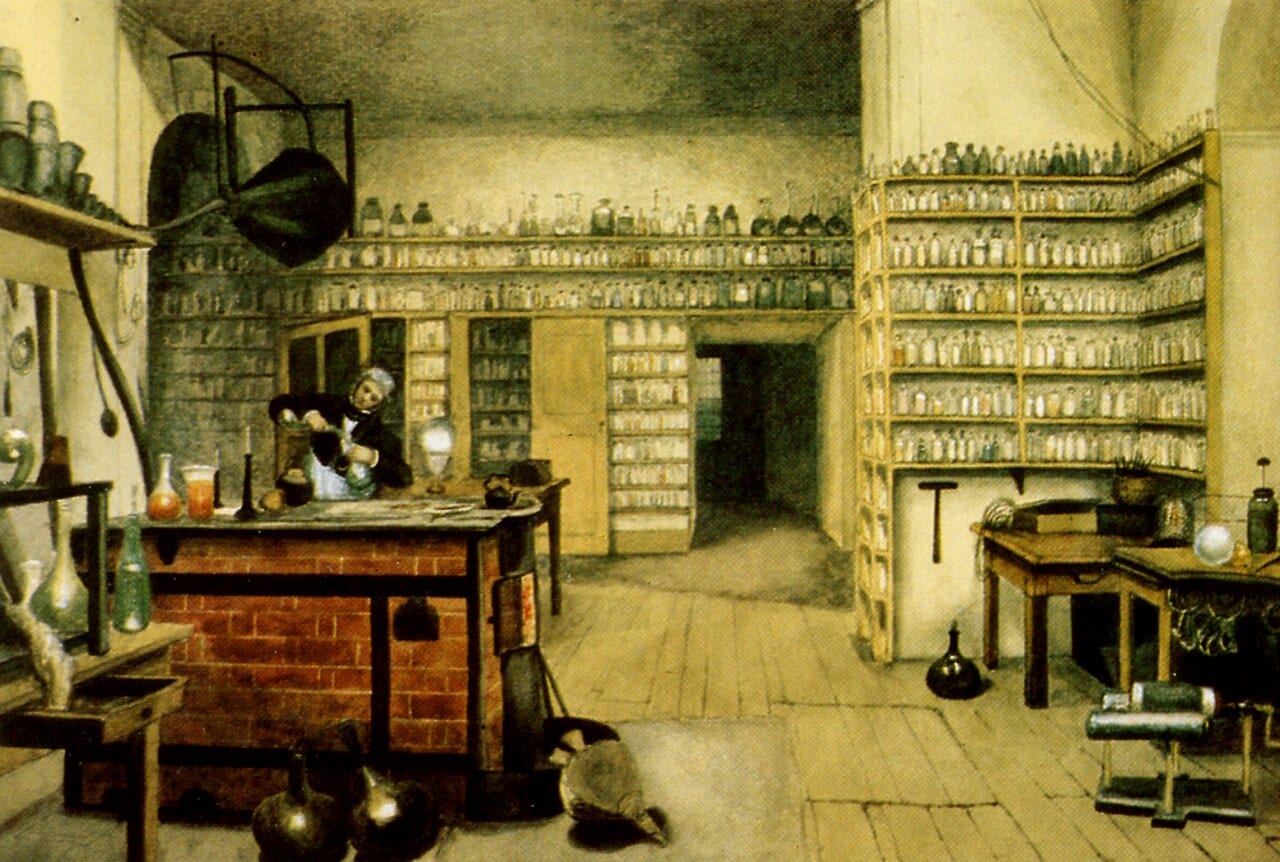
Faraday's reputation was made in chemistry long before he touched electromagnetism seriously. He was the first to liquefy chlorine, in 1823, by heating its hydrate in a sealed tube - a technique that opened the study of gases under pressure. In 1825, examining an oily residue from the London gas works, he isolated and characterised a new hydrocarbon he called bicarburet of hydrogen; it is benzene, one of the most important molecules in industrial chemistry and the compound whose ring structure would occupy chemists for the next forty years. He synthesised the first chlorocarbons, investigated steel alloys and optical glass for the Admiralty, described the clathrate hydrate of chlorine, and in 1827 published Chemical Manipulation, a practical manual on how to actually do laboratory work that stayed in use for decades. He was elected a Fellow of the Royal Society in 1824 and made Director of the Laboratory in 1825.
1821
The First Electric Motor
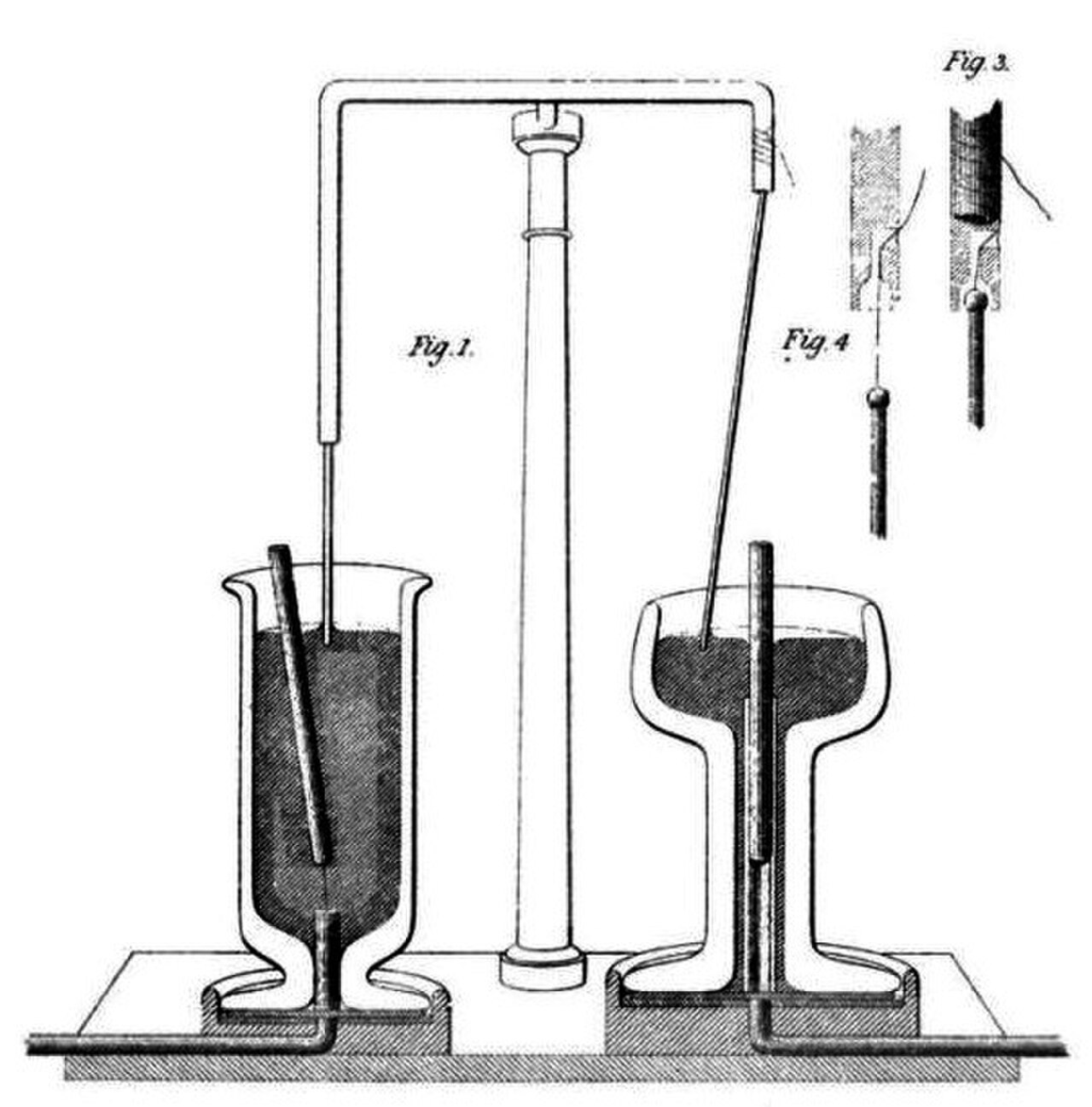
In 1820 the Danish physicist Hans Christian Ørsted had noticed that a compass needle deflects near a wire carrying a current - the first evidence that electricity and magnetism are connected at all. Faraday was asked to write a review of the resulting flurry of work, and in the course of repeating the experiments in September 1821 he produced something new: he suspended a wire so that it dipped into a bath of mercury with a magnet at the centre, passed a current, and the wire began to rotate continuously around the magnet. It is the first conversion of electrical energy into continuous mechanical motion - the ancestor of every electric motor - and Faraday, aged thirty, published it with insufficient credit to William Hyde Wollaston, who had been working on a related idea. The resulting accusation of plagiarism strained his relations with the scientific establishment, and with Davy in particular, for years.
29 August 1831
The Induction Ring
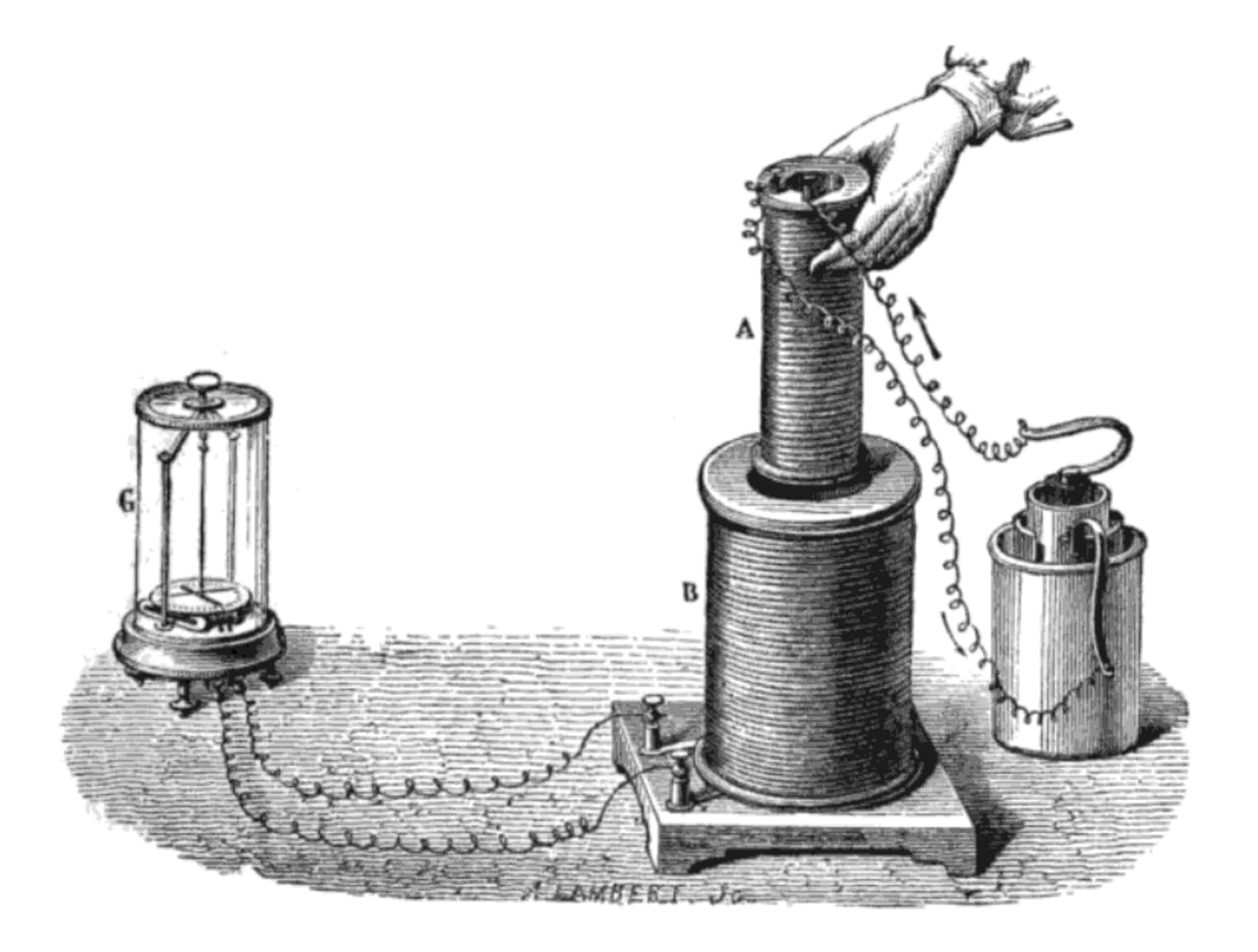
Faraday wound two separate coils of insulated wire around opposite sides of an iron ring, connected one to a battery and the other to a galvanometer, and looked for a current in the second circuit. The steady state gave nothing. But at the instant he connected the battery, and again at the instant he disconnected it, the galvanometer needle jumped. The current was induced not by the presence of a magnetic field but by its change. He spent the following months establishing the general rule - moving a magnet through a coil produces the same effect, as does moving the coil past the magnet - and then built a copper disc rotating between the poles of a magnet that delivered a continuous current, the first dynamo. Almost every kilowatt-hour generated anywhere in the world since has been produced by this principle: something spins, a magnetic field changes, and current flows. The turbine may be driven by falling water, burning coal, steam from a reactor or wind, but the conversion at the end is Faraday's.
What Induction Made Possible
The experiment took an afternoon. Its consequences took a century to build out, and are still the basis of the electrical world.
- The electrical generator: Spin a conductor in a magnetic field and you get current. This remains the only method by which electricity is produced at industrial scale.
- The transformer: Two coils sharing an iron core exchange energy through a changing field, allowing voltage to be stepped up for transmission and down for use - the reason a national grid can exist.
- The induction motor: Running the same principle backwards turns electricity into rotation, powering everything from factory machinery to washing machines and electric cars.
- The field concept: Faraday insisted that the space around a magnet is itself modified, mapped by lines of force. Physics abandoned action at a distance and adopted fields, which is how gravitation, electromagnetism and quantum theory are all now framed.
- Maxwell's equations: Faraday's law of induction is one of the four equations Maxwell assembled in the 1860s, from which he predicted electromagnetic waves and deduced that light is one of them.
- Wireless communication: Those predicted waves, confirmed by Hertz in 1887, became radio, radar, television, mobile telephony and wifi - all downstream of a concept invented by a man who could not do calculus.
The Record
Faraday's Principal Discoveries
An unusually long list for one career, spread across chemistry, electricity, magnetism and optics.
Electromagnetic rotation
Continuous mechanical motion produced by an electric current - the first electric motor in principle, if not yet in useful form.
- Became: The electric motor
Liquefaction of chlorine
The first liquefaction of a gas thought to be permanent, opening the field of gases under pressure.
- Method: Heating the hydrate in a sealed tube
Benzene
Isolated from gas-works residue and characterised as a new hydrocarbon; became the foundational aromatic compound of organic and industrial chemistry.
- He called it: Bicarburet of hydrogen
Electromagnetic induction
A changing magnetic field induces a current in a nearby conductor. The single most consequential experimental result of the nineteenth century.
- Date: 29 August 1831
Laws of electrolysis
The mass of a substance deposited at an electrode is proportional to the quantity of electric charge passed, and to its equivalent weight - the first quantitative link between electricity and matter, and evidence that charge itself comes in units.
- Implied: Discreteness of charge
The vocabulary of electrochemistry
With the polymath William Whewell he coined or fixed the terms electrode, anode, cathode, electrolyte and ion, still universal.
- With: William Whewell
The Faraday cage
Showed with a charged mesh-lined room, and earlier with the ice-pail experiment, that excess charge sits on a conductor's outer surface and the interior is shielded - the basis of electromagnetic screening.
- Principle: Electrostatic shielding
The Faraday effect
A magnetic field rotates the plane of polarised light passing through glass - the first demonstrated link between magnetism and light, and a strong hint that light is electromagnetic.
- Significance: Magneto-optics
Diamagnetism
Found that all matter responds to a magnetic field, most substances being weakly repelled, which generalised magnetism from a property of iron to a property of everything.
- Sample: Heavy glass, then bismuth
1833-1834
Weighing Electricity
Faraday's work on electrolysis is less famous than induction and nearly as important. By passing measured quantities of charge through solutions and weighing what was deposited at the electrodes, he established that the amount of chemical change is strictly proportional to the charge passed, and that for a given charge the masses of different elements deposited stand in the ratio of their chemical equivalents. The implication, which he stated cautiously and others later seized on, is that electricity is not a continuous fluid: it comes in definite portions associated with definite atoms of matter. When J. J. Thomson identified the electron in 1897, the quantity of charge per mole that Faraday had effectively measured - now called the Faraday constant - was one of the numbers that made the identification possible. Faraday also gave the subject its language, working with William Whewell to replace the existing muddle with electrode, anode, cathode, electrolyte and ion.
1845-1855
Lines of Force, and a Physics Without Equations
Because he could not calculate, Faraday visualised. Where his contemporaries described magnets as exerting forces across empty space, he pictured the space itself as filled with curved lines of force, which iron filings scattered on paper made visible, and which he treated as physically real - stretched, compressed, and capable of carrying strain. Most mathematical physicists of the day regarded this as a crutch for a man who could not do the analysis properly. It was in fact the more radical position, and the correct one. In 1845 his discovery that a magnetic field could twist a beam of polarised light, and that all substances respond to magnetism, told him that magnetism was not a special property of iron but something that pervaded space and matter generally.
The vindication came from a Scottish mathematician half his age. James Clerk Maxwell read Faraday's Experimental Researches carefully, took the lines of force literally, and between 1855 and 1865 translated them into the equations that bear his name - from which he derived that electromagnetic disturbances travel at the speed of light, and concluded that light is one of them. Maxwell was explicit about the debt, remarking that Faraday's methods, though never expressed in conventional symbols, were mathematical in the deepest sense and that he had been in effect a mathematician of a very high order. Fields have been the basic furniture of physics ever since; general relativity and quantum field theory are both written in the idiom Faraday invented while sprinkling iron filings on a card.
1827-1860
The Candle, and the Christmas Lectures
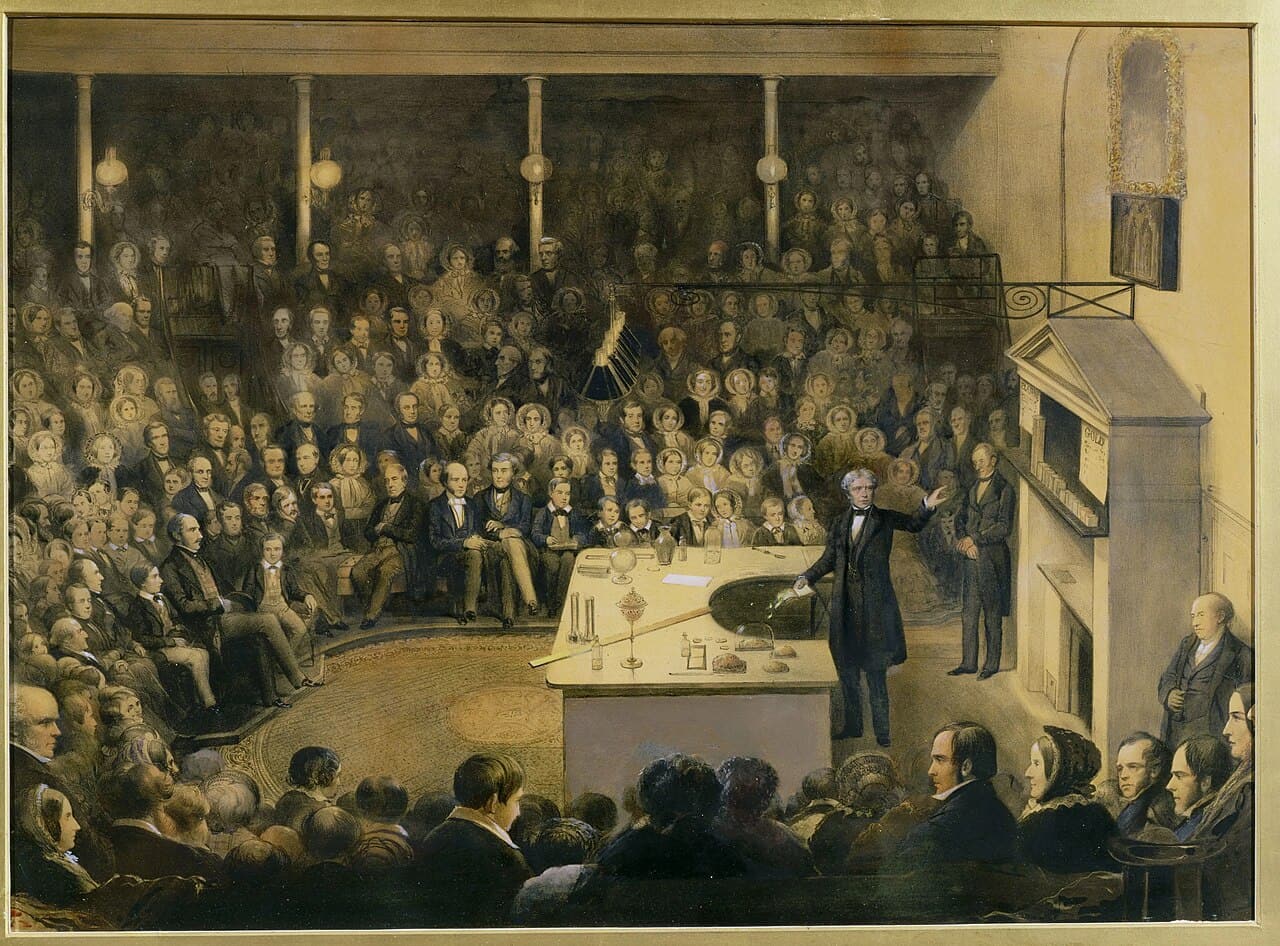
Faraday believed that science belonged to everyone and put an extraordinary amount of effort into saying so in public. He founded the Royal Institution's Friday Evening Discourses in 1825 and delivered the Christmas Lectures for young people nineteen times between 1827 and 1860, a series that continues to this day. The most celebrated set, given in 1848 and published in 1861 as The Chemical History of a Candle, takes a single burning candle and unpacks from it combustion, respiration, the composition of air and water, convection and the conservation of matter - all demonstrated live at the bench, in plain language, without condescension. It has never been out of print in more than a century and a half and remains a model of scientific explanation. He also worked for decades as scientific adviser to Trinity House on lighthouse illumination, advised on the pollution of the Thames, and in the 1850s declined a government request to advise on the production of chemical weapons for the Crimean War, on the grounds that he would have nothing to do with it.
Faraday refused a knighthood, and twice refused the presidency of the Royal Society - the highest office British science could offer. His stated reason was religious: as a Sandemanian he held that seeking worldly honour was incompatible with his faith, and he said he wished to remain plain Mr Faraday to the end. He also declined burial in Westminster Abbey, and was buried instead in the dissenters' section of Highgate Cemetery. He turned down lucrative consulting and expert-witness work in order to keep his time for research, and lived his whole career on an institutional salary in rooms above the laboratory.
Written Works
Books by Michael Faraday
He wrote clearly and constantly, keeping a numbered laboratory diary for forty years that ran to nearly sixteen thousand entries.
Further Reading
Books About Faraday
Biographies covering the science, the faith, and the improbable social ascent.
Faraday, Maxwell, and the Electromagnetic Field
A joint biography tracing how Faraday's physical intuition and Maxwell's mathematics combined into the field theory that underlies modern physics - the best starting point for the ideas.
- Published: 2014
The Electric Life of Michael Faraday
A readable narrative biography, strong on the apprenticeship, the Davy relationship, and the years of experimental work at Albemarle Street.
- Published: 2006
Michael Faraday: Sandemanian and Scientist
The standard study of his religion and how it shaped his conduct, his refusals of honour, and arguably his conviction that nature was unified.
- Published: 1991
Michael Faraday: A Biography
The major scholarly life, written by a historian of science and still the most thorough account of the experimental work itself.
- Published: 1965
Legacy
Why Number Twenty-Three
Michael Hart ranked Faraday 23rd, just behind Watt and just ahead of Maxwell, and the placement captures something real about the pair: Faraday found the phenomenon and Maxwell found its mathematics, and neither would have mattered nearly as much alone. The practical case for Faraday is almost too large to state. Electrical generation, transmission and use - the grid, the motor, the transformer, the whole physical infrastructure of modern life - all descend from experiments he performed between 1821 and 1831 with hand-wound coils and a galvanometer. There is a story, probably embellished, that when Gladstone asked what use his electrical work could possibly be, Faraday replied that one day the government would tax it. Whether or not he said it, the prediction was correct.
The theoretical case is subtler and may be larger. By insisting that space between bodies is not empty but structured by lines of force, Faraday replaced action at a distance with the field, and physics has been a science of fields ever since. He did this without algebra, on the strength of an extraordinary experimental instinct and an unusual willingness to trust a picture over an orthodoxy. The unit of capacitance is the farad; the Faraday constant carries his name in chemistry; his portrait hung in Einstein's study beside Newton and Maxwell. For a blacksmith's son with four years of schooling, who declined every title offered him and died plain Mr Faraday in a house at Hampton Court, it is a difficult record to better.
Related Publications