Joseph Stalin

Joseph Stalin
Born 18 December 1878 • Died 5 March 1953
Lenin, dying, warned the party that Stalin had concentrated unlimited authority in his hands and should be removed from the post of General Secretary. The warning was suppressed. The post itself was administrative - it controlled appointments and paperwork, which nobody senior thought mattered. Within five years the man who controlled who got which job controlled everything, and within fifteen he had killed most of the people who had been at the top of the party alongside him. This profile is included because the list measures consequence, not merit.
Rank
#66
Influence
85
Field
Dictator
Historical Perspective
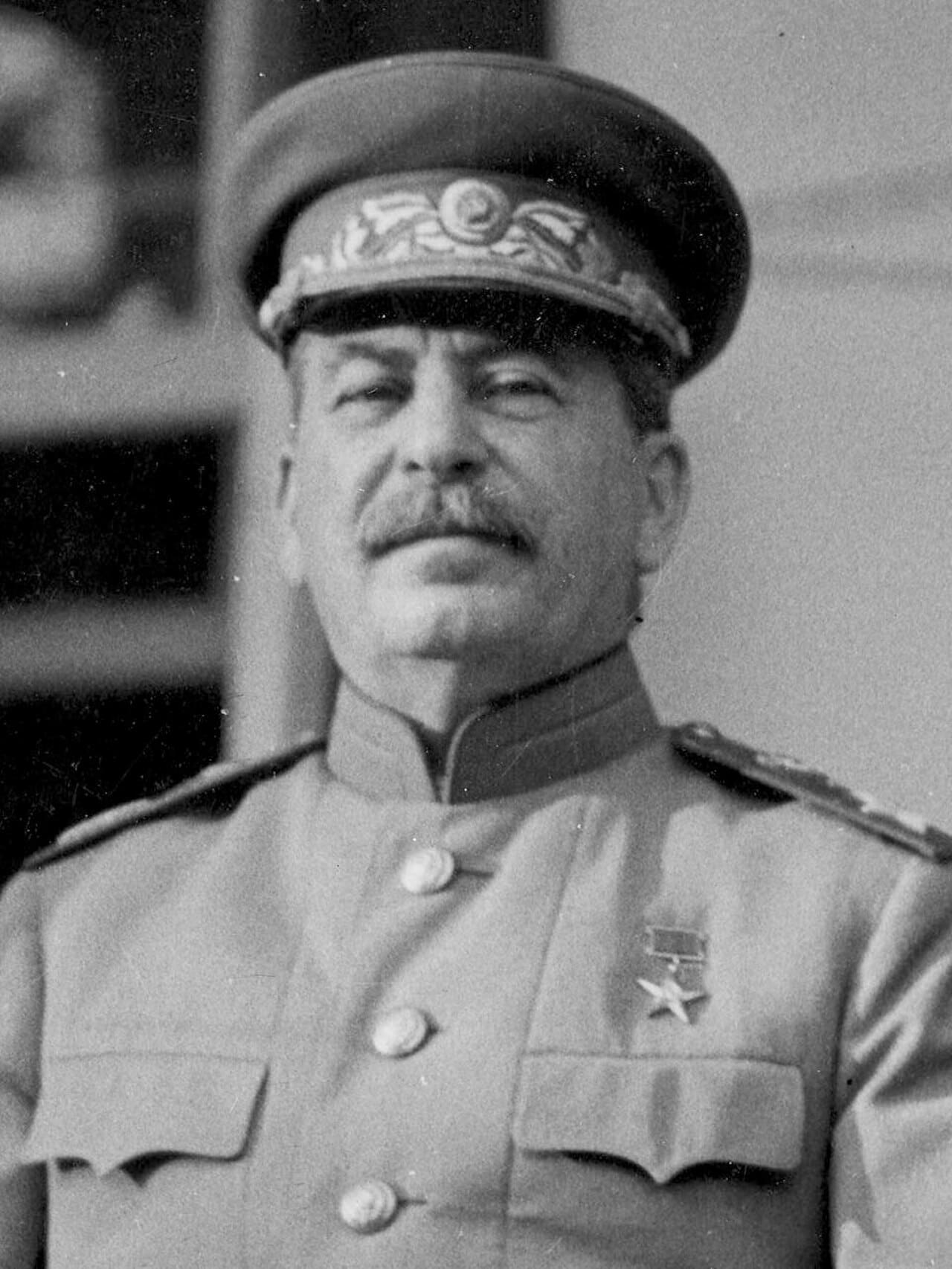
Ioseb Jughashvili was born at Gori in Georgia on 18 December 1878, son of a violent alcoholic cobbler, and won a scholarship to the Tiflis theological seminary, which he left as a Marxist. He spent the years before 1917 organising strikes, editing party papers and financing the Bolsheviks partly through armed robbery, and was arrested and exiled repeatedly. After the October Revolution he held second-rank posts until his appointment as General Secretary in 1922 - an administrative job through which he controlled appointments across the party. Lenin's death in 1924 opened a succession struggle he won by 1929, outmanoeuvring Trotsky, then the left, then the right. From 1928 he drove collectivisation and the Five-Year Plans; the resulting famine of 1932-33 killed millions, with Ukraine worst affected. The Great Terror of 1936-38 shot at least seven hundred thousand people and sent millions to the Gulag. He signed the Molotov-Ribbentrop Pact in August 1939, was invaded in June 1941, and led the USSR through a war that cost some twenty-seven million Soviet lives. He died at Kuntsevo on 5 March 1953. Michael Hart ranked him 66th in The 100.
Influence Meter
85
Measured on a 100-point scale
A measure of consequence, not merit: industrialisation, mass death, and half of Europe
1922-1929
How a Filing Job Became a Dictatorship
The General Secretaryship was created in 1922 as a clerical position: it managed the party's records and, crucially, its appointments. Trotsky, Zinoviev and the other leading figures regarded it as beneath them, which is why Stalin got it. Over the following years he filled thousands of positions across the party and the republics with people who owed him their careers, and when the Central Committee voted on anything, he had already chosen most of the voters. It is the clearest demonstration in modern history that control of personnel is control of an institution.
Lenin saw it late. In notes dictated in December 1922 and January 1923, later called his Testament, he wrote that Stalin had concentrated boundless power in his hands and that he was not sure Stalin would use it with sufficient caution, and in a postscript recommended his removal on grounds of rudeness. The document was suppressed at the Thirteenth Congress in 1924 by colleagues who considered Trotsky the greater threat. Stalin then destroyed them in sequence: allying with Zinoviev and Kamenev to defeat Trotsky, then with Bukharin to defeat Zinoviev and Kamenev, then turning on Bukharin. All of them were shot in the 1930s except Trotsky, who was murdered in Mexico in 1940 with an ice axe.
Collectivisation from 1929 forced peasants onto state and collective farms, confiscated grain to feed the cities and pay for imported machinery, and destroyed the more productive smallholders as a class - the so-called kulaks, of whom some 1.8 million were deported. The result was famine across the grain-growing regions in 1932-33. Estimates of total deaths run from about five to seven million, of whom roughly 3.5 to 5 million were in Ukraine. Grain continued to be exported while people starved, movement out of the affected villages was restricted by decree, and the famine was denied entirely for decades. Whether the Ukrainian famine - the Holodomor - constitutes genocide is a live legal and historical argument; more than thirty countries and the European Parliament have formally recognised it as such, while some historians hold that the intent was to break peasant resistance rather than to destroy a nation. That it was caused by policy, and that the policy continued once the deaths were known, is not disputed.
1936-1953
The Machinery
The scale is documented from Soviet archives opened after 1991, and the figures below are the ones most historians now work with.
The Great Terror
At least 680,000 to 750,000 people executed in two years, on quotas set centrally and filled locally. The victims were overwhelmingly ordinary citizens rather than party figures, though the show trials of the old Bolsheviks are what the period is remembered for.
- Executed: About 700,000
The Gulag
A network of labour camps through which some eighteen million people passed. Mortality varied enormously by camp and year; well over a million died in the system.
- Passed through: About 18 million
Deportation of nationalities
Entire peoples were moved by force - Koreans, Volga Germans, Chechens, Ingush, Crimean Tatars, Kalmyks and others. Deaths in transit and in exile ran to hundreds of thousands.
- Peoples deported: More than a dozen
The officer purge
Three of five marshals, thirteen of fifteen army commanders and a large share of the senior officer corps were shot or imprisoned, four years before the German invasion. The cost in 1941 was catastrophic.
- Marshals shot: 3 of 5
Katyn
Some 22,000 Polish officers, police and intellectuals shot on Politburo order and buried in mass graves. The USSR blamed Germany until 1990.
- Admitted: 1990
The Doctors' Plot
A fabricated conspiracy of mostly Jewish physicians, and the opening of what appeared to be a new antisemitic terror. It ended only because Stalin died.
- Ended by: His death
1939-1945
The Pact, the Invasion, and the Victory
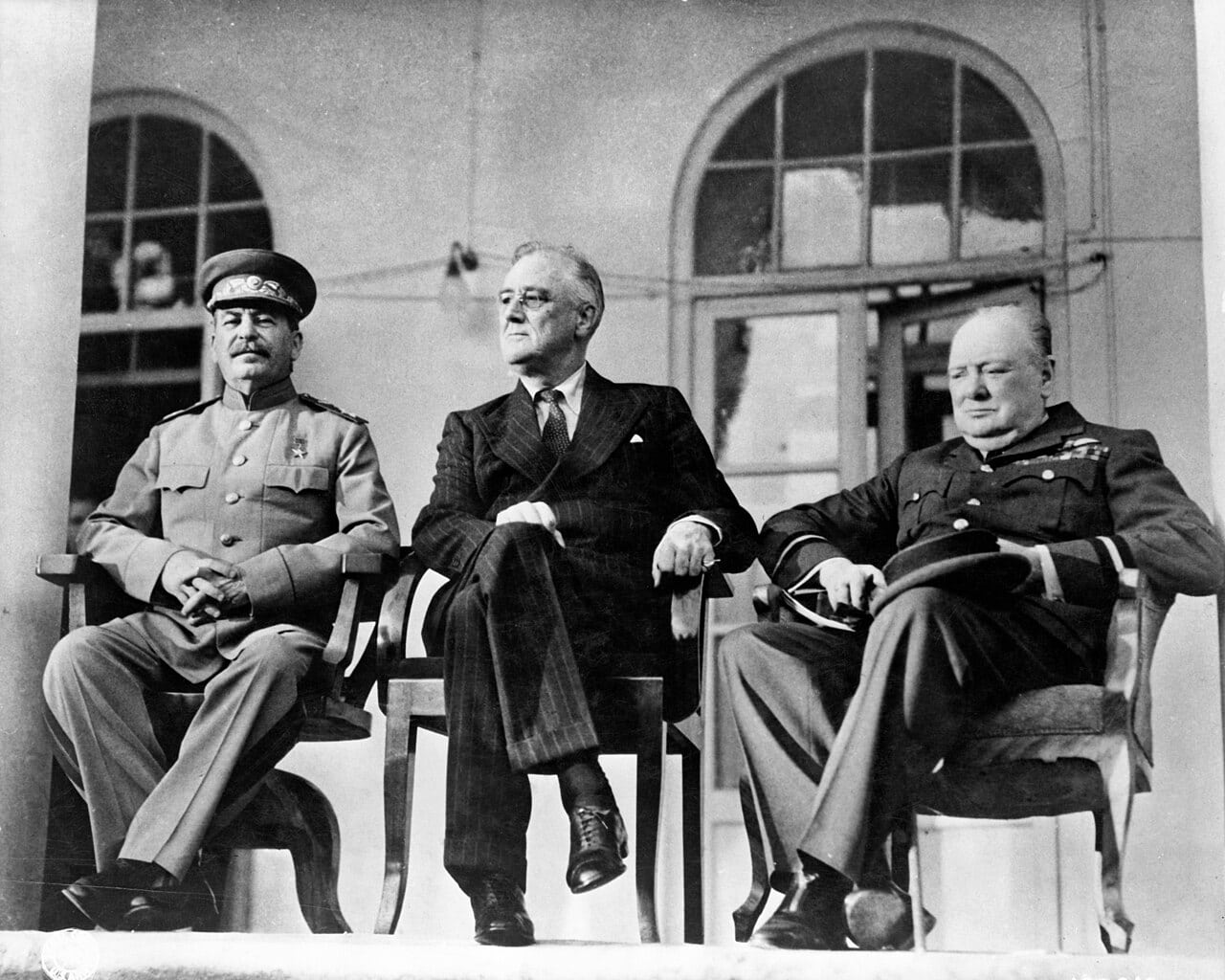
In August 1939 Stalin signed a non-aggression pact with Nazi Germany containing a secret protocol dividing eastern Europe; the Soviet Union then occupied eastern Poland, the Baltic states and parts of Romania and Finland. He appears to have genuinely disbelieved the extensive intelligence warning of a German attack, and when Operation Barbarossa came on 22 June 1941 the Red Army - short of its purged officers - lost catastrophically for months. Stalin withdrew to his dacha for several days. He then recovered, stayed in Moscow when the government evacuated, and directed a war effort that moved entire industries beyond the Urals and eventually broke the Wehrmacht at Stalingrad and Kursk. The Soviet Union bore the largest share of the fighting in Europe and paid around twenty-seven million dead, the great majority of them civilians. The victory left him controlling eastern Europe, gave the regime enormous legitimacy, and is the principal reason his reputation in Russia remains contested rather than settled.
A Note on the Figures
Soviet archives opened after 1991 - summarised in standard scholarship Holodomor Gulag
Death tolls attributed to Stalin's rule were contested for decades, with Cold War estimates ranging from a few million to sixty. The opening of the Soviet archives after 1991 narrowed the range considerably. Most specialists now put excess deaths directly attributable to his policies - executions, the Gulag, deportations and the famines - at somewhere between six and nine million, with wider estimates that include the demographic effects of the famines running higher.
This profile uses those archive-based figures rather than the higher Cold War estimates or the lower official Soviet ones. Where a question remains genuinely open, such as whether the Holodomor meets the legal definition of genocide, it is described as open rather than resolved in either direction.
Last verified: 22 Aug 2026
Further Reading
Books About Stalin
The archival opening after 1991 transformed the field, and most of the essential work postdates it.
Legacy
Why Number Sixty-Six
Michael Hart ranked Stalin 66th, and as with Hitler the ranking measures effect rather than merit. In twenty-five years he converted an agrarian country into an industrial and then a nuclear power, at a cost in human life that is among the highest ever exacted by a government on its own population. He then emerged from the Second World War controlling eastern Europe and half of Germany, which produced the Cold War, the division of the continent for forty-four years, the arms race, and proxy conflicts on every other continent. The political geography of the second half of the twentieth century is largely his.
The other legacy is what his rule did to the idea he claimed to serve. Khrushchev's secret speech in 1956 denounced the cult of personality and the terror, and the shock split communist parties worldwide and began the long delegitimisation that ended in 1991. For anyone assessing Marx at twenty-seven on this same list, Stalin is the awkward middle term: the largest attempt to build the society Marx described, run by a man who cited him constantly, and the reason the attempt is now generally remembered by its body count.
Related Publications