Thomas Jefferson

Thomas Jefferson
Born 13 April 1743 • Died 4 July 1826
Jefferson wrote that all men are created equal, and he wrote it in a house built and maintained by people he owned. He denounced slavery in print as a moral depravity and an abominable crime, drafted legislation to restrict it, and never freed more than a handful of the roughly six hundred people he held across his lifetime. Both facts are him. The United States has spent two hundred and fifty years working through the gap between the sentence and the man who wrote it, and the sentence has generally won.
Rank
#64
Influence
80
Field
Statesman and Writer
Historical Perspective
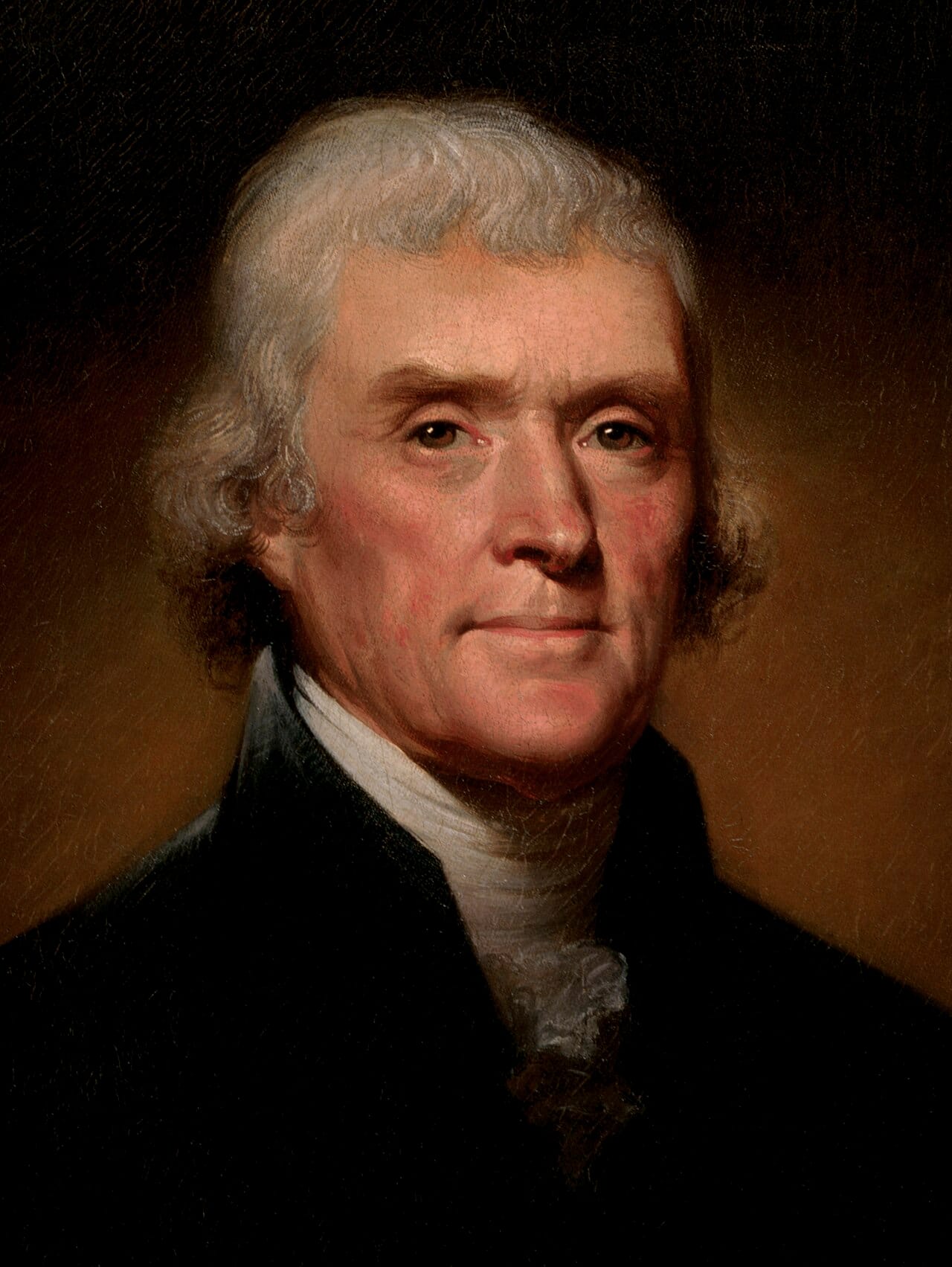
Thomas Jefferson was born on 13 April 1743 at Shadwell in Virginia, son of a planter and surveyor, and inherited land and enslaved people at fourteen. He studied at the College of William and Mary, trained as a lawyer, and entered the Virginia House of Burgesses. In June 1776, aged thirty-three and chosen largely because he wrote well, he drafted the Declaration of Independence; Congress cut roughly a quarter of his text, including a passage blaming the king for the slave trade. He served as governor of Virginia, minister to France from 1785, Washington's Secretary of State, Adams' vice-president, and won the presidency in the bitterly contested election of 1800. As president he bought Louisiana from France in 1803, doubling the country's territory, and sent Lewis and Clark to survey it. He retired to Monticello, founded the University of Virginia in 1819, and died there on 4 July 1826 - the fiftieth anniversary of the Declaration, and within hours of John Adams. Michael Hart ranked him 64th in The 100.
Influence Meter
80
Measured on a 100-point scale
Wrote the founding statement of modern democratic legitimacy, and doubled a continent
June 1776
Seventeen Days, and One Sentence
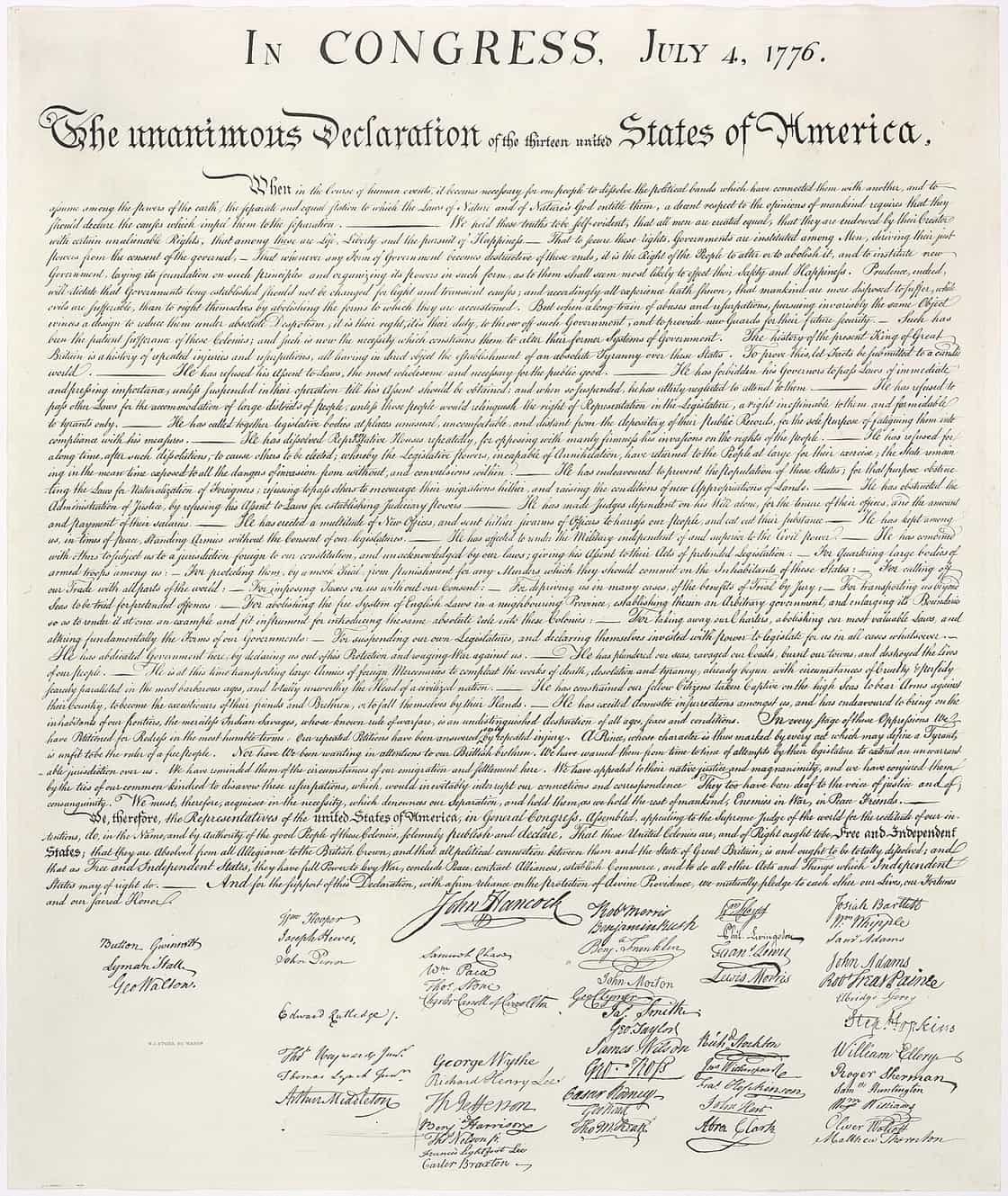
Jefferson drafted the Declaration over about seventeen days in a rented room in Philadelphia, on a portable writing desk of his own design, and he was not pleased with what Congress did to it - he sat through the edits in silence while Franklin tried to console him. Roughly a quarter was cut, including a long passage arraigning George III for the slave trade, which was struck at the insistence of South Carolina and Georgia and, Jefferson noted, of northern delegates whose states profited by carrying enslaved people. What survived is the second paragraph, and it is one of the most consequential pieces of prose ever written in English: that these truths are self-evident, that all men are created equal, that they are endowed with certain unalienable rights, and that governments derive their just powers from the consent of the governed. The philosophy is Locke's, the phrasing is Jefferson's, and the combination has been quoted in independence declarations, constitutions and civil rights campaigns across the world ever since.
The Louisiana Purchase of 1803 transferred some 828,000 square miles - about 2.1 million square kilometres, all or part of fifteen future states - from France to the United States for fifteen million dollars, roughly three cents an acre. Jefferson had sent envoys to Paris to try to buy New Orleans and secure access to the Mississippi; Napoleon, having lost an army to yellow fever and revolution in Haiti and needing money for a European war, offered the entire territory instead. The irony is that Jefferson was a strict constructionist who believed the federal government possessed only powers the Constitution explicitly granted, and the Constitution said nothing about buying territory. He considered a constitutional amendment, concluded there was no time, and went ahead - the largest single expansion in American history, executed by the man most committed to limiting federal power.
Monticello
Six Hundred People
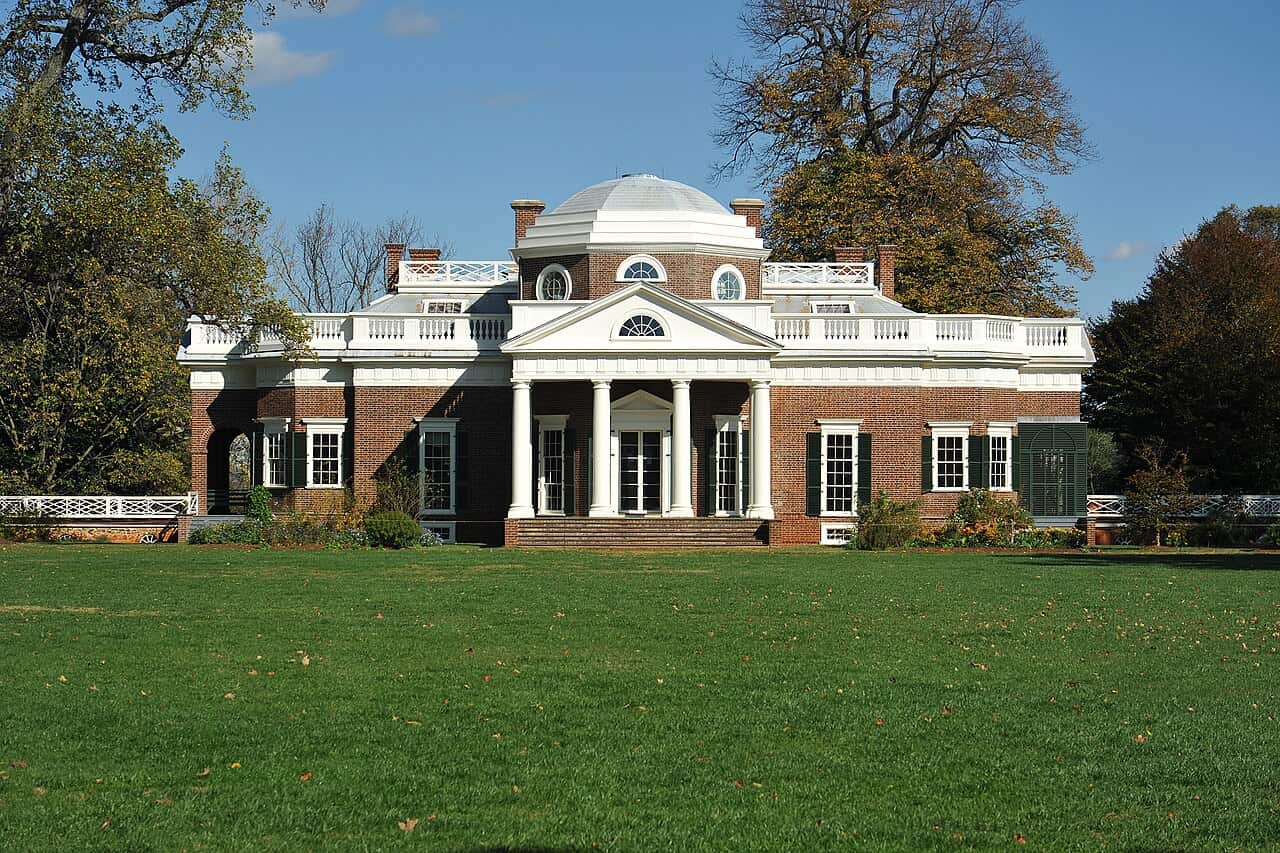
Across his life Jefferson held about six hundred people in slavery, with around a hundred and thirty at Monticello at any time. He freed two during his lifetime and five in his will, all of them members of the Hemings family. His plantation ran on their labour and his debts were secured against them; when he died, deeply insolvent, more than a hundred people were sold at auction and families were separated. He wrote in Notes on the State of Virginia that slavery was a perpetual exercise of the most boisterous passions, that he trembled for his country when he reflected that God is just, and in the same book advanced arguments for the biological inferiority of Black people that were quoted by defenders of slavery for the next century. He proposed emancipation schemes that were always coupled with deportation. Sally Hemings, an enslaved woman who was his late wife's half-sister, bore six children whose paternity DNA evidence published in 1998 and subsequent scholarship attribute to him; she was about sixteen when the relationship began in Paris, where she was legally free and returned with him anyway on a promise regarding her children. The Thomas Jefferson Foundation now states his paternity as settled.
The Record
What He Chose for His Own Epitaph
He specified his gravestone himself and listed three things, none of which was the presidency.
Author of the Declaration of American Independence
The document, and specifically the second paragraph, which supplied the language of natural rights to two centuries of independence and civil rights movements worldwide.
- On the epitaph: First
Author of the Virginia Statute for Religious Freedom
Disestablished the Anglican church in Virginia and barred state support for any religion. It became the model for the First Amendment, and his phrase about a wall of separation between church and state has shaped American constitutional law ever since.
- On the epitaph: Second
Father of the University of Virginia
He designed the buildings, planned the curriculum, chose the books and hired the faculty. It was the first American university with no religious affiliation and no compulsory chapel.
- On the epitaph: Third
The Louisiana Purchase
Doubled the territory of the United States at about three cents an acre, and set the country on the path to the Pacific.
- Not on the epitaph: Nor the presidency
The Lewis and Clark expedition
Sent to find a route to the Pacific and catalogue what was there. It returned with maps, specimens and the information that made westward settlement practical - and, for the peoples already living there, catastrophic.
- Led by: Meriwether Lewis and William Clark
The Embargo Act
His attempt to coerce Britain and France by halting American foreign trade. It wrecked the New England economy, was widely evaded, and is generally judged the worst decision of his presidency.
- Outcome: Repealed in 1809
Further Reading
Books About Jefferson
The historiography has shifted substantially since the 1990s, largely over Monticello and the Hemings evidence.
Legacy
Why Number Sixty-Four
Michael Hart ranked Jefferson 64th, well below Washington at twenty-six, and the ordering reflects a judgement that founding the office mattered more than writing the document. The counter-case is that the document travelled further than the office. Lincoln built the Gettysburg Address on the proposition that all men are created equal and dated the nation from 1776 rather than 1789 to do it; Martin Luther King called the Declaration a promissory note the country had defaulted on; Ho Chi Minh opened Vietnam's declaration of independence in 1945 by quoting it. It has been the standard language of claims against power for two and a half centuries.
The contradiction is not a footnote and should not be smoothed over. Jefferson knew slavery was indefensible, said so in print, and continued to own people and to sell them to pay for wine and books. What his enemies at the time and since have called hypocrisy is better understood as the founding problem of the country he helped make: a republic that stated a universal principle and immediately exempted a fifth of its population from it. That gap produced a civil war, a civil rights movement, and an argument that is still running - and every side of it has quoted his sentence.
Related Publications