Julius Caesar

Julius Caesar
Born 12 July 100 BC • Died 15 March 44 BC
Caesar's assassins believed they were saving the Republic. Twenty-three stab wounds later, they had removed the one man with the authority to hold the settlement together and guaranteed another fourteen years of civil war, at the end of which his adopted son held permanent supreme power and the Republic was finished. It is among the most complete failures of political action on record, and it made the murdered man's name into the title of every subsequent Roman ruler, and then of the German Kaiser and the Russian Tsar.
Rank
#67
Influence
82
Field
General and Dictator
Historical Perspective
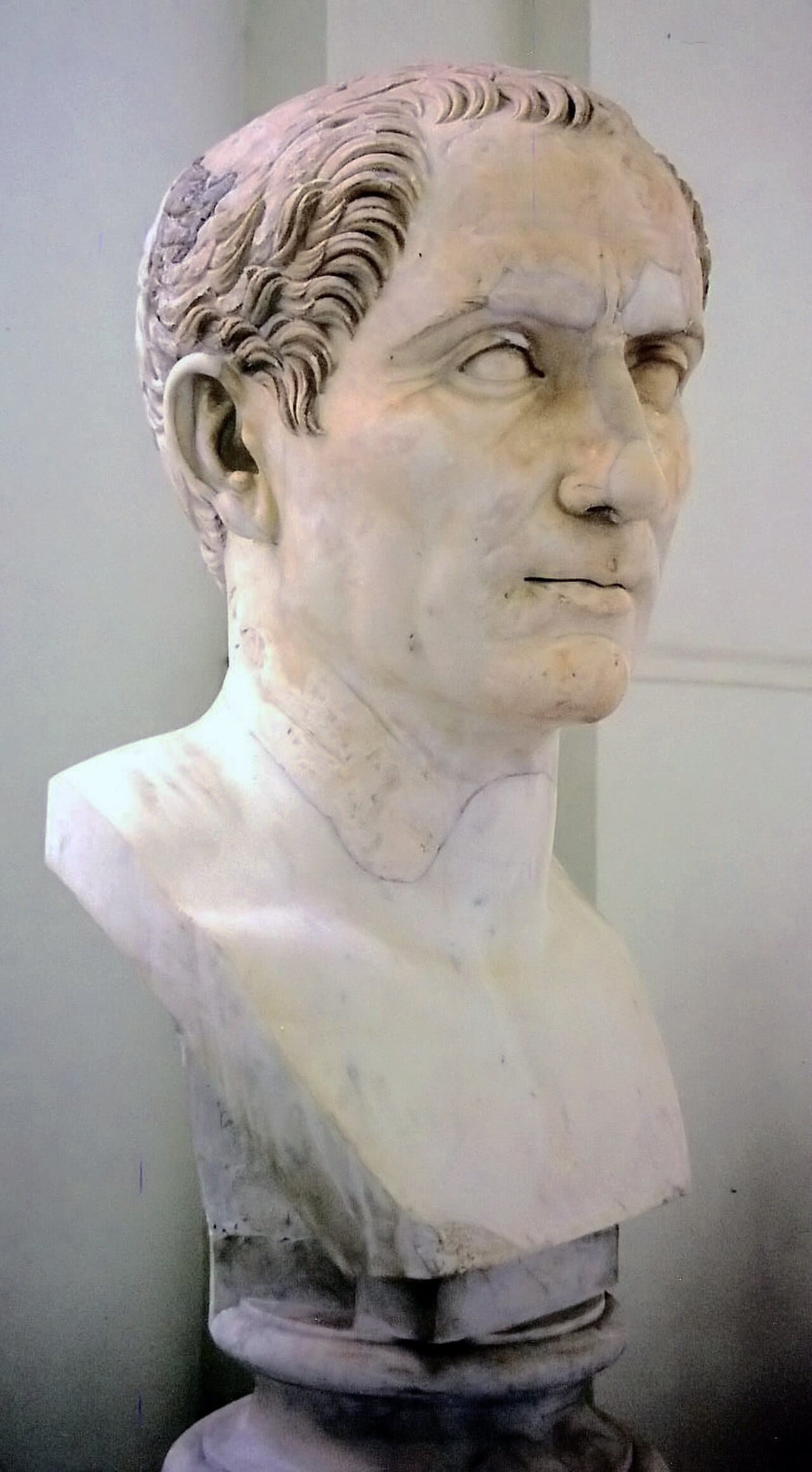
Gaius Julius Caesar was born in Rome on 12 or 13 July 100 BC into an ancient patrician family of no great recent wealth or influence. He rose through the standard offices, incurring enormous debts to fund the public games that bought political support, and in 60 BC formed a private alliance with Pompey, Rome's greatest general, and Crassus, its richest man - the First Triumvirate, which effectively controlled the state. His reward was the governorship of Gaul, and between 58 and 50 BC he conquered the whole of it in a series of campaigns he described himself in the Commentaries, still read as models of Latin prose. Ordered by the Senate to disband his army, he crossed the Rubicon into Italy on 10 January 49 BC, an act of war against his own state. He defeated Pompey at Pharsalus in 48 BC, pursued him to Egypt, installed Cleopatra on its throne, and cleared up the remaining opposition by 45 BC. Made dictator for life in early 44 BC, he was stabbed to death in the Senate on 15 March by some sixty conspirators including Brutus and Cassius. Michael Hart ranked him 67th in The 100.
Influence Meter
82
Measured on a 100-point scale
Conquered Gaul, ended the Republic, and gave Europe a word for supreme power
58-50 BC
Eight Years in Gaul
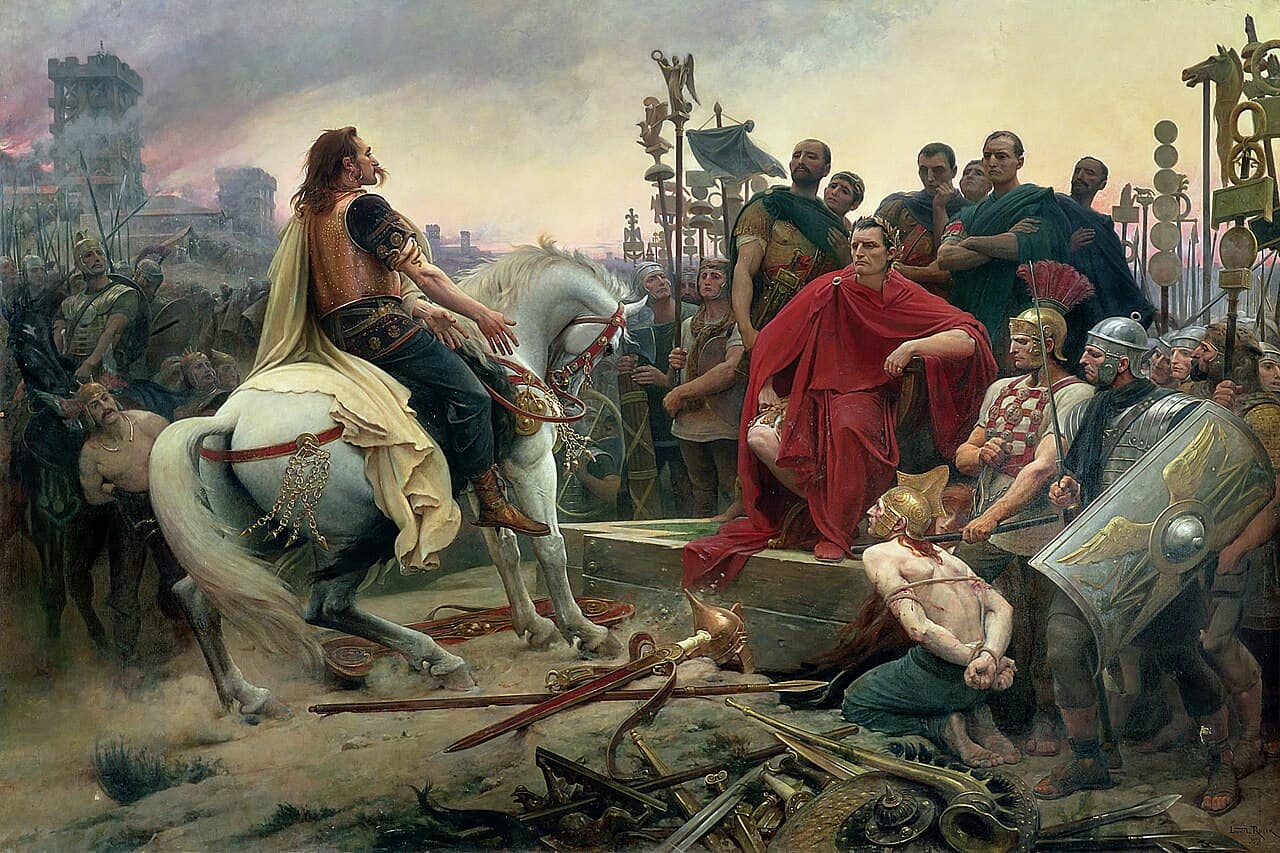
Caesar took a province and turned it into a conquest, extending Roman rule to the Rhine and the Atlantic across territory covering modern France, Belgium and parts of Switzerland, Germany and the Netherlands. He crossed into Britain twice and bridged the Rhine in ten days to make a point. It was also a campaign of extraordinary destruction: Plutarch and other ancient sources put the numbers at around a million killed and a million enslaved out of a Gallic population perhaps three or four times that, and while ancient figures are unreliable, no serious account suggests anything other than a demographic catastrophe. The final revolt under Vercingetorix ended at Alesia in 52 BC, where Caesar built two rings of fortification - one facing in at the besieged town, one facing out at the relieving army - and won against both. He wrote it all up himself in the third person, in prose so clean it has been used to teach Latin for two thousand years, and had it published in Rome as instalments of self-promotion.
The Rubicon was a small river marking the boundary between Caesar's province of Cisalpine Gaul and Italy proper. Roman law forbade a general to bring an army across it; to do so was automatically to declare war on the Republic. Caesar crossed on 10 January 49 BC with a single legion, having been ordered by the Senate to surrender his command and stand trial, which would have ended his career and possibly his life. Suetonius reports him saying alea iacta est - the die is cast - as he went. The phrase and the river have both become permanent metaphors for an irreversible decision. Militarily the crossing was almost trivial; Italy was undefended and Pompey withdrew to Greece rather than fight. Constitutionally it was the end of the Roman Republic, though nobody involved understood that at the time.
What He Did With Power
He held supreme authority for barely five years, much of it on campaign, and legislated at speed throughout.
- The Julian calendar: The Roman year had drifted some three months out of alignment with the seasons. On the advice of the Alexandrian astronomer Sosigenes he fixed the year at 365.25 days with a leap day, effective 1 January 45 BC. It stood for over sixteen centuries and the Gregorian calendar is a minor correction to it.
- Citizenship extended: He granted Roman citizenship to communities across Gaul, Spain and beyond, and admitted provincials to the Senate - deeply offensive to the old aristocracy and the beginning of an empire in which being Roman was not a matter of birth.
- Debt relief and land settlement: He cancelled a portion of debts, capped interest, and settled tens of thousands of veterans and poor citizens in colonies overseas, which reduced the volatile urban population of Rome.
- The Senate enlarged and diluted: He raised its membership to nine hundred and filled it with his own supporters, destroying its independence as an institution before the assassins tried to save it.
- Public works: The Forum of Caesar, the rebuilding of Corinth and Carthage as colonies, plans for a canal at Corinth and the draining of the Pontine marshes - much of it left unfinished.
- The precedent of permanent power: Dictator had been an emergency office limited to six months. Dictator perpetuo, taken in February 44 BC, made it permanent, and that is what got him killed.
15 March 44 BC
The Ides
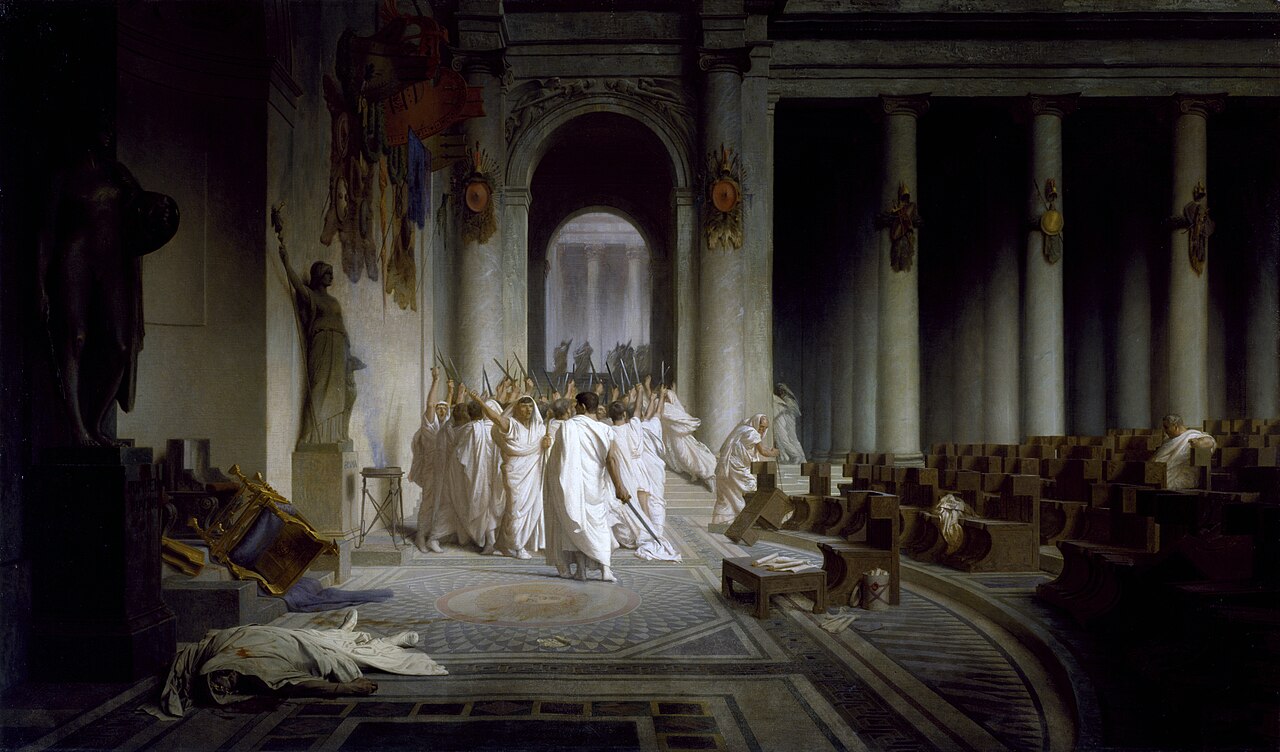
Some sixty senators were involved, led by Marcus Junius Brutus - whose mother had been Caesar's mistress and whom Caesar had pardoned after Pharsalus - and Gaius Cassius Longinus. They cornered him at a Senate meeting held in the portico of Pompey's theatre and stabbed him twenty-three times; the physician who examined the body reported that only one wound was fatal. He fell at the base of a statue of Pompey, the rival he had destroyed. The famous last words are Shakespeare's rather than history's; Suetonius reports that he said nothing, though some claimed he addressed Brutus in Greek. The conspirators had no plan beyond the killing. Mark Antony turned the funeral into a riot, the assassins fled, and within two years they were dead. The result was thirteen more years of civil war ending at Actium in 31 BC, after which Caesar's adopted heir Octavian held everything and took the name Augustus.
Further Reading
Books By and About Caesar
He is one of the few figures of the ancient world whose own writing survives in quantity, which is both a gift and a problem.
Legacy
Why Number Sixty-Seven
Michael Hart ranked Caesar 67th, notably below Augustus at eighteen, and the reasoning is that Augustus built the imperial system that lasted while Caesar merely destroyed the republican one that preceded it. That is defensible and slightly unfair. Caesar conquered Gaul, which brought a vast territory permanently into the Latin-speaking world and is the reason France exists as a Romance-language country rather than a Germanic one. He also demonstrated that a general with a loyal army could simply take the state, a lesson every subsequent Roman commander understood.
The linguistic afterlife is unusual. Caesar was a family name; it became the title of every Roman emperor, then Kaiser in German and Tsar in Russian and Slavic languages, and was still in use as a word for a monarch into the twentieth century. The month of July is named for him. The calendar he fixed in 45 BC, corrected by ten days in 1582, is the one on the wall. For a man who held supreme power for about five years and was murdered by his own colleagues, the residue is remarkably durable.
Related Publications