Louis Daguerre

Louis Daguerre
Born 18 November 1787 • Died 10 July 1851
Before 1839, every image of a person or a place was made by a human hand. A portrait meant sitting for a painter, and only the wealthy did it; nobody outside that class had any idea what their own great-grandparents had looked like. Then a Paris showman worked out how to make light itself do the drawing, the French government bought the method and handed it to everyone, and within two years ordinary people could own an exact likeness of their own faces. It is difficult to name a change in visual culture of comparable size.
Rank
#47
Influence
76
Field
Artist and Inventor
Historical Perspective
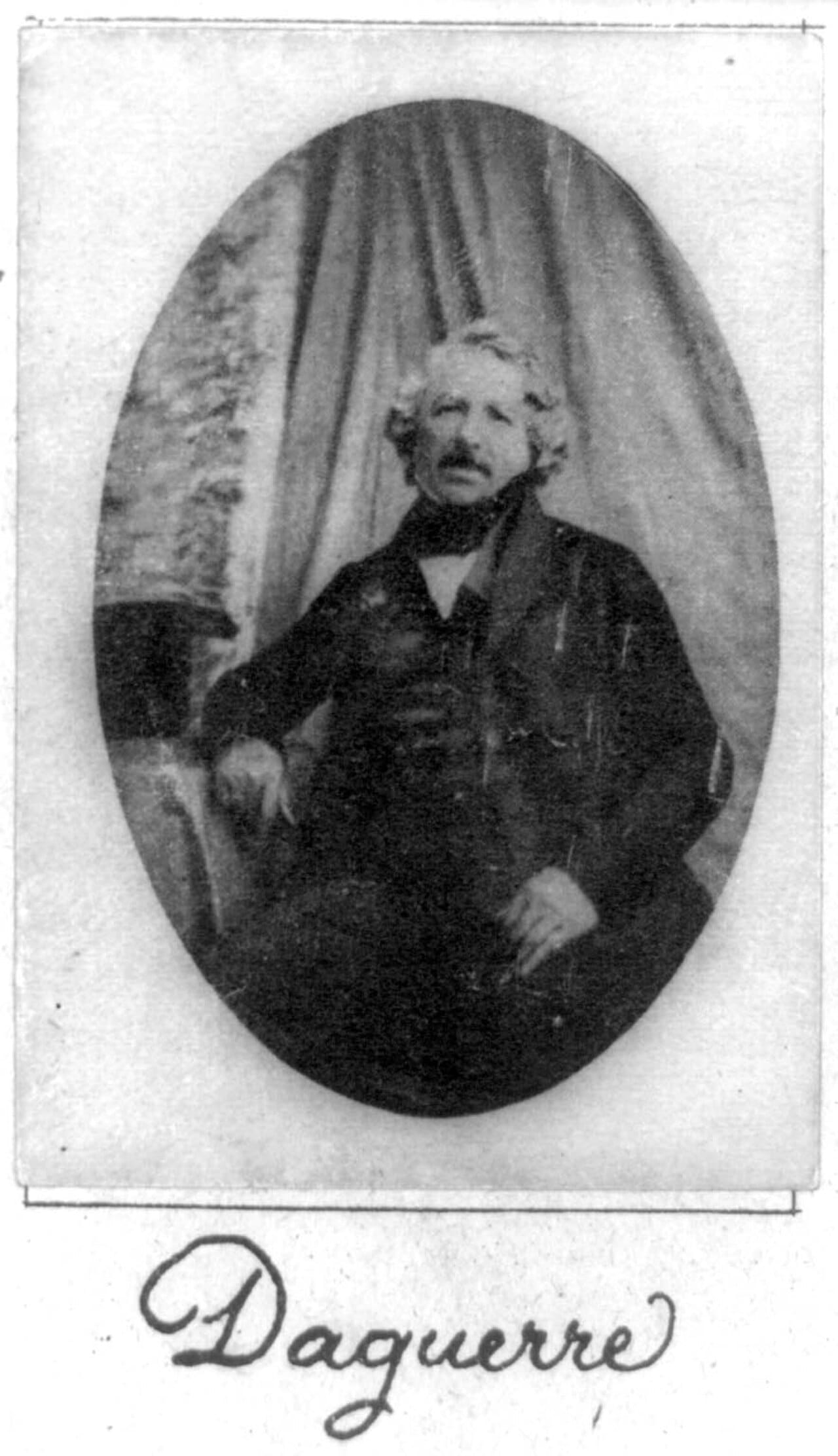
Louis-Jacques-Mandé Daguerre was born at Cormeilles-en-Parisis on 18 November 1787 and trained as an architect's apprentice, then as a scene painter for the Paris opera, where he became known for elaborate illusionistic stage effects. In 1822 he opened the Diorama, a purpose-built theatre in which vast semi-transparent painted scenes changed appearance as the lighting behind and in front of them was manipulated - a commercial spectacle that made him wealthy and that depended entirely on his understanding of light. He used a camera obscura to help lay out the paintings, and like others wondered whether the projected image could be made to stay. In 1829 he entered partnership with Nicéphore Niépce, who had already produced the first permanent camera image around 1826 or 1827 with an exposure of many hours. Niépce died in 1833; Daguerre continued, and by 1837 had the process that bears his name. François Arago announced it to the Académie des Sciences on 7 January 1839, and in August the French state purchased it in exchange for pensions and released it to the world. Daguerre died at Bry-sur-Marne on 10 July 1851. Michael Hart ranked him 47th in The 100.
Influence Meter
76
Measured on a 100-point scale
Made the photograph practical, and gave it away
1826-1833
The Partner Who Got There First and Died
Any honest account of the daguerreotype has to begin with Nicéphore Niépce, an inventor from Chalon-sur-Saône who by 1826 or 1827 had made what is generally regarded as the earliest surviving camera photograph - a view from his workroom window at Le Gras, captured on a pewter plate coated with bitumen of Judea over an exposure that lasted at minimum several hours and possibly days. It is barely legible, and the sun has moved far enough during the exposure to light both sides of the courtyard. Niépce called the process heliography and could not make it practical. Daguerre, who had been experimenting on his own, wrote to him and after two years of wary correspondence they formed a partnership in 1829. Niépce died of a stroke in 1833 with the problem unsolved and his family in financial difficulty; his son Isidore inherited the partnership and, later, a smaller pension than Daguerre's. Daguerre named the finished process after himself alone.
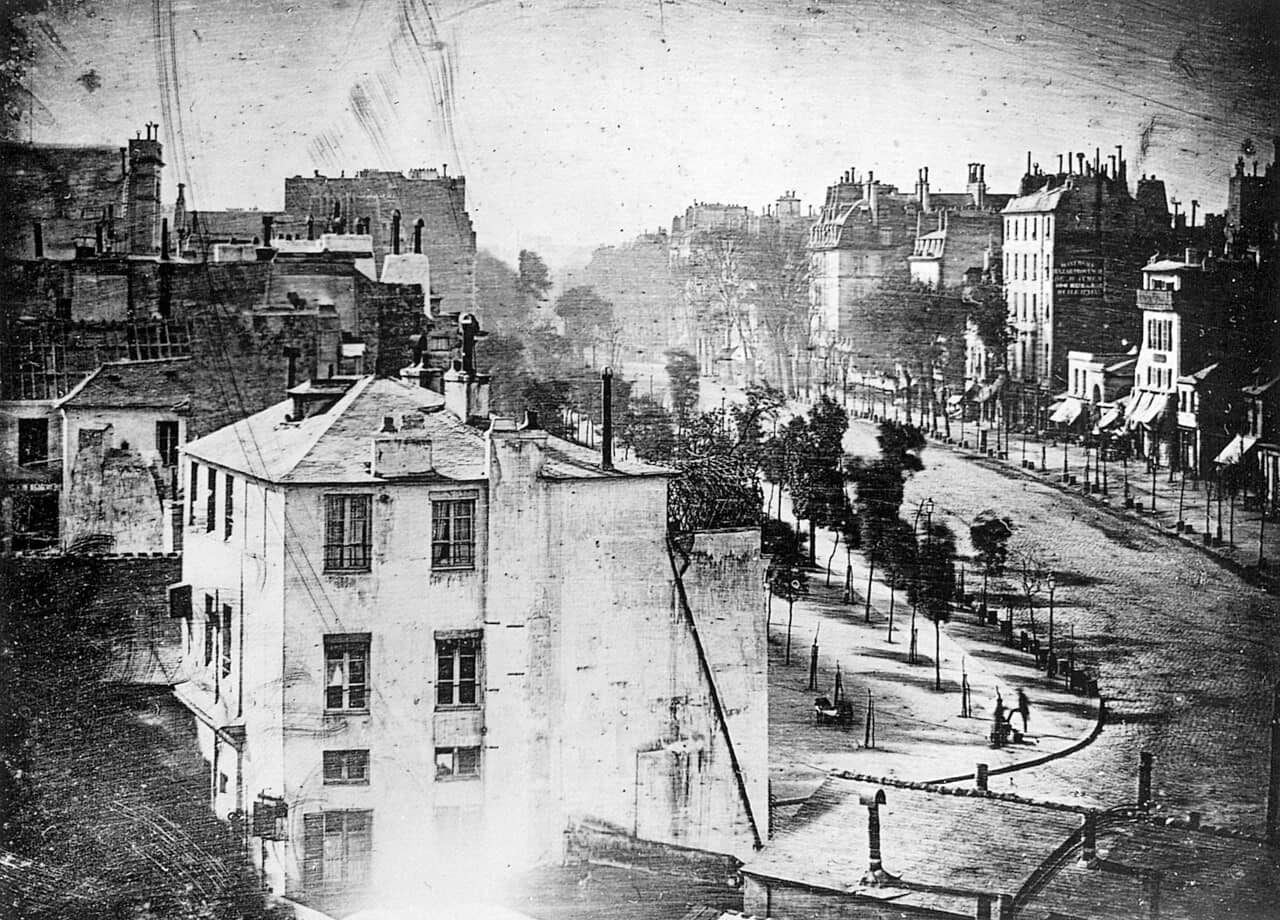
Daguerre's decisive discovery was the latent image, and the standard story is that it was an accident. A plate exposed for far too short a time appeared blank; put away in a cupboard, it was found days later to carry a fully formed picture. Daguerre worked out that mercury vapour from a broken thermometer in the cupboard had developed it. The story may be embroidered, but the principle is real and it is what made photography possible as a practical matter: light does not have to complete the image, only to start a chemical change that a developer can then amplify. It cut exposure times from many hours to a few minutes, and by the early 1840s, with faster lenses and chemical accelerators, to under a minute - short enough for a person to sit still. Every photographic process from then until digital sensors, including all film, worked on the same principle.
1839
Bought by a Government and Given Away
Daguerre tried and failed to sell subscriptions to the process privately, and then found a better patron. The astronomer and politician François Arago took up the cause, announced the invention to the Académie des Sciences on 7 January 1839, and argued in the Chamber of Deputies that a discovery of this kind should not be locked up as a monopoly. In July the state granted Daguerre a pension of six thousand francs a year for life and Isidore Niépce four thousand, in return for the process being published freely for anyone to use. The full technical manual was released on 19 August 1839 to a packed joint meeting of the Academies, and within days opticians in Paris had sold out of lenses.
There was one exception, and it says something about the man. Days before the French announcement, an agent acting for Daguerre patented the process in England, so that British users had to pay a licence fee. The result was that photography developed differently in Britain, where William Henry Fox Talbot's rival calotype - a negative-positive process, inferior in detail but infinitely reproducible - had more room to grow. In the long run Talbot's approach won, since a daguerreotype is a unique object that cannot be copied, and every photograph made between the 1850s and the digital era used the negative principle rather than Daguerre's.
What a Photograph Changed
The daguerreotype itself lasted about twenty years as a dominant technology. What it started did not stop.
- Ordinary people got faces: Portraits had been for those who could afford a painter. By the mid-1840s a daguerreotype cost a few dollars, and millions of people acquired an exact image of a spouse, a child or a dead relative.
- Evidence became visual: A photograph was taken to show what was actually there, which changed journalism, war reporting, police work, medicine and science. Roger Fenton in the Crimea and Mathew Brady's operators in the American Civil War brought back images no engraving could match.
- Painting was released: With accurate depiction mechanised, painters had a reason to stop competing on likeness. The line from photography to Impressionism and after is not a straight one but it is real, and painters at the time said so.
- Astronomy and science acquired a recorder: Photographic plates could accumulate light over hours and see what no eye could, and could record a spectrum, a bacterium or an eclipse objectively. Arago made exactly this argument to the deputies in 1839.
- The past became visible: For everyone born after about 1840, the previous generation has a face. It is a change in the texture of memory that is almost impossible to feel from this side of it.
- Everything downstream: Film, cinema, television, the photocopier, medical imaging, satellite reconnaissance and the several trillion photographs taken each year on telephones all descend from the moment an image was made to stay.
Further Reading
Books About Daguerre and Early Photography
Much of the Diorama's records burned with the building in 1839, so the personal record is thinner than the technical one.
Legacy
Why Number Forty-Seven
Michael Hart ranked Daguerre 47th, and the choice of Daguerre over Niépce or Talbot is defensible on the same ground that puts Morton above Crawford Long: he produced the version that worked well enough to be adopted immediately and publicly, and the world took it up within months. Niépce got there first and could not make it usable. Talbot's negative principle proved more important in the long run and he patented it aggressively, which slowed its spread. Daguerre had the process that gave a clear image in a few minutes, and a government willing to hand it to everyone.
The scale of what followed is hard to hold in view because it is now ambient. Something in the order of a trillion photographs are made every year, most of them on telephones, by people who have never thought about it. Photographs supply the evidence in courts, the record in medicine, the surveillance in cities, the memory in families and the substance of every visual medium invented since, cinema included. All of it starts from a scene painter with a good understanding of light, a dead partner's unfinished experiments, and a plate of silvered copper held over a dish of warm mercury.
Related Publications