Rene Descartes

Rene Descartes
Born 31 March 1596 • Died 11 February 1650
Descartes decided to find out what he actually knew. He set aside everything he had been taught, everything his senses reported, even mathematics, on the ground that a sufficiently powerful deceiver could be feeding him all of it. What survived was a single fact: something was doing the doubting. From that one point - I think, therefore I am - he tried to rebuild the whole of human knowledge. He also, almost in passing, worked out how to describe a curve with an equation, which is why every graph you have ever seen has an x and a y axis.
Rank
#49
Influence
82
Field
Philosopher and Mathematician
Historical Perspective
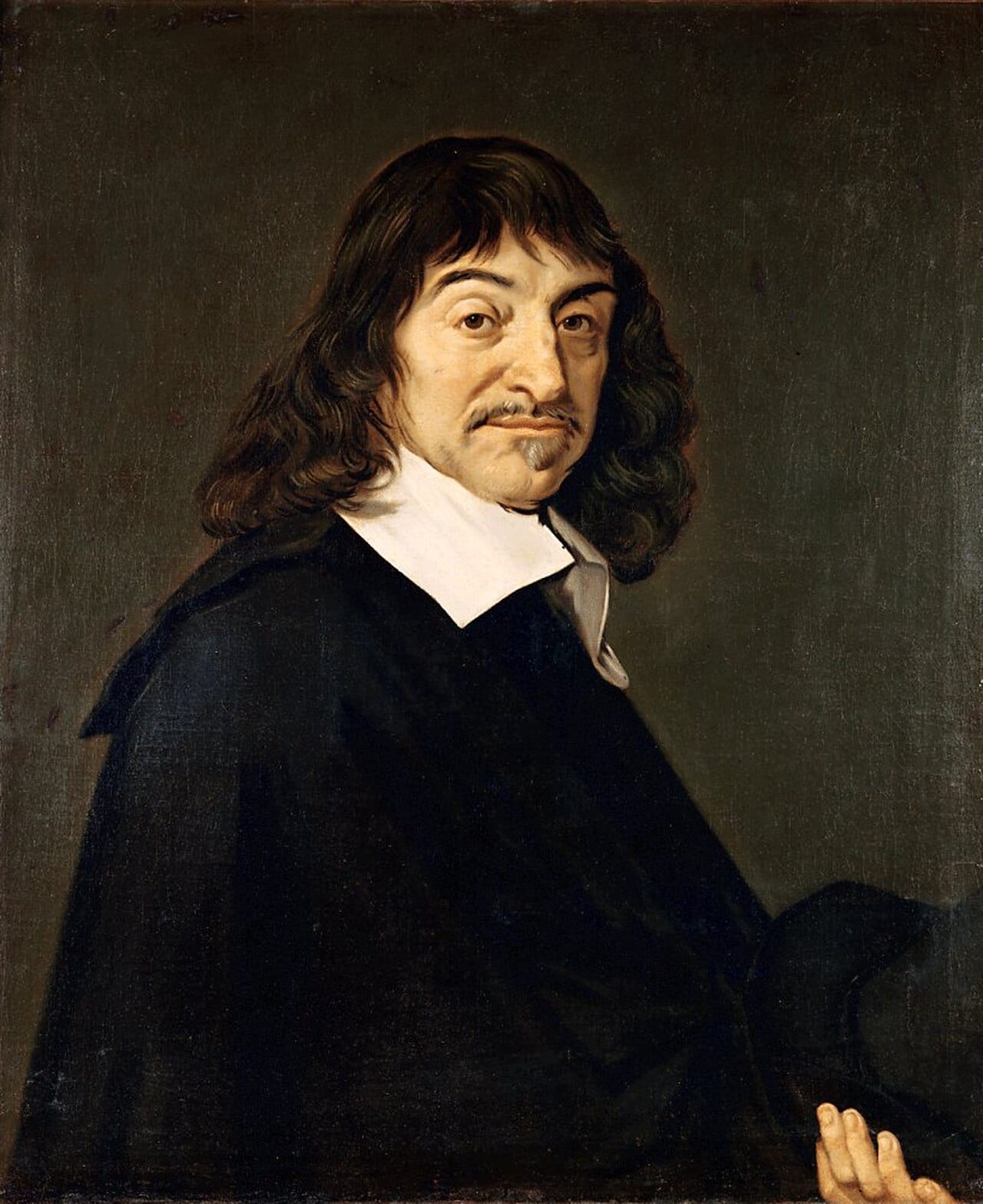
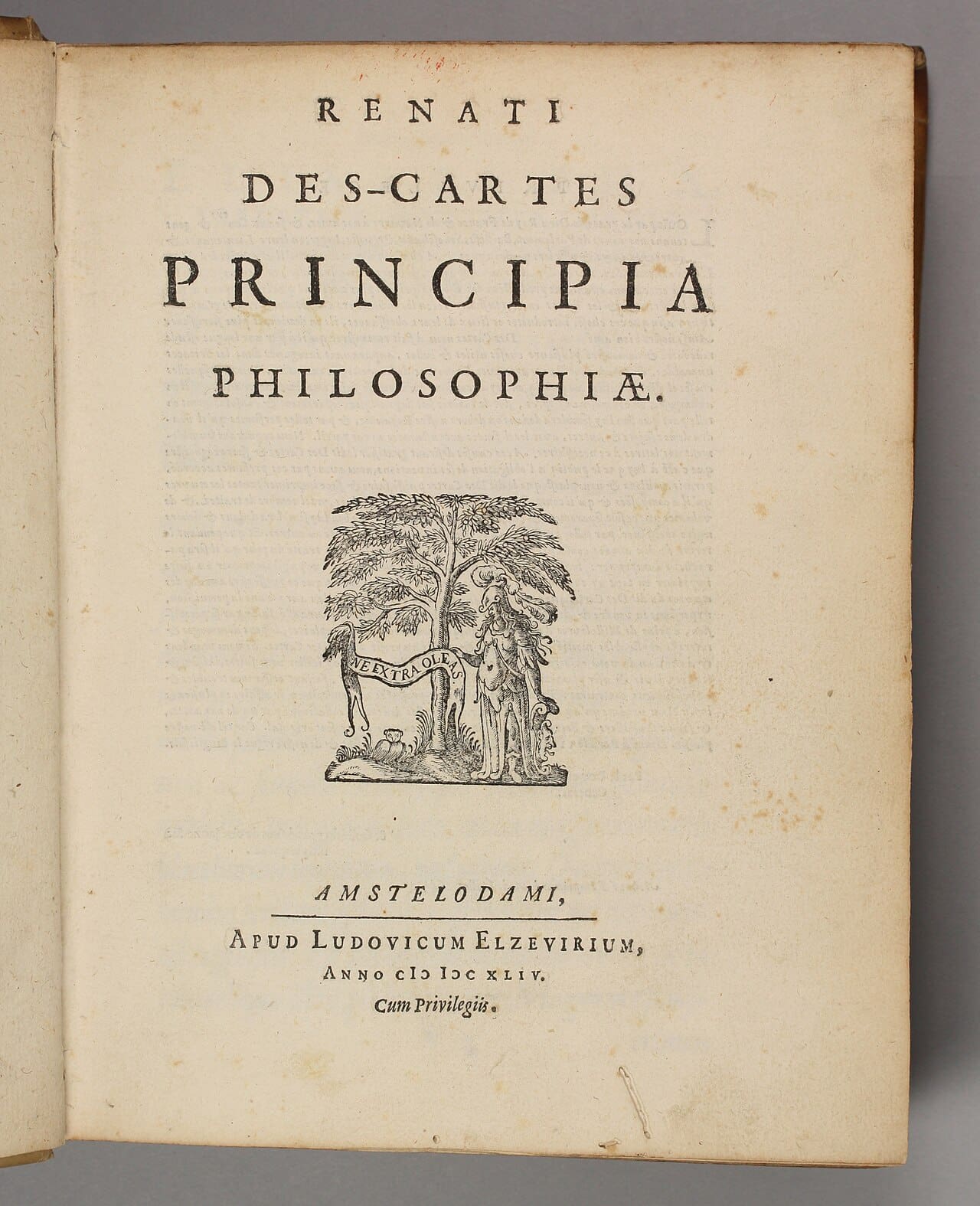
René Descartes was born at La Haye en Touraine on 31 March 1596, the son of a provincial magistrate, and educated at the Jesuit college of La Flèche, where the rector allowed a sickly boy to stay in bed until eleven - a habit he kept for life and which may have killed him. He took a law degree at Poitiers in 1616 and then joined an army, less to fight than to see the world. On the night of 10 November 1619, in a stove-heated room at Neuburg on the Danube, he had three vivid dreams which he took as a divine instruction to found a unified science on mathematical reasoning. In 1628 he moved to the Dutch Republic, which was tolerant, commercial and far from the French authorities, and stayed twenty years, moving house constantly. The Discourse on the Method appeared in 1637 with three essays attached, one of which invented analytic geometry; the Meditations followed in 1641 and the Principles of Philosophy in 1644. In 1649 he accepted an invitation from Queen Christina of Sweden, who required philosophy lessons at five in the morning in an unheated library, and died of pneumonia in Stockholm on 11 February 1650. Michael Hart ranked him 49th in The 100.
Influence Meter
82
Measured on a 100-point scale
Founded modern philosophy, and gave mathematics the coordinate plane
1637-1641
Demolishing the Building to Check the Foundations
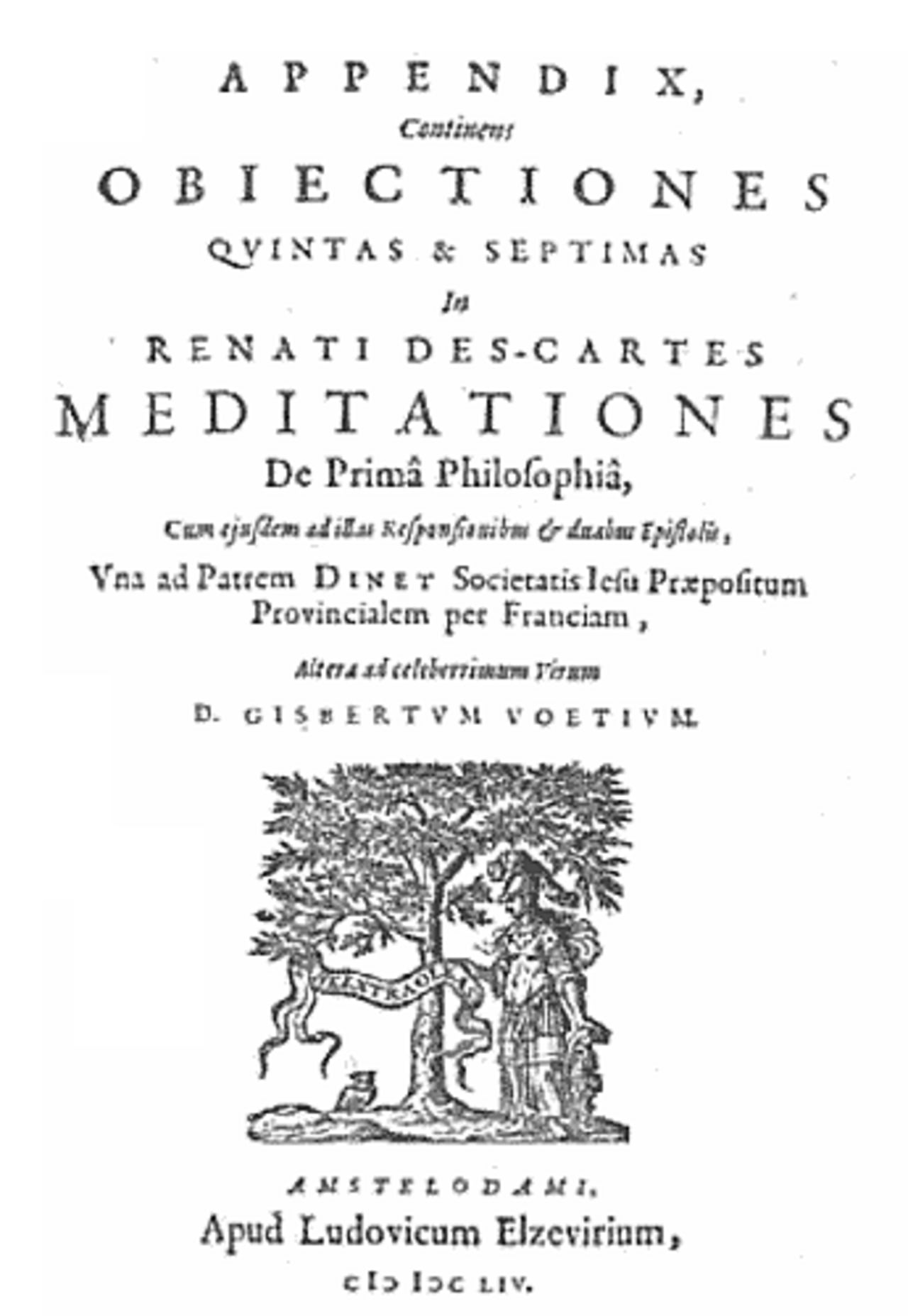
Descartes' method was to treat any belief that could be doubted as if it were false, and see what was left standing. The senses deceive - a straight stick looks bent in water - so sensory evidence goes. Dreams feel exactly like waking, so the existence of the external world goes. Even arithmetic could in principle be the work of a malicious demon manipulating his thoughts, so mathematics goes. What cannot go is the doubting itself: to be deceived, there must be someone to deceive. Je pense, donc je suis, in the French of the Discourse; cogito, ergo sum in the Latin of the later work. From that one certainty he argued outward - to the existence of God, and from God's non-deceiving nature back to the reliability of clear and distinct ideas, and so to the external world. Almost every philosopher since has accepted the starting move and rejected the reconstruction, which is a fair summary of his influence.
La Géométrie, one of three essays appended to the Discourse in 1637, did something that had eluded mathematicians for two thousand years: it joined algebra to geometry. By fixing two perpendicular reference lines and locating any point by its distance along each, Descartes made it possible to write a curve as an equation and an equation as a curve - a circle becomes x squared plus y squared equals r squared. The consequences were immediate and enormous. Geometrical problems could now be solved by algebraic manipulation rather than by ingenious construction, and the behaviour of a curve could be studied analytically. Newton and Leibniz built calculus on it within a generation. Every graph, every plotted function, every coordinate in a computer's memory and every point in a three-dimensional model descends from that essay, which is why the plane is called Cartesian.
The Problem He Left Behind
Two Substances, and No Way to Connect Them
Descartes divided reality into two kinds of thing. There is res cogitans, thinking substance - the mind, unextended, indivisible, known directly. And there is res extensa, extended substance - matter, occupying space, divisible, and governed entirely by mechanical laws. The move was enormously productive for science, because it licensed treating the whole physical world, animal bodies included, as a machine to be analysed without reference to purposes or souls. Physiology, and eventually medicine, took the invitation.
It also created a problem he could not solve. If mind and matter are utterly different substances, how does a decision to raise an arm move an actual arm? Descartes proposed that the interaction occurred in the pineal gland, a small structure near the centre of the brain, and nobody found this convincing, least of all Princess Elisabeth of Bohemia, who pressed him on it in a correspondence that remains the sharpest criticism of his system produced in his lifetime. The mind-body problem is still live in philosophy of mind and neuroscience, and Gilbert Ryle's mocking phrase for the doctrine - the ghost in the machine - has outlived most of the arguments against it.
1633
The Book He Suppressed
Descartes had a complete work of physics and cosmology, Le Monde, ready for publication in 1633. It assumed the Earth moves. In June of that year the Roman Inquisition condemned Galileo, and Descartes - a Catholic living in a Protestant country, with no desire to be a martyr - withdrew the manuscript, writing to Mersenne that he would rather suppress it than publish anything the Church might disapprove. It appeared only after his death. He later smuggled the same cosmology into the Principles of Philosophy of 1644 by presenting it as a hypothesis and adding a formal statement that he submitted to the Church's judgement. The caution did not ultimately protect him: his works were placed on the Index of Prohibited Books in 1663, thirteen years after he died, and Dutch Calvinist theologians had already accused him of atheism during his lifetime.
What He Actually Contributed
He is remembered for one sentence, which understates a career that reshaped several fields at once.
- Analytic geometry: Coordinates joining algebra to geometry, and the precondition for calculus, physics as we practise it, and every graph ever drawn.
- Methodical doubt: The procedure of accepting nothing that can be questioned, and building only on what survives. It set the standard of rigour that modern philosophy has argued about ever since.
- The mechanical universe: Treating the physical world, including living bodies, as matter in motion governed by laws - a working assumption that made modern physiology and physics possible.
- Rationalism: The claim that reason rather than sensory experience is the primary route to knowledge, taken up by Spinoza and Leibniz and opposed by Locke, Berkeley and Hume.
- Notation still in use: Letters from the start of the alphabet for known quantities and the end for unknowns, and the modern exponent notation. Writing x squared rather than a word is his convention.
- The mind-body problem: Less a contribution than a bequest. Every subsequent theory of consciousness has had to say what it makes of the split he introduced.
Further Reading
Books By and About Descartes
He wrote clearly and for a general reader, which is unusual for a philosopher of his standing and worth taking advantage of.
Legacy
Why Number Forty-Nine
Michael Hart ranked Descartes 49th, and the case has two independent legs, which is unusual. As a mathematician he supplied the coordinate system, without which Newtonian physics, calculus, engineering and computing are all unimaginable in their actual form. As a philosopher he is conventionally called the father of modern philosophy, not because his conclusions were adopted - almost none of them were - but because he changed what the discipline was about. Medieval philosophy asked what exists; Descartes made the prior question how a mind can know anything at all, and epistemology has occupied the centre of the subject ever since.
Spinoza and Leibniz built rationalist systems on his foundations, the British empiricists defined themselves against him, and Kant's entire project is an attempt to settle the quarrel. The dualism has aged worst and travelled furthest: neuroscience proceeds on the assumption that it is false, while finding the actual relation between brain activity and conscious experience as intractable as Descartes found it. A man who wanted to establish certainty ended up bequeathing the discipline its most durable open problem.
Related Publications