Michelangelo

Michelangelo
Born 6 March 1475 • Died 18 February 1564
Michelangelo did not want to paint the Sistine Chapel. He was a sculptor, he said so constantly, and he believed the commission was a trap arranged by rivals who expected him to fail at a medium he had barely used. He spent four years on scaffolding with his head tilted back, wrote a comic poem about the physical misery of it - his beard pointing at heaven, his brush dripping into his face, his spine bent like a Syrian bow - and produced what is probably the most famous painted surface on Earth.
Rank
#50
Influence
79
Field
Sculptor, Painter and Architect
Historical Perspective
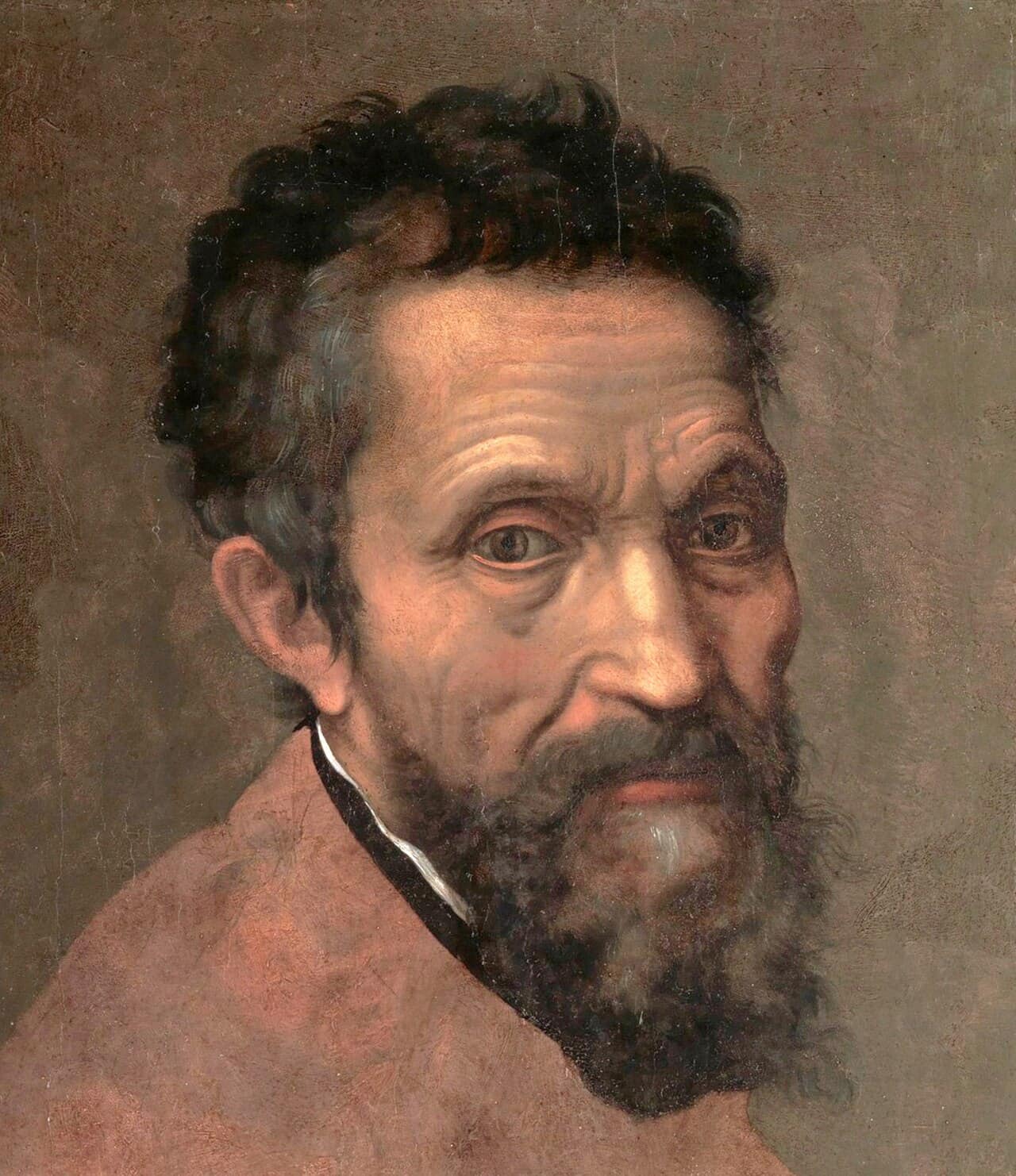
Michelangelo Buonarroti was born at Caprese in Tuscany on 6 March 1475 into a family of minor and declining gentility that regarded artistic work as beneath them; his father beat him for wanting it. At thirteen he was apprenticed to the painter Domenico Ghirlandaio, and shortly afterwards was taken into the household of Lorenzo de' Medici, where he studied antique sculpture in the Medici garden and ate at the same table as the leading humanists of Florence. He was twenty-four when he carved the Pietà, twenty-nine when the David was unveiled. Julius II summoned him to Rome, first for a tomb that was never properly built and then, in 1508, for the Sistine ceiling, finished in 1512. He returned to the chapel a quarter of a century later for the Last Judgement, painted between 1536 and 1541. From 1546, at seventy-one, he was architect of St Peter's, and designed the dome. He wrote over three hundred poems, many of them love poetry addressed to men. He died in Rome on 18 February 1564, aged eighty-eight, and his body was smuggled to Florence for burial. Michael Hart ranked him 50th in The 100.
Influence Meter
79
Measured on a 100-point scale
Raised the artist from craftsman to genius, and left three arts permanently altered
1498-1504
Two Statues That Made Him at Twenty-Nine
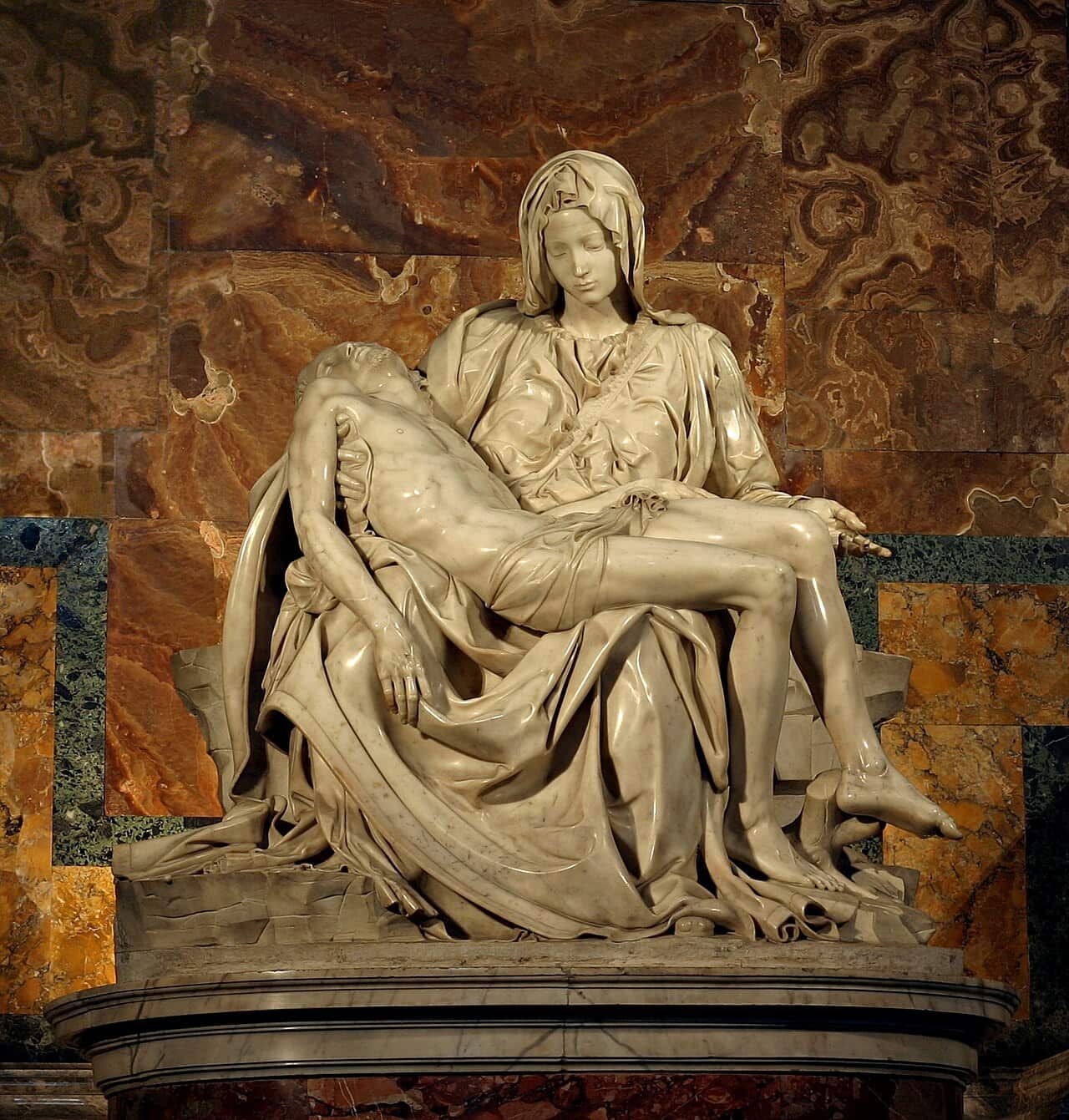
The Pietà, carved between 1498 and 1499 when he was twenty-four, is the only work Michelangelo ever signed - reportedly after overhearing visitors credit it to a Milanese sculptor, at which he came back at night and cut his name across the Virgin's sash. He is said to have regretted the vanity and never signed anything again. The David followed between 1501 and 1504, cut from a single block of Carrara marble that had been abandoned for forty years after another sculptor botched it; at over five metres it is more than twice life size, and it was placed outside the Palazzo Vecchio as a civic emblem of a small republic surrounded by larger enemies. Both display the quality contemporaries could not account for: an ability to make marble read as flesh, cloth and hair, and to hold a whole figure in mind while removing everything that was not it. He described the process as liberating a figure already inside the stone.
The Sistine Chapel ceiling covers over five hundred square metres and contains more than three hundred figures, painted between 1508 and 1512. The popular image of Michelangelo lying on his back is wrong: he designed a scaffold that let him stand, bent backwards, with the fresco a short distance above his face. Fresco is unforgiving - pigment must be applied to wet plaster and cannot be corrected once dry - and he had limited experience of it, dismissing the assistants brought from Florence early on. The programme grew from the twelve apostles originally commissioned into nine scenes from Genesis flanked by prophets and sibyls. The Creation of Adam, with the two hands not quite touching, is among the most reproduced images ever made. He was thirty-seven when he finished, and complained in a sonnet that the work had given him a goitre and ruined his sight.
The Range
Three Arts, Seventy Years
Vasari's claim was that he was supreme not in one art but in all three, which was a startling thing to say about anyone and has not been said convincingly about anyone since.
Pietà
The dead Christ across his mother's lap, carved from one block. The Virgin appears younger than her son, which Michelangelo defended on the ground that chastity preserves.
- Location: St Peter's, Rome
David
Over five metres, from a block others had rejected, showing the moment before the fight rather than the victory after it. The emblem of Renaissance Florence.
- Height: About 5.17 m
The Sistine ceiling
Nine Genesis scenes, prophets, sibyls and ignudi across more than five hundred square metres, painted by a man who insisted he was not a painter.
- Figures: Over 300
The Last Judgement
The altar wall of the same chapel, painted twenty-five years later in a darker and more turbulent style. The nudity caused such offence that draperies were added after his death by a painter nicknamed the breeches-maker.
- Censored: From 1565
The Laurentian Library vestibule
A staircase that pours down into a cramped hall, deliberately breaking classical proportion. Usually identified as the beginning of Mannerism in architecture.
- Significance: Anticipates Baroque
The dome of St Peter's
Taken on at seventy-one, unpaid, as a religious duty, and completed after his death to his design. It became the model for domes from London to Washington.
- Completed: 1590, after his death
The Rondanini Pietà
He was still cutting it days before he died at eighty-eight - a gaunt, half-emerged figure utterly unlike the polished Pietà of sixty years earlier, and unbearably moving because of it.
- Worked on until: 1564
Status
The First Artist Who Was a Genius
Before the sixteenth century a painter or sculptor in Europe was a member of a guild, closer in status to a goldsmith or a carpenter than to a poet. Michelangelo is where that changes. He was the first Western artist whose biography was published in his own lifetime - twice, by Vasari and by his pupil Condivi, the second apparently commissioned by Michelangelo to correct the first. He was called il Divino, the divine one, by contemporaries. Contemporaries also coined terribilità for the awe his work produced, a word implying something closer to terror than to admiration.
He behaved accordingly. He quarrelled violently with Julius II, walked out of Rome in a fury and made the Pope negotiate his return; he refused most commissions, kept his own counsel, worked alone where the practice of the time was a busy workshop, and grew wealthy while living in conditions visitors described as squalid. He wrote poetry addressed to Tommaso dei Cavalieri that is among the earliest substantial body of love poetry from one man to another in a modern European language - his great-nephew changed the pronouns when publishing it in 1623, and the originals were not restored until the nineteenth century. The Romantic idea of the artist as a solitary, difficult, divinely gifted figure begins here, and it has proved extremely durable.
Further Reading
Books About Michelangelo
Around fourteen hundred of his letters and drawings survive, which makes him unusually well documented for a Renaissance figure.
Legacy
Why Number Fifty
Michael Hart ranked Michelangelo 50th, and the placement of any artist on such a list rests on a judgement about how far aesthetic achievement counts as historical influence. The concrete case is straightforward enough. His late style - elongated, tense, deliberately breaking classical balance - produced Mannerism and then fed the Baroque, which shaped European art and architecture for two centuries. The dome of St Peter's became the template for domed buildings from St Paul's in London to the United States Capitol.
The larger case is about the status of the artist. He established that a painter or sculptor could be a figure of the first rank in a society, negotiating with popes as something other than a supplier, and that a work of art could be an expression of an individual mind rather than the fulfilment of a contract. That idea travelled through Bernini, Rembrandt and the Romantics into the modern assumption that art is self-expression by an exceptional person. Five hundred years later, some six million people a year queue to look up at a ceiling painted by a man who kept insisting he was not a painter.
Related Publications