Sui Wen Ti

Sui Wen Ti
Born 21 July 541 • Died 13 August 604
China had been broken into competing states for roughly two hundred and seventy years - longer than the United States has existed - with rival dynasties in the north and south, a nomadic ruling class in half of it, and no serious prospect of reunion. Yang Jian took the northern throne in 581 and had the whole country under one government within eight years. His dynasty collapsed under his son almost immediately, and the institutions he built ran China for the next three centuries.
Rank
#85
Influence
78
Field
Emperor
Historical Perspective
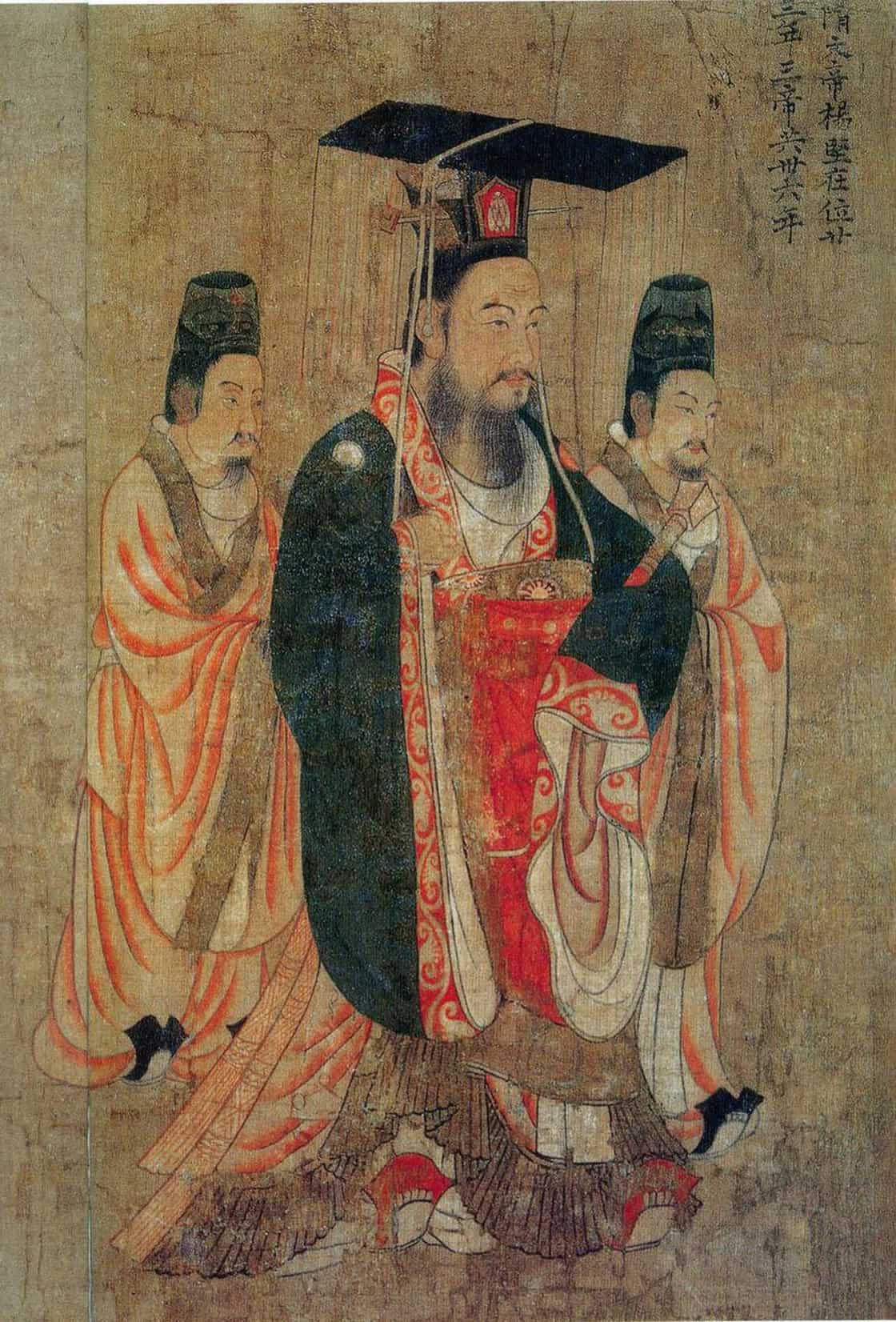
Yang Jian was born on 21 July 541 into a prominent military family of the mixed Chinese and Xianbei aristocracy that dominated northern China, and his daughter married the heir of the Northern Zhou. When that emperor died young in 580, Yang Jian became regent for a child, eliminated rival princes, and in 581 had the boy abdicate to him - founding the Sui dynasty and taking the name Wen. He spent eight years preparing, then invaded the southern Chen dynasty in 588 with a force that crossed the Yangtze at multiple points, and took its capital in 589. China was one state again for the first time since the fall of the Western Jin in 317. He ruled for twenty-three years with a reputation for frugality, suspicion and enormous administrative energy: a simplified legal code, land redistribution, a national census that nearly doubled the recorded population, granaries said to hold decades of grain, and the first stretches of what became the Grand Canal. He died at the Renshou Palace on 13 August 604, in circumstances contemporaries suspected involved his son Yang Guang. Michael Hart ranked him 85th in The 100.
Influence Meter
78
Measured on a 100-point scale
Reunified China, and built the institutions the Tang golden age ran on
The Machinery
What He Actually Built
Conquest reunified the territory. The reforms are why it stayed reunified after his dynasty fell.
The Kaihuang code
A drastically simplified law code that cut the number of capital offences, abolished several mutilating punishments and standardised procedure. The Tang code, which became the model for legal systems in Japan, Korea and Vietnam, is a revision of it.
- Basis of: The Tang code
The equal-field system
State allocation of land to peasant households by size, with most reverting to the state on death. Inherited from earlier northern regimes and applied nationally, it broke the great estates and put taxpayers back on the rolls.
- Purpose: Land to households, revenue to the state
Recruitment by examination
He began replacing recommendation by aristocratic patronage with written examination for entry to the bureaucracy. It developed under the Tang and Song into the civil service system that lasted until 1905.
- Abolished in: 1905
The census
A systematic count that raised the recorded households from under four million to around nine million - mostly by finding people the great families had been concealing from the tax rolls.
- Households recorded: 4m to 9m
State granaries
A national network of grain stores against famine and for provisioning armies, on a scale that impressed later chroniclers as excessive. Tang officials were reportedly still drawing on Sui grain decades after the dynasty fell.
- Reputedly held: Decades of supply
The Grand Canal
Linking the rice-producing Yangtze basin to the northern capitals and frontiers. Completed at ruinous human cost under his son, it tied the two halves of China together economically and is still in use.
- Completed by: Emperor Yang
The period Wen ended is known as the Northern and Southern Dynasties, and it had lasted since the collapse of the Western Jin in 317 - two hundred and seventy-two years of division, longer than the whole of the Han unification that preceded it. Northern China had been ruled for most of that time by dynasties of steppe origin, principally the Xianbei, who had partly sinicised; the south was governed by a succession of short-lived Chinese dynasties around the Yangtze. The two halves had diverged in language, law, religion, aristocracy and military organisation. Wen's reunification was therefore not a restoration of something recently lost but the reassembly of a political unit that nobody alive had experienced. That China exists as a single state today, rather than as several, is conventionally traced to two men - Shih Huang Ti, who made it one the first time, and Wen, who made it one again after the longest period in which it was not.
604-618
The Dynasty That Lasted Thirty-Seven Years
Wen's son Yang Guang, who became Emperor Yang, inherited a full treasury and an efficient state and spent both. He completed the Grand Canal using forced labour on a scale that traditional histories put in the millions, with enormous mortality; rebuilt Luoyang as a second capital; and launched three catastrophic invasions of Goguryeo in Korea that consumed armies and produced nothing. Rebellion broke out across the country and he was strangled by his own guards in 618. The Sui is conventionally paired with the Qin as a short, brutal, hugely consequential dynasty that exhausted itself building the infrastructure a longer and more admired successor then enjoyed - the Han after the Qin, the Tang after the Sui. Traditional Chinese historiography, written under the Tang, had every incentive to portray Emperor Yang as a monster and did so; modern historians are somewhat more measured, without disputing the scale of the waste.
Further Reading
Books About the Sui
The dynasty is comparatively little studied in English relative to its importance.
Legacy
Why Number Eighty-Five
Michael Hart ranked Wen 85th, and the argument is a counterfactual about the largest political unit on Earth. Europe fragmented after Rome and never reassembled; China fragmented after the Han and did reassemble, and the person who reassembled it was Yang Jian. Had he failed, there is no obvious reason China would not have followed the European pattern, with several successor states diverging permanently in language and institutions. Chinese unity is not a natural fact but a repeated political achievement, and this is the most important of the repetitions.
The institutional legacy is the second half of the case. The Tang dynasty, generally regarded as the high point of Chinese civilisation, ran on Sui foundations - the legal code, the land system, the canal, the granaries and above all the principle that officials should be selected by examination rather than birth. That last idea produced a meritocratic bureaucracy that governed China for over a thousand years, was studied and admired by European reformers in the eighteenth century, and is an ancestor of every modern civil service.
Related Publications