TL;DR — Did AI Subscriptions Actually Get More Expensive?
Entry price vs. ceiling, 2023 to 2026
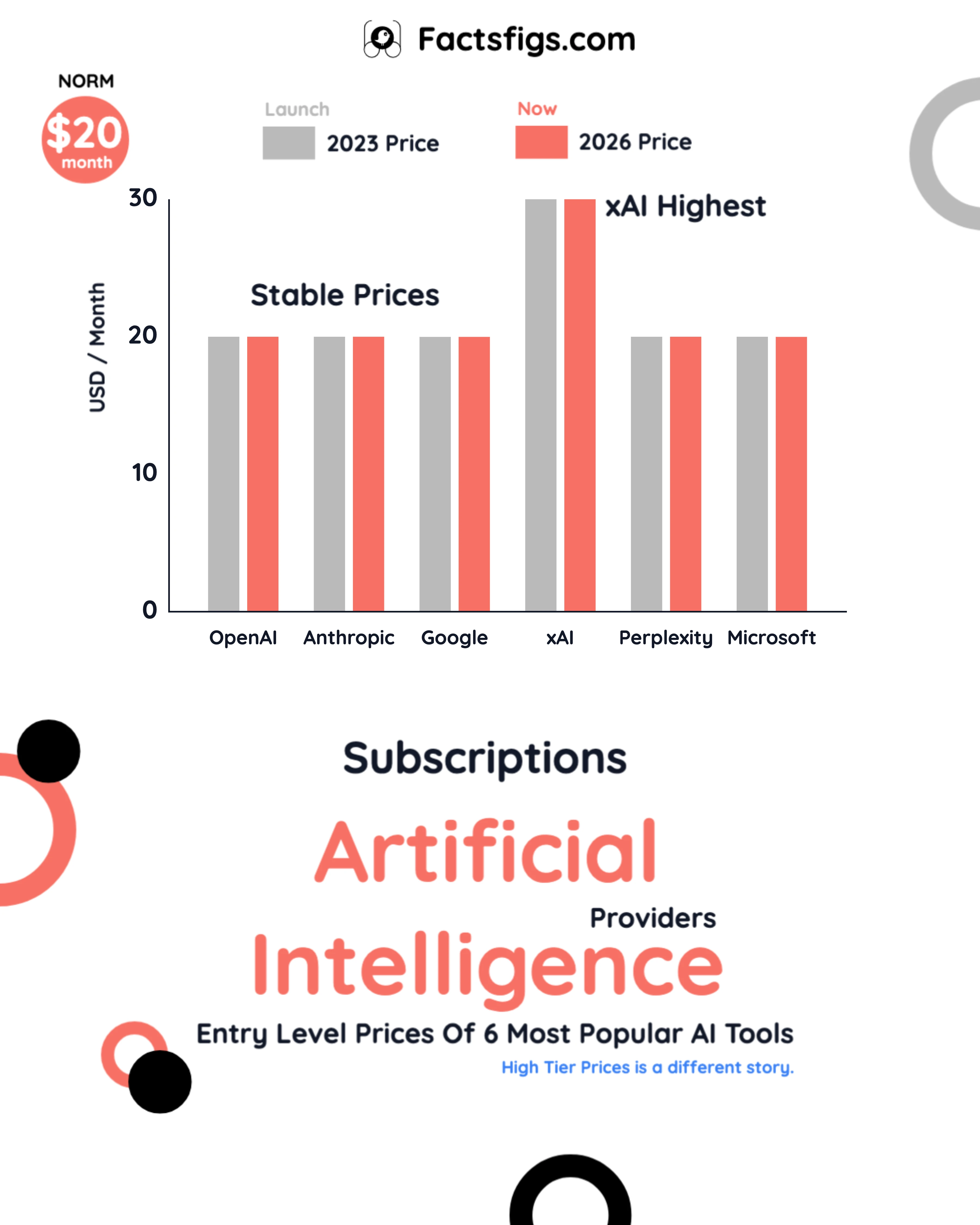
Only at the top. The price most people pay for a flagship AI subscription has sat at roughly $20 a month since February 2023 and has never been raised. What changed is the tier above it: in 2023 there was nothing to buy above the standard plan, and by August 2026 five providers sell a $200 tier while xAI sells a $300 one. The floor held, the ceiling appeared from nothing, and the gap between them opened tenfold.
! Key takeaways:
•
The $20 entry price never moved:ChatGPT Plus has cost $20 since 1 February 2023 and Claude Pro $20 since 7 September 2023. Neither has been raised once — unusual stability for consumer software over three years.
•
The ceiling went from nonexistent to $200:OpenAI created the category with ChatGPT Pro at $200 on 5 December 2024. Anthropic, Google, xAI and Perplexity all followed within eight months.
•
Five providers converged on one menu:Roughly $20 for the standard plan, about $100 for five times the usage, about $200 for twenty times it. The prices line up almost to the dollar across OpenAI, Anthropic, Google, xAI and Perplexity.
•
xAI prices higher at both ends:SuperGrok charges $30 where the field charges $20, and SuperGrok Heavy charges $300 — 50% above the $200 pack and the highest consumer ceiling in the market.
•
Microsoft never built a ceiling:Copilot Pro launched at $20 in January 2024, was withdrawn from new buyers, and was folded into Microsoft 365 Premium at $19.99. No $200-class consumer chat tier was ever offered.
•
A cheaper basement opened instead:ChatGPT Go at $8, Google AI Plus at $4.99, SuperGrok Lite at $10 and Perplexity Education Pro at $10 all sit below the old $20 floor rather than above it.
? The numbers:
•
Entry tier, ChatGPT Plus and Claude Pro:$20
•
Ceiling, ChatGPT Pro and Claude Max 20x:$200
•
Highest consumer ceiling, SuperGrok Heavy:$300
•
Cheapest paid tier, Google AI Plus:$4.99
•
Floor-to-ceiling spread, 2023:1x
•
Floor-to-ceiling spread, 2026:10x
The popular complaint that AI subscriptions keep getting more expensive is half right, and the half it gets wrong matters. The mainstream price has been fixed at $20 for three years while capability climbed underneath it. What the industry actually built was a new premium tier above that price, aimed at a small group of heavy users, and a set of cheaper tiers below it aimed at everyone else. Nobody raised the price of the plan most people actually buy.
Continue reading below for the full detailed article →
Overview
How a Frozen $20 Floor Ended Up Ten Times Below the Ceiling
Measured on one yardstick — the cheapest full-featured paid plan against the most expensive individual plan — six major AI providers tell a consistent story. In 2023 the standard plan was also the most expensive plan money could buy, so the spread was 1x. By August 2026 the standard plan still costs about $20 while the top plan costs $200, and $300 at xAI. The floor did not rise to meet the ceiling; the ceiling was built on top of a price that nobody touched.
The Three Numbers That Define AI Subscription Pricing
Three figures carry the whole comparison: the entry price that has not moved since February 2023, the ceiling that did not exist until December 2024, and the ratio between them. Every provider in this comparison can be placed against those three numbers, and the two that break the pattern — xAI above it, Microsoft outside it — are interesting precisely because of how far they sit from them.
The Entry Price That Has Not Moved Since 2023
$20
ChatGPT Plus launched at $20 a month on 1 February 2023 and costs $20 today. Claude Pro matched it at $20 that September and has never moved either. Perplexity Pro has held around $20 since 2023, and Google's entry tier has sat at $19.99 since February 2024. Four independent companies, three and a half years, and not one increase to the plan most subscribers actually buy.
The Ceiling OpenAI Invented in December 2024
$200
Before 5 December 2024 no consumer AI subscription cost more than about $20, because no tier existed above the standard plan. ChatGPT Pro arrived at $200 and created the category outright. Anthropic followed on 9 April 2025, Google that May, Perplexity in mid-2025 and xAI that July. An entire price bracket went from empty to crowded in roughly seven months.
The Spread Between the Two, Up From 1x
10x
In 2023 the cheapest full plan and the most expensive one were the same product, so the floor-to-ceiling ratio was exactly 1x. Today $20 to $200 is a clean 10x at OpenAI, Anthropic, Google and Perplexity, and $30 to $300 is the same 10x at xAI. Measured against the field's $20 norm rather than its own floor, xAI's ceiling reaches 15x.
OpenAI by the Numbers
Go, the budget rung $8 Launched globally in January 2026 after an India pilot — OpenAI's answer to the question of what sits below $20.
Plus, the entry tier $20 Unchanged since 1 February 2023 and still the reference price every competitor sets its own standard plan against.
Pro, the ceiling $200 The first $200 consumer AI tier, launched 5 December 2024, with a $100 rung added beneath it on 9 April 2026.
The single most durable number in consumer AI is $20 a month. ChatGPT Plus set it on 1 February 2023 and has never raised it. Claude Pro arrived on 7 September 2023 at exactly the same price and has never raised it either. Perplexity Pro has held around $20 since 2023, and when Google finally entered the paid market in February 2024 it priced Google One AI Premium at $19.99 — a cent under the incumbent rather than a challenge to it.
That is unusual. Consumer software subscriptions normally drift upward, and the underlying product here changed beyond recognition over the same period: context windows grew, reasoning modes appeared, and the models behind the same $20 plan were replaced several times over.
Price Anchoring · $20 Across Four Companies
The consistency is not coincidence so much as anchoring. Once ChatGPT Plus established $20 as the price of a flagship chatbot, matching it became the safe move and undercutting it signalled a weaker product. Anthropic matched to the dollar. Google came in a cent below. Perplexity, selling a different product — a cited answer engine rather than a chatbot — landed on the same number anyway. The figure stopped being a pricing decision and became a category convention.
Only xAI broke ranks upward. Standalone SuperGrok launched around February 2025 at $30, the one entry tier in this comparison priced above the norm. Microsoft, meanwhile, matched at $20 in January 2024 and then walked its consumer plan back entirely — the only provider whose entry price moved down rather than staying put.
How $200 Went From Unthinkable to Standard in Seven Months
In 2023 the ceiling question had no answer, because there was no ceiling. The standard plan was the most expensive consumer option every provider sold, which is why the floor-to-ceiling spread for that year is exactly 1x across the board. Paying more was not an available choice.
ChatGPT Pro changed that on 5 December 2024 at $200 a month — ten times the price of the plan directly beneath it, and the first consumer AI tier at that level. The number was widely treated as an outlier at launch.
The Cascade · Five Providers in Eight Months
It did not stay an outlier. Anthropic launched Claude Max on 9 April 2025 at $100 and $200, framed explicitly as an answer to ChatGPT Pro. Google put AI Ultra at $249.99 on 20 May 2025, the highest opening price of the group. Perplexity Max reached $200 by mid-2025. xAI closed the run on 9 July 2025 with SuperGrok Heavy at $300, offered at $99 for a subscriber's first three months. A bracket that was empty in November 2024 held five products by the following summer.
What these tiers sell is capacity rather than capability. The $200 plan is generally the same model family as the $20 plan with roughly twenty times the usage allowance, which is why the pricing scales so cleanly and why the tiers are aimed at a narrow group of heavy users — people running long agentic sessions or working inside the tools all day — rather than at the general subscriber.
The Convergence
Five Labs, One Identical $20 / $100 / $200 Menu
The sharpest finding in this dataset is not the size of the spread but how similar the ladders have become. By August 2026 five providers sell the same three-rung structure: roughly $20 for the standard plan, about $100 for five times the usage, about $200 for twenty times it. The prices line up almost to the dollar, and so do the multipliers.
Opposite Directions · Google Cut, OpenAI Added
They did not arrive there together. Google launched its ceiling highest, at $249.99, and then cut and restructured it into a $99.99 five-times tier and a $199.99 twenty-times tier — pulling its top price down into the pack rather than pushing above it. OpenAI moved the other way, adding a $100 rung beneath its existing $200 Pro on 9 April 2026 to fill the gap Anthropic had occupied since 2025. One company came down, another filled in, and the two menus ended up mirroring each other.
That convergence is worth reading carefully. Identical price points across independent competitors usually signal that everyone is solving the same constraint — here, the cost of serving heavy inference to a small number of very active users — rather than that anyone found a pricing edge. The $100 and $200 rungs are priced off usage economics, not off what the market will bear.
It also means the ceiling is no longer climbing. The most recent moves in this dataset are a cut and a fill, not a raise. Whether $200 turns out to be a durable upper bound or a way station is the open question the next twelve months will answer.
xAI is the only provider in this comparison that sits above the field at both ends. Standalone SuperGrok costs $30 against a $20 norm, and SuperGrok Heavy costs $300 against a $200 one — 50% higher at the top and 50% higher at the bottom. Its internal spread is still exactly 10x, the same ratio as everyone else; the whole ladder is simply shifted upward.
Grok also reached the market by a different route. It shipped first as a bundled feature inside X Premium+ in November 2023 rather than as a standalone subscription, and the standalone tier did not appear until roughly February 2025 — well after the $20 convention had hardened elsewhere.
The $300 Tier · Highest Consumer Ceiling in the Market
SuperGrok Heavy, launched 9 July 2025, remains the most expensive individual AI subscription of the six providers here. The $99 introductory rate for a subscriber's first three months is itself a signal: a third of list price is a steep enough discount to suggest the headline number is doing positioning work as much as revenue work. Measured against the field's $20 entry norm rather than xAI's own $30 floor, that ceiling sits 15x above the price most people pay.
Outlier · No Ceiling
Microsoft Declined to Build a Top Tier at All
Microsoft is the counterexample that makes the rest of the pattern legible. Copilot Pro launched in January 2024 at $20, squarely on the convention. Then Microsoft went the other way: the standalone plan was withdrawn from new buyers on 1 October 2025 and folded into Microsoft 365 Premium at $19.99, with existing Copilot Pro subscriptions set to stop renewing on 1 August 2026.
More striking is what never appeared. Microsoft has no $200-class consumer chat tier and never built one. Its high end is Copilot Studio at $200 a month, which is an agent-building add-on rather than a power-user chat plan, and enterprise Microsoft 365 Copilot at $30 per seat, which is a different buyer entirely.
Why the Absence Matters · A Choice, Not an Inevitability
Every other provider treated the $200 tier as a necessary response once OpenAI created it. Microsoft, with more consumer distribution than any of them, decided the opposite — that AI belongs bundled into a $19.99 productivity subscription rather than sold as a premium standalone. That single refusal is the strongest evidence in this dataset that the $20-to-$200 ladder was a strategic choice the industry made, not an economic law it discovered.
The Basement
The Quiet 2026 Development Is Cheaper, Not Pricier
While attention went to the top of the ladder, the more consequential change for most people happened at the bottom. A set of tiers now sits beneath the old $20 floor: ChatGPT Go at $8, launched globally in January 2026 after an India pilot; Google AI Plus at $4.99; SuperGrok Lite at $10; and Perplexity Education Pro at $10 for verified students.
This is the detail that most directly contradicts the assumption that AI subscriptions keep getting more expensive. The entry price did not rise. The market added rungs underneath it, which means the cheapest way to pay for a capable AI assistant in 2026 costs a quarter of what the cheapest paid option cost in 2023.
The trade is usually usage limits, model access, or in ChatGPT Go's case advertising. But the direction of travel at the volume end of the market is unambiguously downward, and it is happening at the same time as the $200 tiers that generate the headlines.
Complete Tier Data
Every Consumer Tier From Six AI Providers, 2022–2026
Each provider's full consumer ladder, with the price at launch and the price as of August 2026. Reading the two price columns side by side shows how little moved: apart from Google's Ultra cut and its AI Plus repricing, almost every tier still sells at the number it launched with.
OpenAI
Free
Free
2022-11-30
$0
$0
OpenAI
Go
Budget
2026-01-15
$8
$8
OpenAI
Plus
Entry
2023-02-01
$20
$20
OpenAI
Pro 5x
Mid
2026-04-09
$100
$100
OpenAI
Pro 20x
Top
2024-12-05
$200
$200
Anthropic
Free
Free
2023-07-01
$0
$0
Anthropic
Pro
Entry
2023-09-07
$20
$20
Anthropic
Max 5x
Mid
2025-04-09
$100
$100
Anthropic
Max 20x
Top
2025-04-09
$200
$200
Google
Free
Free
2023-03-21
$0
$0
Google
AI Plus
Budget
2025-10-01
$9.99
$4.99
Google
AI Pro
Entry
2024-02-08
$19.99
$19.99
Google
AI Ultra 5x
Mid
2026-05-15
$99.99
$99.99
Google
AI Ultra 20x
Top
2025-05-20
$249.99
$199.99
xAI
X Premium
Budget
2023-11-01
$8
$8
xAI
SuperGrok Lite
Budget
2026-01-01
$10
$10
xAI
SuperGrok
Entry
2025-02-15
$30
$30
xAI
SuperGrok Heavy
Top
2025-07-09
$300
$300
Perplexity
Free
Free
2023-01-01
$0
$0
Perplexity
Education Pro
Budget
2026-01-01
$10
$10
Showing 1-20 of 25
Page 1 of 2
US list prices, monthly billing, individual plans only; enterprise and per-seat business tiers are excluded. Several launch dates are approximate: Google AI Ultra's restructure date, SuperGrok and SuperGrok Lite, Perplexity Pro and Perplexity Education Pro. Google AI Plus is shown at its reported $9.99 launch price and its current $4.99 US price. Microsoft's Copilot Pro was withdrawn from new buyers in October 2025 and existing subscriptions stop renewing on 1 August 2026.
Limits
What a LIST-Price Comparison Cannot Settle
This comparison measures list prices, and list prices hide a great deal. A $200 tier is not ten times more capable than a $20 one; it is generally the same models with roughly twenty times the usage allowance. Anyone reading the spread as a capability gap is reading it wrong.
Bundles and Billing · Not Like-for-Like
Several of these plans are not pure AI subscriptions at all. Google's tiers include cloud storage and other consumer services; Microsoft's $19.99 buys the Office applications alongside the AI features. Annual billing also cuts the real price — Claude Pro drops to $17 a month when paid yearly, and Perplexity Pro to roughly $16.67 — so the monthly headline numbers overstate what committed subscribers actually pay.
Two further limits are worth stating plainly. These are US list prices, and regional pricing diverges sharply — the same tiers cost very different amounts in local currency elsewhere. And the comparison says nothing about value per dollar: the $20 that bought GPT-4-era access in 2023 buys a far more capable system in 2026, which is arguably a real-terms price cut that a nominal-price chart cannot show.
The dataset is also perishable. Three of the most significant figures here — ChatGPT Go, the $100 Pro rung, and Google's Ultra restructure — all landed within the last eight months, and any of them could move again before this is a year old.
Verdict
The Answer Depends on Which Rung You Stand On
So did AI subscription prices rise between 2023 and 2026? For the roughly $20 plan that most subscribers buy, no — it is the same price it was on 1 February 2023, and cheaper options now exist beneath it that did not exist then.
For the top of the market, emphatically yes. A bracket that was empty in 2023 now runs to $200 across five providers and $300 at xAI, which is a real and large increase in what it is possible to spend on a consumer AI subscription.
Both things are true at once, and conflating them is what makes the popular complaint feel right while being wrong about the number that matters to most people. The ceiling rose. The floor did not. The distance between them is the actual story, and at 10x it is wider than in almost any other consumer software category.
The direction of travel from here looks flatter than the last two years suggest. Google cut its ceiling rather than raising it, OpenAI's most recent move was to add a cheaper rung, and the newest tiers in the market are the $4.99 and $8 ones. If the pattern holds, the interesting pricing action has already moved from the top of the ladder to the bottom.
The pricing data behind this story was compiled manually by FactsFigs from the official subscription and pricing pages of the six providers covered — OpenAI, Anthropic, Google, xAI, Perplexity and Microsoft — together with each product's original launch announcement and corroborating technology-press reporting for historical prices. Because the dataset was assembled in-house from many separate sources rather than drawn from a single published dataset, no third-party source link applies. Subscription prices change frequently — verify current rates on the provider's own page before subscribing.
FactsFigs reviews, cleans, and cross-checks every source dataset before shaping it into a data story. Each visualization is created and designed in FactsFigs Design Studio — an internal tool developed and owned by FactsFigs — and is the original work of a FactsFigs author, not an AI-generated copy of any existing graphic. Individual assets within a visual may or may not be produced with AI tools, but the design of the visual itself is solely FactsFigs' own.
Figures are estimates at the time of publication, provided for information only — nothing here is financial advice or a guarantee of accuracy.
The charts in this article were built with our own publishing system. See what it does →