TL;DR — Does Apple Actually Raise iPhone Prices Every Year?
The myth, the base-tier reality, and where prices actually climb
Nine iPhones in, the assumption is that every launch means a higher price tag.
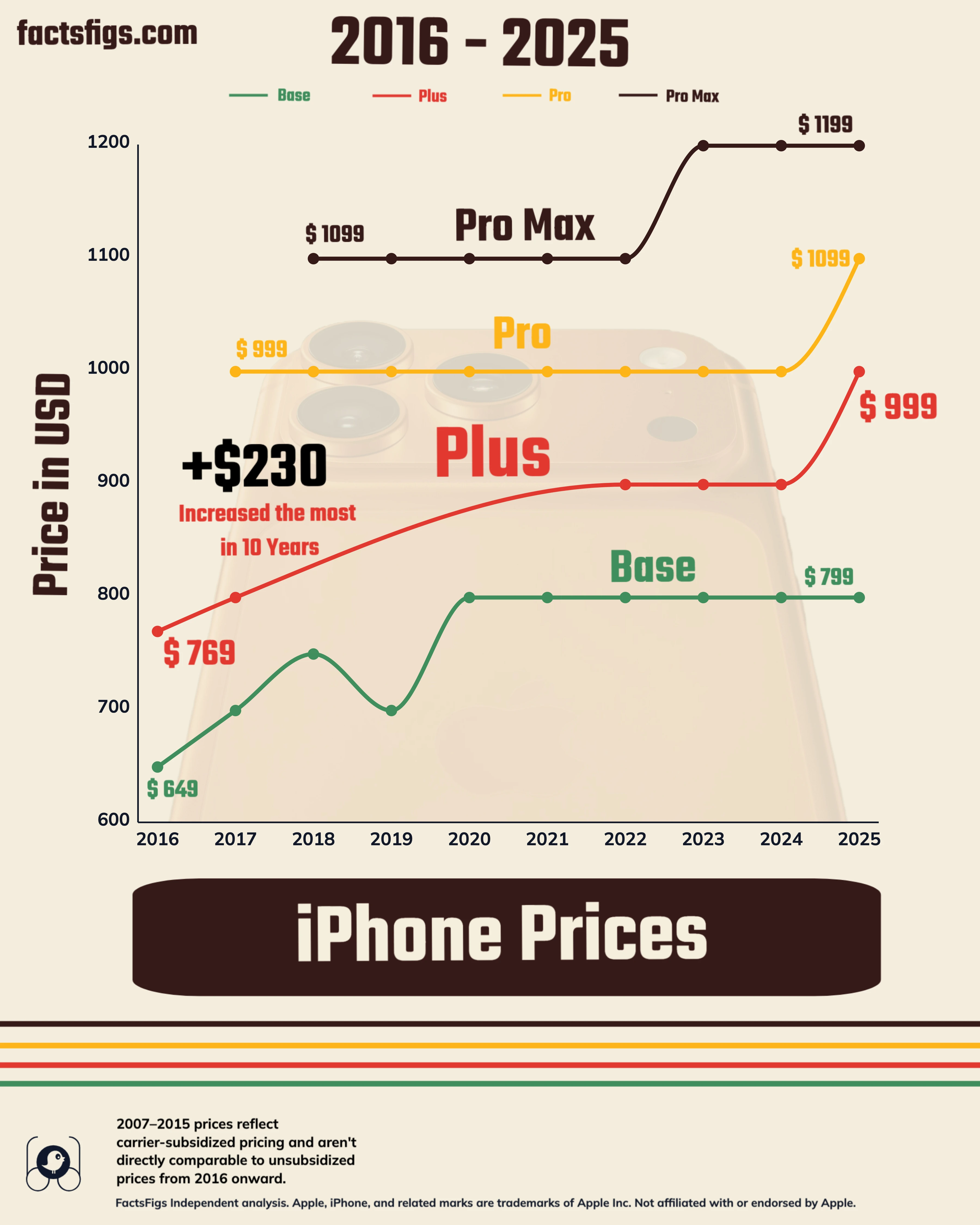
The base tier tells a different story: it moved only twice between 2017 and 2025, and one of those moves was a decrease.
What actually climbed was the ceiling — driven by new premium tiers and selective Pro-line hikes, not blanket price increases on the phone most people buy.
! What the Data Actually Shows:
•
The Popular Belief:Every new iPhone launch gets read as another price hike — a narrative reinforced by nine straight years of new models.
•
What Actually Happens at the Base Tier:The base iPhone has sat at exactly $799 for six straight generations (2020-2025), and it was actually $100 cheaper in 2019 than the year before.
•
Where the Money Really Moves:Apple's lineup average climbs when new top tiers get added, like the $999 iPhone X in 2017, or when Pro-line prices move — Pro Max jumped in 2023 after five flat years, and Pro jumped in 2025 after eight.
? The Numbers Behind the Myth:
•
Base Price, 2020-2025:$799, unchanged across six generations
•
2019 Base Price:$699 - a year-over-year decrease from 2018's $749
•
2025 Pro Jump:$999 to $1,099 - the first Pro-tier price change since the tier launched in 2017
Apple does raise the ceiling of its lineup most years, but not by raising the price of the phone you already own. The base tier has spent as much time flat or falling as it has climbing.
Continue reading below for the full detailed article →
Overview
Apple's pricing reputation often outpaces reality. Since the iPhone 7 in 2016, base model starting prices have actually stayed remarkably flat, holding at $799 for most generations and even returning to $699 for the iPhone 11. What has shifted is the top of the lineup: the arrival of Pro and Pro Max tiers pushed flagship pricing past the $1,000 mark starting with the iPhone X in 2017, and Pro Max pricing climbed further in 2023 and again with the iPhone 17 Pro in 2025. Viewed against US inflation, several nominal price freezes have quietly meant real declines in cost for base models, even as premium tiers pulled the average upward. This overview traces where prices actually moved, where they held steady, and how tier restructuring, not blanket annual increases, has driven Apple's iPhone pricing story over the past decade.
The Three Numbers That Settle the Price Question
Every iPhone launch gets read as evidence that Apple raised prices again, but the record is more selective than that. The base tier, the one most buyers actually choose, moved only a handful of times across nine years, and one of those moves was down. What actually got more expensive is the ceiling: new premium tiers, and the rare year Apple repriced an existing model outright. These three numbers are the ones that actually decide whether the myth holds.
Six-Year Freeze · Base Price Stuck at
$799
From the iPhone 12 in 2020 through the iPhone 17 in 2025, the entry-level iPhone has launched at exactly $799 for six generations running. New chips, cameras, and materials arrived every year, and the 2025 model even doubled its base storage to 256GB at no extra cost; the price tag itself did not move once across that entire six-year span.
A Rare Price Cut in 2019
$699
The iPhone 11 launched at $699 in 2019, a full $50 below the iPhone XR's $749 the year before, one of the few times in iPhone history the base tier actually got cheaper rather than more expensive. It's the clearest data point against the always-rising narrative, landing just a year before the price settled at $799 for six straight generations.
Eight Years Flat · Pro Jumps in 2025
$1,099
The Pro tier held at exactly $999 from its 2017 debut as the iPhone X through the iPhone 16 Pro in 2024, eight straight years unchanged while the base tier moved around it. The iPhone 17 Pro's jump to $1,099 in 2025 is the first Pro-tier increase ever, ending the longest price freeze of any tier in this dataset.
The Base iPhone by the Numbers
56% of Years, Base Price Didn't Move 56 %From 2017 to 2025, the base iPhone's launch price held flat in five of nine year-over-year comparisons, including one outright decrease in 2019.
88% of Years, Pro Price Didn't Move 88 %The Pro tier held at exactly $999 for seven straight years before its first price change in 2025, flat in seven of eight year-over-year comparisons.
86% of Years, Pro Max Price Didn't Move 86 %Pro Max held at $1,099 for five years before jumping to $1,199 in 2023, flat in six of seven year-over-year comparisons since its 2018 debut.
The Base Model Tells a Different Story
Why Nominal Prices Stayed Flat for Years
The idea that Apple raises iPhone prices every year does not hold up when you look at the entry-level model in nominal dollars. The base iPhone 7 launched at $649 in 2016, and it took until 2017 for that number to move, to $699 with the iPhone 8. From there the number didn't hold steady so much as bounce: it rose to $749 for the 2018 iPhone XR, then actually dropped back to $699 for the 2019 iPhone 11 — a rare year-over-year decrease at the entry tier. The first jump to $799 came with the iPhone 12 in 2020, and that figure has not budged since.
From 2020 through 2025, the base iPhone price has sat at exactly $799 across six consecutive generations: the 12, 13, 14, 15, 16, and 17. That is half a decade without a single nominal increase at the entry tier, even as Apple introduced new chips, cameras, and materials each year. The pattern undercuts the common assumption that a new iPhone automatically means a higher sticker price.
The 2025 iPhone 17 makes the case even more directly. Apple kept the price at $799 while doubling the base storage tier to 256GB, a configuration that previously would have cost more. On a per-gigabyte basis, that is a real price cut for buyers, not just a freeze. Whatever pricing pressure shows up elsewhere in the lineup, the base iPhone has not been the vehicle for annual increases that popular perception suggests.
The real pricing mechanism
How Apple Raises Prices by Adding New Tiers Instead
Look closely at the year-over-year record and a pattern emerges: it's new tiers at the top of the lineup, not steep repricing of the phones people already know, that do the real work. In 2017 the base and Plus tiers moved only modestly — iPhone 8 to $699, a $50 increase on the iPhone 7, and iPhone 8 Plus to $799, a $30 increase on the iPhone 7 Plus — while Apple introduced an entirely new tier above them: the iPhone X at $999, the first iPhone ever to cross the four-figure mark. That new $999 tier, not the modest bump on the base and Plus tiers, is what pulled the lineup's average sharply higher that year.
This is the mechanism in its clearest form: the biggest price move in a lineup rarely comes from repricing a phone that already exists — it comes from inserting a new tier above it. The base and Plus tiers absorbed only a small, incremental increase in 2017; the iPhone X's $999 debut is what actually dragged the lineup's average sharply upward that year. Anyone drawn to the new design, screen, or camera system paid a real premium for a genuinely new product — that premium, not a hike on the familiar models, is where most of the year's price growth actually happened.
The 2020 iPhone 12 generation is the exception that proves the rule: this is the one year the base tier itself was directly repriced, from $699 in 2019 to $799, a straightforward $100 increase rather than a new tier absorbing the difference. The Pro ($999) and Pro Max ($1,099) held at exactly what the iPhone 11 Pro and 11 Pro Max had already reached the year before — and that three-tier Base/Pro/Pro Max structure wasn't new in 2020 either; it dates back to the iPhone XS Max in 2018. What actually changed in 2020 was Apple finally moving the entry price after three years of the base tier drifting between $699 and $749. Tier creation is Apple's most-used lever, but 2020 shows the company will also move an existing sticker price directly when it decides to.
The Real Cost, Adjusted for Time
What Inflation Reveals About the 2016 iPhone 7's Real Cost
Nominal price tags flatten a decade of change into a single number, but inflation adjustment tells a different story. In 2025 dollars, the 2016 iPhone 7 actually cost $878, and the iPhone 7 Plus cost $1,041 — both figures sitting well above the $799 that buys today's base iPhone 17. The Plus model's real cost even lands in the same range as the current iPhone 17 Pro's $1,099 price point, despite the two devices occupying entirely different tiers nine years apart.
This isn't about Apple slashing prices; it's about Apple simply not raising them fast enough to keep pace with inflation. The base and Plus tiers have largely held their nominal sticker prices year over year, which sounds like stability but functions as a quiet discount once general price levels are factored in. A number that looks frozen on a spec sheet is, in real terms, worth less every year it stays the same.
Viewed this way, the last decade of iPhone pricing looks less like relentless price hikes and more like flat-to-declining real prices at the base and Plus levels, with the Pro and Pro Max tiers the main exception in select years — including the 2023 and 2025 increases at the top of the lineup. The popular narrative that Apple raises prices every year doesn't hold up once inflation adjustment enters the picture; it's the entry-level buyer, not the flagship shopper, who has arguably gotten the better deal over time.
Looking Ahead
Why the Next iPhone's Price Is Still a Guess
Apple has not confirmed the Apple iPhone 18 Pro Max release date, and as of this writing the company's official iPhone lineup still features the iPhone 17 family rather than anything newer. That hasn't stopped reporting from getting specific: outlets including Forbes and 9to5Mac, citing Apple's own event-timing pattern over the past 15 years, have converged on a Wednesday, September 9, 2026 keynote, with pre-orders opening September 11 and devices reaching stores September 18. Treat that as an informed forecast, not an announcement.
Pricing is even less settled, and for good reason: Apple has not listed a single number for any iPhone 18 model. What exists instead is a cluster of analyst estimates pointing the same direction. Analyst Jeff Pu has projected the iPhone 18 Pro and Pro Max could each rise $250 to $300 over their iPhone 17 predecessors, while Counterpoint Research has put the Pro Max increase closer to $200.
Stacked onto the iPhone 17 Pro Max's $1,199 starting price, those estimates land somewhere between roughly $1,399 and $1,499 - a range, not a confirmed figure, tied by several reports to rising TSMC wafer costs and pricier NAND and DRAM memory rather than Apple simply charging more for the same components.
If the rumored increase holds, it would land on the Pro Max specifically, consistent with the pattern this data already shows: the base tier is the one that stays put, and the Pro Max is the one that occasionally moves. Whether that pattern holds a tenth time won't be knowable until Apple actually says so.
This table extends the price record back to 2007, including the carrier-subsidized pricing Apple used through 2015. The chart above covers only the unsubsidized era, 2016 onward - subsidized and unsubsidized prices aren't directly comparable.
2007
iPhone (1st gen)
Base
499
8GB variant launched at $599
2008
iPhone 3G
Base
199
—
2009
iPhone 3GS
Base
199
—
2010
iPhone 4
Base
199
—
2011
iPhone 4S
Base
199
—
2012
iPhone 5
Base
199
—
2013
iPhone 5S
Base
199
Budget sibling iPhone 5C sold alongside
2013
iPhone 5C
Budget
99
Sold alongside 5S
2014
iPhone 6
Base
199
—
2014
iPhone 6 Plus
Plus
299
—
2015
iPhone 6S
Base
199
—
2015
iPhone 6S Plus
Plus
299
—
2016
iPhone 7
Base
649
US carriers ended 2-yr contract subsidy model around this time
2016
iPhone 7 Plus
Plus
769
—
2017
iPhone 8
Base
699
—
2017
iPhone 8 Plus
Plus
799
—
2017
iPhone X
Pro
999
First iPhone to cross $1,000
2018
iPhone XR
Base
749
—
2018
iPhone XS
Pro
999
—
2018
iPhone XS Max
Pro Max
1099
—
Showing 1-20 of 50
Page 1 of 3
Prices shown are nominal USD at launch, unadjusted for inflation.
Conclusion
The Verdict: Selective Price Increases, Not Blanket Ones
Apple does not raise iPhone prices every year, at least not at the tier where most people actually buy. The base model spent six straight years pinned to $799, and it was $100 cheaper in 2019 than the year before it. What looks like relentless annual inflation from the outside is, at the tier that matters most to most buyers, closer to a decade of restraint.
Where the myth holds up is at the top of the lineup. New tiers like the iPhone X in 2017 and Pro Max in 2018 set new ceilings, and the Pro and Pro Max lines have each taken a real price hike when Apple decided the moment called for it, most recently in 2023 and 2025. If the rumored iPhone 18 Pro Max increase materializes this September, it will be one more data point for the same pattern: it's the top of the lineup that moves, not the phone most people actually buy.
Data Source and Attribution
The data behind this story comes from Apple's own official launch pricing, announced at each iPhone keynote from 2016 through 2025 and cross-checked against Apple's published product pages and press coverage at the time of release. Inflation-adjusted figures are calculated in 2025 dollars using U.S. Consumer Price Index data, and full credit for the underlying pricing record goes to Apple's own public announcements.
FactsFigs reviews, cleans, and cross-checks every source dataset before shaping it into a data story. Each visualization is created and designed in FactsFigs Design Studio — an internal tool developed and owned by FactsFigs — and is the original work of a FactsFigs author, not an AI-generated copy of any existing graphic. Individual assets within a visual may or may not be produced with AI tools, but the design of the visual itself is solely FactsFigs' own.
Figures are estimates at the time of publication, provided for information only — nothing here is financial advice or a guarantee of accuracy.
Last verified: 04 Aug 2026
The charts in this article were built with our own publishing system. See what it does →