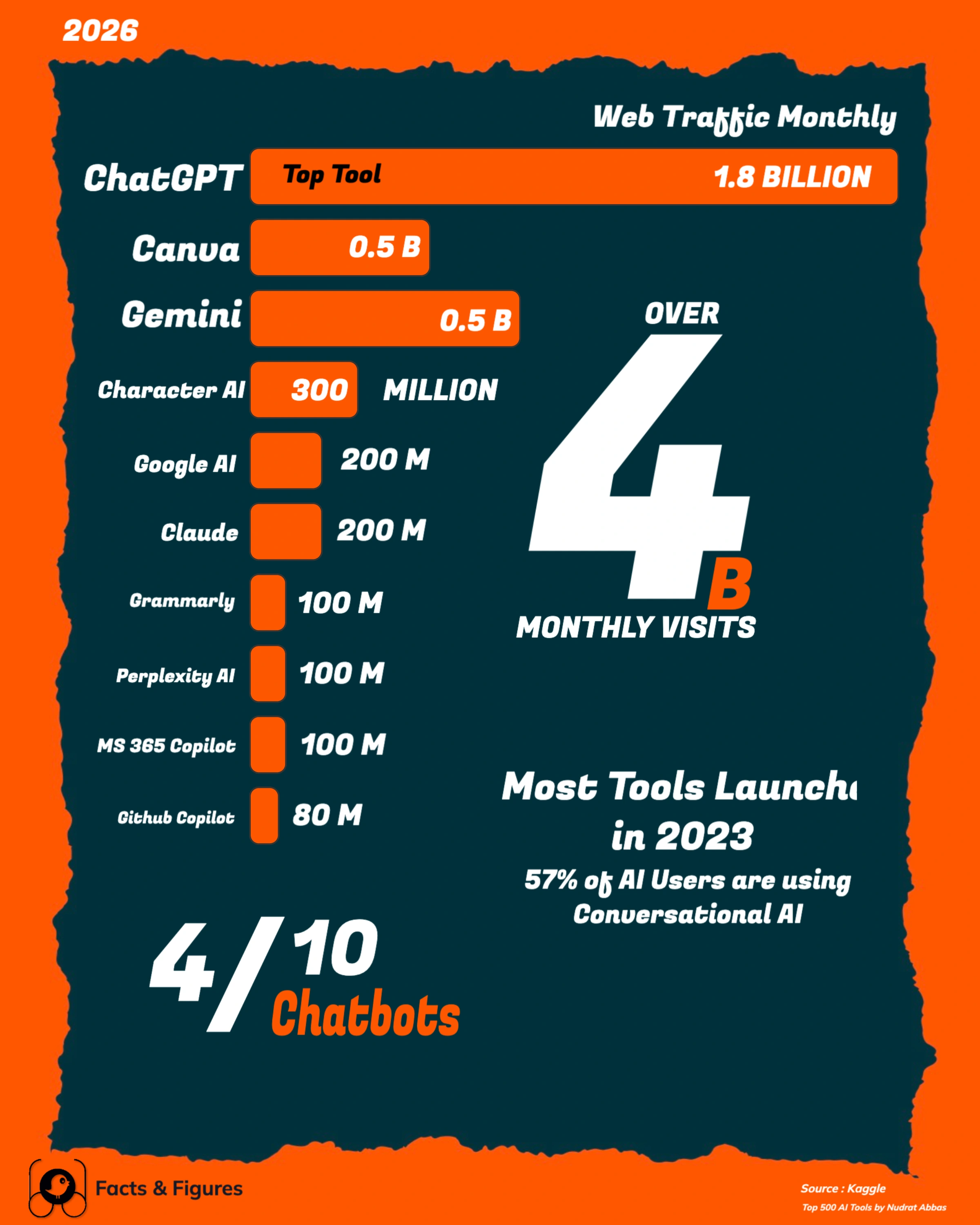
ChatGPT leads with an estimated 1.8B monthly visits — roughly 44% of the 4.13B combined visits across the top 10.
Four chatbots — ChatGPT, Gemini, Character.AI, and Claude — drive most of that traffic; design, productivity, search, and coding tools fill the rest.
Grammarly (2009) is the only tool here that predates the generative-AI era; eight of the other nine launched in 2022–2023.
! Why This Matters:
•
Context:Every tool on the list sells the same interaction: describe what you want in plain language — as a chat, a design prompt, a sourced search query, or a code comment.
•
Signal:Raw web visits undercount real usage — ChatGPT’s ~1.44B app installs and Microsoft 365 Copilot’s 20M+ paid seats barely register as browser traffic.
•
Action:Watch distribution, not just model quality: Gemini shipping as the Android default and AI-native search are already redrawing these shares.
? Key Data at a Glance:
•
Primary Metric:1.8B monthly visits — ChatGPT
•
Combined Reach:4.13B monthly visits across the top 10
The leaderboard isn’t fixed: in the year after this data was compiled, Gemini’s traffic share tripled to 27.3% and Claude climbed from 1.6% to 8.9% — a genuine redistribution that moves the race from raw model capability to who owns the doorway users walk through.
Continue reading below for the full detailed article →
Overview
One Interaction Model Behind All 10 Tools
The world's ten most-visited AI tools span conversational assistants, image generation, productivity tools, search, and coding help — yet nearly every one runs on the same interaction model: describe what you want in plain language, and the tool does it. ChatGPT, Gemini, Claude, and Character.AI make that literal as chat interfaces; Canva's Magic Studio turns a prompt into a design, Perplexity turns a query into an answer, and Microsoft 365 Copilot, Google Workspace AI, and GitHub Copilot Chat replace menus and syntax with a sentence. Grammarly, built around inline suggestions rather than a prompt box, is the one holdout.
#1 ChatGPT — 1.8B Monthly Visits, 44% of the Top 10
Every tool on this list is pulling search-engine-scale traffic for the same reason: they all offer Google-style answers with intelligence built in. It feels like chatting with a super-intelligent tutor who answers your question directly, instead of putting you through the misery of results pages where you have to dig for it yourself. ChatGPT was the first to package that feeling into a chatbot with its stunning entry in November 2022 — and that is exactly why people now treat these tools like search engines.
AI Traffic Leader · 1.8B Monthly Visits
An estimated 1.8 billion visits a month — knocking on 2 billion — for a single chatbot. Traffic at that scale means one thing: the chatbot is doing its job fairly enough that people keep coming back.
Record-Breaking Launch · 1M Users in 5 Days
Launched on November 30, 2022, ChatGPT hit 1 million users in five days and 100 million monthly users by January 2023 — the fastest-growing consumer app in history at the time. TikTok needed nine months for that; Instagram took about two and a half years.
Free to Start, Paid for More
Anyone can use it free at chatgpt.com or the mobile app — ask questions, draft emails, summarize documents, get code written, or practice a language. Free and paid plans are on offer: paid tiers unlock more usage, newer models, and heavier workloads for power users.
More Than a Chatbot
It holds context across a whole conversation and follows up like a tutor would. It reads images, talks back in voice mode, and works in dozens of languages — the qualities that turn a curious first visit into a daily habit.
ChatGPT by the Numbers
44% of Top 10 AI Traffic 44 %ChatGPT's 1.8 billion monthly visits alone make up 44% of the 4.13 billion visits across all ten tools in this ranking.
73% Still Desktop 73 %Only about 27% of ChatGPT's traffic arrives via mobile web — the rest, 73%, is still logged through desktop browsers.
52.7% Gen-AI Market Share 53 %ChatGPT's share of worldwide generative-AI website visits slid from 76.4% in June 2025 to 52.7% by late May 2026, per Similarweb tracking.
Design Tools
#2 Canva AI — 500M Visits From a Design Tool, Not a Chatbot
Canva sits in a different category than the four chatbots ranked above it — it's a design tool, and design tools win by demanding less skill, not by sounding smarter. That's been the pitch since before 'AI tool' was even a category: pick a template, drag in a photo or logo, and a social post, resume, or presentation slide is done in minutes, no training required. That ease already carried Canva to an estimated 170 million active users and 500 million monthly visits — the second-highest traffic in this ranking — before generative AI entered the picture. What's new is the AI layer now built into that same workflow: text-to-image generation, one-click background removal, and automatic design suggestions, which is exactly why an established tool like this is still climbing.
Free Plan vs. Canva Pro
Canva keeps that reach wide with a free plan that covers the core templates, drag-and-drop editing, and basic AI tools most casual users need — no subscription required. The paid Canva Pro tier unlocks the deeper end of that same AI layer, including Magic Studio's text-to-image generation, an automatic background remover, a saved brand kit for logos and fonts, and extra cloud storage, aimed at users who outgrow the free tier's basics.
Conversational AI
#3 Gemini — 750M Visits and Google's Distribution Edge
Multimodal From Day One · 90M Active Users
Gemini is Google's general-purpose chatbot, built to draft text, answer questions, analyze images, and write or debug code inside one conversation thread. It reached the public in 2023 and already draws an estimated 750 million monthly visits and 90 million active users, trailing only ChatGPT and Canva AI. People use it like ChatGPT — a first stop for research, coding help, or brainstorming — but Gemini's multimodal grounding lets it reason directly over a photo, a PDF, or a spreadsheet pasted into the chat, not just plain text, pulling a Google-scale audience into a product barely two years old.
Built-In Distribution · Default on Android
Gemini's biggest advantage isn't the model — it's where Google can put it. Making Gemini the default assistant on Android phones, and wiring it into Search, Gmail, and Docs, hands the chatbot to hundreds of millions of people who never made a decision to download anything. Every rival on this list has to earn each visit through habit or word of mouth; Gemini inherits its audience from products people already open every day.
Share Tripled in a Year · 8.9% → 27.3%
That distribution is already showing up in the numbers. Similarweb's tracking puts Gemini's share of generative-AI website visits at 27.3% by late May 2026 — more than triple the 8.9% it held in June 2025, and the fastest share gain of any tool in this ranking. If that trajectory holds, the #3 spot here understates where Gemini sits by the time the next snapshot is taken.
Companion AI
#4 Character.AI — 300M Visits Built on 18-Minute Sessions
Character.AI lets anyone build or chat with a custom AI persona — a historical figure, a fictional character, an original creation — instead of a single general-purpose assistant. Since launching in 2022 it has built an estimated 20 million active users generating roughly 300 million monthly visits, more traffic than Claude, Grammarly, or Perplexity AI pull individually. The product is used less for quick lookups than for company: ongoing, in-character conversations people return to the way they'd return to a favorite show, not a search box closed the moment an answer arrives.
Productivity
#5 Google Workspace AI — 200M Visits, 30+ per User
Google Workspace AI folds generative features directly into Docs, Sheets, Gmail, and Meet — drafting a document from a prompt, summarizing a long email thread, or writing a first-pass spreadsheet formula without leaving the app someone already has open. It launched in 2023 and shows an estimated 200 million monthly visits against roughly 6 million active users, a ratio of more than 30 visits per user a month — a feature people dip into repeatedly during the workday, not a destination visited once. Nobody opens a browser tab specifically for it — the tool comes to the document, not the other way round.
Conversational AI
#6 Claude — 200M Visits, a Quarter of ChatGPT's User Base
Built for Careful Answers · 200M Monthly Visits
Claude, built by Anthropic, positions itself around careful, well-reasoned answers for writing, coding, and analysis rather than speed or breadth of features. Its monthly traffic runs at 200 million visits against 50 million active users — more than a quarter of ChatGPT's user base already, just three years after Anthropic's public launch in 2023.
Long-Context Work · Whole Documents at Once
Its main draw for professional users is long-context handling: pasting in a full contract, codebase, or research paper and asking Claude to work through the whole document at once, rather than clipping it into pieces first. That single capability is why its audience skews toward lawyers, developers, and researchers — work where losing the thread halfway through a document is the difference between useful and useless.
From Rounding Error to Contender · 1.6% → 8.9%
Claude is also the quiet mover in this ranking. Similarweb pegs its slice of generative-AI visits at 8.9% by late May 2026, up from just 1.6% a year earlier — with its sharpest single-month gain, 2.9 points, landing right at the end of that stretch. A 200-million-visit tool compounding at that pace is exactly the kind of challenger the raw traffic rankings undersell.
#7 Grammarly — 100M Visits From a Pre-AI Tool (2009)
Grammarly runs as a browser extension, checking grammar, tone, and clarity inline as someone types in Gmail, Google Docs, Slack, or almost any other web form — corrections appear as underlines and side-panel suggestions, not a chat window. That inline-editing model, first built in 2009, still draws an estimated 100 million monthly visits and 30 million active users, predating the generative-AI boom that produced the other nine products by more than a decade. Its use case is narrower than a chatbot's — proofreading and polishing existing text, not producing it from scratch — which is why it holds a loyal, repeat-use audience instead of one-off visits.
AI Search
#8 Perplexity AI — 100M Visits Challenging Google Search
Perplexity AI turns a search query into a synthesized, sourced answer instead of a page of blue links to click through and compare — each response carries inline citations a user can check like a footnote. Launched in 2022, it now draws an estimated 100 million monthly visits from roughly 15 million active users, a traffic total tied with Grammarly despite operating in a category — search — that Google has dominated for over two decades. Its core use case is research: comparing products, summarizing a topic across sources, or fact-checking a claim in one pass instead of ten browser tabs.
Productivity
#9 Microsoft 365 Copilot — 100M Web Visits, 20M Paid Seats
Microsoft 365 Copilot embeds an AI assistant directly into Word, Excel, PowerPoint, Outlook, and Teams — drafting a first pass of a report, building a slide-deck outline, or turning a meeting transcript into action items without switching apps. It launched in 2023, with active users at roughly 345,000 against 100 million monthly visits, a striking gap for a productivity tool: most of that traffic likely lands on Microsoft's marketing and licensing pages, since the product ships as a per-seat add-on to an existing subscription rather than something anyone can sign up for directly.
GitHub Copilot autocompletes code as a developer types, suggesting the next line — or the next whole function — based on context from the file, comments, and the surrounding codebase, then lets the developer accept, edit, or reject it inline. Since its 2021 launch it has become many developers' entry point into AI-assisted coding, now pulling an estimated 80 million monthly visits and 15 million active users from a genuinely technical audience: people writing production code, not casual visitors testing a chatbot. Copilot Chat, its newer layer, lets a developer describe a function in plain English and get a first draft to edit.
Full Rankings
All 10 AI Tools, Ranked by Monthly Traffic
Rank, tool name, primary category, estimated monthly web traffic, estimated active users, and release year for the top 10 AI tools by monthly web traffic, from ChatGPT at #1 to GitHub Copilot at #10.
Traffic and active-user figures are estimates from the same Kaggle dataset used throughout this post, not official numbers reported by the companies themselves.
Adoption
How 4.13 Billion Monthly Visits Split Across the Top 10
The 4.13 billion monthly visits split unevenly across the top 10, and the shape of that split says as much as the total itself. The top three tools — ChatGPT, Gemini, and Canva AI — account for roughly 3.05 billion visits between them, or about 74% of all traffic in this ranking. The remaining seven tools split the other 26%, with the bottom five (Claude, Grammarly, Perplexity AI, Microsoft 365 Copilot, and GitHub Copilot) combining for just 580 million visits — less than Gemini pulls on its own.
By category, conversational AI dominates: ChatGPT, Gemini, Character.AI, and Claude together generate roughly 3.05 billion visits, about 74% of the combined total, even though they're only 4 of the 10 tools. Productivity tools (Google Workspace AI and Microsoft 365 Copilot) trail far behind at 300 million combined, or 7%, despite plugging into some of the most widely used office software on earth — a reminder that being embedded in a workflow doesn't translate to standalone web traffic the way a chatbot does.
Chatbots
Why 4 Chatbots Drive Most of the Traffic
Conversational AI dominates the rankings, with ChatGPT, Gemini, Character.AI, and Claude collectively attracting billions of monthly visits. These platforms have transformed how users search, learn, create content, and interact with technology, making chatbot-based interfaces the leading gateway into the modern AI ecosystem. Distribution deals widen the gap further: Google has been rolling Gemini out as the default assistant on Pixel, Samsung Galaxy, and other Android phones through 2026, replacing the long-running Google Assistant and handing Gemini a built-in placement advantage no independent chatbot can buy. Character.AI wins a different way — through depth rather than breadth. Its average visit runs around 18 minutes, more than double a typical ChatGPT session, because the product is built around sustained role-play conversations rather than quick, one-off queries.
Web-visit counts like the ones behind this chart only capture browser traffic, and that undercounts a growing share of actual usage. ChatGPT's app has been downloaded roughly 1.44 billion times since its May 2023 launch, yet only about 27% of ChatGPT's overall traffic arrives via mobile web — the majority, 73%, is still logged through desktop browsers. A large population of app-only users never touches chatgpt.com and stays invisible to this kind of website ranking entirely.
The same distortion cuts the other way for enterprise tools. Microsoft 365 Copilot's spot in this ranking reflects public web visits, but Microsoft told investors on its April 2026 earnings call that paid Microsoft 365 Copilot seats had passed 20 million, up from 15 million the previous quarter — real, revenue-generating usage that happens inside Word, Excel, and Teams rather than on a public website, so it barely registers as "traffic" at all. Consumer chatbots and enterprise productivity tools are, in effect, being measured on two different scales.
Generative AI
Why 9 of the Top 10 Launched After 2020
Most of the top-ranked AI platforms were launched between 2022 and 2023, marking the rapid emergence of the generative AI era. The speed of adoption highlights how quickly AI tools moved from experimental products into mainstream consumer, workplace, and developer workflows worldwide. Grammarly is the outlier on this list — it launched back in 2009, more than a decade before generative AI existed, and only reached this ranking by bolting AI writing features onto an already-massive existing user base, a reminder that traffic dominance and AI-nativeness aren't the same thing.
2025-2026 Shift
What's Changed Since This Snapshot
This dataset captures a moment, and the market has moved fast since. Similarweb's worldwide traffic tracking shows ChatGPT's share of generative-AI website visits sliding from 76.4% in June 2025 to 52.7% by late May 2026, while Gemini's share more than tripled over the same stretch, from 8.9% to 27.3%. Claude moved from a rounding error to a real contender, climbing from 1.6% to 8.9% — including a 2.9-point jump in a single month, its fastest move yet.
Two forces are driving that shift. First, Google's push to make Gemini the default assistant across Android — not just an app people choose to download — turns hundreds of millions of existing phones into built-in distribution that no independent chatbot can replicate. Second, AI-native search products are pulling traffic away from the categories these tools were once compared to: Perplexity told investors in mid-2025 it was processing 780 million queries a month and growing more than 20% month-over-month, while Google's own AI Overviews now appear on 48% of search queries as of March 2026. The competitive question for 2026 isn't just which chatbot has the most visits — it's which company controls the entry point people open first.
Conclusion
The Takeaway — Distribution Beats Model Capability
The rapid rise of high-traffic AI platforms signals a shift toward AI-powered digital experiences across nearly every industry, from search and content creation to coding and everyday productivity. But the leaderboard behind this chart isn't fixed: in the year after this data was compiled, the second- and third-place platforms gained more worldwide traffic share than the market leader lost — a genuine redistribution, not just a slowdown at the top. Competition among AI platforms is shifting from raw model capability toward distribution: who owns the phone's default assistant, the browser's AI answers, or the enterprise software the visits never show up in.
The data behind this story comes from the Kaggle dataset “Top 100 AI Tools 2026,” covering estimated monthly web traffic, active user counts, launch years, and primary categories for leading AI platforms. The dataset is published under the CC0 Public Domain license, and full credit for collecting and maintaining it goes to Kaggle contributor nudratabbas.
FactsFigs reviews, cleans, and cross-checks every source dataset before shaping it into a data story. Each visualization is created and designed in FactsFigs Design Studio — an internal tool developed and owned by FactsFigs — and is the original work of a FactsFigs author, not an AI-generated copy of any existing graphic. Individual assets within a visual may or may not be produced with AI tools, but the design of the visual itself is solely FactsFigs' own.
Figures are estimates at the time of publication, provided for information only — nothing here is financial advice or a guarantee of accuracy.
2026-07-16
The charts in this article were built with our own publishing system. See what it does →