

95%
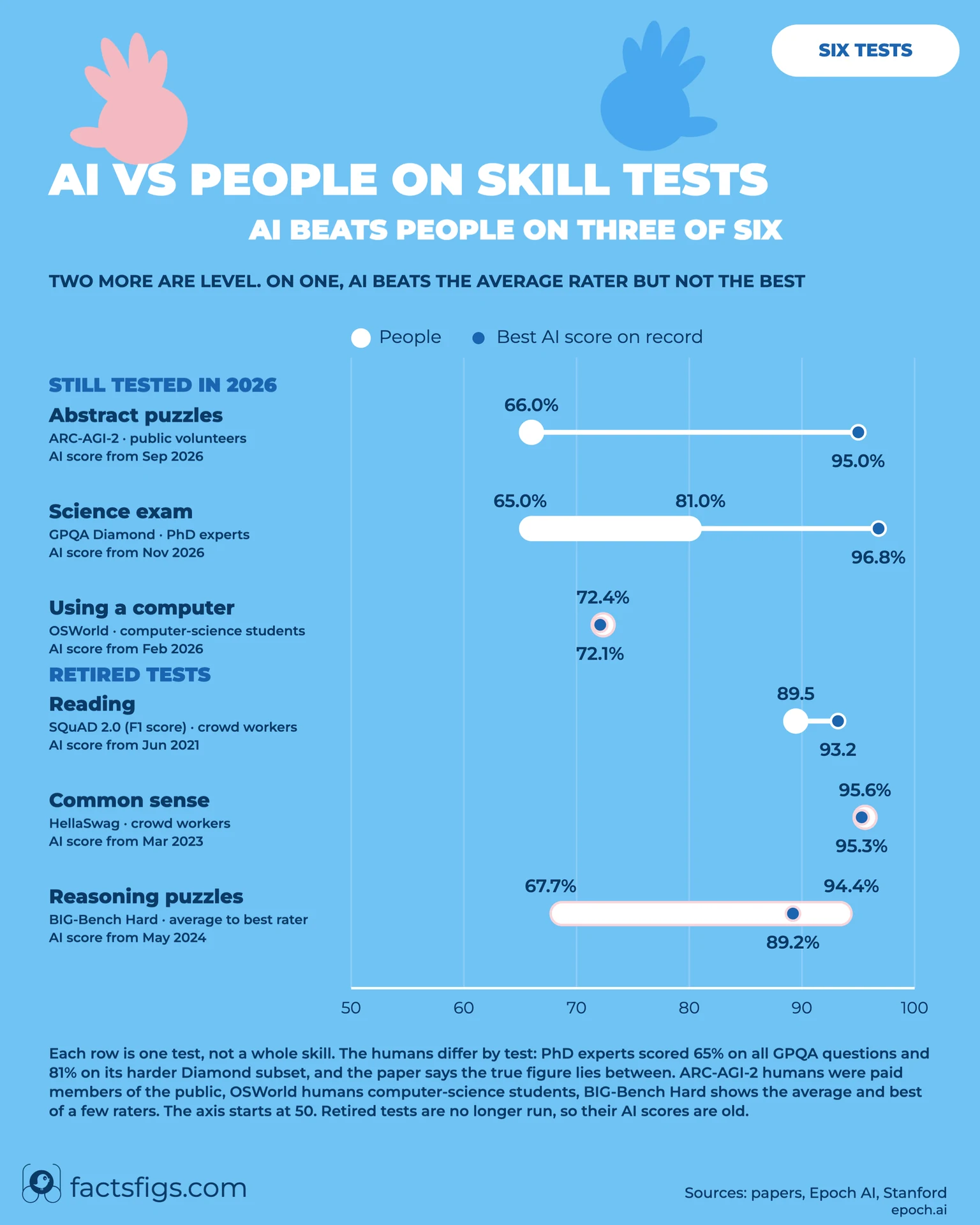
On ARC-AGI-2, 407 members of the public solved 66% of the puzzles they attempted. The best AI score on record is 95.0%, from 3 September 2026.

Facts & Figures
Visual Intelligence
Six tests, each with a published human score
On these six tests, often yes. AI now scores above people on abstract puzzles, PhD-level science questions and reading comprehension. It is level with them on using a computer and on common sense. On multi-step reasoning puzzles it beats the average human rater but not the best. That is a statement about tests, not about skills. The human scores come from different kinds of people. Three of the tests are retired and give old AI scores. For maths and research there is no comparable human score at all.
These tests were built to measure AI and scored in a lab. A model beating people on a test is not the same as doing a person's job better, and where the human baseline is a handful of raters or a paid crowd, the gap says little. Read the chart as six data points, not a verdict.
Continue reading below for the full detailed article →
Overview
A benchmark is a fixed set of questions or tasks with a scoring rule. To say AI beats people on one, someone has to give the same questions to people and record how well they do. That human score is the baseline, and it is only as good as the group that produced it. We picked six benchmarks where the people who built the test published a human score in their own paper, and where an AI score is on record. For each we show the human score and the best AI score on record, with the date of that AI score. Three tests, GPQA Diamond, ARC-AGI-2 and OSWorld, are still run on new models in 2026. Three, SQuAD 2.0, BIG-Bench Hard and HellaSwag, are retired: AI passed or matched people years ago and labs stopped reporting on them, so their AI scores are old.
AI is far ahead on puzzles and science questions and level with people on computer tasks.
95%
On ARC-AGI-2, 407 members of the public solved 66% of the puzzles they attempted. The best AI score on record is 95.0%, from 3 September 2026.
97%
PhD-level experts scored 65% on all GPQA questions and 81% on its harder Diamond subset. The best AI score on record is 96.8%, from 17 November 2026.
72%
On OSWorld, college computer-science students completed 72.36% of office and web tasks. The best AI score on record is 72.1%, from 17 February 2026.
The Wins
On three of the six tests. ARC-AGI-2 asks a player to work out a new pattern from a few examples and apply it to a fresh grid, with no special knowledge needed. Its authors tested 407 members of the general public in paid sessions: they solved 66% of the puzzles they attempted, and every puzzle in the test was solved by at least two of them. The best AI score on record is 95.0%, from 3 September 2026.
GPQA Diamond is a set of 198 multiple-choice questions in biology, physics and chemistry, written by PhD-level experts so that a web search does not answer them. Experts in the field scored 65% on the full question set and 81% on the Diamond subset, a figure the paper says is inflated because the subset keeps questions the experts got right, so it puts the true expert score between the two. Skilled non-experts with unlimited web access scored 34% on the full set. The best AI score on record is 96.8%, from 17 November 2026.
SQuAD 2.0 is a reading test: answer questions about a Wikipedia paragraph, or say that the paragraph does not contain the answer. Crowdworkers scored 89.45 on the F1 measure, which gives partial credit for overlapping answers. The best AI entry on the Stanford leaderboard, an ensemble of models, scored 93.2 in June 2021.
The Draws
Using a computer is the one current test where AI has not clearly passed people. OSWorld gives an agent 369 tasks across everyday programs on a real computer. Computer-science college students with basic software skills, seeing the tasks for the first time, completed 72.36%. The best AI score on record is 72.1%, from 17 February 2026. That is a tie within a third of a point.
Two cautions. The human figure comes from the 2024 paper on the original set of tasks, while the AI scores are reported on the benchmark's later version. The pages we read do not say whether the humans were re-tested. A harder OSWorld 2.0 also exists, where the best AI score on record is 31.4%, but the sources we read give no human score for it, so we cannot say how people would do.
Common sense is level too, on a retired test. HellaSwag asks which ending best finishes a sentence about an everyday situation. Crowd workers scored 95.6% and the best AI score in our data, from GPT-4 in March 2023, is 95.3%. Later models may score higher, but their scores are not in the data we used.
The Split Decision
Not on every test. BIG-Bench Hard is a set of 23 reasoning tasks picked because earlier models could not beat the average human rater on them. The paper reports two human scores: an average of 67.7% and a best rater at 94.4%. The best AI score on record is 89.2%, from Google's Gemini 1.5 Pro in May 2024. That is above the average rater and below the best one.
The paper warns that its human raters were a few people given a few hours and are not representative of the population, so the range is a rough guide. In October 2022 the benchmark's authors showed one model, OpenAI's Codex, beating the average rater by more than 6 points once it was prompted to reason step by step.
GPQA also has a range. If the expert score is 65%, AI is 32 points ahead; if it is 81%, 16 points ahead. Either way it is ahead, but the size of the gap depends on which end you believe.
The Catch-Up
Fast on recent tests. On ARC-AGI-2 the first AI score above 10% came on 9 July 2025, at 16%. The first above the human 66% came on 5 February 2026, at 68.8%, and the best score reached 95.0% on 3 September 2026, less than 14 months after that first 16%.
On GPQA Diamond, GPT-4 scored 35.7% in March 2023, just above the 34% of skilled non-experts. The first AI score above the 65% expert mark came on 17 December 2024, at 74.2%, and the first above 81% on 25 March 2025, at 83.8%.
On reading, AI passed people earlier. The first SQuAD 2.0 leaderboard entry above the human 89.45 F1 score came on 20 March 2019, at 89.47.
The Gaps
They are not in the chart because we found no human score we could set beside an AI score. FrontierMath, Epoch AI's set of expert-written maths problems, says typical problems take mathematicians hours or days. The pages we read give no human score. The best AI score on its Tiers 1 to 3 is 95.1%, from 9 November 2026.
The classic MATH test has human scores too, but they are single people, one computer-science PhD student at about 40% and one three-time International Mathematical Olympiad gold medallist at 90%. The AI data we have covers only the hardest subset of it. Setting those side by side would mislead.
Research is harder still. No test we found measures AI doing research and also reports how research scientists score on it. Forecasting against professional superforecasters is a promising comparison, but its human scores sit on a site we could not read for this post.
Test by Test
Each test with the humans who set its baseline, the human score, the best AI score on record and who got it. Sort any column to reorder the rows.
| Abstract puzzles | ARC-AGI-2 | 407 members of the public, paid | 66% | 95.0% | GPT-6 Astra (Max), 3 Sep 2026 | AI ahead |
| Science exam | GPQA Diamond | PhD-level experts | 65% to 81% | 96.8% | GPT-6.2 Astra (max), 17 Nov 2026 | AI ahead |
| Using a computer | OSWorld | Computer-science students | 72.36% | 72.1% | Claude Sonnet 4.6 (100 steps), 17 Feb 2026 | Level |
| Reading (retired) | SQuAD 2.0 | Crowd workers | 89.45 F1 | 93.2 F1 | IE-Net ensemble, 4 Jun 2021 | AI ahead |
| Common sense (retired) | HellaSwag | Crowd workers | 95.6% | 95.3% | GPT-4 (10-shot), 14 Mar 2023 | Level |
| Reasoning puzzles (retired) | BIG-Bench Hard | A few raters, average and best | 67.7% to 94.4% | 89.2% | Gemini 1.5 Pro, 14 May 2024 | Between average and best |
Human scores: Rein et al. 2023 (GPQA), Chollet et al. 2025 (ARC-AGI-2), Xie et al. 2024 (OSWorld), Rajpurkar et al. 2018 and the Stanford leaderboard (SQuAD 2.0), Zellers et al. 2019 (HellaSwag), Suzgun et al. 2022 (BIG-Bench Hard). AI scores: Epoch AI benchmark data, 18 Nov 2026, and the Stanford leaderboard.
Reading It Carefully
A test is not a skill. Scoring 97% on science questions does not make a model a better scientist, and 95% on puzzles does not mean it thinks like a person. These tests were built to measure AI, usually as multiple choice or short answers, and people were tested on them as an afterthought, often on a screen and in a rush.
The humans are different on every row: paid volunteers, PhD experts, computer-science students, crowd workers and a few raters. A score of 66% from one group and 72% from another are not comparable, and most baselines are a single study from a few years ago.
Three of the six tests are retired, so their AI scores are old, and a model that has seen a test's questions in training can score well without the skill. Epoch's own evaluation and the leaderboards we read do not remove that risk. We give no reasons for why AI improved, because none of the sources we read does.
Epoch AI, Capabilities & benchmarking Stanford SQuAD2.0 leaderboard
AI scores come from Epoch AI's benchmark data, updated 18 November 2026, which is published under a Creative Commons Attribution 4.0 licence for Epoch's own evaluations; data Epoch compiles from outside projects keeps its original licence. Epoch AI, 'Capabilities & benchmarking'. Published online at epoch.ai. Retrieved from 'https://epoch.ai/benchmarks/use-this-data' [online resource]. Accessed 18 Nov 2026. SQuAD 2.0 scores are from the Stanford leaderboard, read 18 Nov 2026.
Human scores come from the test authors' papers on arXiv: Rein et al., GPQA (2311.12022); Chollet et al., ARC-AGI-2 (2505.11831); Xie et al., OSWorld (2404.07972); Rajpurkar, Jia and Liang, SQuAD 2.0 (1806.03822); Zellers et al., HellaSwag (1905.07830); Suzgun et al., BIG-Bench Hard (2210.09261). FactsFigs selected the tests, matched each to its human score and AI score and drew the comparison. No data download is offered.
FactsFigs reviews, cleans and cross-checks every source dataset before shaping it into a data story. Each visualization is created and designed in FactsFigs Design Studio, an internal tool developed and owned by FactsFigs, and is the original work of a FactsFigs author, not an AI-generated copy of any existing graphic. Individual assets within a visual may or may not be produced with AI tools, but the design of the visual itself is solely FactsFigs' own.
Figures are scores from fixed tests at the time of publication, provided for information only; nothing here is a forecast or a guarantee of accuracy.
Last verified: 18 Nov 2026
Related Publications
Companies built 102 of the 111 notable AI models Epoch AI recorded for 2025, 92%. In 2010 universities built 8 of 10.
17 Nov 2026
Pew's six surveys: Republicans were 14 points more concerned than Democrats about AI in 2021. In June 2026 Democrats led by 7 points, 56% to 49%.
16 Nov 2026
US and Chinese companies trained 94% of OpenRouter's 50 most-used AI models in May 2026, up from 76%. China rose from 10% to 40%.
12 Nov 2026
Under-45s worry most that their work could be automated, at 37% and 38%. Workers over 65 barely worry: just 7%.
11 Nov 2026