

92%
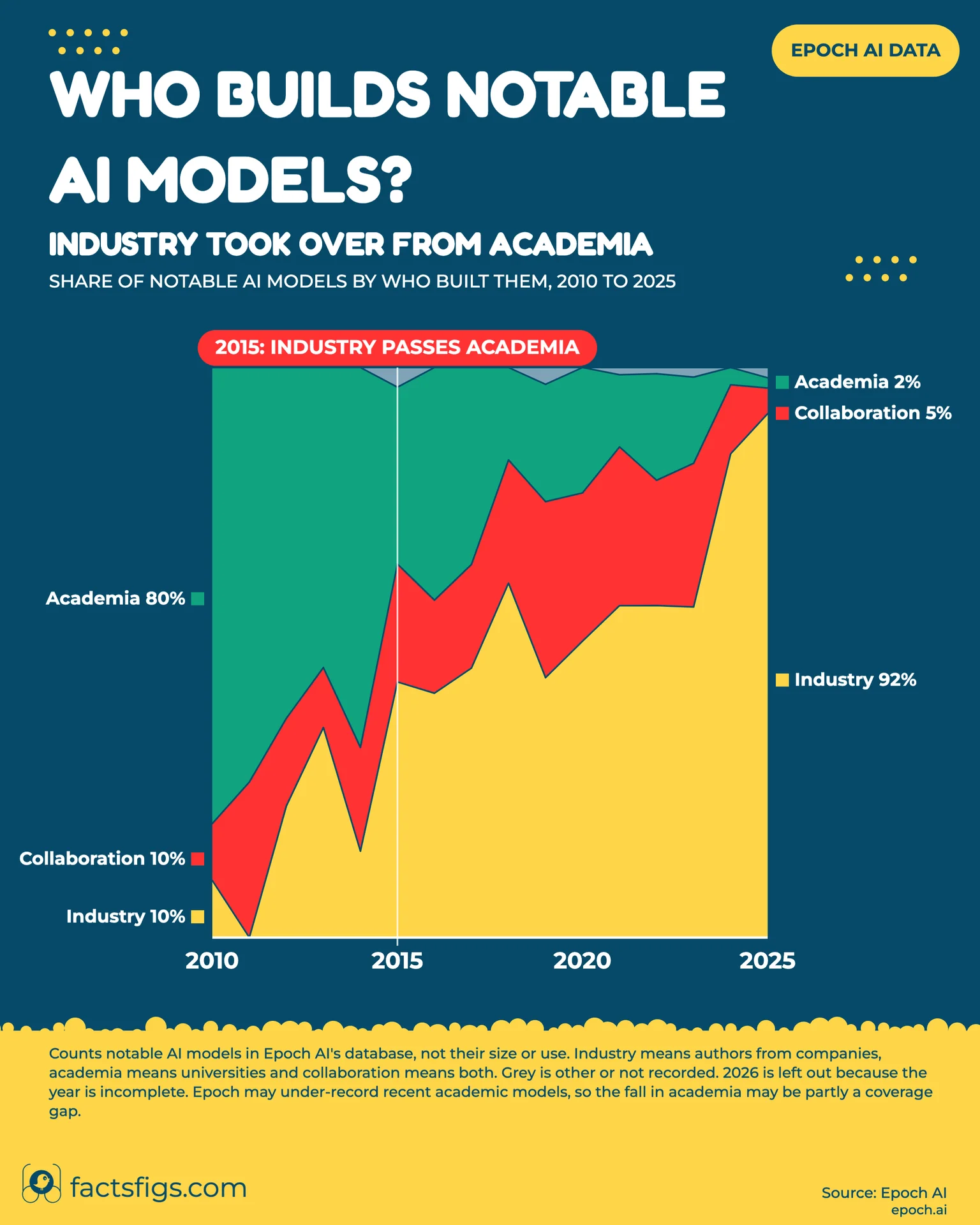
Industry built 102 of the 111 notable models recorded for 2025. In 2010 it built 1 of 10.

Facts & Figures
Visual Intelligence
Epoch AI's database of notable models, 2010 to 2025
Companies. Of the 111 notable AI models Epoch AI recorded for 2025, companies built 102, or 92%. Collaborations between companies and universities built 5 and universities alone built 2. In 2010 the picture was the other way round: universities built 8 of 10, or 80%. The handover came in 2015, when companies first built more notable models than universities, and it has held every year since. The largest models are almost all industry's too: in every year from 2022 the five models with the most training compute all came from companies.
Epoch's database records almost no notable academic models after 2023. Part of that may be how recent models are recorded and which tests they pass, so read it as what Epoch recorded, not as proof that universities stopped building AI.
Continue reading below for the full detailed article →
Overview
Epoch AI, a non-profit research organisation, maintains a database of AI models it judges notable. A model gets in when it set a state-of-the-art result on a recognised benchmark, is highly cited, is historically significant, has more than a million monthly users or cost more than $1 million in 2023 dollars to train. Epoch staff can also add a model at their discretion. Each model is tagged by the organisations its authors work for: industry for companies, academia for universities and a collaboration when both appear. Our World in Data publishes the same list as a chart of notable AI "systems"; the data is Epoch's. This post counts models, one each, so a small research model and a frontier model count the same. It is a count of what was built and by whom, not of compute, spending or use. The database holds 1,100 notable models, 873 of them published from 2010 to 2025, which is where this post starts because Epoch says its coverage before 2010 is sparse.
Companies took over the count in 2015 and are close to all of it now. They also build almost every one of the largest models.
92%
Industry built 102 of the 111 notable models recorded for 2025. In 2010 it built 1 of 10.
2%
Universities built 8 of 10 notable models in 2010 and 2 of 111 in 2025. Epoch may under-record recent academic models.
142
Of the models trained with at least 10^23 floating-point operations, companies built 142, collaborations 11, universities 2 and other builders 3.
The Present
Companies. Epoch's database lists 111 notable AI models published in 2025. Companies built 102 of them, 92%. Collaborations between companies and universities built 5 and universities alone built 2. The other 2 had another type of builder or none recorded.
The pattern is stronger at the top end. Training compute is a count of the arithmetic steps a training run performs, measured in floating-point operations, or FLOP. Epoch flags 158 models trained with at least 10^23 FLOP, a threshold some regulators use for large-scale models. Companies built 142 of them, collaborations 11, universities 2 and other builders 3. In every year from 2022 to 2026, all five models with the most training compute that year, among those with an estimate, came from companies.
The 2026 count looks even more one-sided: 99 of the 101 models published up to 10 November are from companies. That year is incomplete, and 80 of its 101 entries are listed as discretionary additions by Epoch's staff rather than as passing a fixed test, so it is left off the chart.
The Handover
In 2015, by count. Universities built 65% of Epoch's notable models in 2010 to 2014, against 19% for companies. In 2015 companies built 13 and universities 9. Companies have built more every year since, though only just in 2016, with 21 against 20.
The gap then widened. Companies built 48% of notable models in 2015 to 2019 and 69% in 2020 to 2025, while universities went from 29% to 11%. Companies passed half of a single year's models in 2018, at 62%, fell back to 46% in 2019 and have been above half in every year since 2020.
The total grew as well, so shares understate the change. Epoch recorded 10 notable models for 2010, 49 for 2016, 119 for 2023 and 111 for 2025. Industry went from 1 model in 2010 to 102 in 2025, while universities peaked at 22 in 2014 and fell to 2.
The Builders
OpenAI is the company named most often in the database, on 81 notable models, just ahead of Google on 80. Epoch lists Google under several names, including Google, Google Brain, Google Research, DeepMind and Google DeepMind, and 218 models name at least one of them. Of the other single names, Meta AI has 45 models, Alibaba 38, Microsoft 29, Nvidia 29 and Anthropic 25. A model with authors from several organisations is counted once for each.
Since 2020 the order is OpenAI with 54, Meta AI with 39, Google DeepMind with 38, Google with 35 and Alibaba with 27. For how the companies compare on money, our post on AI company valuations shows who is worth what.
Among universities, Stanford leads over all years with 33 notable models, ahead of Carnegie Mellon with 29, the University of Toronto with 25 and Tsinghua University with 22. Since 2020 Tsinghua leads with 20, ahead of Stanford with 15, UC Berkeley with 12 and MIT with 10.
Working Together
Less than it was. Models with authors from both companies and universities were between 22% and 31% of notable models in each year from 2019 to 2023, peaking at 31% in 2019. In 2024 the share was 12% and in 2025 it was 5%, which is 5 models out of 111.
Collaboration fell as well, from 30 models in 2023 to 12 in 2024.
We count a model as a collaboration when its author list names both a company and a university. Epoch's own documentation describes a stricter rule, at least 30% of authors from each side, which the downloadable data does not carry, so our collaboration counts may differ somewhat from Epoch's own labels.
The Gap
The database records almost none: 3 in 2024 and 2 in 2025, against 18 in 2023 and 22 in 2014. We would not read that as universities stopping. The data lets us check three things that point to a record-keeping effect as well as a real shift.
First, the drop is not only about how citations accumulate. Among models that qualified by improving the state of the art on a benchmark, a test that needs no waiting, universities built 16 in 2023, 3 in 2024 and 1 in 2025, while companies stayed between 41 and 44. Second, some of Epoch's tests can only be met by industry in this data. All 31 models listed for costing over $1 million to train in 2024 are from companies, and so are all 22 listed for having over a million monthly users. Third, Epoch says major models are added within about two weeks and others periodically in literature reviews, so some recent work may not have been added yet.
So the honest reading is that Epoch's database records almost no new notable academic models since 2023. We cannot tell from this data whether universities built fewer of them or whether they are not yet recorded, and neither Epoch's page nor its documentation says.
Year by Year
Each year's notable models in Epoch AI's database, split by whether the authors work for companies, universities, both or neither. Sort any column to reorder the rows.
| 2010 | 1 | 1 | 8 | 0 | 10 | 10 | 80 |
| 2011 | 0 | 3 | 8 | 0 | 11 | 0 | 72.7 |
| 2012 | 3 | 2 | 8 | 0 | 13 | 23.1 | 61.5 |
| 2013 | 7 | 2 | 10 | 0 | 19 | 36.8 | 52.6 |
| 2014 | 5 | 6 | 22 | 0 | 33 | 15.2 | 66.7 |
| 2015 | 13 | 6 | 9 | 1 | 29 | 44.8 | 31 |
| 2016 | 21 | 8 | 20 | 0 | 49 | 42.9 | 40.8 |
| 2017 | 26 | 10 | 19 | 0 | 55 | 47.3 | 34.5 |
| 2018 | 23 | 8 | 6 | 0 | 37 | 62.2 | 16.2 |
| 2019 | 31 | 21 | 14 | 2 | 68 | 45.6 | 20.6 |
| 2020 | 26 | 13 | 11 | 0 | 50 | 52 | 22 |
| 2021 | 46 | 22 | 10 | 1 | 79 | 58.2 | 12.7 |
| 2022 | 53 | 20 | 17 | 1 | 91 | 58.2 | 18.7 |
| 2023 | 69 | 30 | 18 | 2 | 119 | 58 | 15.1 |
| 2024 | 84 | 12 | 3 | 0 | 99 | 84.8 | 3 |
| 2025 | 102 | 5 | 2 | 2 | 111 | 91.9 | 1.8 |
| 2026 (to 10 Nov) | 99 | 1 | 0 | 1 | 101 | 98 | 0 |
Source: Epoch AI. Industry means companies, academia means universities, collaboration means both appear among the authors' organisations. 'Other or not recorded' covers government, research collectives and models with no recorded sector. 2026 is incomplete and runs to 10 November.
Reading It Carefully
It is one curated list, not all AI. Epoch decides which models are notable, and its tests are not neutral between sectors: costing over $1 million to train or having a million users are things companies do. A database built this way will tend to show companies building notable models, and the true gap between sectors may be smaller than it looks.
It counts models and credits authors' employers. One model counts once however large it is, and a university lab funded by a company counts as academia. It does not measure spending, compute or use, and it does not say who paid for the work.
It does not say why. Neither Epoch nor Our World in Data explains why companies took over, and we do not supply reasons. The 2024 to 2026 figures are the least certain, for the reasons above, and 2026 is a part year.
The data behind this story comes from Epoch AI's Data on AI models, its table of notable AI models, which is published under a Creative Commons Attribution 4.0 licence. Full credit for collecting, estimating and maintaining it goes to Epoch AI. Epoch AI, 'Data on AI models'. Published online at epoch.ai. Retrieved from 'https://epoch.ai/data/ai-models' [online resource]. Accessed 17 Nov 2026. Modified by FactsFigs: counted notable models by publication year and by the sector of the authors' organisations (a model is a collaboration when both industry and academic organisations are listed) and calculated the shares; 2026 runs to 10 November.
FactsFigs reviews, cleans and cross-checks every source dataset before shaping it into a data story. Each visualization is created and designed in FactsFigs Design Studio, an internal tool developed and owned by FactsFigs, and is the original work of a FactsFigs author, not an AI-generated copy of any existing graphic. Individual assets within a visual may or may not be produced with AI tools, but the design of the visual itself is solely FactsFigs' own.
Figures are counts from a curated database at the time of publication, provided for information only; nothing here is a forecast or a guarantee of accuracy.
Last verified: 17 Nov 2026
Related Publications
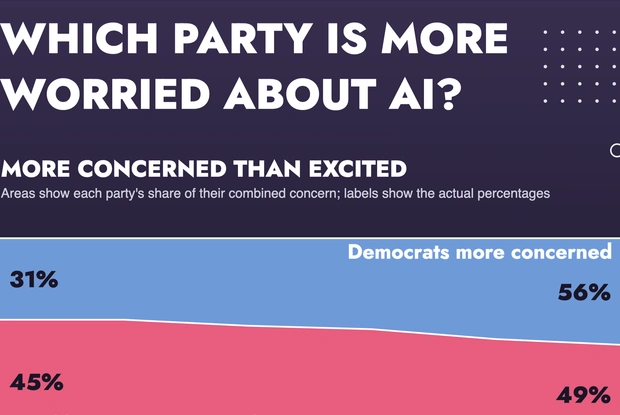
Pew's six surveys: Republicans were 14 points more concerned than Democrats about AI in 2021. In June 2026 Democrats led by 7 points, 56% to 49%.
16 Nov 2026
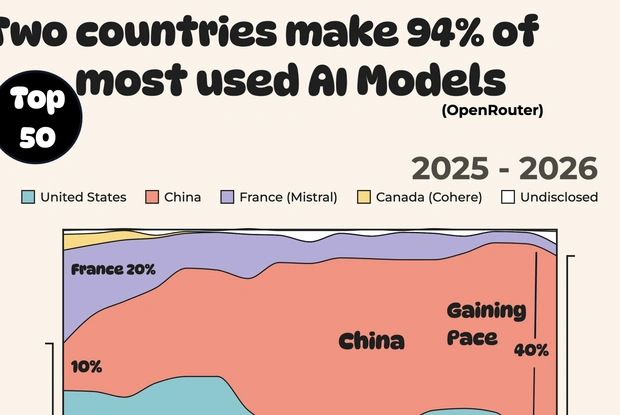
US and Chinese companies trained 94% of OpenRouter's 50 most-used AI models in May 2026, up from 76%. China rose from 10% to 40%.
12 Nov 2026
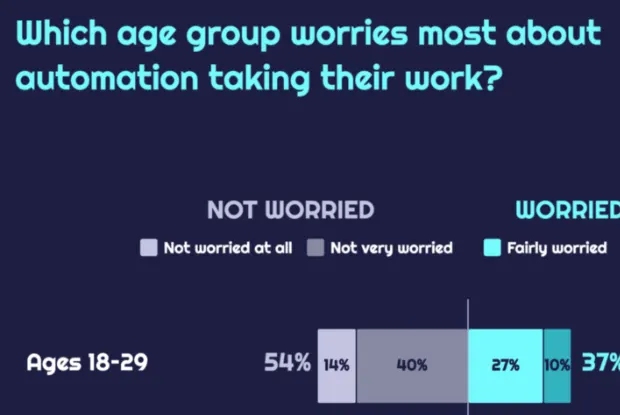
Under-45s worry most that their work could be automated, at 37% and 38%. Workers over 65 barely worry: just 7%.
11 Nov 2026
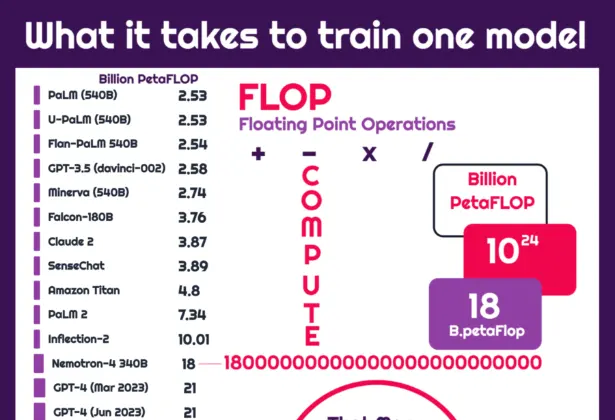
Epoch AI estimates put 24 AI training runs between 2.53 and 940 billion petaFLOP, a 371-fold spread, measured as arithmetic done, not quality.
26 Oct 2026