

19.75M
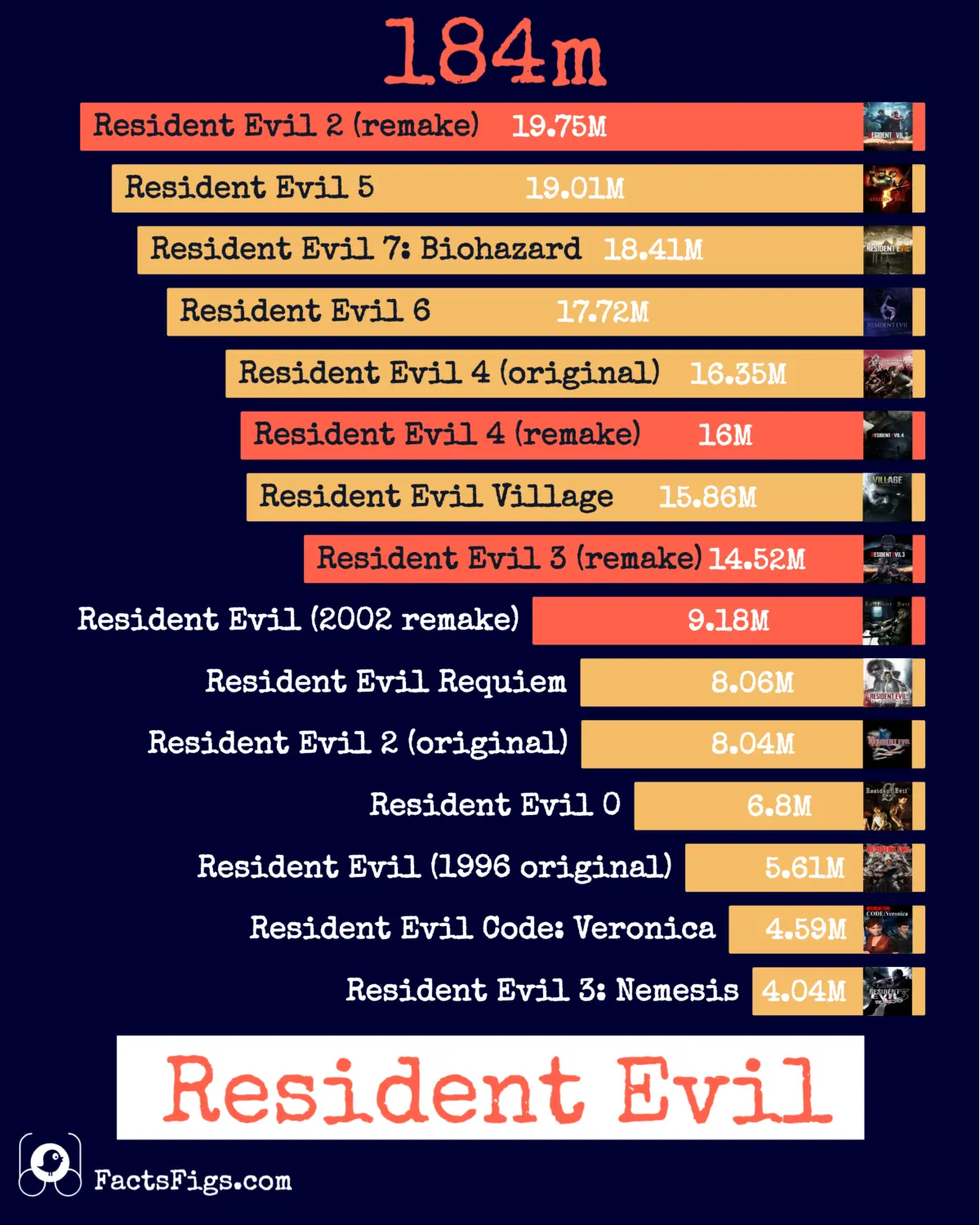
The 2019 Resident Evil 2 remake, which ended Resident Evil 5’s run at the top of the series.

Facts & Figures
Visual Intelligence
The 2019 remake of Resident Evil 2, on Capcom’s own figures
The Resident Evil 2 remake is the best-selling game in the series at 19.75 million copies. It passed Resident Evil 5, which had held the record since 2009, at 19.01 million. All fifteen games here add up to 183.94 million copies, 86.4% of the 213.0 million Capcom reports for the whole series as of 30 June 2026. That sum and that share are ours. Three of the four remakes outsold the games they remade. Resident Evil 4's has not: 16.00 million against the original's 16.35 million, short by about 350,000 copies.
Capcom is the one publisher in this series of posts that maintains a per-title table and restates it quarterly. That is why this ranking can be built on official figures where the Zelda one could not.
Continue reading below for the full detailed article →
The sourcing, stated first
Every figure here is Capcom's. The company publishes a Platinum Titles page listing each release past one million and restates it quarterly, and it reports finer per-title totals in its quarterly materials. The structure of this ranking follows the VG Sales Wiki's Resident Evil page, which is the most complete public breakdown of which release belongs to which game. We checked that page against Capcom before using it and found two rows that were not Capcom figures at all. Both are corrected below, and both are named.
A new leader after fifteen years, the remake that has not caught its original, and the newest game already in the top ten.
19.75M
The 2019 Resident Evil 2 remake, which ended Resident Evil 5’s run at the top of the series.
0.98x
16.00 million against the 2005 original’s 16.35 million. The only remake here that has not passed the game it remade.
8.06M
Five months old and already 10th, ahead of the 1998 Resident Evil 2 by 19,143 copies.
The leader
The 2019 remake of Resident Evil 2 is the best-selling game in the series at 19.75 million copies. Resident Evil 5 is second at 19.01 million, and it had held first place since its release in 2009. Resident Evil 7: Biohazard is third at 18.41 million.
The order at the top is tight. Four games sit between 16 and 20 million and the gap from first to fourth is about two million copies, which is inside the range a single strong quarter can move. The gap below them is not tight at all: eighth place is 14.52 million and ninth is 9.18 million, a drop of more than five million.
Eight games are above 14 million and they carry 74.8% of everything these fifteen have sold. That share is our arithmetic, across figures Capcom states on different dates.
The handover
Resident Evil 5 was the series' best-selling game from its release in March 2009 until 2026. It reached that position quickly, with 10.90 million on PS3 and Xbox 360 alone, then kept adding through a Gold Edition in 2010 and a PS4 and Xbox One release in 2016, each of which Capcom counts separately. Its 19.01 million is the sum of three such releases across seven years.
The Resident Evil 2 remake got to 19.75 million a different way: one release, in January 2019, carried across six platforms as new hardware arrived. It did not need a Gold Edition or a generational re-release, because the same product kept being sold on whatever was current. That is the pattern every game in the top four shares, and it is why four of the top five are from 2017 or later.
The margin is 740,000 copies, which is small enough that the order could reverse. Resident Evil 5 is still selling, and Capcom still counts it. What it cannot do any more is add a fourth release, because the game is now seventeen years old and has already been through the catalogue cycle twice.
Remakes
Three of the four do, and one does not. Resident Evil 3's remake has sold 3.59 times what Resident Evil 3: Nemesis managed, 14.52 million against 4.04 million. The Resident Evil 2 remake is 2.46 times the 1998 original. The 2002 GameCube remake of the first game, counted with its HD Remaster, is 1.64 times the 1996 original.
Resident Evil 4 is the exception. The 2023 remake has sold 16.00 million and the 2005 original has sold 16.35 million, so the remake is still about 350,000 copies short. It is the only case here where the newer version has not passed the older one, and the reason is in the original's own record: Capcom has re-released Resident Evil 4 on seven platforms since 2005, and the chart counts all of them.
Together the four remakes and remasters account for 59.45 million copies, 32.3% of the fifteen games. Both figures are ours.
How the figures are built
Capcom counts releases, not games. Its Platinum Titles page lists every individual release past one million copies with its own platform and date, so Resident Evil 4 from 2005 appears seven separate times, Resident Evil 5 three times, and Resident Evil 6 three times. A ranking by game has to add those together, and that addition is ours rather than Capcom's.
The threshold matters too. Platinum Titles includes only releases past one million, so the smaller editions of a game are absent from it by design. For those rows this ranking follows the VG Sales Wiki's breakdown, which carries the sub-million releases.
One row has no published total at all. The 1996 original is listed only as its individual releases, so its 5.61 million is our sum of the six of them: the PlayStation original, the Saturn and DS versions, both Director's Cut editions and the 2026 Steam release.
What we changed
The source table gave Resident Evil 4's remake 16.80 million copies. That number is an estimate published by Alinea Analytics, a sales analytics firm, and not a Capcom figure. Capcom's own Platinum Titles page puts the game at 16.00 million as of 30 June 2026, and this ranking uses that.
The same table gave Resident Evil Requiem 8.50 million. That is also Alinea's, and it covers PlayStation 5, Steam and Xbox Series only, with nothing for Nintendo Switch 2. Capcom reported in its quarterly results for April to June 2026 that Requiem had surpassed 8.06 million, and that is the figure here.
Both corrections move a number down, which is the direction an estimate usually errs in when it is built from storefront tracking rather than shipments. Neither changes the order at the top, but the 16.80 million figure would have put the Resident Evil 4 remake ahead of its own original, and it is not.
Outside the ranking
The fifteen games above are the mainline series. Capcom's table also carries the spin-offs, and some of them would place respectably if they were included. Resident Evil Revelations 2 is the largest at 4.30 million, which would sit 14th, ahead of Code: Veronica. The first Revelations has 3.10 million on PS3, Xbox 360, Wii U and PC, plus 1.50 million on PS4 and Xbox One, and a Revelations Collection at 1.70 million that packages both games together.
Resident Evil: Operation Raccoon City follows at 2.80 million, the 2003 Outbreak at 1.45 million, and The Umbrella Chronicles on Wii at 1.30 million. Added up, the seven spin-off rows Capcom lists come to 16.15 million copies, though the Collection's 1.70 million overlaps the two Revelations games it contains, so the true figure is lower than that.
They are kept out of the ranking for one reason: a mainline entry and a light-gun shooter are different products competing for different buyers, and putting them on one axis invites a comparison neither supports. They are listed here instead so the exclusion is visible rather than silent.
Reconciling the total
Capcom reports 213.0 million copies for the whole of Resident Evil as of 30 June 2026. The fifteen mainline games here account for 183.94 million of that, and the spin-offs in Capcom's table add about 16.15 million more. That leaves roughly 12.9 million copies unaccounted for, and the gap is worth understanding rather than ignoring.
Most of it is the threshold. Platinum Titles lists only releases that have passed one million copies, so every edition below that line is absent from the page while still counting toward the series total Capcom reports. Resident Evil has a long tail of those: regional editions, value packs, mobile versions and early digital releases, each too small to list and numerous enough to matter in aggregate.
Some of the gap runs the other way. The compilation packs are credited to each game they contain, which inflates our mainline sum by 1,364,396 copies, and the Revelations Collection does the same inside the spin-off figure. Those two effects push in opposite directions and neither is published separately, so 12.9 million is the size of what cannot be resolved from Capcom's own pages, not an error in them.
The full ranking
Lifetime sales in millions of copies. Releases is how many separate versions Capcom counts for that game.
| 1 | Resident Evil 2 (remake) | 2019 | 19.75 | 1 | Capcom |
| 2 | Resident Evil 5 | 2009 | 19.01 | 3 | Capcom |
| 3 | Resident Evil 7: Biohazard | 2017 | 18.41 | 1 | Capcom |
| 4 | Resident Evil 6 | 2012 | 17.72 | 3 | Capcom |
| 5 | Resident Evil 4 (original) | 2005 | 16.35 | 7 | Capcom |
| 6 | Resident Evil 4 (remake) | 2023 | 16.00 | 1 | Capcom |
| 7 | Resident Evil Village | 2021 | 15.86 | 1 | Capcom |
| 8 | Resident Evil 3 (remake) | 2020 | 14.52 | 1 | Capcom |
| 9 | Resident Evil (2002 remake) | 2002 | 9.18 | 2 | Capcom |
| 10 | Resident Evil Requiem | 2026 | 8.06 | 1 | Capcom |
| 11 | Resident Evil 2 (original) | 1998 | 8.04 | 1 | Capcom |
| 12 | Resident Evil 0 | 2002 | 6.80 | 2 | Capcom |
| 13 | Resident Evil (1996 original) | 1996 | 5.61 | 3 | Our sum |
| 14 | Resident Evil Code: Veronica | 2000 | 4.59 | 2 | Capcom |
| 15 | Resident Evil 3: Nemesis | 1999 | 4.04 | 1 | Capcom |
Figures are Capcom's, from its Platinum Titles page (as of 30 June 2026) and its quarterly reports, except Resident Evil (1996), which is our sum of its six listed releases because no total is published for it. Resident Evil 4 (remake) and Resident Evil Requiem were corrected away from third-party estimates, as described above. Each game total is the sum of its own releases, and compilation packs such as the Biohazard Triple Pack are credited to every game inside them, so 1,364,396 copies are counted under more than one row. Spin-offs are out of scope: the Revelations games, Operation Raccoon City, Outbreak and The Umbrella Chronicles all appear in Capcom's table but are not mainline entries. The fifteen games here total 183.94 million against the 213.0 million Capcom reports for the whole series.
When this changes
Capcom restates Platinum Titles quarterly, so the next revision is the thing to watch. Requiem is the most likely to move: it reached 8.06 million in about five months and sits tenth, with the games above it between 9 and 15 million.
The Resident Evil 4 remake is the other one. It is roughly 350,000 copies behind the 2005 original, which is about one quarter of ordinary sales at its current pace, so the two could swap at almost any update. If they do, every remake in the series will have beaten the game it remade.
Sales figures are Capcom's own, from its Platinum Titles page as of 30 June 2026 and from its quarterly reports. The breakdown of which release belongs to which game follows the VG Sales Wiki's Resident Evil page, used under CC BY-SA and linked above. FactsFigs checked that page against Capcom and replaced two figures that were third-party estimates rather than Capcom numbers.
Our own arithmetic is marked where it appears: every game total is a sum of its releases, as is the 183.94 million across all fifteen, the 59.45 million for the four remakes, the percentages drawn from them, and the 5.61 million for the 1996 original, which Capcom publishes only as separate releases. The 1,364,396 copies counted under more than one game are our count as well.
FactsFigs reviews, cleans, and cross-checks every source dataset before shaping it into a data story. Each visualization is created and designed in FactsFigs Design Studio - an internal tool developed and owned by FactsFigs - and is the original work of a FactsFigs author, not an AI-generated copy of any existing graphic. Individual assets within a visual may or may not be produced with AI tools, but the design of the visual itself is solely FactsFigs' own.
Figures are estimates at the time of publication, provided for information only - nothing here is financial advice or a guarantee of accuracy.
Last verified: 13 Oct 2026
Related Publications
Twenty-six Legend of Zelda games ranked by reported lifetime sales. Nintendo publishes a figure for only three of them.
12 Oct 2026
Square Enix has counted five Final Fantasy games twice. VII leads at 15.7M+, but VIII and IX cannot be ranked from the official record.
12 Oct 2026
Persona passed 30 million copies in June 2026, from 11.1 million in 2019. Two re-releases made up 73.9% of the latest year.
10 Oct 2026
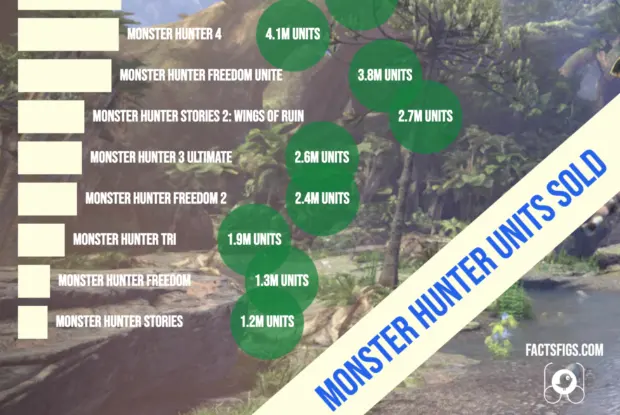
World leads Capcom's official Monster Hunter list at 22.4 million units, but nothing sits between 5.4 and 11.8 million: two eras, one 6.4 million-unit gap.
10 Oct 2026