Best-Selling Monster Hunter Games: Sales by Game, Ranked

By Saif Ur Rahman Published 10 Oct 2026 Updated 10 Oct 2026
Gaming 0 views
FactsFigs
0 shares
FactsFigs Data Story
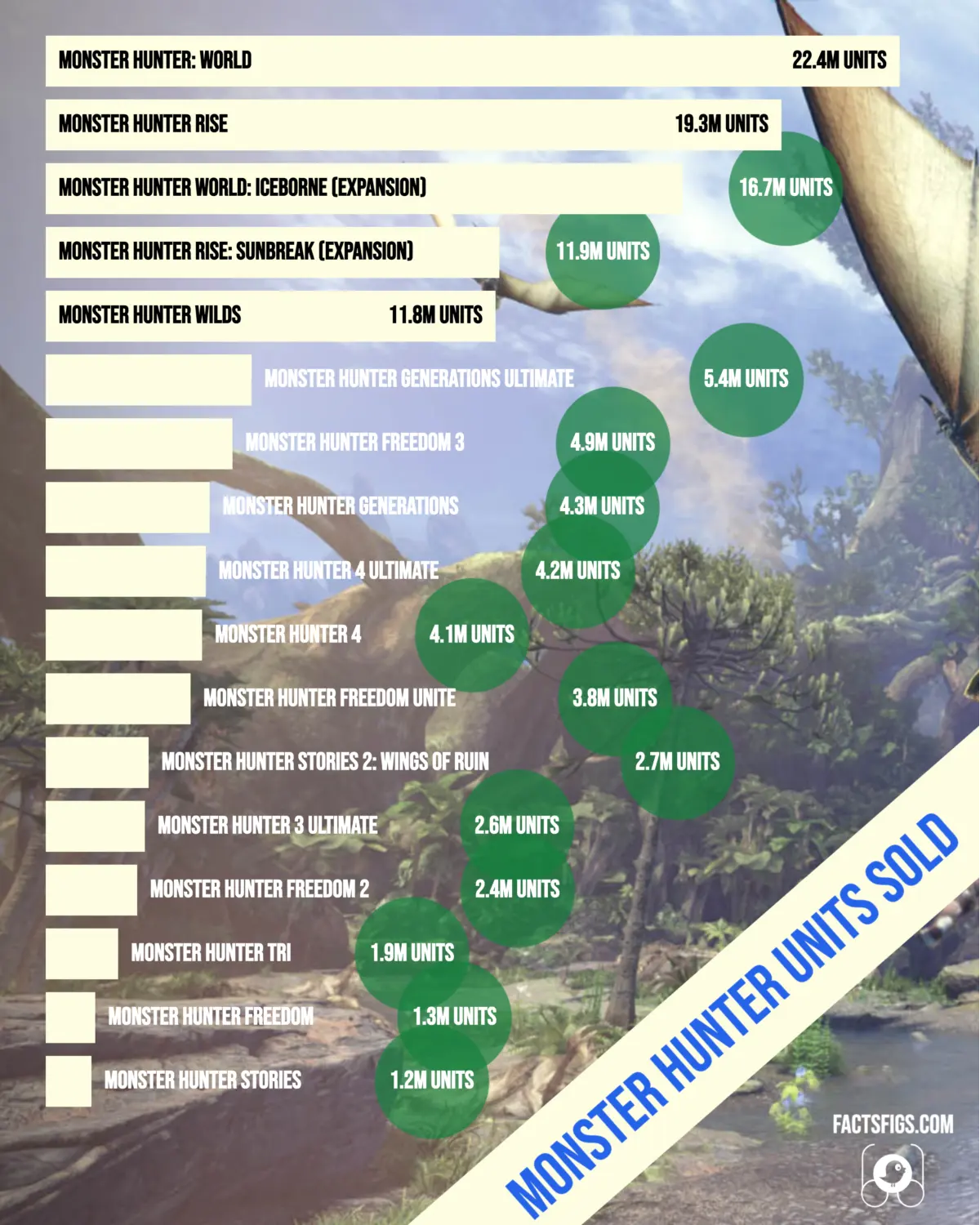
Horizontal ranked bar chart of lifetime units for 17 Monster Hunter releases, in millions, as of 30 June 2026, coloured by release era (before 2018, or 2018 and later). Monster Hunter: World is longest at 22.4 million and Monster Hunter Stories shortest at 1.2 million; no bar falls between 5.4 and 11.8 million. Four releases with no Capcom figure are not drawn, and the Iceborne (16.7) and Sunbreak (11.9) expansion bars are separate from, not added to, their base games.

TL;DR: Which Monster Hunter Game Sold the Most?

A ranked list that is really two lists with a void between them

Monster Hunter: World leads Capcom's list with 22.4 million units as of 30 June 2026, base game only, ahead of Monster Hunter Rise at 19.3 million. The list splits in two: twelve releases sit between 1.2 and 5.4 million units, five between 11.8 and 22.4 million, and none between 5.4 and 11.8 million. All five rows above the gap are from 2018 or later, and two of them, Iceborne and Sunbreak, are expansions counted separately from the games they extend. Four of 21 releases have no Capcom figure, which means under 1 million units or not counted, not zero.

! What the Shape of the List Shows:

  • •
    The Void: No release sits between 5.4 and 11.8 million units. That 6.4 million gap separates twelve rows from five.
  • •
    The Two Eras: Everything above the gap came out in 2018 or later. The biggest older game, Generations Ultimate, has 5.4 million units, 24.1% of World's total.
  • •
    The Overlap Risk: Iceborne (16.7 million) and Sunbreak (11.9 million) are expansions, and Capcom does not say how they overlap with bundles, so the bars are never added.

? The Numbers Behind the List:

  • •
    Units on the 17 Rows: 120.9 million, a sum of overlapping rows and not Capcom's series total
  • •
    Series Total: 131 million units as of 30 June 2026, up from 39 million in March 2017
  • •
    Rows Capcom Has Not Updated: 9 of 17, unchanged since September 2021

Monster Hunter is not one long ladder of hits. It is a handheld-era group that tops out at 5.4 million units and a modern group that starts at 11.8 million, and the list cannot say whether the games, the platforms or the market caused the break.

Continue reading below for the full detailed article →

Overview

Why Capcom's Own Ranking Is Only Half the Story

Capcom publishes a ranked list of every Monster Hunter release past 1 million units, and in June 2026 it called World its best-selling single title of all time. This post starts from that list, as printed with an as-of date of 30 June 2026, and asks a different question: what shape do the 17 figures make? Sorted by release era, they fall into two groups with a hole between them. Twelve releases sit between 1.2 and 5.4 million units. Five sit between 11.8 and 22.4 million. Not one game lands in the 6.4 million units between 5.4 and 11.8. Everything below explains what sits on each side, why two of the five are expansions rather than games, and what the four blank rows do and do not mean.

The Three Numbers That Define Monster Hunter's Shape

A 22.4 million-unit leader, a 6.4 million-unit hole in the middle of the list and a 131 million-unit series total frame everything else in this ranking: how far World sits above the field, where the field splits in two, and how much of the series the 17 rows can and cannot account for.

Best-Selling Game · 22.4M

22.4M Units

Monster Hunter: World, released in January 2018, carries 22.4 million units on Capcom's list as of 30 June 2026. That is the base game alone: Capcom's footnote excludes copies of the Iceborne Master Edition, a bundle of World and Iceborne. Counting those copies Capcom prints 30.4 million, but that is a different basis, so the ranking keeps 22.4 million.

The Empty Gap · 6.4M

6.4M Unit Gap

The largest game from before 2018, Generations Ultimate, has 5.4 million units. The smallest of the five modern rows, Monster Hunter Wilds, has 11.8 million. The 6.4 million units between them hold no Monster Hunter release, which turns a 17-row ranking into two separate groups: twelve games at or below 5.4 million and five at or above 11.8 million.

Series Total · 131M

131M Units

Capcom's series total reached 131 million units as of 30 June 2026, up from 39 million in March 2017, a 3.4 times climb across 28 dated points. The 17 rows on the list add up to 120.9 million, but they overlap and four releases have no figure, so the rows cannot be reconciled to the series total by simple addition.

Monster Hunter: World by the Numbers

  • 3.1M Ahead of Rise 3.1 M World leads Rise (19.3 million units) by 3.1 million, so the top of the list is a close race between two games rather than a runaway: World is 1.16 times Rise. Both sit well above Wilds, the third full game, at 11.8 million.
  • 30.4M With the Master Edition 30.4 M Capcom's page footnote prints 30.40 million units including the Iceborne Master Edition, 8.0 million more than the 22.4 million row. Capcom's 8 June 2026 press release uses the 30 million basis, so a headline can quote either figure and both are Capcom's.
  • 5.3x the Median Release 5.3 x The median of the 17 rows is 4.2 million units, so World has 5.3 times the units of the typical Monster Hunter game on the list. Against the smallest row, Monster Hunter Stories at 1.2 million, the range is 18.7 times.

The Shape

Monster Hunter Sales by Game: The 6.4M Void in the Middle

Sort Capcom's 17 figures from largest to smallest and the list does not slope, it steps. World (22.4 million units), Rise (19.3), Iceborne (16.7), Sunbreak (11.9) and Wilds (11.8) form an upper group. Generations Ultimate (5.4) starts the lower group, which runs through Freedom 3 (4.9), Generations (4.3), 4 Ultimate (4.2) and 4 (4.1) down to Stories at 1.2 million. Between Generations Ultimate and Wilds, no release has a figure.

The lower group is crowded and the upper group is not. Twelve releases share a band that ends at 5.4 million units, while the smallest of the upper five, Wilds, has more than twice that (11.8 against 5.4). The median of all 17 rows, 4.2 million, describes the older games and not the modern ones. That is the sense in which Monster Hunter has two eras rather than one long ladder: nothing links them but a 6.4 million-unit void.

The One Exception to the Era Rule · Stories 2

Eleven of the 17 rows were released before 2018 and six in 2018 or later. Every row above the gap is from the later group, but not every later row is above it. The spin-off Monster Hunter Stories 2: Wings of Ruin, released in July 2021, has 2.7 million units and sits among the older games. The era split and the gap are close to the same line, not exactly the same line.

Even the largest older game has not stood still. Generations Ultimate has 24.1% of World's units, and Capcom's page showed 4.3 million for it in September 2021; the row now folds in a Switch version.

Era, Platform and Format

What Could Explain the Gap, and What Cannot

The list invites explanations, and none of them can be proved from it. Ten of the 11 pre-2018 rows began on a handheld: four on the PlayStation Portable (12.4 million units combined) and six on the Nintendo 3DS (21.8 million). The eleventh, Monster Hunter Tri, began on Wii (1.9 million). Those groupings follow each game's original platform, because Capcom does not split units by platform.

The six rows from 2018 onward look different on paper. All six list PC alongside consoles, and the platform lists for World, Iceborne, Rise, Sunbreak and Wilds add PlayStation and Xbox versions. Digital copies are inside every figure, since Capcom's page notes that its "DL" label "includes all digital download units for each platform". Across all Capcom games, 93.0% of unit sales in the year to March 2026 were digital, but Capcom publishes no per-title split, so the digital share of any Monster Hunter row is unknown.

One share is worth stating with its definition attached. Five rows, World, Rise, Iceborne, Sunbreak and Wilds, hold 82.1 million of the 120.9 million units across the 17 rows, or 67.9%. That is a share of the rows on Capcom's list, not of the 131 million series total, and two of the five are expansions.

What the list cannot separate is era from quality. Capcom prints only the Japanese first-release month, never Western dates, and publishes no launch-window figures for the older games, so how long each game has been on sale cannot be compared. Whether the newer rows lead because of better games, different platforms or a larger market is beyond what the data can say.

Expansions and Bundles

Why Iceborne and Sunbreak Are Never Added to Their Games

Capcom gives Iceborne (16.7 million units) and Sunbreak (11.9 million) their own rows, and both are expansions that need the base game to play. Their bars sit beside World and Rise, never on top of them. Capcom's decks say ranking figures include "versions with additional content" but not how an expansion overlaps with a base game or a bundle, so adding a pair could count the same copies twice.

World carries two figures on one Capcom page. The row reads 22.40 million units and is footnoted "Excludes shipments of Monster Hunter World: Iceborne Master Edition", the bundle of World and Iceborne. A second line reads "Unit sales including Monster Hunter World: Iceborne Master Edition: 30.40 million units". The 8.0 million difference is the implied number of Master Edition copies, which Capcom never prints. Its June 2026 press release used the larger basis: World "has surpassed 30 million units in cumulative sales worldwide, making it Capcom's best-selling single title of all time".

The definition has moved before. Capcom's earnings deck for the year to March 2023 listed World's yearly figures without the Master Edition. The deck for the year to March 2024 restated the same years to include it, adding 3.6 million units across the years to March 2020 through March 2023, under the same label, "Monster Hunter: World".

A rough cross-check hints at the overlap without settling it. The 17 rows sum to 120.9 million against a series total of 131 million, a 10.1 million shortfall. Add the 8.0 million implied Master Edition copies and it shrinks to 2.1 million, small enough for rounding and four unlisted games. That works only if Iceborne's row leaves Master Edition copies out. It is a FactsFigs inference, not a Capcom statement, which is why no pair of bars is combined and 22.4 million stays the row value.

The Four Blanks

Four Releases Have No Figure, and Blank Is Not Zero

Of the 21 Capcom-published Monster Hunter releases measured in units, 17 appear on Capcom's list and four do not: the three PlayStation 2 originals (Monster Hunter in 2004, G in 2005 and Dos in 2006) and Monster Hunter Stories 3, released on 13 March 2026. That is 81% coverage, but a flattered figure: Capcom's page lists only titles past 1 million units, which it calls "the generally accepted standard for a major hit", so every title on it is a million-seller by construction.

Capcom never says whether an unlisted game is below 1 million units or simply uncounted, and the list has already shown that absence can be wrong. Monster Hunter Stories, on sale since October 2016, is missing from every archived copy of Capcom's page that FactsFigs checked through the update as of 31 December 2025. In the update as of 30 June 2026 it appears at 1.2 million units, and Capcom gives no explanation. The game had received ports in June 2024.

The newest game is the live case. Stories 3 went on sale on 13 March 2026 and was still unlisted about three and a half months later; Capcom's results for the year to March 2026 say only that it "contributed to earnings". It may enter the list at the next update, which would turn four blanks into three.

That is why the four rows stay in the table below, labelled "not disclosed", and are left out of the bars. A bar of zero length would claim a measurement Capcom has not made.

The Series Total

How the Series Total Climbed From 39 to 131 Million

Capcom also publishes a running series total, the one place where Monster Hunter's history is complete. Across 28 dated points from 31 March 2017 to 30 June 2026 the total rose from 39 million units to 131 million, a 3.4 times climb. It stood at 48 million on 31 March 2018, the first year-end after World's January launch, and passed 100 million as of 31 March 2024.

The total stalled only once, reading 78 million at both 30 September and 31 December 2021. Its largest single step came in the three months to 31 March 2025, from 108 to 120 million, the quarter Wilds launched; Capcom's deck puts Wilds at 10.10 million units by that date. Since then the total has risen by 1 to 4 million a quarter, reaching 127 million as of 31 March 2026 and 131 million as of 30 June 2026. Wilds itself has added only about 1.7 million units since March 2025.

The older games are not finished contributors. On Capcom's Master-Edition-inclusive basis, World added 0.78 million units in the three months to 30 June 2026, about 71% of the 1.10 million it added in the whole of the year to March 2026.

Frozen and Moving Rows

Nine Legacy Rows Frozen, Seven Still Moving

Archived copies of Capcom's page cover 11 update dates between 30 September 2021 and 30 June 2026. Nine rows never changed across that time: Freedom (1.3 million units), Freedom 2 (2.4), Freedom Unite (3.8), Tri (1.9), Freedom 3 (4.9), 3 Ultimate (2.6), 4 (4.1), 4 Ultimate (4.2) and Generations (4.3). They are either final or no longer updated, and Capcom does not say which, so "as of 30 June 2026" is true of the page and not necessarily of every game on it.

Seven rows do move: World, Iceborne, Rise, Sunbreak, Wilds and two older rows whose platform lists include later ports. Generations Ultimate, whose row covers a Switch version, rose from 4.3 to 5.4 million units, and Stories 2 rose from 1.3 to 2.7 million. The 17th row, Stories, entered the page only in the final update. Across 151 row-to-row comparisons over those 11 dates, no row was ever revised downward.

The next update is expected with Capcom's second-quarter results on 27 October 2026, with figures as of 30 September 2026, and should move the seven live rows. Wilds reaches Switch 2 on 4 December 2026 and its expansion, Ascendance, is due in 2027, so the top of the list will keep shifting while the nine frozen games sit still.

The Full Data Table

Monster Hunter Sales by Game: All 21 Releases and Their Status

Capcom's lifetime units for every Monster Hunter release, as of 30 June 2026. Expansions are flagged and never added to their parents, and four releases have no Capcom figure.

1Monster Hunter: WorldJan 20182018 and laterGame22.4Base game only; Capcom footnotes 30.4M including the Iceborne Master Edition
2Monster Hunter RiseMar 20212018 and laterGame19.3Row includes the PC, PlayStation and Xbox versions
3Monster Hunter World: IceborneSep 20192018 and laterExpansion16.7Expansion. Not part of World's 22.4M; never add to World
4Monster Hunter Rise: SunbreakJun 20222018 and laterExpansion11.9Expansion. Not part of Rise's 19.3M; never add to Rise
5Monster Hunter WildsFeb 20252018 and laterGame11.8Still moving; Switch 2 version due 4 Dec 2026
6Monster Hunter Generations UltimateMar 2017Pre-2018Game5.4Includes the Switch version; was 4.3M in Sep 2021
7Monster Hunter Freedom 3Dec 2010Pre-2018Game4.9Unchanged since Sep 2021
8Monster Hunter GenerationsNov 2015Pre-2018Game4.3Unchanged since Sep 2021
9Monster Hunter 4 UltimateOct 2014Pre-2018Game4.2Unchanged since Sep 2021
10Monster Hunter 4Sep 2013Pre-2018Game4.1Unchanged since Sep 2021
11Monster Hunter Freedom UniteMar 2008Pre-2018Game3.8Unchanged since Sep 2021
12Monster Hunter Stories 2: Wings of RuinJul 20212018 and laterSpin-off2.7The one 2018-and-later row below the gap; was 1.3M in Sep 2021
13Monster Hunter 3 UltimateDec 2011Pre-2018Game2.6Unchanged since Sep 2021
14Monster Hunter Freedom 2Feb 2007Pre-2018Game2.4Unchanged since Sep 2021
15Monster Hunter TriAug 2009Pre-2018Game1.9Unchanged since Sep 2021
16Monster Hunter FreedomDec 2005Pre-2018Game1.3Unchanged since Sep 2021
17Monster Hunter StoriesOct 2016Pre-2018Spin-off1.2First listed in the 30 Jun 2026 update
n/aMonster Hunter (PlayStation 2)Mar 2004Pre-2018GameNot disclosedUnder 1M units or not counted; Capcom does not say which
n/aMonster Hunter G (PlayStation 2)Jan 2005Pre-2018GameNot disclosedUnder 1M units or not counted; Capcom does not say which
n/aMonster Hunter Dos (PlayStation 2, Japan only)Feb 2006Pre-2018GameNot disclosedUnder 1M units or not counted; Capcom does not say which

Showing 1-20 of 21

Page 1 of 2

Units are Capcom's printed figures, truncated to 0.1 million. World is the base game only. "Not disclosed" means under 1 million units or not counted, and Capcom does not say which. Release months for the three PlayStation 2 originals are pointers from Wikipedia, not Capcom. Capcom's Japanese names: Freedom is Portable, Freedom 2 is Portable 2nd, Freedom Unite is Portable 2nd G, Freedom 3 is Portable 3rd, Generations is X, Generations Ultimate is XX and 4 Ultimate is 4G. That pairing is by row position, release month and figure, not a Capcom statement.

Verdict

Two Eras and a Gap: What the Ranking Really Says

Capcom's list answers the question in the title: World is the best-selling Monster Hunter game, with 22.4 million units on the base-game basis and 30.4 million with the Master Edition. The more useful answer is the shape. Twelve releases top out at 5.4 million units, five start at 11.8 million, and those five are all from 2018 or later.

Three things keep that finding honest. The top rows overlap in ways Capcom does not explain, so no two should be added. The four blank rows are unknowns, not zeros. And nine rows have not moved in years, so the older games may look stale rather than final. The list cannot say whether 2018 changed the games, the platforms or the market. Capcom's next update, expected on 27 October 2026, will show how far the top rows have moved since this 30 June 2026 snapshot.

Data Source and Attribution

Capcom IR: Platinum Titles (as of June 30, 2026) Capcom IR: Game Series Sales (as of June 30, 2026) Capcom press release, 8 June 2026

Every unit figure in this story comes from Capcom Co., Ltd.'s own investor relations documents: the Platinum Titles page, printed as of 30 June 2026 and read by FactsFigs on 10 October 2026, the Game Series Sales page, and Capcom's earnings presentations from March 2017 to June 2026. World's Master Edition wording comes from Capcom's 8 June 2026 press release. No estimate sites or trackers were used, and full credit for the figures goes to Capcom.

Capcom's documents say "shipments" in some places and "sales" in others and define neither, so this story calls every figure "units", the word Capcom's page uses. Digital downloads are included. The page does not state a region, although Capcom's press releases describe World's and the series' totals as worldwide, and it does not print when its figures were published. Release months for the three PlayStation 2 originals are pointers from Wikipedia, not Capcom.

FactsFigs reviews, cleans, and cross-checks every source dataset before shaping it into a data story. Each visualization is created and designed in FactsFigs Design Studio - an internal tool developed and owned by FactsFigs - and is the original work of a FactsFigs author, not an AI-generated copy of any existing graphic. Individual assets within a visual may or may not be produced with AI tools, but the design of the visual itself is solely FactsFigs' own.

Figures are estimates at the time of publication, provided for information only - nothing here is financial advice or a guarantee of accuracy.

Last verified: 10 Oct 2026

The charts in this article were built with our own publishing system. See what it does →