TL;DR: Which Presidents Lost Both Chambers, and Who Survived?
Seven presidents have lost the House and the Senate in one midterm. The three hit in a first term were re-elected; the three hit in a second term saw their party lose the White House.
Cleveland in 1894, Wilson in 1918, Truman in 1946, Eisenhower in 1954, Clinton in 1994, George W. Bush in 2006 and Trump in 2026 each went into a midterm with their party running both chambers and came out with the other party running both. Trump's case is provisional: on 11 Nov 2026, 13 House races on AP's count and two Senate races on Fox News Decision Desk calls were still uncalled, though neither majority can change hands back.
In the six resolved cases the next presidential election split by term. Truman, Eisenhower and Clinton were on the ballot and won; Cleveland, Wilson and Bush were not, and their party lost. Six cases make a pattern, not a law. Trump, elected in 2016 and 2024, cannot be elected again under the 22nd Amendment.
! What Separates the Seven Cases:
•
First-Term Hits Ended in Re-election:Truman won in 1948, Eisenhower in 1956 and Clinton in 1996, each with the opposition still running Congress.
•
Second-Term Hits Ended in Defeat:Cleveland, Wilson and Bush were not on the next ballot, and their party lost in 1896, 1920 and 2008.
•
2026 Is Still Being Counted:On 11 Nov 2026, 13 House races and the Alaska and Mississippi Senate seats were uncalled.
? The Figures Behind the Seven Midterms:
•
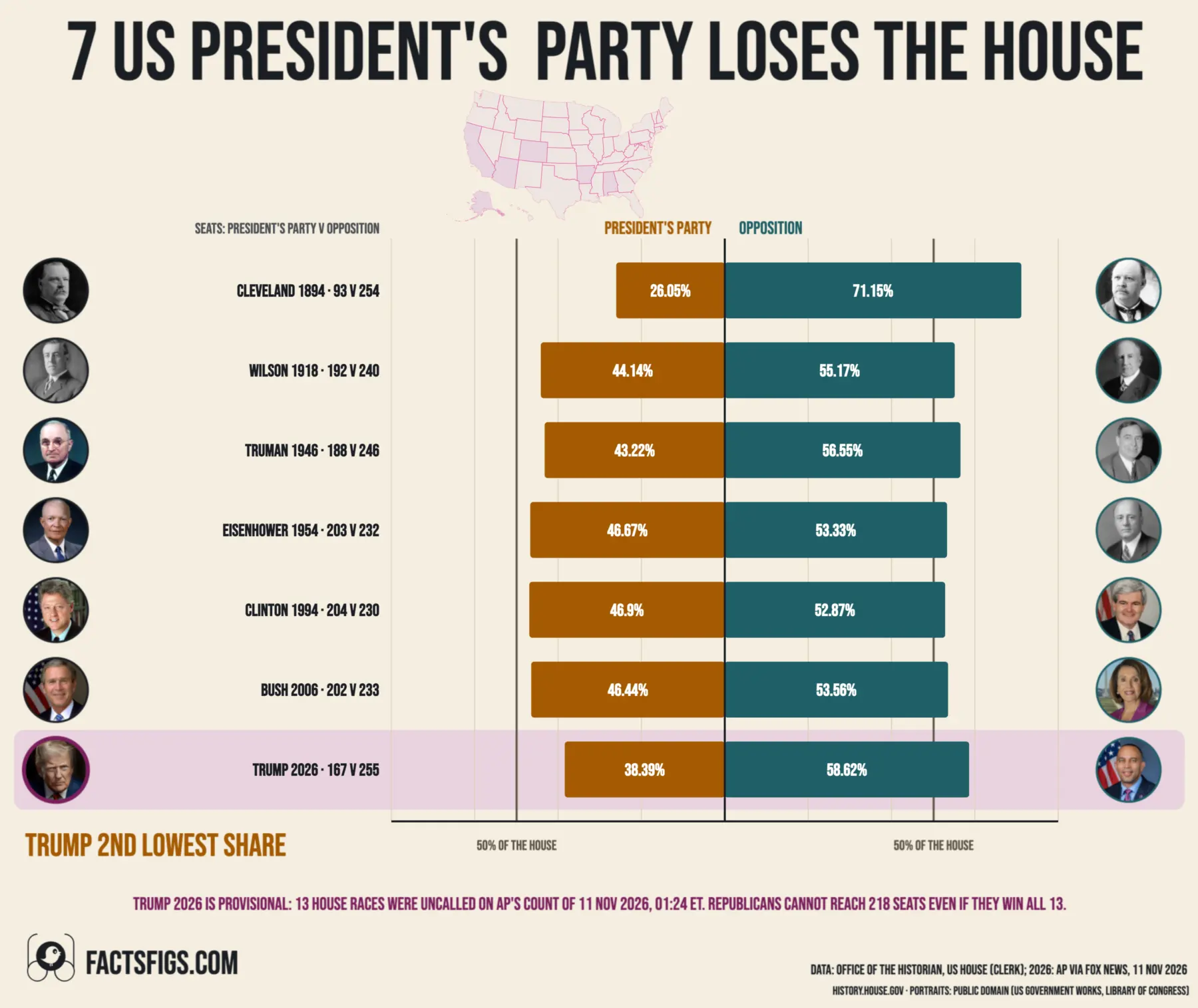
Lowest House share:26.05% for Cleveland's party, 1894
•
Trump's House share:38.39%, 167 of 435 seats, provisional on 11 Nov 2026
•
Largest House loss:125 seats for Cleveland's party in 1894, on the Clerk's count
•
Largest Senate loss:12 seats for Truman's party in 1946
Losing seats is routine: the president's party lost House seats in 18 of the 20 midterms from 1946 to 2022. Losing both chambers in one night is not, and it has now happened seven times.
Continue reading below for the full detailed article →
Overview
Why Losing Both Chambers Is Not Just a Bad Midterm
A bad midterm is the normal price of holding the White House. Losing control of the whole of Congress in a single night is a different event, because it leaves a president with no chamber to move a bill and a House able to investigate. This story tracks the seven times it has happened, from Cleveland in 1894 to Trump in 2026, and asks what each president's next election looked like. The seat counts are compared as shares of the chamber, because the House grew from 357 seats to 435 over the period, and the 2026 figures are provisional.
The Three Numbers That Frame Seven Midterms
How common a bad midterm is, how rare losing both chambers is, and what split the seven presidents afterwards.
18 of 20 Midterms Cost the President House Seats
18 of 20
From 1946 to 2022 the president's party lost House seats in 18 of 20 midterms. Only Clinton in 1998 and George W. Bush in 2002 gained them, so a bruising midterm is the ordinary cost of holding the White House. What sets these seven apart is the second chamber: in each case the Senate fell with the House.
6 of 33 Earlier Midterms Cost Both Chambers
6 of 33
Polity Policy's infographic counts six midterms among the 33 decided before 2026 in which the president's party held both chambers going in and lost both coming out. Its tallies rest on the Clerk's and the Senate Historical Office's tables, which this story checked directly. Trump's provisional 2026 result, as counted on 11 Nov 2026, makes seven.
3 of 3 First-Term Presidents Were Re-elected
3 of 3
Truman won in 1948 with 303 electoral votes, Eisenhower in 1956 with 457 and Clinton in 1996 with 379. All three were in their first terms at the midterm and were on the next ballot. The three second-term presidents, Cleveland, Wilson and Bush, were not, and their party lost the White House in 1896, 1920 and 2008.
Trump 2026 by the Numbers
House share, provisional 38.39 %167 of 435 seats on AP's 11 Nov 2026 count, with 13 races uncalled.
House seats lost, at most 53 seatsFrom 220 in the initial 119th Congress; 40 if Republicans win all 13 uncalled.
Senate seats held, 2 uncalled 44 seatsDown from 53; the Democratic caucus stands at 54, as of 11 Nov 2026.
The definition
What Counts as Losing Both Chambers in One Night
The test is narrow on purpose. The president's party must hold the House and the Senate going into one midterm, and the opposition must hold both after it. Polity Policy, an infographic site that tracks midterms back to 1838, applies that rule to the decided midterms before 2026 and finds six cases in 33. The Clerk of the House's and the Senate Historical Office's tables, which both report the party division immediately after each election, support all six, and 2026 makes seven.
Three of those calls are narrower than they look. In 1894 no party held an outright Senate majority: Democrats had 44 of 88 seats going in and Republicans 44 of 90 coming out, both pluralities. In 1918 the Democrats organised the House with 214 seats against 215 Republican ones, helped by minor-party members. In 1954 Democrats won exactly half the Senate, 48 of 96, and their majority rested on Wayne Morse, an independent who became a Democrat on 17 Feb 1955.
Not every list agrees. IBTimes, on 4 Nov 2026, named 1946, 1994 and 2006 as the other three instances since the Second World War and left out 1954. The official tables show Democrats winning both chambers that year, so this story keeps it.
The measure
Why Share of the House Beats Raw Seat Counts
Raw seats mislead across 130 years because the chamber changed size: 357 seats in 1894, which counts Utah's seat after statehood in 1896, and 435 since 1913. Share is the only like-for-like measure. By it Cleveland's party kept 26.05% of the House, Truman's 43.22%, Wilson's 44.14%, Bush's 46.44%, Eisenhower's 46.67% and Clinton's 46.90%. Trump's party holds 38.39% on AP's count of 11 Nov 2026.
Cleveland's collapse is the outlier, and even its size is disputed. The Clerk's tables put Democrats at 218 seats going in and 93 coming out, a loss of 125, the largest of the seven. Dubin's count, taken on the opening day of the 54th Congress before 11 contested seats were resolved, has 105 Democrats and a loss of 113. This story uses the Clerk's figure, and so does the chart.
Trump's party is second-lowest of the seven whatever the remaining counts do, because winning all 13 uncalled seats would lift it only to 41.38%. The rows do not sum to 100 because other seats exist: 10 third-party seats in 1894, nine Populists and one Silver member, and 13 uncalled seats in 2026.
The Senate
The Senate Lost Anywhere From 1 Seat to 12
The Senate runs on a different scale, which is why the chart stays on the House. Truman's party lost 12 seats in 1946, Clinton's nine in 1994, Wilson's seven in 1918, Bush's six in 2006, Cleveland's four in 1894 and Eisenhower's only one in 1954. These counts take the party division immediately after each election from the Senate Historical Office's table.
The baseline matters. Measured against the eve of the election rather than the opening count, five of the six historical figures shift by one or two seats: Wilson's seven becomes five, Truman's 12 becomes 11, Eisenhower's one becomes two, Clinton's nine becomes eight and Cleveland's four becomes five. Bush's six holds.
Bush's 2006 Senate was the closest call of all: 49 Democrats, 49 Republicans and two independents, Sanders of Vermont and Lieberman of Connecticut, who caucused with the Democrats for a working majority of 51.
The full set, both chambers
All Seven Midterms: House and Senate Seats After the Election
Seats held by the president's party and by the opposition immediately after each election, the president's party's share of the chamber, and the seats it lost against the opening count of the previous Congress. The 2026 rows are provisional.
1894
Cleveland (D)
House
93
254
26.05%
125
357 seats include Utah's (admitted 1896); 10 third-party seats
1894
Cleveland (D)
Senate
40
44
44.44%
4
No outright majority before or after; 6 Populist or Silver seats after
1918
Wilson (D)
House
192
240
44.14%
22
Democrats organised the 65th with 214 seats to 215, with minor-party support
1918
Wilson (D)
Senate
47
49
48.96%
7
Republicans hold exactly the 49 needed
1946
Truman (D)
House
188
246
43.22%
56
1 American Labor seat after
1946
Truman (D)
Senate
45
51
46.88%
12
1 Progressive before
1954
Eisenhower (R)
House
203
232
46.67%
18
1 independent before
1954
Eisenhower (R)
Senate
47
48
48.96%
1
Democrats 48 of 96 with independent Morse; he became a Democrat in 1955
1994
Clinton (D)
House
204
230
46.90%
54
1 independent after
1994
Clinton (D)
Senate
48
52
48.00%
9
Immediately after the election; Republicans reached 54 by Mar 1995
2006
Bush (R)
House
202
233
46.44%
30
1 independent before
2006
Bush (R)
Senate
49
49 (51 in caucus)
49.00%
6
49 Democrats plus 2 independents caucusing with them = 51
2026
Trump (R)
House
167
255
38.39% (provisional)
53 (at most)
Provisional: 13 races uncalled on 11 Nov 2026; loss is an upper bound
2026
Trump (R)
Senate
44
52 (54 in caucus)
44.00% (provisional)
9 (at most)
Provisional: caucus 54, 2 seats uncalled; loss is an upper bound
Download this data (CSV)Seat counts: Office of the Historian, US House of Representatives, and the Senate Historical Office, US government works in the public domain. The 2026 rows are provisional counts as of 11 Nov 2026 (House: AP via Fox News; Senate: Fox News Decision Desk; NPR for the Senate's starting split). Compiled by FactsFigs; free to use with credit to FactsFigs and these sources.
Seat losses use the party division immediately after each election for both before and after, so they can differ by one or two seats from counts taken on the eve of the election. In 2026, seats lost is an upper bound against the initial 119th Congress; the 2026 rows come from AP's House count and Fox News Decision Desk Senate calls of 11 Nov 2026 and will change as races are called.
First-term presidents
Three First-Term Presidents Fought the New Congress and Won
Truman's Democrats lost 56 House seats and 12 Senate seats in 1946, and Republicans took over both chambers in January 1947. He vetoed the Taft-Hartley Act on 20 Jun 1947; the House overrode him 331-83 that day and the Senate 68-25 on 23 Jun. Then he ran against the body that had done it. He called a special session on 27 Jul 1948, campaigned against the "do-nothing Congress" from 6 Sep to 30 Oct, and won 303 electoral votes to Dewey's 189. By one count that Congress still passed 906 public bills.
Eisenhower's party fell from 221 House seats to 203 in 1954, and the Senate went to the Democrats 48 to 47 with Morse as the independent in between. A Democratic Congress was still where the Federal Aid Highway Act, signed 29 Jun 1956, and the Civil Rights Act of 1957, signed 9 Sep 1957, became law. In 1956 he won 457 electoral votes to Stevenson's 73, with 57.4% of the popular vote, and Democrats kept both chambers. His party paid in 1958, losing 48 House and 13 Senate seats.
Clinton's Democrats fell to 204 House seats against 230 in 1994. His debt-limit veto of 13 Nov 1995 was followed by shutdowns from 14 to 19 Nov 1995 and from 16 Dec 1995 to 6 Jan 1996, and polls blamed Republican leaders more. He vetoed a welfare bill on 9 Jan 1996, signed a welfare law on 22 Aug 1996 and won 379 electoral votes to Dole's 159. The same Congress impeached him on 19 Dec 1998, and the Senate acquitted him on 12 Feb 1999, 45-55 on perjury and 50-50 on obstruction.
Only Truman made the Congress his campaign. All three, though, stood for re-election with the opposition holding the legislature, and all three won. One caveat on the label: Truman's first term was the remainder of Franklin Roosevelt's fourth, and 1948 was his first election as a presidential nominee.
Second-term presidents
Three Second-Term Presidents Never Faced Voters Again
Cleveland's second term, which followed a gap after his first, ran against a Republican House and a Republican Senate plurality. He vetoed the rivers and harbors bill on 29 May 1896 and Congress overrode him, 219-61 in the House on 2 Jun and 56-5 in the Senate on 3 Jun. His party then split over free silver. It nominated William Jennings Bryan on the fifth ballot, Cleveland declined the Gold Democrats' appeal to run again on 3 Sep, and McKinley won 271 electoral votes to 176.
Wilson lost his life's work to the Congress he had just lost. The Senate refused consent to the Treaty of Versailles on 19 Nov 1919, 39-55 with the Lodge reservations and 38-53 without them, and again on 19 Mar 1920, 49-35, seven votes short of two-thirds. He had suffered a serious stroke on 2 Oct 1919, and the 66th Congress overrode his Volstead Act veto on 28 Oct. In 1920 Democrats nominated James Cox on the 44th ballot and Harding won 404 electoral votes to 127.
Bush's reckoning started the next day: he announced Donald Rumsfeld's resignation on 8 Nov 2006, one day after the election. Nancy Pelosi became Speaker on 4 Jan 2007 and the Iraq surge followed a week later. He issued 11 vetoes to the 110th Congress and four were overridden, including the Water Resources Development Act, 361-54 in the House and 79-14 in the Senate, while his Iraq war-funding veto was sustained 222-203. In 2008 Obama won 365 electoral votes to 173, and Bush could not run.
What came next
Who Was on the Next Ballot, and Who Kept the White House
Each president's term at the midterm, whether he could stand again, and the result of the next presidential election, in electoral votes.
1894
Cleveland (D)
Second, non-consecutive
No
1896: McKinley (R) won, 271-176
Lost
1918
Wilson (D)
Second
No
1920: Harding (R) won, 404-127
Lost
1946
Truman (D)
First, inherited from Roosevelt's fourth
Yes, won
1948: Truman (D) won, 303-189
Held
1954
Eisenhower (R)
First
Yes, won
1956: Eisenhower (R) won, 457-73
Held
1994
Clinton (D)
First
Yes, won
1996: Clinton (D) won, 379-159
Held
2006
Bush (R)
Second
No, term-limited
2008: Obama (D) won, 365-173
Lost
2026
Trump (R)
Second, non-consecutive
No, barred by the 22nd Amendment
2028: not yet held
Pending
Download this data (CSV)Electoral votes: National Archives, Office of the Federal Register, Electoral College results, a US government work in the public domain. Term and eligibility follow the 22nd Amendment. The 2028 row is pending. Compiled by FactsFigs; free to use with credit to FactsFigs and the National Archives.
Truman's 1948 race also drew 39 electoral votes for Thurmond. Cleveland and Wilson faced no term limit; Bush was barred by the 22nd Amendment. Trump's ineligibility is derived from his two elections (2016 and 2024) and the amendment's text. Electoral-vote results from the National Archives (Office of the Federal Register), Electoral College results.
Trump 2026 · Provisional, 11 Nov 2026
What Is Still Uncalled in Trump's 2026 Count
As of 11 Nov 2026, 09:26 ET, AP's count on Fox News had House Democrats at 255 and Republicans at 167, which leaves 13 of the 435 races uncalled; AP's most recent call was California's 7th district at 7:46 PM ET on 10 Nov. In the Senate, Fox News Decision Desk calls put the Democratic caucus at 54 and Republicans at 44, with two seats uncalled: Alaska and Mississippi, both Republican-held.
Neither majority is in doubt. If Republicans won every uncalled House race they would reach 180, far short of the 218 needed, and keeping both Senate seats would give them only 46 against the 51 needed. The numbers can still move. Alaska's ranked-choice tabulation is expected on 18 Nov, and the Louisiana runoffs in LA-5 and LA-6 are on 12 Dec, so the House count cannot be complete before then. Peltola led Sullivan 48.95% to 47.20% in Alaska with 84.32% reporting; Colom led Hyde-Smith 49.11% to 48.79% in Mississippi with 97.81% reporting.
Seats lost needs a baseline. This story counts from the initial 119th Congress, 220 Republican House seats and 53 Senate seats, the same series used for the six earlier cases. That gives a loss of at most 53 in the House and nine in the Senate. Against the eve of the election the House figure is 51, and AP's own page shows 42 on a baseline it does not state. In the Senate, 45 Democrats plus seven flips make 52, and 54 once the two independents who caucus with them are added, the same 49-and-51 split seen in 2006.
The president has already set his tone. Trump said on 4 Nov 2026, as NPR reported it, "I'll become Mr. Veto" and that "at some point we'll probably make deals". Democrats have signalled inquiries into the independence of the Justice Department and Homeland Security, and Rep. Robert Garcia is expected to chair House Oversight. None of this has happened yet: the 120th Congress does not sit until January 2027.
The limits of the pattern
What Six Cases Can and Cannot Settle
Six cases make a pattern, not a law, and the pairs are not as clean as the table makes them look. Truman's first term was the remainder of Roosevelt's fourth. Cleveland's second term came after a gap, as Trump's does. Bush was barred from running by the 22nd Amendment, ratified on 27 Feb 1951, while Cleveland and Wilson faced no limit: Cleveland declined an appeal to run again and Wilson was not nominated, though Britannica reports he hoped for a third nomination. "Did not run" is three different facts.
The data also cannot say whether the midterm wipeout caused any of those results. The presidents who won were on the ballot, and the three whose party lost were not; being on the ballot is the one thing that separates the two sets cleanly, and it is exactly what a president's place in his terms decides.
Trump is a second-term case, and a non-consecutive one like Cleveland's. He was elected in 2016 and 2024, and the 22nd Amendment says no person shall be elected to the office of President more than twice. The 2028 election has not happened, and six earlier cases are all this story has to say about it.
The data behind this story comes from the Office of the Historian of the US House of Representatives (Party Divisions of the House) and the Senate Historical Office's party division tables, read from an archived 2013 capture because senate.gov refused automated access. The 2026 House counts are AP results and the Senate counts are Fox News Decision Desk calls, both as carried by Fox News on 11 Nov 2026, and are provisional. The seat tables and portraits are US government works in the public domain, and full credit for compiling them goes to the House and Senate historians.
FactsFigs reviews, cleans, and cross-checks every source dataset before shaping it into a data story. Each visualization is created and designed in FactsFigs Design Studio, an internal tool developed and owned by FactsFigs, and is the original work of a FactsFigs author, not an AI-generated copy of any existing graphic. Individual assets within a visual may or may not be produced with AI tools, but the design of the visual itself is solely FactsFigs' own.
Figures are estimates at the time of publication, provided for information only. Nothing here is financial advice or a guarantee of accuracy.
Last verified: 11 Nov 2026
The charts in this article were built with our own publishing system. See what it does →