TL;DR: What Do Hackers Actually Steal Crypto Through?
A $6.36bn record, and a pattern older than it
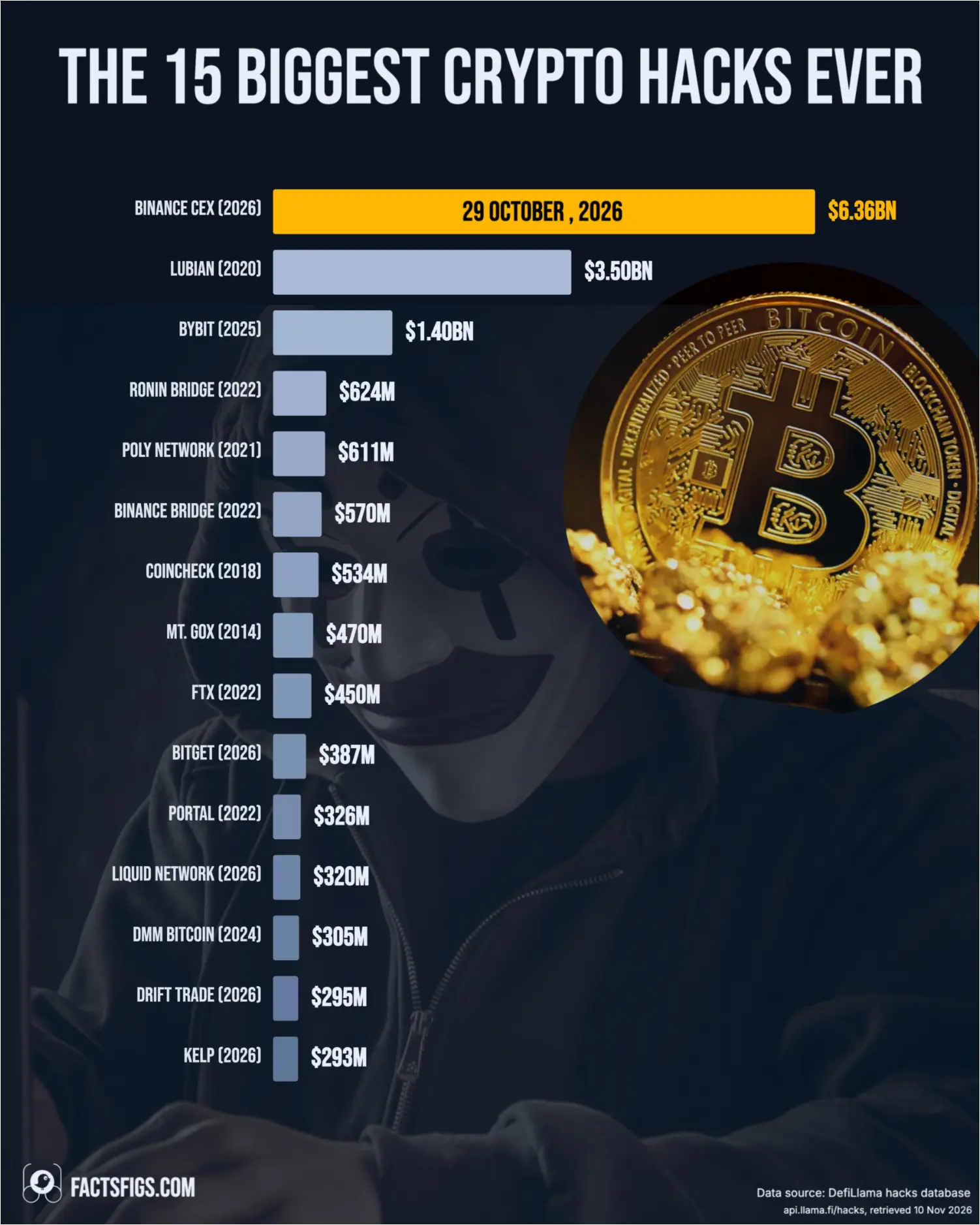
On 29 October 2026 about $6.36bn was taken from Binance, the largest digital-asset theft on record and more than four times the previous one, Bybit's in February 2025. The FBI attributes it to North Korea's TraderTraitor group.
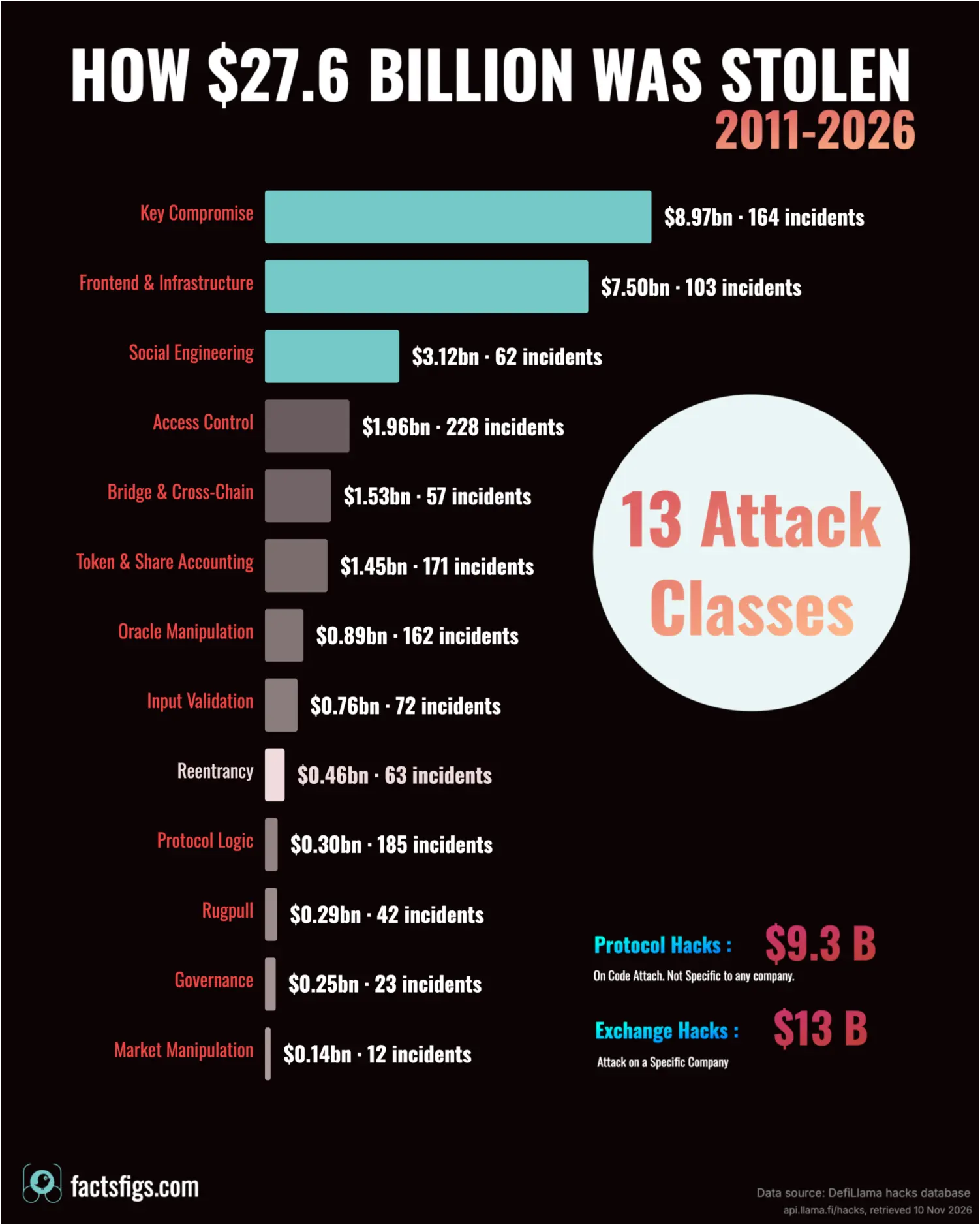
DefiLlama's database holds 1,345 incidents since 2011, $27.60bn in all. Attacks on keys, people and infrastructure are 24% of the classified incidents and 71% of the money, and still 55% with Binance and LuBian removed.
Reentrancy, the best-known smart-contract bug, ranks ninth at $0.46bn.
! The Pattern Behind the Record:
•
Keys Dominate · 71% of the Money:Key compromise, frontend and infrastructure attacks, and social engineering took $19.58bn of $27.60bn, from 329 of 1,344 classified incidents.
•
Bugs Are Common · 575 Incidents, 11% of Dollars:Access control, protocol logic and oracle manipulation produced 575 incidents between them, but only $3.15bn.
•
Reentrancy Ranks Ninth · $0.46bn:The classic smart-contract exploit has cost about a twentieth of what key compromise has.
? The Numbers Behind the Claim:
•
Recorded since 2011:$27.60bn across 1,345 incidents
•
Without Binance and LuBian:55% of the money, from the same 24% of incidents
•
2026 so far:337 incidents and $8.78bn, the worst year on record
The largest losses come through whoever holds the keys, not through bugs in the code. Binance is the extreme case of a pattern the data shows without it.
Continue reading below for the full detailed article →
Overview
Why the Binance Record Is Only Half the Story
Binance's $6.36bn loss will be remembered as a headline. The more useful number sits in the records behind it. DefiLlama's database logs 1,345 crypto hacks from 2011 to 10 November 2026, each with a date, a target, an amount and an attack class, and 1,344 of them are classified. Adding up the dollars by class answers a question the news cycle rarely asks: through which door does the money actually leave?
The answer cuts against how crypto security is usually discussed. Smart-contract bugs get the audits and the conference talks. Stolen keys, fooled employees and compromised infrastructure get the money.
Three Numbers That Frame Where Crypto Gets Stolen
The record, the pattern behind it and the surprise at the bottom of the ranking, all from DefiLlama's hacks database to 10 November 2026.
The Binance Heist · $6.36bn
$6.36bn
About $6.36bn left Binance on 29 October 2026, after attackers used stolen credentials to run a malicious script against the wallet signing service. It is the largest digital-asset theft on record, more than four times the previous record, Bybit's $1.4bn in February 2025, and larger than the next four biggest thefts in the database combined.
Keys, People and Infrastructure · 71%
71%
Key compromise, frontend and infrastructure attacks, and social engineering account for $19.58bn of the $27.60bn stolen since 2011, from 329 of 1,344 classified incidents, or 24% of the count. Remove the two largest events, Binance and LuBian, and the same three classes still hold 55% of the money, from the same share of incidents.
Reentrancy's Rank · 9th
9th
Reentrancy, the smart-contract bug class most associated with early DeFi, has cost $0.46bn across 63 incidents. That ranks ninth of 13 attack classes by dollars: about a twentieth of key compromise's $8.97bn, and less than a fortieth of the $19.58bn taken by the three key-and-people classes combined. Many incidents, but little money.
The Binance Heist by the Numbers
72% of 2026's Total 72 %Binance's $6.36bn is 72% of the $8.78bn DefiLlama logs for 2026 so far, across 337 incidents.
23% of All Crypto Theft Ever 23 %One incident is $6.36bn of the $27.60bn recorded since 2011.
95% Covered by Binance 95 %Binance says it will absorb the loss. About 95% of the affected assets had been covered by early November.
How the attack was built
How a Fake Job Interview Led to $6.36bn
Binance's own account, as reported by CNBC, BleepingComputer and Cyber Security News on 3 November, starts in June 2026. A DevOps engineer on the wallet team went looking for a popular AI coding tool and installed a tampered Homebrew package instead. Binance caught it, replaced the device and rotated credentials, but the attackers now knew the engineer's role and his wallet-infrastructure colleagues. CNBC and Cyber Security News date the attack from June; BleepingComputer says it began in September. Binance treats June as the reconnaissance that made September possible, which is the reading used here.
In September a different engineer was contacted on a job platform by a fake "Project Director". A fake HR representative held a live video interview, and a fake CEO held a second on a chat app that ended with a coding assignment. The assignment carried 0-day malware onto the work machine, replacing the Homebrew pyenv binary. In Binance's words: "The 0-day malware was not detected by the endpoint security protection tools at the time."
On 20 October the attackers used that machine, plus an internal AI tool, to take over two more wallet-infrastructure engineers, and came away with credentials and a container deployment token. On 29 October those credentials deployed a malicious script against the wallet signing service, and funds moved across multiple chains. The attackers also abused Ethereum's EIP-7702 to keep draining after withdrawals were suspended.
Binance began reopening withdrawals on 1 November and says it will absorb the loss rather than pass it to users. BleepingComputer reported about $2.85bn frozen or intercepted as of 3 November; CNBC rounds it to about $3bn. The FBI attributes the theft to North Korea's TraderTraitor group. Binance co-CEO Richard Teng did not himself name North Korea; he acknowledged that the FBI had. North Korea's Kim Yo Jong denied involvement on 3 November.
Where AI appears, and where it does not
Two Different AI Tools Figure in the Binance Attack
They are easy to merge, so it is worth keeping them apart. In June the bait was a tampered install of a public AI coding tool, found by an engineer who was searching for it. That is a supply-chain lure: the tool's popularity is the hook, and the AI is incidental to the attack.
In October the pivot used Binance's own internal AI tool, a different thing entirely. Teng's account is that the attackers "moved violently through our internal AI tools" and gained access that breached "the system that authorized our wallet transaction." That is the whole of what is on the record. None of the reporting we reviewed names the tool or describes what it did.
Whether AI coding tools and their install paths are becoming a more common way into companies is a separate question, and this dataset cannot answer it. DefiLlama classifies hacks by technique and target, not by whether AI was involved, so there is nothing here to chart.
Group three classes together: key compromise, frontend and infrastructure attacks, and social engineering. They are different tactics with a common target, the people and systems that hold keys and authorise transfers, rather than the code that executes them. Between them they account for $19.58bn of the $27.60bn stolen, from 329 of 1,344 classified incidents.
That is 24% of incidents and 71% of the dollars. The obvious objection is that Binance does the work, and it does carry weight: $6.36bn is 23% of everything ever recorded. So take it out, and take out LuBian's $3.50bn too, the second-largest event. The same three classes still hold 55% of the money, from the same 24% of incidents. The finding does not depend on the outlier.
The biggest thefts say the same thing. Nine of the fifteen largest hacks fall in those three classes, and they account for $14.03bn of the $16.45bn the fifteen total, 85%. Bybit, the previous record, was signer phishing. Ronin Bridge, Coincheck, Mt. Gox and Bitget were all key compromises.
The code-bug classes
Why Code Bugs Make Many Hacks but Little Money
Reentrancy is the exploit most associated with DeFi's early years, and it ranks ninth of thirteen classes by dollars: $0.46bn across 63 incidents. Key compromise has cost about twenty times as much at $8.97bn, and the three key-and-people classes together more than forty times as much.
The pattern holds across the code-flaw classes. Access Control is the most common class in the database at 228 incidents, and has cost $1.96bn. Protocol Logic has 185 incidents and $0.30bn. Oracle Manipulation has 162 and $0.89bn. Between them, 575 incidents, 43% of the classified total, have taken $3.15bn, 11% of the money.
None of this makes a code bug harmless. Poly Network's access-control flaw cost $611m in 2021 and still ranks fifth on the all-time list. But dollar losses and incident counts measure different things, and the catastrophic losses concentrate where one stolen key or one fooled employee unlocks everything.
What the totals hide
Why a Typical Key Hack Is Smaller Than You Think
The headline share describes where catastrophic losses come from, not what a typical incident looks like. Every class is long-tailed: a handful of enormous events drag the average far above the middle. Key compromise averages $54.7m per incident, but its median incident is $4.8m. Frontend and infrastructure averages $72.8m against a median of $1.6m.
A typical reentrancy hack and a typical frontend or infrastructure hack sit within $0.2m of each other, at $1.4m and $1.6m. What separates the classes is the worst incident, not the usual one: the few cases where whoever got the key got everything. Three in four incidents fall in the other ten classes.
The 2026 context
What 2026 Looks Like Without the Binance Heist
DefiLlama logs 337 incidents and $8.78bn for 2026 so far, the worst year in its records and more than three times 2025's $2.72bn. Binance accounts for $6.36bn of that, 72%.
Take it out and the rest of 2026 comes to $2.42bn, below 2025's full-year total, with the year not yet over. That is not a quiet year, though. Four other 2026 incidents topped $290m: Bitget at $387m on 24 September, Liquid Network at $320m on 6 September, Drift Trade at $295m on 1 April and Kelp at $293m on 18 April. Bitget was a hot-wallet key compromise; the other three were bridge and access-control failures. One year is too lumpy to show a pattern, which is why the argument rests on the all-time record.
Every attack class
All 13 Attack Classes, Ranked by Dollars Stolen
Dollars, incident counts, and the mean and median loss per incident for each class, all-time. The gap between mean and median in the first three rows is the long tail: a few huge thefts among many small ones.
Key Compromise
$8.97bn
32.5%
164
$54.7m
$4.8m
Frontend & Infrastructure
$7.50bn
27.2%
103
$72.8m
$1.6m
Social Engineering
$3.12bn
11.3%
62
$50.3m
$2.0m
Access Control
$1.96bn
7.1%
228
$8.6m
$0.64m
Bridge & Cross-Chain
$1.53bn
5.6%
57
$26.9m
$2.0m
Token & Share Accounting
$1.45bn
5.3%
171
$8.5m
$0.30m
Oracle Manipulation
$0.89bn
3.2%
162
$5.5m
$0.80m
Input Validation
$0.76bn
2.7%
72
$10.5m
$0.41m
Reentrancy
$0.46bn
1.7%
63
$7.3m
$1.4m
Protocol Logic
$0.30bn
1.1%
185
$1.6m
$0.20m
Rugpull
$0.29bn
1.0%
42
$6.8m
$2.05m
Governance
$0.25bn
0.9%
23
$10.9m
$1.58m
Market Manipulation
$0.14bn
0.5%
12
$11.3m
$0.94m
Aggregated by FactsFigs from DefiLlama's hacks database, retrieved 10 November 2026. 1,344 of 1,345 incidents carry an attack class. The classes are DefiLlama's own, and the shares sum to 100%.
What this cannot settle
Where These Numbers Stop Being Reliable
Everything here rests on one database and its classifications. DefiLlama assigns each incident an attack class and a technique, and a different taxonomy would move dollars between classes, which is why the argument leans on the three-class group rather than on any single class's rank. Dollar values are DefiLlama's too. The Bybit theft is $1.4bn here, while most reports at the time said about $1.46bn, and some reports round Binance's $6.36bn to $6.3bn or $6.4bn.
The recovery picture is still moving. Frozen funds and the share of losses Binance has covered have changed from week to week since 29 October, and the figures quoted here are those reported by early November. And this is a record of incidents DefiLlama has logged. Anything unreported or unlogged is not in it.
The verdict
The Money Leaves Through the Keys, Not the Code
Binance is the largest theft on record and an extreme case of the kind that has always cost the most: a path to the keys and the signing system, built from a fake job and a tampered install, not from a flaw in anyone's smart contract.
The records back to 2011 say the same without it: 24% of incidents, 71% of the money, and 55% even after removing the two biggest events. Code bugs fill the incident log. Keys, people and infrastructure fill the loss column.
The data behind this story comes from DefiLlama's hacks database, retrieved on 10 November 2026, covering 1,345 incidents since 2011. DefiLlama's terms do not allow its data to be republished, so FactsFigs charts only figures it computed from the database and offers no download. Full credit for collecting and maintaining it goes to DefiLlama. The account of the attack is Binance's, as reported by CNBC, BleepingComputer and Cyber Security News on 3 November 2026.
FactsFigs reviews, cleans, and cross-checks every source dataset before shaping it into a data story. Each visualization is created and designed in FactsFigs Design Studio, an internal tool developed and owned by FactsFigs, and is the original work of a FactsFigs author, not an AI-generated copy of any existing graphic. Individual assets within a visual may or may not be produced with AI tools, but the design of the visual itself is solely FactsFigs' own.
Figures are estimates at the time of publication, provided for information only. Nothing here is financial advice or a guarantee of accuracy.
Last verified: 10 Nov 2026
The charts in this article were built with our own publishing system. See what it does →