

26
Companies holding a Californian permit to test an autonomous vehicle with a safety driver aboard, as of September 2026.

Facts & Figures
Visual Intelligence
Four of twenty, and one of those four can charge you for the ride.
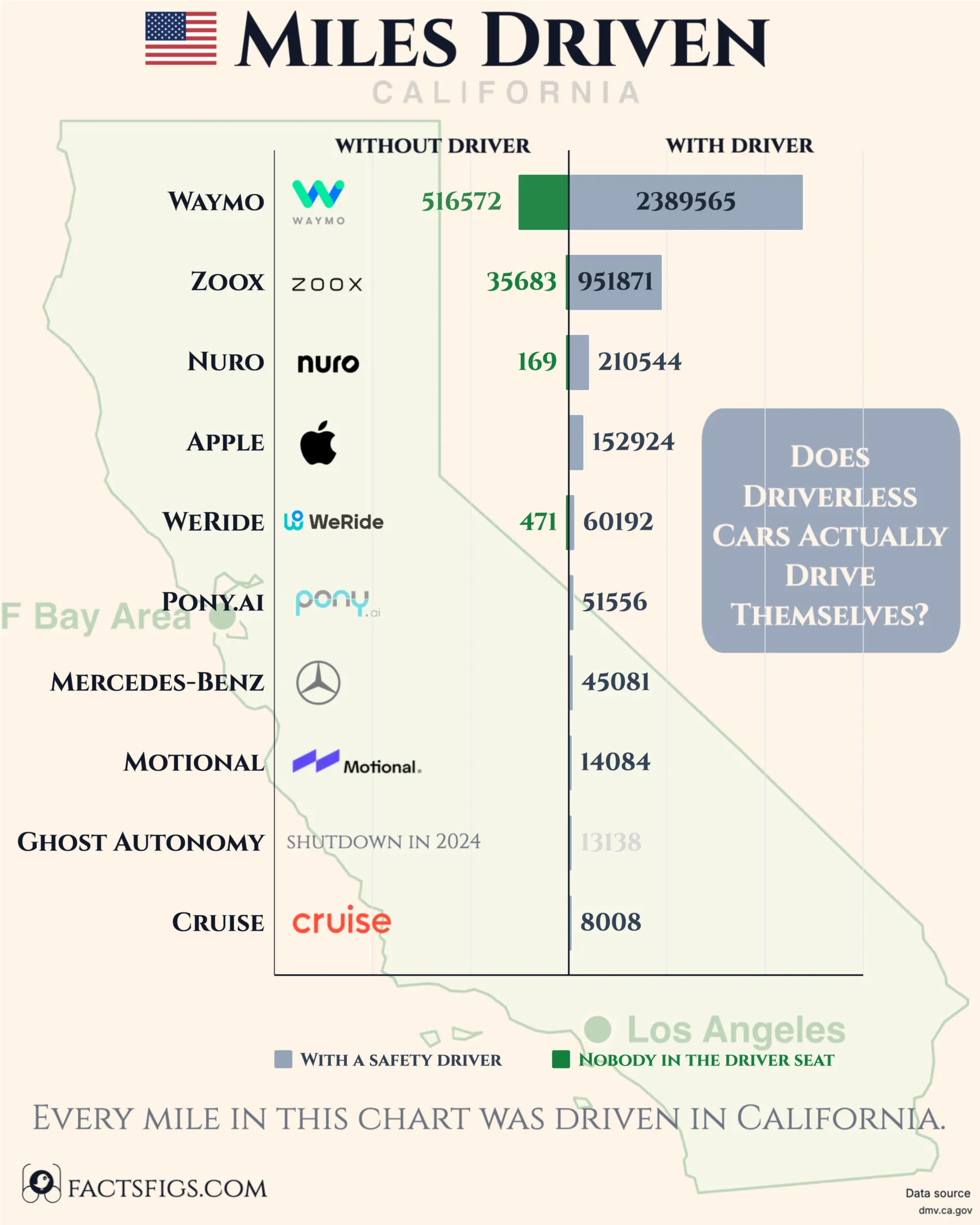
Twenty companies reported testing autonomous vehicles on California public roads in the year to 30 November 2024. Four of them reported a single mile with nobody in the driver seat. Waymo accounts for 93 per cent of those driverless miles. Even for Waymo, 82 per cent of its testing still had a safety driver aboard. The rest of the field is further back than the word "driverless" suggests. Apple drove 152,924 miles and never once removed the driver.
Continue reading below for the full detailed article →
The sourcing, stated first
Every figure in the chart comes from the California DMV’s own mileage files, read as published data rather than through anyone’s summary. They are real miles, driven in autonomous mode on public roads. The DMV is explicit about what they exclude: private roads, out-of-state testing, anything below SAE Level 3, and SIMULATION. That last exclusion matters, because simulated miles are where the enormous figures live, and they are not these. One more exclusion shapes everything here. In the DMV’s words, disengagement reporting "is not required for AV operations conducted under deployment permits". Waymo’s actual robotaxi service runs under exactly such a permit, so none of its commercial driving appears in this chart at all. In the quarter to 30 June 2026 that service carried passengers 16,579,725 miles across 4,220,075 trips, filed separately with the state utilities regulator. It belongs beside this chart, not inside it.
How many may test, how many have taken the driver out, and how many may charge.
26
Companies holding a Californian permit to test an autonomous vehicle with a safety driver aboard, as of September 2026.
6
A separate permit for testing with nobody in the vehicle. Two holders have never reported a driverless mile.
1
Waymo alone holds the authorisation to run a driverless passenger service and take money for it.
The distinction that matters
California issues two separate testing permits, and the gap between them is the gap between research and a product. One lets a company test an autonomous vehicle with a trained human in the driver seat, ready to take over. The other lets it test with nobody there at all.
Twenty companies filed mileage for the year to 30 November 2024. Sixteen of them reported only the first kind. Four reported any of the second: Waymo, Zoox, WeRide and Nuro.
The volumes make the gap starker than the count does. Those four between them reported 552,896 driverless miles, and 516,572 of those were Waymo’s. WeRide managed 471. Nuro managed 169, which is about the distance from San Francisco to Sacramento and back.
This is why a chart of total miles flatters the field. Apple drove 152,924 miles in California that year, more than every company except Waymo, Zoox and Nuro, and never once took the driver out.
Even the leader supervises
Waymo reported 2,389,565 supervised miles against 516,572 driverless ones. So even at the front of the field, 82 per cent of testing still had a human in the seat.
That is not a criticism; it is what testing is for. But it does answer the question people actually ask. The company furthest along still runs four supervised miles for every one it runs alone, and it has been at this since 2009.
The number that shows how far ahead Waymo is sits outside this chart entirely. Its commercial robotaxi service, which operates under a deployment permit rather than a testing one, carried passengers 16,579,725 miles across 4,220,075 trips in the single quarter to 30 June 2026. That is thirty times its entire year of testing mileage, and the state does not require it in these files.
Every company that filed
All twenty companies that reported mileage, sorted by supervised miles. "None reported" means the company filed no driverless mileage, which is not the same as being unable to: two permit holders can test driverless and reported nothing.
| Waymo | 2,389,565 | 516,572 | 17.8% |
| Zoox | 951,871 | 35,683 | 3.6% |
| Nuro | 210,544 | 169 | 0.1% |
| Apple | 152,924 | none reported | 0% |
| WeRide | 60,192 | 471 | 0.8% |
| Pony.ai | 51,556 | none reported | 0% |
| Mercedes-Benz | 45,081 | none reported | 0% |
| Motional | 14,084 | none reported | 0% |
| Ghost Autonomy | 13,138 | none reported | 0% |
| Cruise | 8,008 | none reported | 0% |
| AutoX | 7,459 | none reported | 0% |
| aiMotive | 3,744 | none reported | 0% |
| Nissan | 2,153 | none reported | 0% |
| Imagry | 856 | none reported | 0% |
| Gatik | 726 | none reported | 0% |
| Nullmax | 513 | none reported | 0% |
| Bosch | 164 | none reported | 0% |
| Vueron | 40 | none reported | 0% |
| Valeo | 36 | none reported | 0% |
| Apollo | 3 | none reported | 0% |
Public-road testing in autonomous mode only. Private roads, out-of-state testing, systems below SAE Level 3 and simulation are all excluded by the DMV, as are operations under a deployment permit. Nuro filed under two spellings and is combined here.
What happens next
These reports have been the public record of autonomous driving in America since 2014, and California is about to retire them. The DMV says its 2026 regulations will replace the disengagement reporting requirement with a different set of measures entirely.
What replaces it is more useful. The proposed rules ask for vehicle miles travelled during testing AND deployment, which would close the gap this page has had to work around: for the first time, commercial robotaxi mileage would sit in the same return as testing mileage. They also ask for crash reporting aligned to the federal standing order, vehicle immobilisations, and heavy braking events above a defined threshold.
That matters beyond bookkeeping. Disengagements measured how often a human rescued the car, which made sense when every car had a human in it. Most of the questions people now ask about driverless vehicles are about cars with nobody aboard, and a disengagement cannot happen in one.
So this chart is close to the last of its kind. It is a decade-long record of an industry learning to drive, ending at the point where the thing being measured stopped matching the thing being built.
What this page does not claim
The same files carry disengagement counts, and it is tempting to divide miles by disengagements and call the result a safety league table. We have not, because the DMV says plainly that the reports "are intended to provide insight into the operational activities of each permit holder and are not designed for comparative analysis across companies".
The reason is that companies define a disengagement differently, test in different places and in different conditions, and report it themselves. A company testing in heavy city traffic will look worse than one testing on an empty road, and neither number says anything about the product a passenger would ride in.
Miles driven is a different kind of figure. It is an activity count, it is reported the same way by everyone, and dividing it between companies says who is doing the work. That is all this page claims.
One more limit worth stating: these are the figures for the year to November 2024. The DMV announced in February 2026 that the following year’s total exceeded nine million miles, roughly double, but it has not published the per-company files for that year, and its own link to them points at a page that does not contain them.
California DMV autonomous vehicle program California Public Utilities Commission AV programs
Mileage figures are from the California DMV’s autonomous vehicle mileage files for the reporting year ending 30 November 2024, read as published data files rather than through any summary of them. Permit counts are from the DMV’s current permit-holder lists. Waymo’s commercial passenger figures are from its quarterly filings with the California Public Utilities Commission.
The DMV defines what these miles are and are not: public-road testing in autonomous mode, excluding private roads, out-of-state testing, systems below SAE Level 3 and simulation. Operations under a deployment permit are not reportable, which is why Waymo’s commercial service is given separately rather than added in.
No disengagement rate or safety ranking appears here, following the DMV’s own statement that the data is not designed for comparison across companies. Nuro filed under two spellings in the same reporting year and its rows are combined; without that, a reader would count twenty-one companies where there are twenty.
The per-company files for the year to November 2025 were not public when this was written. The DMV’s February 2026 release gives a total of more than nine million miles but no company breakdown, its reports page returns an error, and the release’s own link to the data points at the regulations page instead. We checked each of those directly rather than taking a secondary report’s figures.
Related Publications
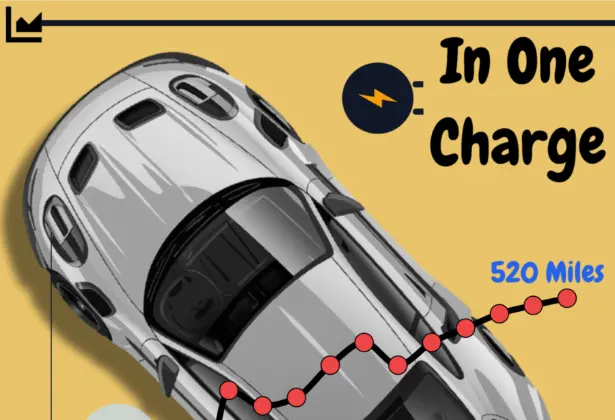
The highest EPA-rated range peaked at 520 miles in 2022 and has slipped to 512. Meanwhile the median electric car went from 82 miles to 295.
19 Oct 2026
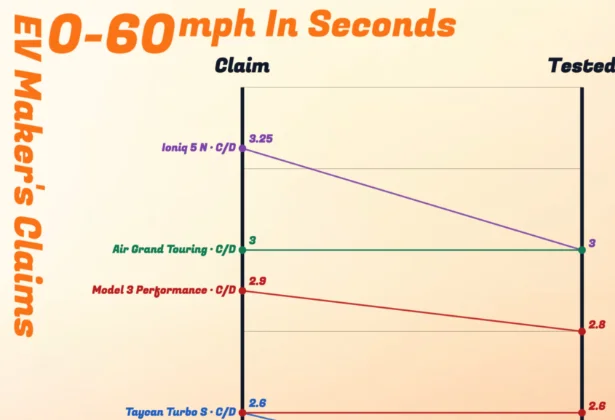
Tesla claims 1.99 seconds for the Plaid, measured with a one-foot rollout. Here is what Car and Driver and MotorTrend actually recorded, for it and fourteen other runs.
19 Oct 2026
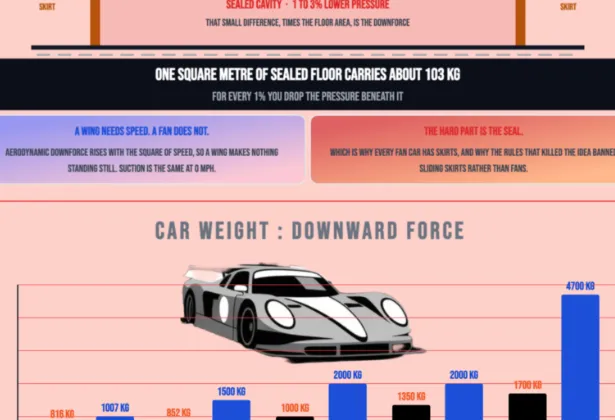
Suction, not a wing. Every fan car since the 1970 Chaparral presses down harder than it weighs, and only one has ever been shown driving upside down.
19 Oct 2026
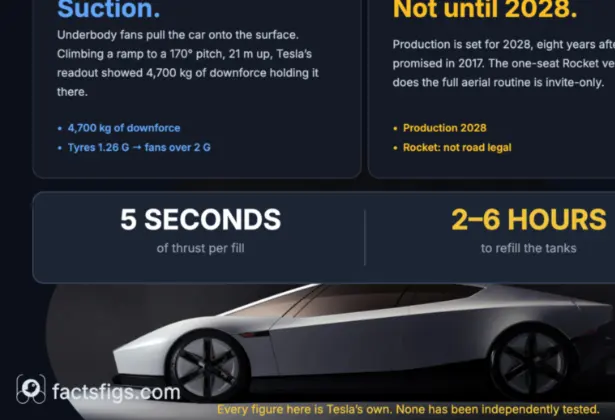
Tesla’s Roadster climbed a ramp upside down and flipped over a row of cars. The footage is real, but it is not flight: here is how the suction and thrusters actually work.
18 Oct 2026