TL;DR: Which Countries Are Buying the Most Electric Cars?
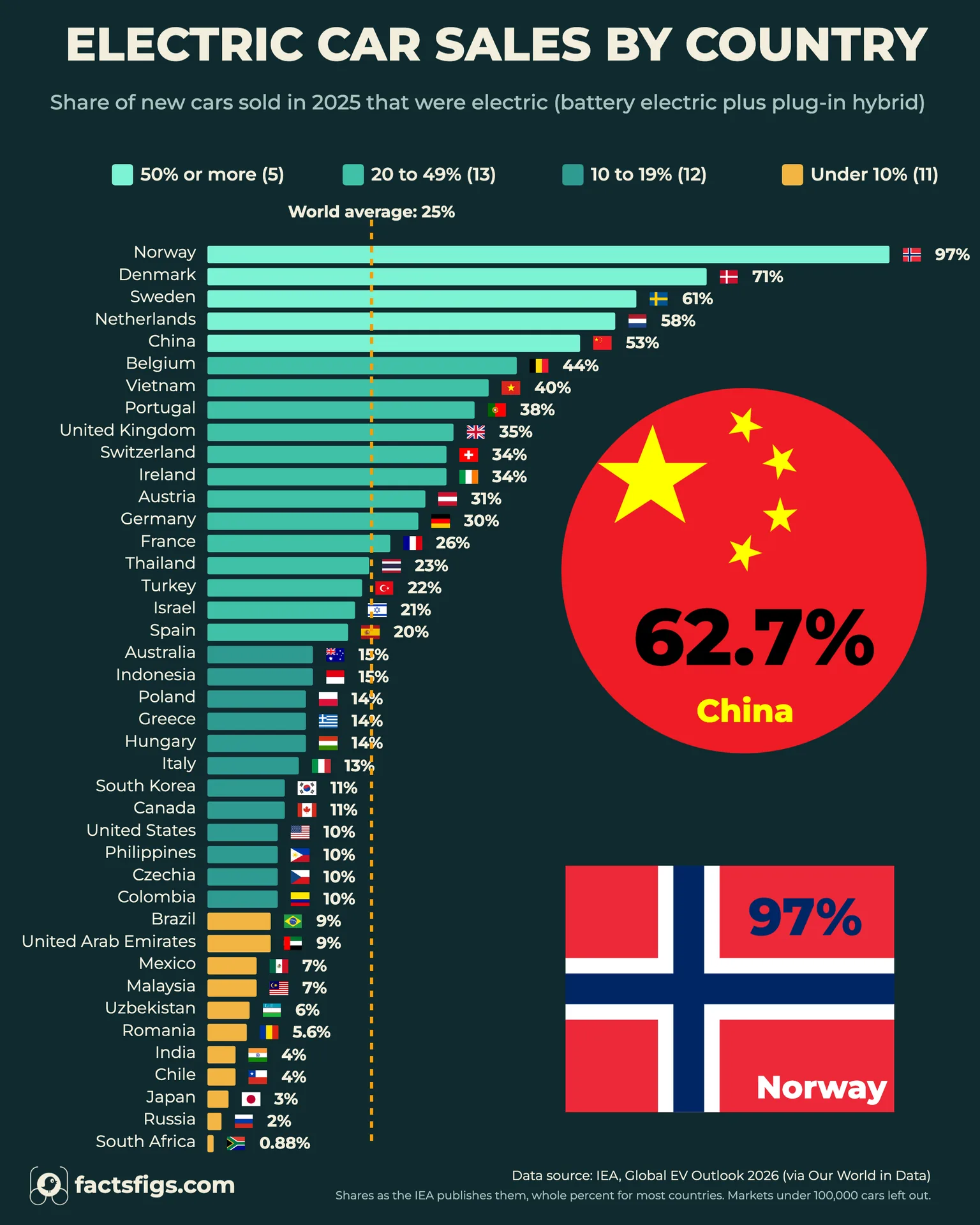
Norway by share at 97%, China by volume. The world average is 25%.
Norway's new-car sales were about 97% electric in 2025, against a world average of 25%. Electric means battery electric plus plug-in hybrid. Denmark (71%), Sweden (61%), the Netherlands (58%) and China (53% in the data file) are the only other ranked countries above 50%.
China is fifth by share but bought 62.7% of the world's electric cars. Vietnam (40%) is ahead of the United Kingdom, Germany and France, while the United States, India and Japan sit in the lower half.
! Where the Ranking Surprises:
•
Vietnam · 40%:Ahead of the United Kingdom (35%), Germany (30%) and France (26%).
•
China · Fifth by Share, First by Volume:The IEA's text says almost 55%, the data file 53%. China bought 62.7% of the world's electric cars.
•
US, India, Japan · 10%, 4%, 3%:Three large markets rank 27th, 37th and 39th of 41.
? The Numbers Behind the Claim:
•
Countries ranked:41 of 59, markets of about 100,000 cars or more
•
World and Europe:25% and 28% of new cars sold were electric
•
Norway:97%, with 172,800 electric cars, up from 75% in 2020
Small markets lead by share, China leads by volume and several large markets lag.
Continue reading below for the full detailed article →
Overview
How to Read a Share That Hides Market Size
The ranking measures one thing: the share of new cars sold in 2025 that were electric. The IEA's Global EV Outlook 2026 defines an electric car as battery electric or plug-in hybrid. Conventional hybrids are not counted. It is a share of one year's sales, not of the cars on the road.
The shares are the IEA's, rounded to whole percent for most countries. Only markets of about 100,000 cars or more are ranked, 41 of the 59 countries with a 2025 value. The other 18 are in the table only.
Three Numbers That Frame Electric Car Adoption
The leader by share, the leader by volume and the world average.
Norway · 97% Electric
97%
Norway's new-car sales were about 97% electric in 2025, up from 75% in 2020. That is 172,800 electric cars in a market FactsFigs estimates at about 178,000 cars a year. The IEA's text says nearly all of them were battery electric, with plug-in hybrids under 2% of its electric sales, so the share is almost entirely battery cars.
China · 62.7% of World Electric Sales
62.7%
China sold 13.3 million electric cars in 2025 out of 21.2 million worldwide, which is 62.7%. Europe accounted for 20.3% and the United States for 7.2%. China ranks only fifth by share, at 53% in the data file and almost 55% in the IEA's report text, but on a far larger market than any country above it.
World Average · 25%
25%
Across the world, 25% of new cars sold in 2025 were electric, and Europe reached 28%. Both are IEA figures. Of the 41 ranked countries, 18 are at 20% or above and 11 are below 10%. A large part of the world figure is China's, since it supplied 13.3 million of the 21.2 million electric cars sold.
Norway by the Numbers
Electric Share of New Cars 97 %The highest of the 41 ranked countries.
Electric Cars Sold 172800 Under 1% of the 21.2 million sold worldwide.
Share in 2020 75 %A gain of 22 points in five years.
The top band
Electric Car Sales by Country: Norway Leads at 97%
Norway sold 172,800 electric cars in 2025, 97% of its new-car market, up from 75% in 2020. Denmark is second at 71%, up from 16%, the biggest gain of any ranked country at 55 points. Sweden follows at 61% (32% in 2020) and the Netherlands at 58% (25%).
These are small markets. FactsFigs estimates Norway sells about 178,000 new cars a year, Denmark about 190,000 and Sweden about 284,000. Those totals are approximate. Norway's 172,800 electric cars are fewer than the Netherlands' 228,000 and about a fifth of Germany's 860,000.
Three markets too small to be ranked also sit above 50%: Nepal at 68%, Iceland at 62% and Finland at 57%. They sold 13,063, 10,200 and 42,000 electric cars, so they appear in the table only.
The scale gap
Why China Is Fifth by Share but First by Volume
China's 2025 share is 53% in the data file behind the chart and almost 55% in the IEA's own report text. The cause of the gap is not stated. The chart and table use 53 because they come from one file. Either way China ranks fifth, behind Norway, Denmark, Sweden and the Netherlands.
It sold 13.3 million electric cars in 2025 out of 21.2 million worldwide, which is 62.7% of the total. Europe took 20.3% and the United States 7.2%. China's electric sales are about 77 times Norway's 172,800, so the world average of 25% depends heavily on one country.
It also moved fast. China went from 5.7% in 2020 to 53% in 2025, a gain of 47.3 points. Among ranked countries only Denmark, at 55 points, gained more.
Why Vietnam Is Ahead of the UK, Germany and France
Europe as a whole reached 28% in 2025, three points above the world's 25%. Belgium leads the middle of the table at 44%, followed by Portugal at 38% and the United Kingdom at 35%, then Ireland and Switzerland at 34%. Austria is at 31%, Germany at 30% and France at 26%, with Spain at 20%.
Vietnam is the surprise. At 40% it is seventh overall and ahead of every one of those countries except Belgium. It sold about 180,000 electric cars, against 700,000 in the United Kingdom at 35% and 860,000 in Germany at 30%. The IEA's text agrees, putting Vietnam at nearly 40% and Germany at around 30%.
Thailand (23%) and Turkey (22%) are also ahead of Spain (20%), and both started from almost nothing: 1.1% and 0.21% in 2020. The United Kingdom gained 24 points since 2020, Germany 16 and France 15.
The big laggards
Why the US, India and Japan Sit So Low
By FactsFigs' estimate of market size, the United States, India and Japan are the second, third and fourth largest car markets among the 59 countries, behind only China. All three rank low. The United States is at 10%, 27th of 41 and tied with the Philippines, Czechia and Colombia. India is at 4%, 37th and tied with Chile. Japan is at 3%, 39th.
The IEA's text is more cautious than the whole numbers. It puts the United States just below 10% and Japan at less than 3%, and a whole-number 10 can stand for anything from 9.5 to 9.9. They are called about 10% and under 3% here. All three have grown: the United States from 2.3% in 2020, India from 0.12% and Japan from 0.77%.
Size still makes them matter. The United States sold 1.53 million electric cars, 7.2% of the world total and the biggest national count after China. India sold 170,100 and Japan 102,000.
Japan's figure comes with a definition. The IEA notes that conventional hybrids sell far more than electric cars there, and they are not counted as electric in this ranking. A low score means few plug-in or battery cars, not few hybrids.
South Korea sits in the same band as the United States. It reached double digits for the first time in 2025, at 11%, with electric sales up about 65% to over 200,000 (217,000 in the data file).
Emerging markets
How Chinese Imports Are Lifting Emerging Markets
Several of the fastest risers lean on one supplier. The IEA says that across emerging markets other than China, 60% of electric car sales are Chinese imports.
Mexico shows it most clearly. Its electric share topped 7% in 2025, up from about 2% in 2024, and 85% of its electric sales were imported from China. The data file shows Mexico at 7% on 90,000 electric cars.
Brazil reached 9%, up from 6.5% in 2024 and 0.16% in 2020. Colombia reached 10%, which the IEA attributes to cheaper Chinese models, tax exemptions and the end of fuel subsidies. Costa Rica reached 17% but sold only 12,190 electric cars, so it is in the table only.
Nepal is at 68%, the third-highest share of all 59 countries. The IEA lists it among the largest increases since 2020, driven by imports from China. The file has no 2020 value for it, and it sold only 13,063 electric cars.
Two kinds of electric
Battery Electric or Plug-In Hybrid: What the IEA Reports
Electric here covers two kinds of car. Battery electric vehicles made up 65% of electric car sales worldwide in 2025, and plug-in hybrids the other 35%.
The mix varies by country. Norway's electric sales were nearly all battery electric, with plug-in hybrids under 2%. In Southeast Asia more than 90% were battery electric. In Brazil battery electric cars were 45% of electric sales, so plug-in hybrids outsell them, and in Uzbekistan they were 33%.
Uzbekistan's share also differs by source. The IEA's report text gives 8% of total car sales, while the data file behind the chart gives 6%. The chart and table keep 6 and the text records 8. The difference is not explained.
For every other country the split is not in the figures shown here, so it is left out rather than guessed.
Countries estimated to have sold 100,000 cars or more are ranked; the other 18 carry no rank. Ties are ordered by electric cars sold.
1
🇳🇴 Norway
97
75
+22
172,800
—
2
🇩🇰 Denmark
71
16
+55
134,700
—
—
🇳🇵 Nepal
68
-
-
13,063
small market
—
🇮🇸 Iceland
62
52
+10
10,200
small market
3
🇸🇪 Sweden
61
32
+29
173,000
—
4
🇳🇱 Netherlands
58
25
+33
228,000
—
—
🇫🇮 Finland
57
18
+39
42,000
small market
5
🇨🇳 China
53
5.7
+47.3
13,300,000
—
6
🇧🇪 Belgium
44
11
+33
180,000
—
7
🇻🇳 Vietnam
40
-
-
180,077
—
8
🇵🇹 Portugal
38
13
+25
86,000
—
—
🇸🇬 Singapore
37
2.6
+34.4
20,580
small market
—
🇱🇦 Laos
36
-
-
6,150
small market
9
🇬🇧 United Kingdom
35
11
+24
700,000
—
—
🇱🇺 Luxembourg
35
11
+24
16,700
small market
10
🇨🇭 Switzerland
34
14
+20
79,000
—
11
🇮🇪 Ireland
34
7.4
+26.6
43,000
—
12
🇦🇹 Austria
31
9.5
+21.5
90,000
—
13
🇩🇪 Germany
30
14
+16
860,000
—
14
🇫🇷 France
26
11
+15
450,000
—
Showing 1-20 of 59
Page 1 of 3
Electric means battery electric plus plug-in hybrid. Small market means FactsFigs estimates fewer than 100,000 new cars sold in 2025, back-calculated from the rounded shares. Shares are whole percent except Romania, Slovakia, Croatia and South Africa. A dash means the file has no 2020 value. Seychelles has no 2025 value and is omitted. Country names follow Our World in Data. Source: IEA, Global EV Outlook 2026.
The limits
What a Share Ranking Cannot Tell You
Share and size answer different questions. Norway's 97% rests on 172,800 cars and China's 53% on 13.3 million, so a place in the ranking says nothing about how many electric cars a country buys. Markets under about 100,000 cars are left out of the ranking for that reason: 18 of the 59.
The cutoff uses FactsFigs' own market sizes. The IEA gives electric sales and shares, so each total here is electric sales divided by the rounded share. A share shown as 25% could be anywhere from 24.5% to 25.5%, which moves the total by about 2%. New Zealand (about 96,700 cars) and Slovakia (about 93,400) are within 7% of the line and could sit on either side.
Rounding also creates ties. 55 of the 59 values for 2025 are whole numbers, and 8 values among the 41 ranked are shared by two or more countries, such as Switzerland and Ireland at 34% or the United States, the Philippines, Czechia and Colombia at 10%. Ranks 27 and 30 are the same share.
Finally, a share of sales in one year is not a share of the cars on the road, and it counts plug-in hybrids as electric but conventional hybrids as not.
The verdict
Why Norway Leads the Ranking but China Leads the Market
Norway leads on share at 97% and China on volume at 13.3 million cars. The four European countries above 50% sold 708,500 electric cars between them, about 3.3% of the 21.2 million sold worldwide. China alone sold 62.7%.
The movement is in the middle. Vietnam is ahead of the United Kingdom, Germany and France, Mexico and Colombia grew on Chinese imports, and the United States at about 10%, India at 4% and Japan under 3% all rank in the lower half. The world average is 25% and Europe's is 28%.
All figures are the IEA's for 2025, read on 13 November 2026. For how far these cars go and how claims about them hold up, see our post on EV range, 0-60 times and self-driving.
The data behind this story is the IEA's Global EV Outlook 2026, read through Our World in Data's republication on 13 November 2026. The shares are the IEA's, rounded to whole percent for most countries. Market sizes used for the 100,000-car cutoff are FactsFigs' approximation, back-calculated from those shares. Remarks on battery electric and plug-in hybrid sales come from the IEA's report text. The IEA states CC BY 4.0 for the report and non-CC terms for its downloadable data product, so FactsFigs offers no file until that is clarified. Full credit for collecting and maintaining the data goes to the IEA.
FactsFigs reviews, cleans and cross-checks every source dataset before shaping it into a data story. Each visualization is created and designed in FactsFigs Design Studio, an internal tool developed and owned by FactsFigs, and is the original work of a FactsFigs author, not an AI-generated copy of any existing graphic. Individual assets within a visual may or may not be produced with AI tools, but the design of the visual itself is solely FactsFigs' own.
Figures are estimates at the time of publication, provided for information only. Nothing here is financial advice or a guarantee of accuracy.
Last verified: 13 Nov 2026
The charts in this article were built with our own publishing system. See what it does →