

861 km inside
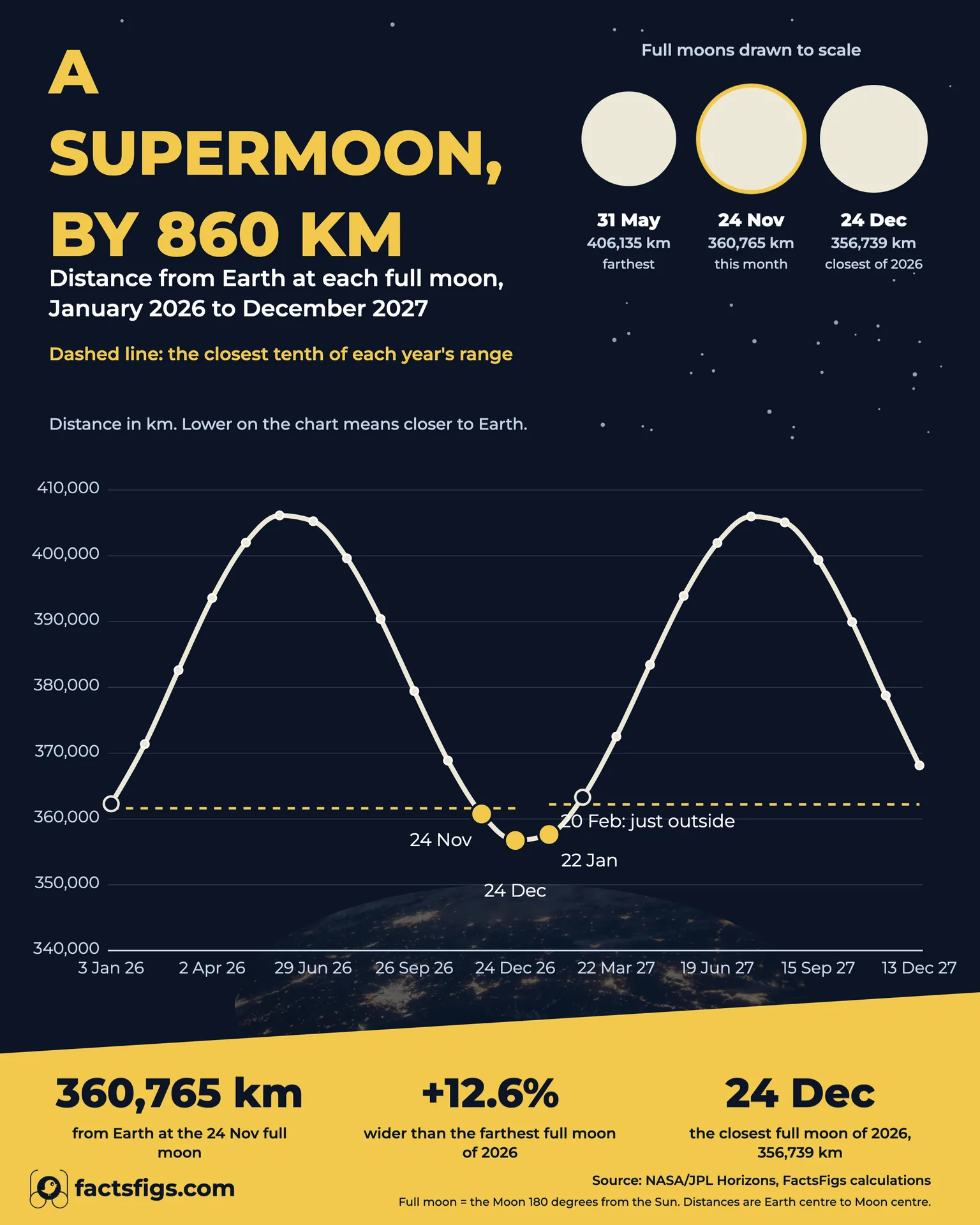
The 24 November full moon is 360,765 km away, against a line of 361,626 km. The margin is 0.24% of the distance.

Facts & Figures
Visual Intelligence
Yes, by the usual test, but only by about 860 km, and the full moon on 24 December is closer.
The full moon of 24 November 2026, at 14:53 UTC, is 360,765 km from Earth. That is inside the closest tenth of the year's range of full-moon distances, a line at 361,626 km, so it counts as a supermoon by the test Farmers' Almanac uses. It clears the line by about 860 km, 0.24% of the distance. It looks about 12.6% wider than the farthest full moon of 2026. The closest full moon of 2026 comes a month later, on 24 December, at 356,739 km. Sources disagree on how many supermoons come in a row, three or four, because there is no official definition. The distances change smoothly. The label does not.
A supermoon is a full moon that happens near the Moon's closest approach, but nobody has fixed how near. The size difference is real and small, about 6% wider than an average full moon, so the label is a line drawn on a smooth change.
Continue reading below for the full detailed article →
Overview
Every full moon is a different distance from Earth. The Moon's orbit is an oval, so its distance swings from about 357,000 km at its closest to about 406,000 km at its farthest. Whether a given full moon is called a supermoon depends on where in that swing it falls. We calculated the Moon's position from NASA's JPL Horizons system for every hour from December 2025 to January 2028. A full moon is the moment the Moon sits 180 degrees from the Sun along the ecliptic, the Sun's path across the sky. We took the distance from Earth's centre to the Moon's centre at that moment, which gives 25 full moons from January 2026 to December 2027. Our distances for 24 November, 24 December and 22 January match the figures in the Farmers' Almanac to within a kilometre. NASA says "supermoon" is not an official astronomical term, and says it is typically used for a full moon that comes within at least 90 percent of perigee, the Moon's closest point to Earth. Farmers' Almanac states its test in terms of distance: a full moon in the closest tenth of that year's range of distances. This post uses the second one, and says so each time.
How far inside the line it is, how much wider it looks and how much brighter, against the farthest full moon of 2026.
861 km inside
The 24 November full moon is 360,765 km away, against a line of 361,626 km. The margin is 0.24% of the distance.
12.6% wider
Its apparent width is 33.11 arcminutes, against 29.41 for the farthest full moon of 2026, on 31 May.
26.7% brighter
By distance alone, from the inverse-square law. It ignores the Moon's phase angle and its wobble, so treat it as an upper estimate.
The 24 November full moon
Yes, narrowly. The full moon of 24 November 2026 happens at 14:53 UTC, when the Moon is 360,765 km from Earth. NASA's own list gives 14:54 UTC, a minute later, which is within rounding.
Take the test Farmers' Almanac uses. The Moon's distance in 2026 runs from 356,648 km at its closest, on 24 December, to 406,436 km at its farthest, on 11 December. The closest tenth of that range ends at 361,626 km. A full moon inside that line counts. The 24 November full moon is 861 km inside it, a margin of 0.24%.
That margin is thin, and it is the reason the headline says narrowly. Had the Moon been 900 km farther at that moment, the same test would call this an ordinary full moon. The Moon has not changed. The line is where somebody chose to put it.
The Moon looks full for about three nights, the night before, the night of and the night after, so the exact moment is not the one to watch for. In Pakistan 14:53 UTC is 19:53, in London it is 14:53 and in New York it is 09:53. Wherever it is daytime at that instant, the Moon is below the horizon and rises that evening.
Size and brightness
Measured against the farthest full moon of 2026, on 31 May at 406,135 km, the 24 November full moon is 12.6% wider. Its apparent width is 33.11 arcminutes against 29.41. An arcminute is a sixtieth of a degree, so the full moon always measures about half a degree across, and the difference between the extremes is about four arcminutes.
NASA puts the extreme at the same size. It says the full moon at its closest can appear up to 14 percent bigger and 30 percent brighter than the faintest moon of the year. Our figures for 24 December, the closest of 2026, are 13.8% wider and 29.6% brighter, so they match NASA's rounded ones.
Against the average, the gap is smaller. The 13 full moons of 2026 average 383,010 km, and the 24 November full moon is about 6.2% wider than that. A change of 6% is hard to see without a comparison, because there is nothing in the sky to hold the Moon up against. NASA says the same of the 14 percent figure: it is not a big difference in detectable size.
The brightness figures come from distance alone. Light falls with the square of the distance, so a Moon 11% closer is about 27% brighter. They ignore the Moon's phase angle and its small rocking, which also change how bright a full moon is, so read them as the effect of distance and no more.
The closest of the year
No. The 24 December 2026 full moon, at 01:28 UTC, is closer: 356,739 km, which is 13.8% wider than the farthest full moon of the year. It is the closest of the 25 full moons we calculated. The next closest is 22 January 2027, at 357,645 km, and 24 November is third.
The perigee tells the same story from the other side. The Moon reaches its closest point of this month on 25 November at 21:08 UTC, at 359,336 km, 30.2 hours after the full moon. On 24 December the perigee comes at 08:37 UTC and 356,648 km, only 7.2 hours after the full moon, so the two almost coincide. That is why December wins by 4,000 km.
If the aim is to see the biggest full moon of the year, the 24 December one is the better bet, and clouds on either date decide more than the distance does. The two are about 1.2% apart in apparent width.
The count
Three by Farmers' Almanac's test: 24 November, 24 December and 22 January. Space.com calls 24 November the first of four in a row. NASA says supermoons happen three to four times a year and always appear consecutively. The sources differ about this run of moons, not about the Moon.
The data shows where they come apart. The fourth candidate is 20 February 2027, at 363,306 km. The 2027 line is 362,220 km, so it misses by 1,086 km. On the other side, 3 January 2026 misses the 2026 line by 686 km. A line 1,100 km higher would admit 20 February, and one 900 km lower would drop 24 November.
The distances between full moons change smoothly, a few thousand kilometres a month. A label that flips between yes and no at one number turns that smooth change into a count, and the count moves with the number. Neither three nor four is wrong. They answer different questions.
One more wrinkle: a calendar-year line splits a run that crosses New Year. 22 January is judged against 2027's range, and 24 November against 2026's. The two lines differ by 594 km, which is 69% of the margin on 24 November.
The full moons
Each row is one full moon. The width is the Moon's apparent diameter seen from Earth's centre, and the comparison is with the farthest full moon of 2026, on 31 May. The last column applies the closest-tenth line for that calendar year.
| 3 Jan 2026, 10:02 | 362,312 | 32.97 | 12.1% | No |
| 1 Feb 2026, 22:09 | 371,387 | 32.16 | 9.4% | No |
| 3 Mar 2026, 11:37 | 382,612 | 31.22 | 6.1% | No |
| 2 Apr 2026, 02:11 | 393,595 | 30.35 | 3.2% | No |
| 1 May 2026, 17:23 | 402,000 | 29.72 | 1.0% | No |
| 31 May 2026, 08:45 | 406,135 | 29.41 | 0.0% | No |
| 29 Jun 2026, 23:56 | 405,254 | 29.48 | 0.2% | No |
| 29 Jul 2026, 14:35 | 399,618 | 29.89 | 1.6% | No |
| 28 Aug 2026, 04:18 | 390,398 | 30.60 | 4.0% | No |
| 26 Sep 2026, 16:49 | 379,436 | 31.48 | 7.0% | No |
| 26 Oct 2026, 04:11 | 368,873 | 32.38 | 10.1% | No |
| 24 Nov 2026, 14:53 | 360,765 | 33.11 | 12.6% | Yes |
| 24 Dec 2026, 01:28 | 356,739 | 33.49 | 13.8% | Yes |
| 22 Jan 2027, 12:17 | 357,645 | 33.40 | 13.6% | Yes |
| 20 Feb 2027, 23:23 | 363,306 | 32.88 | 11.8% | No |
| 22 Mar 2027, 10:43 | 372,527 | 32.07 | 9.0% | No |
| 20 Apr 2027, 22:27 | 383,429 | 31.15 | 5.9% | No |
| 20 May 2027, 10:59 | 393,901 | 30.33 | 3.1% | No |
| 19 Jun 2027, 00:44 | 401,952 | 29.72 | 1.0% | No |
| 18 Jul 2027, 15:44 | 405,979 | 29.42 | 0.0% | No |
Showing 1-20 of 25
Source: FactsFigs calculations from NASA/JPL Horizons. Times are UTC. The 2026 line is 361,626 km and the 2027 line is 362,220 km. 2026 has 13 full moons because two fall in May.
Why the distance changes
The Moon's orbit is an oval with Earth off-centre, so the distance changes all month. The Moon goes from one closest point to the next in about 27.5 days, but from one full moon to the next in about 29.5 days. The two cycles drift about two days apart every month, and every so often they line up.
Our table shows the drift. On 31 May the nearest perigee came 331 hours, nearly 14 days, before the full moon, and the full moon was the farthest of the year. Through the autumn the nearest perigee closed in on the full moon: 124 hours after it on 26 September, 62 on 26 October, 30 on 24 November and 7 on 24 December. That closing gap is the run of close full moons.
The alignment comes round again, but not on a fixed date. After 22 January 2027 the gap opens again, and no full moon from March to December 2027 comes within 5,000 km of the 2027 line. By 13 December 2027 the distance is falling again, to 368,142 km.
For more space data from NASA, see our look at how many exoplanets the agency has found and who found them.
The limits
It cannot tell you how the Moon will look. A supermoon is about 6% wider than an average full moon. Low on the horizon the Moon also looks larger than it does overhead, an illusion with no change in its size, and it can hide a 6% difference entirely.
It cannot settle the definition. We name the test each time. Another source may use a different line, and its count will differ without either of us having a wrong distance.
The distances are our own calculation, and they carry two small caveats. The full-moon moment is found by interpolating hourly positions, and the line depends on the perigee and apogee we found for each year. Our 24 November time is one minute earlier than NASA's, and the cutoff margin of 861 km could move by a kilometre or so with the rounding of those two extremes.
The brightness figures use distance alone. And the story ages quickly. The best time to read it is now to the 22 January 2027 full moon, after which the next run of close full moons is a different story.
NASA/JPL Horizons System NASA Science: Supermoons
The positions of the Moon and the Sun are from NASA/JPL's Horizons System, queried hourly from December 2025 to January 2028, for the Moon as seen from Earth's centre. A full moon is the moment the Moon's ecliptic longitude is 180 degrees from the Sun's. Every distance, width, brightness figure and line in this post is FactsFigs' own calculation from those positions. The wording of the supermoon definition, the 14 percent and 30 percent figures and the three to four a year are from NASA Science's page on supermoons, last updated 12 February 2026. The closest-tenth test and the count of three in a row are from Farmers' Almanac, and the count of four is from Space.com. We read both only for those two points, and we do not reproduce their text. The data was manually collected by FactsFigs.
FactsFigs reviews, cleans and cross-checks every source dataset before shaping it into a data story. Each visualization is created and designed in FactsFigs Design Studio, an internal tool developed and owned by FactsFigs, and is the original work of a FactsFigs author, not an AI-generated copy of any existing graphic. Individual assets within a visual may or may not be produced with AI tools, but the design of the visual itself is solely FactsFigs' own.
Figures are estimates at the time of publication, provided for information only. Nothing here is financial advice or a guarantee of accuracy.
Last verified: 24 Nov 2026
Related Publications

Nvidia fell 4.34% the day Huang resigned but was already down 19% from 28 October. Across 20 big tech CEO exits the median first-day move was a 0.6% fall.
23 Nov 2026
Satellite launches rose 8.5 times from 2019 to 2025, to 4,605. Starlink was 69% of them. Without it the US share falls from 82% to 42%.
21 Nov 2026
NASA's archive lists 6,470 exoplanets from every telescope. Kepler, TESS and K2 found 67% of them, and two Kepler papers added almost a third.
19 Nov 2026
FAA price estimates for 32 rockets show no trend by launch year. Falcon 9 is $3,604 per kg against a $12,719 median, and its list price is down 7% since 2018.
18 Nov 2026