

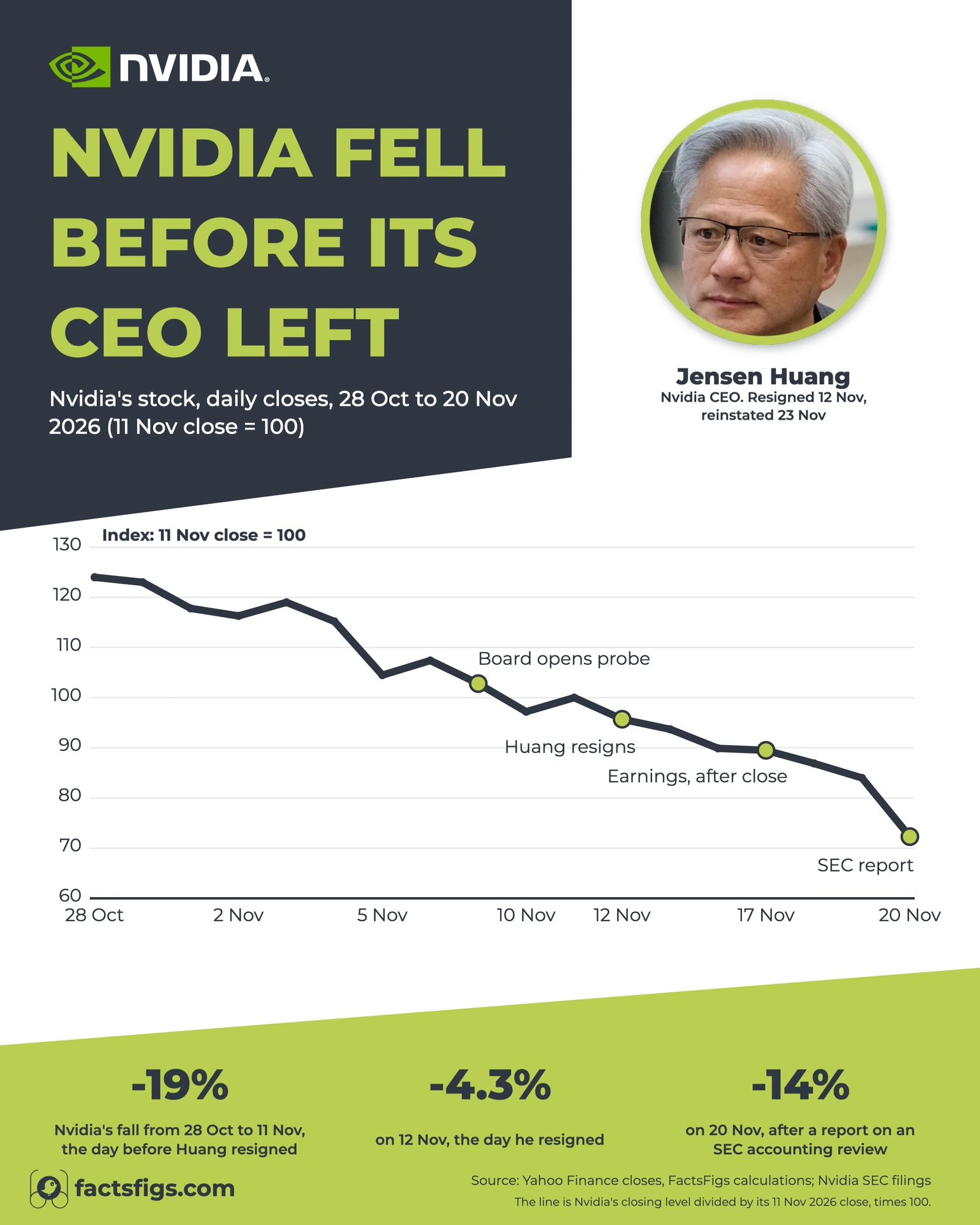
4.34% fall
Nvidia closed down 4.34% on 12 November, the first session after the news. The Nasdaq fell 0.39%, so Nvidia did 3.95 points worse than the market.

Facts & Figures
Visual Intelligence
Down 4.34% on the day, after a 19% slide in the two weeks before it, and the CEO was back 11 days later.
Nvidia's stock closed down 4.34% on 12 November 2026, the day Jensen Huang resigned as chief executive. The Nasdaq Composite fell 0.39%. The headlines quoting 7% to 14% were intraday lows. By then Nvidia was already 19% below its 28 October close, and its biggest one-day fall, 14%, came on 20 November after a report that the SEC was looking at its accounting. On 23 November the board reinstated Huang. Across 20 exits at big technology companies since 2005, the median first-day move was a fall of 0.6%. Nine stocks fell by more than 1%, five moved by less than 1% and six rose by more than 1%. Sudden departures did worst: none of the five rose.
Headlines tie a CEO's exit to a share-price fall, but the exit is rarely the only news. At Nvidia most of the fall came before it, and across 20 past cases the reaction depended on how sudden the exit was.
Continue reading below for the full detailed article →
Overview
When a chief executive leaves a big company, headlines often pair the exit with a fall in the share price. The pairing is easy to write and hard to prove, because a stock moves for many reasons on any day and the exit is rarely the only news. This post tests it on Nvidia, then on 20 earlier exits at large technology companies. Jensen Huang resigned as Nvidia's president, chief executive and board member on 12 November 2026, effective immediately. Nvidia's filing was accepted at 08:52 a.m. New York time, before the market opened, so 12 November was the first session that could react. We measure every exit the same way. We take the percentage change in the stock between the close before the news and the close of the first regular session after it, and set it beside the Nasdaq Composite's change over the same session. We use closing prices, not the intraday lows that headlines quote. Nvidia then did something no other company in our set did. On 23 November, 11 days after Huang resigned, its board reinstated him.
How much Nvidia fell on the day, how much it had already fallen, and how big its worst day was.
4.34% fall
Nvidia closed down 4.34% on 12 November, the first session after the news. The Nasdaq fell 0.39%, so Nvidia did 3.95 points worse than the market.
19% fall
The 11 November close was 19% below the 28 October close, and seven of the 18 sessions from 28 October to 20 November fell by 4% or more.
14.01% fall
Nvidia fell 14.01% on 20 November, after a report that the SEC was looking at its accounting. The Nasdaq fell 5.28% that day.
Resignation day
Nvidia's stock closed down 4.34% on 12 November 2026, the day it announced Jensen Huang's resignation. The Nasdaq Composite fell 0.39% that day, so the stock did about 3.95 percentage points worse than the market.
That is smaller than the headlines suggested. Shares fell as much as 14% in early trading, and many reports quoted figures between 7% and 14%, but those were intraday lows. The stock recovered much of the loss and finished at 4.34% down, the figure CNBC also reported. A number quoted without saying whether it is a close or an intraday low tells you little about where the stock ended.
Nvidia's release gave no reason for the exit. The board had said on Sunday 8 November that its independent directors would investigate reports that Huang was the target of a foreign intelligence effort, and that it had no reason to believe national security or company secrets had been compromised. We report only what the company has said. That investigation was still running when the board reinstated him on 23 November.
One caution on the comparison with the Nasdaq. Nvidia is among the largest companies in the index, so its own fall pulls the index down and makes the gap look smaller than it is. For where Nvidia sits among the chip makers, see our ranking of semiconductor companies by revenue.
Before the news
Yes. The 11 November close, the last before the news, was 19% below the 28 October close, which is where the chart starts. In the five sessions before the announcement the stock lost 13.2%.
Two of the bigger drops had no resignation behind them. On 5 November Nvidia fell 9.3% in a sell-off across chip stocks in which the S&P 500 lost 4.4%, and no company filing came out that day. On 9 November it fell 4.3%, the first session after the board's Sunday statement about the investigation, while the Nasdaq rose 2.7%.
So the resignation did not start the slide. It arrived in the middle of one. Seven of the 18 sessions from 28 October to 20 November fell by 4% or more, and the 4.34% fall on resignation day is one of them.
After the news
It kept falling. Nvidia lost 2.0% on 13 November and 4.1% on 16 November, when CNBC reported its lowest close since July 2025.
Nvidia reported results after the close on 17 November. Revenue was $115.8 billion, up 103% from a year earlier, and the company guided to $130 billion for the next quarter. The stock rose as much as 5% in after-hours trading, but the first regular session, 18 November, closed 2.9% down while the Nasdaq rose 0.4%. The rebound was not in the closing price.
The largest one-day fall came on 20 November, when Nvidia dropped 14% after Reuters reported that the SEC was looking at possible accounting issues at the company. The SEC had not confirmed the report. The Nasdaq fell 5.3% that day, so it was a market-wide sell-off as well, and it was a separate event from the resignation.
From the close of 11 November, the day before the news, to the close of 20 November, Nvidia lost 27.7% and the Nasdaq lost 11.2%.
On Monday 23 November, before the market opened, Nvidia's board voted unanimously to reinstate Huang, effective immediately. It said it was satisfied with his candor and ability to lead, and that input from senior levels of the US government led it to conclude his return poses no national security risk. The investigation by independent directors continues. Colette Kress, who was interim chief executive, stays chief financial officer.
Past exits
Not usually by much, and not always. We looked at 20 exits of chief executives and other top leaders at large US-listed technology companies between 2005 and 2026, including Nvidia's. It is a hand-built sample of well-known cases, chosen to include falls, rises and non-events. It is not a census, and five of the 20 were announced together with results or guidance, which muddies the test.
On the first regular session after the news, 9 stocks fell by more than 1%, 5 moved by less than 1% either way and 6 rose by more than 1%. The median move was a fall of 0.6%. Measured against the Nasdaq the picture is a little worse: 11 stocks did worse than the index, 2 about the same and 7 did better, with a median shortfall of 1.5 points.
The range is wide. Snowflake fell 18.1% when it announced its chief executive's retirement together with weak guidance, and Microsoft rose 7.3% when Steve Ballmer announced his retirement in 2013.
Nvidia's 4.34% fall is the fourth worst of the 20 and the fifth worst against the Nasdaq. For a stock as volatile as Nvidia it was unusual but not extreme. The move was about 1.6 times the stock's normal daily swing, and Snowflake, Logitech and HP in 2010 each moved more than four times theirs.
Past exits
Each row is the percentage change from the close before the news to the close of the first regular session after it. Planned means the company described a retirement or succession, sudden means the leader left at once with an interim in place, forced means the board removed the leader, and health means a medical reason.
| Nvidia, Jensen Huang | 12 Nov 2026 | Sudden | -4.34% | -0.39% |
| Apple, Tim Cook | 20 Apr 2026 | Planned | -2.52% | -0.59% |
| Intel, Pat Gelsinger | 2 Dec 2024 | Sudden | -0.50% | +0.97% |
| Snowflake, Frank Slootman | 28 Feb 2024 | Planned* | -18.14% | +0.90% |
| Logitech, Bracken Darrell | 13 Jun 2023 | Sudden | -11.10% | +0.39% |
| Meta Platforms, Sheryl Sandberg | 1 Jun 2022 | Planned | +5.42% | +2.69% |
| Amazon, Jeff Bezos | 2 Feb 2021 | Planned* | -2.00% | -0.02% |
| Intel, Bob Swan | 13 Jan 2021 | Forced | +6.97% | +0.43% |
| IBM, Ginni Rometty | 30 Jan 2020 | Planned | +5.09% | -1.59% |
| Alphabet, Larry Page and Sergey Brin | 3 Dec 2019 | Planned | +1.87% | +0.54% |
| Oracle, Mark Hurd | 11 Sep 2019 | Health* | -4.26% | +0.30% |
| Texas Instruments, Brian Crutcher | 17 Jul 2018 | Sudden* | -0.10% | -0.01% |
| Intel, Brian Krzanich | 21 Jun 2018 | Sudden* | -2.38% | -0.88% |
| Cisco, John Chambers | 4 May 2015 | Planned | +0.14% | +0.23% |
| Microsoft, Steve Ballmer | 23 Aug 2013 | Planned | +7.29% | +0.52% |
| Intel, Paul Otellini | 19 Nov 2012 | Planned | +0.30% | +2.21% |
| Hewlett-Packard, Leo Apotheker | 22 Sep 2011 | Forced | -2.11% | +1.12% |
| Apple, Steve Jobs | 24 Aug 2011 | Health | -0.65% | -1.95% |
| Hewlett-Packard, Mark Hurd | 6 Aug 2010 | Forced | -7.99% | +0.75% |
| Hewlett-Packard, Carly Fiorina | 9 Feb 2005 | Forced | +6.90% | -1.64% |
Source: FactsFigs calculations from daily closing prices. * Announced together with results or guidance. Sheryl Sandberg left as chief operating officer. When the news came after the close, as with Apple in 2026 and 2011, the move is for the next session. In the nine cases where a news outlet also reported the first-day move, ours agreed within 0.15 points.
Exit types
Sudden exits were punished most. Of the 5 sudden departures in our set, Nvidia, Intel in 2024, Logitech, Texas Instruments and Intel in 2018, none rose and the median first-day move was a fall of 2.4%. In the five sessions after the news the median shortfall against the Nasdaq was 9.0 points.
Planned handovers were close to neutral. The median first-day move across 9 cases was a rise of 0.3%, with 4 up, 2 flat and 3 down. Apple fell 2.5% when it announced in April 2026 that Tim Cook would become executive chairman and John Ternus chief executive. IBM, Microsoft and Meta (when Sheryl Sandberg left as chief operating officer) each rose by 5% or more.
Forced exits were mixed, with 2 of the 4 rising. The stock rose 6.9% when HP removed Carly Fiorina in 2005 and 7.0% when Intel replaced Bob Swan in 2021. It fell 8.0% when Mark Hurd resigned from HP in 2010 and 2.1% when HP dropped Leo Apotheker in 2011, after a report the day before.
That pattern fits a simple idea. A stock tends to fall when the exit is a surprise and nothing explains it, and to hold or rise when the market was already waiting for a change.
The research
Academic studies find that the average reaction to a CEO change is small. Huson, Malatesta and Parrino, in a 2004 study, found an average two-day abnormal return of 0.34% across 1,302 turnovers at large US companies, which the authors read as investors treating the change as mildly good news on average. We read the working draft of that paper, not the published version.
What matters is who leaves and why. A 2021 study of forced exits at S&P 1500 companies by Farah and Li found, as reported by 24/7 Wall St, that stocks which had beaten the market fell about 3.4% over five days when their chief executive was fired, while laggards rose about 1.0%. We could not open the paper, so treat those two figures as reported and not checked.
Our small sample points the same way. No exit at a company whose stock had beaten the Nasdaq over the previous year rose on the day: of 5 such cases, 3 fell and 2 barely moved. Of the 10 that had lagged the Nasdaq, 5 rose. With 20 cases that is a hint, not a result. Nvidia had lagged the Nasdaq over the previous year and still fell, so it does not fit the pattern.
The limits
It cannot show cause. A stock can fall on the day a CEO leaves for reasons that have nothing to do with the CEO, and Nvidia shows it: the 12 November move came during a long slide and a falling market.
Timing is imperfect. For most older exits we know only that the news came before the open or after the close, and some news leaked first. HP in 2011 had a report the day before the official announcement, and Intel in 2021 may have as well. We count the first regular session after the official news.
The sample is small and hand-built. Companies whose price history was not available, including Twitter, Yahoo and Dell, could not be included, and the five exits announced with earnings or guidance mix two kinds of news.
The price changes are our own calculations from daily closing prices. The Nasdaq comparison also understates Nvidia's gap because Nvidia is a large part of the index. And the story is not over: the board's investigation continues, and the SEC matter is a press report the SEC has not confirmed.
Yahoo Finance: NVDA historical prices NVIDIA: NVIDIA Announces CEO Transition
The daily closing prices of Nvidia, the Nasdaq Composite and the other companies are from Yahoo Finance, and every percentage change and index level in this post is FactsFigs' own calculation from them. In the nine cases where a news outlet reported the first-day move, ours agreed within 0.15 points. Nvidia's dates and statements are from its 12, 17 and 23 November 2026 filings with the SEC (Form 8-K), its press release of 12 November, its board statement of 8 November and its results release of 17 November. The 20 November report on an SEC review is from Reuters as reported by CNBC. The studies cited are Huson, Malatesta and Parrino (2004), Journal of Financial Economics 74(2), and Farah and Li (2021), International Journal of Financial Studies 9(3). The portrait of Jensen Huang in the chart is a crop of a photograph by Anderseidesvik, licensed under CC BY-SA 4.0 (creativecommons.org/licenses/by-sa/4.0), from Wikimedia Commons, cropped to a circle and resized. The Nvidia logo is a public domain file from Wikimedia Commons. Nvidia is a registered trademark of NVIDIA Corporation, and FactsFigs is not affiliated with it. The data was manually collected by FactsFigs.
FactsFigs reviews, cleans and cross-checks every source dataset before shaping it into a data story. Each visualization is created and designed in FactsFigs Design Studio, an internal tool developed and owned by FactsFigs, and is the original work of a FactsFigs author, not an AI-generated copy of any existing graphic. Individual assets within a visual may or may not be produced with AI tools, but the design of the visual itself is solely FactsFigs' own.
Figures are estimates at the time of publication, provided for information only. Nothing here is financial advice or a guarantee of accuracy.
Last verified: 23 Nov 2026
Related Publications
Satellite launches rose 8.5 times from 2019 to 2025, to 4,605. Starlink was 69% of them. Without it the US share falls from 82% to 42%.
21 Nov 2026
NASA's archive lists 6,470 exoplanets from every telescope. Kepler, TESS and K2 found 67% of them, and two Kepler papers added almost a third.
19 Nov 2026

FAA price estimates for 32 rockets show no trend by launch year. Falcon 9 is $3,604 per kg against a $12,719 median, and its list price is down 7% since 2018.
18 Nov 2026
Transistor counts for 63 chips from 1971 to 2025 still follow a doubling every two years for the biggest packages, while single dies slowed to 2.8 years.
17 Nov 2026