Sticker prices rose on all three platforms. In 2026 dollars, all three fell.
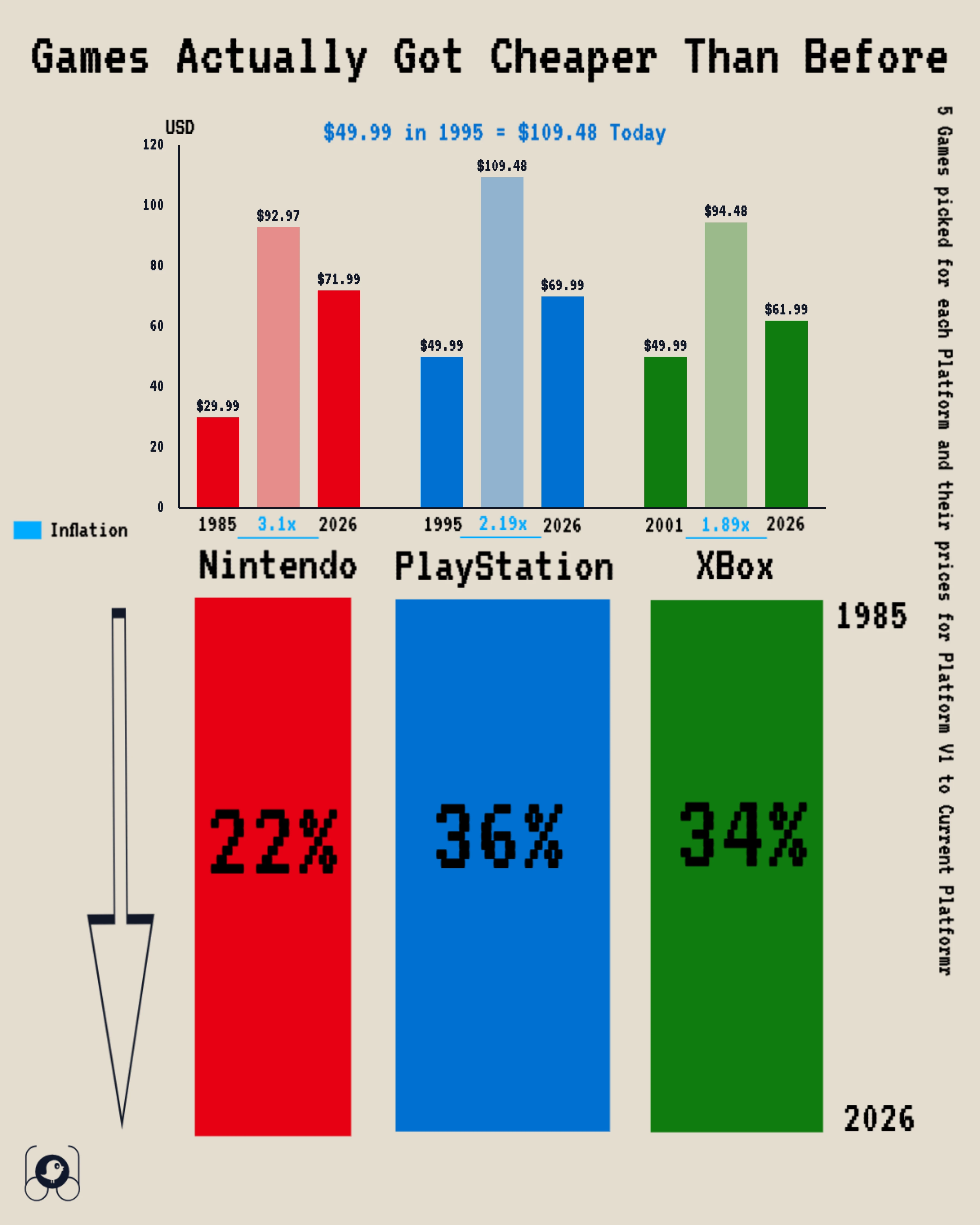
Five launch-window games and five current games from Nintendo, PlayStation and Xbox, with the older prices converted into 2026 dollars.
Nominally, prices climbed everywhere: $29.99 to $71.99 on Nintendo, $49.99 to $69.99 on PlayStation, $49.99 to $61.99 on Xbox.
In real money the direction reverses. Those launch games cost $92.97, $109.48 and $94.48 in today's dollars, putting every current basket 22% to 36% below what its own platform charged on day one.
! What Three Console Generations Actually Cost:
•
The Popular Belief:Games keep getting pricier, with $79.99 releases treated as the proof.
•
What the Sticker Prices Did:They rose on every platform: Nintendo up 140%, PlayStation up 40%, Xbox up 24% in nominal dollars since launch.
•
What Those Prices Do in 2026 Money:They fall. Nintendo lands 22% below 1985, Xbox 34% below 2001, PlayStation 36% below 1995.
? The Numbers That Flip the Answer:
•
Nintendo, 1985 to 2026:$29.99 nominal, $92.97 in 2026 dollars, against $71.99 today
•
PlayStation, 1995 to 2026:$49.99 nominal, $109.48 in 2026 dollars, against $69.99 today
•
Xbox, 2001 to 2026:$49.99 nominal, $94.48 in 2026 dollars, against $61.99 today
Sticker prices did rise, and on Nintendo they more than doubled. But the dollars they were paid in shrank faster. Measured in the same money, a 2026 game costs 22% to 36% less than the games that launched each of these three consoles, and the cheapest title on shelves today, at $49.99, matches the nominal price of a 1995 PlayStation disc.
Continue reading below for the full detailed article →
Overview
Prices Rose on Paper and Fell in Practice
A $79.99 price tag on a new Switch 2 release is the number that starts most arguments about games getting expensive, and next to the $29.99 an NES cartridge cost in 1985 it looks unanswerable. The problem is that the two figures are quoted in different money. Put them in the same units and the argument changes shape: measured in 2026 dollars, that 1985 cartridge was a $92.97 purchase, a 1995 PlayStation disc $109.48, a 2001 Xbox game $94.48, every one of them above what its own platform charges today. Sticker prices genuinely went up, by 140% on Nintendo alone. Real prices genuinely came down. What follows works through where each platform's current lineup sits, why 1995 turns out to be the most expensive moment in the comparison, and what a snapshot like this can and cannot settle.
Three Platforms, Three Real-Dollar Price Drops
Comparing a $29.99 NES cartridge to a $79.99 Switch 2 release only works if both numbers sit in the same money. Five launch-window games from each platform, measured against five games selling on that platform's storefront today, with the older set converted into 2026 dollars at its era's inflation multiplier: 3.1x for 1985, 2.19x for 1995, 1.89x for 2001. Once that conversion runs, all three platforms land in the same place, and it is not the place the myth predicts.
Nintendo · 22% Below Its 1985 Price
22%
Super Mario Bros., Duck Hunt, Excitebike, Kung Fu and Gyromite all carried the same $29.99 NES price in 1985, worth $92.97 once the era's 3.1x inflation multiplier is applied. The five Switch 2 titles in this dataset average $71.99, from Pokemon Pokopia at $59.99 up to Mario Kart World at $79.99, landing 22% below that 1985 figure.
PlayStation · 36% Below Its 1995 Price
36%
Ridge Racer, Warhawk, Battle Arena Toshinden, ESPN Extreme Games and NBA Jam Tournament Edition each launched at $49.99 alongside the PS1 in September 1995, or $109.48 in 2026 money, the highest real-dollar figure anywhere in this dataset. Every current PS5 title here sits at a flat $69.99, a 36% drop and the steepest of the three platforms.
Xbox · 34% Below Its 2001 Price
34%
Halo: Combat Evolved held $49.99 from the Xbox's November 2001 launch until late 2003, the same price as Dead or Alive 3, Project Gotham Racing, Oddworld and Fuzion Frenzy, or $94.48 today at a 1.89x multiplier. The five current Xbox Series games average $61.99, the cheapest current basket of the three, and 34% below 2001.
Nintendo, 1985 to 2026, by the Numbers
1985 Sticker Price · $29.99 Per Cartridge $29.99 What an NES game actually cost at the counter in 1985, the same price on Super Mario Bros., Duck Hunt, Excitebike, Kung Fu and Gyromite alike.
That Same Price in 2026 Money · $92.97 $92.97 Apply the 3.1x inflation multiplier between 1985 and 2026 and that $29.99 cartridge becomes a $92.97 purchase, above every real Nintendo price in this dataset, 1985 and 2026 alike.
What Switch 2 Games Cost Today · $71.99 $71.99 The five Switch 2 titles here average $71.99, from $59.99 for Pokemon Pokopia to $79.99 for Mario Kart World, or $20.98 under the inflation-adjusted 1985 price.
Origins
Why Old Sticker Prices Hide Their Real Cost
Three console launches, sixteen years apart, and the sticker price barely moved. A new NES cartridge cost $29.99 in 1985, the price on Super Mario Bros., Duck Hunt, Excitebike, Kung Fu and Gyromite alike. Ten years later Sony put Ridge Racer and four other launch titles on US shelves at $49.99 each when the PlayStation arrived on September 9, 1995. Six years after that, the Xbox launched in November 2001 with Halo: Combat Evolved, Dead or Alive 3 and three more at that same $49.99, a price Halo held until late 2003. Those numbers only look flat because each is counted in the money of its own decade. Converted into 2026 dollars they separate sharply, $92.97 for the NES cartridge, $109.48 for the PlayStation disc and $94.48 for the Xbox game, and the cheapest sticker price of the three turns out to belong to the era whose dollars were worth the most.
The Spread
Why 2026 Has No Single Game Price
Ask what a game costs in 2026 and this dataset refuses to give one answer. Across the fifteen current titles here, prices run from $49.99 for Age of Mythology: Retold Premium Edition up to $79.99 at the top of Nintendo's Switch 2 lineup, a $30 band on shelves in the same year. Averaged out, the three platforms land $10 apart, at $71.99, $69.99 and $61.99: close enough to look alike, far enough that the cheapest basket buys a game for ten dollars less than the dearest.
Nintendo · Two Titles at the $79.99 Ceiling
Nintendo carries both the highest average in the dataset, $71.99, and the widest internal range. Mario Kart World and Kirby and the Forgotten Land with Star-Crossed World both sit at $79.99, while Pokemon Pokopia holds at $59.99, a $20 spread inside a single platform's current slate. Nintendo is also the only one of the three splitting a price by format: Yoshi and the Mysterious Book lists at $69.99 physical and $59.99 digital, the first title under that new policy.
PlayStation · Five Games, One Price
PlayStation is the outlier for the opposite reason. Ghost of Yotei, Resident Evil Requiem, Marvel's Wolverine, 007 First Light and Crimson Desert all list at exactly $69.99, with no variation across the five. Where Nintendo spreads its lineup over three price points and Xbox over three more, Sony's current slate has a single number, which also makes it the only platform whose average is a real price rather than a blend.
Xbox · The Only $49.99 Left on the Shelf
Xbox runs the cheapest current basket at $61.99, and it gets there from the bottom. Age of Mythology: Retold Premium Edition at $49.99 is the lowest current price anywhere in the dataset, with PRAGMATA and Dying Light: The Beast at $59.99 behind it; only Borderlands 4 and Daemon X Machina: Titanic Scion reach $69.99. Xbox never touches $79.99 at all, which is why its average lands ten dollars under Nintendo's.
Two Readings
Why the Same Data Gives Two Opposite Answers
Run the same thirty rows two ways and they answer the question in opposite directions. Count in the dollars each price was actually paid in and every platform gets more expensive: Nintendo's average rises from $29.99 to $71.99, a 140% climb; PlayStation moves $49.99 to $69.99, up 40%; Xbox goes $49.99 to $61.99, up 24%. Count in 2026 dollars and all three fall, by 22% on Nintendo, 36% on PlayStation and 34% on Xbox. Neither reading is wrong. They are measuring different things.
The size of the disagreement is not random either. It tracks how far back the launch sits. Nintendo's 1985 prices carry a 3.1x multiplier and produce the widest split in the dataset: up 140% on paper, down 22% in real terms, a gap of more than 160 percentage points between the two answers. PlayStation's 1995 prices carry 2.19x and split by about 76 points. Xbox's 2001 prices carry 1.89x and split by roughly 58. The older the console, the more the sticker price misleads.
Which is why the choice of starting year decides the argument before a single price is compared. Begin at 2001 and games look 24% dearer; begin at 1985 and they look 140% dearer, and that is the version that gets quoted. Begin anywhere at all and adjust for inflation, and the direction flips regardless of which console is picked. Three platforms launched sixteen years apart at three different sticker prices, and they still land within ten dollars of each other today, at $71.99, $69.99 and $61.99.
Super Mario Bros. sold at the standard $29.99 NES price in 1985. Multiply by 3.1 and that is $92.97 in 2026 money. Mario Kart World, the priciest game Nintendo lists in this dataset and the title most often held up as evidence of runaway pricing, costs $79.99. Nintendo's most expensive current release is nearly thirteen dollars cheaper, in the same money, than its most famous launch cartridge.
Ridge Racer · $109.48 vs Ghost of Yotei's $69.99
Ridge Racer arrived with the PlayStation in the US on September 9, 1995 at $49.99, which a 2.19x multiplier turns into $109.48, the highest real price in all thirty rows. Ghost of Yotei sits on the PS5 storefront today at $69.99, the same as every other current PlayStation title here. The gap between them, $39.49, is more than half the price of the modern game.
Halo: Combat Evolved · $94.48 vs $69.99 Today
Halo: Combat Evolved launched with the Xbox in November 2001 at $49.99 and held that price until late 2003, an unusually long run at full retail. In 2026 dollars it is a $94.48 game. Borderlands 4 and Daemon X Machina: Titanic Scion, the two dearest Xbox titles on the current list, are $69.99, and Age of Mythology: Retold Premium Edition at $49.99 matches Halo's original sticker exactly, twenty-five years later.
None of the three modern games is a like-for-like successor, and holding a 1995 arcade racer against a 2026 open-world release stretches the point. What the pairs do show is the size of the correction. On all three platforms, the price a buyer handed over on launch day, restated in today's money, sits above anything those platforms charge now.
The Honest Counter-Case
What This Comparison Cannot Settle
Everything here is a sticker price. The thirty rows cover what a game costs to buy and nothing else: no season pass, no in-game currency, no online subscription, no expansion sold two years after release. Those categories barely existed when the NES launched in 1985 and are routine in 2026, so a comparison built purely on shelf prices is measuring the narrowest possible definition of what a game costs. A real-terms fall in the sticker price is perfectly compatible with a rise in total spend.
The baskets are also small, and not strictly like for like. Five games represent each platform in each era, drawn from launch-window titles on one side and current storefront listings on the other, which means the 2026 figures are today's prices rather than each game's launch price. The 1985 column is an era-standard rate too, the going price for a new NES release rather than a receipt from one purchase, so Nintendo's 3.1x multiplier is applied to a representative figure, not an exact one.
And a single listed price is increasingly not the only price. Yoshi and the Mysterious Book carries $69.99 physically and $59.99 digitally, the first Nintendo title split that way, which means the platform average of $71.99 shifts depending on which format gets counted. Regional pricing, storefront discounts, bundles and second-hand copies sit outside these rows entirely, and the conversion itself is a US consumer-price adjustment, so the result holds for a US buyer and travels less well anywhere else.
The Full Data Table
Thirty Games, Three Platforms, 1985 to 2026
Five launch-window games and five current games for each platform, with the nominal price, the inflation multiplier applied to it, and the resulting 2026 value.
Nintendo
1985
Launch (NES)
Super Mario Bros.
1985
29.99
3.1
92.97
Standard NES new-release price per era (retroonly.com); NES launched as Famicom 1983 Japan, 1985 US
Nintendo
1985
Launch (NES)
Duck Hunt
1985
29.99
3.1
92.97
US launch bundle title
Nintendo
1985
Launch (NES)
Excitebike
1985
29.99
3.1
92.97
Early NES title
Nintendo
1985
Launch (NES)
Kung Fu
1985
29.99
3.1
92.97
Early NES title
Nintendo
1985
Launch (NES)
Gyromite
1985
29.99
3.1
92.97
R.O.B.-compatible launch title
Nintendo
1985
Current (Switch 2)
Mario Kart World
2026
79.99
1
79.99
Confirmed launch price, standalone
Nintendo
1985
Current (Switch 2)
Donkey Kong Bananza
2026
69.99
1
69.99
Confirmed launch price
Nintendo
1985
Current (Switch 2)
Pokemon Pokopia
2026
59.99
1
59.99
Confirmed launch price
Nintendo
1985
Current (Switch 2)
Kirby and the Forgotten Land + Star-Crossed World
2026
79.99
1
79.99
Confirmed current price
Nintendo
1985
Current (Switch 2)
Yoshi and the Mysterious Book (physical)
2026
69.99
1
69.99
First title under Nintendo's new physical/digital split pricing; digital = $59.99
PlayStation
1995
Launch (PS1)
Ridge Racer
1995
49.99
2.19
109.48
Flagship US launch title (Sept 9, 1995)
PlayStation
1995
Launch (PS1)
Battle Arena Toshinden
1995
49.99
2.19
109.48
US launch title
PlayStation
1995
Launch (PS1)
Warhawk
1995
49.99
2.19
109.48
US launch title
PlayStation
1995
Launch (PS1)
ESPN Extreme Games
1995
49.99
2.19
109.48
US launch title
PlayStation
1995
Launch (PS1)
NBA Jam Tournament Edition
1995
49.99
2.19
109.48
US launch title
PlayStation
1995
Current (PS5)
Ghost of Yotei
2026
69.99
1
69.99
Confirmed current PS Store price
PlayStation
1995
Current (PS5)
Resident Evil Requiem
2026
69.99
1
69.99
Confirmed current PS Store price
PlayStation
1995
Current (PS5)
Marvel's Wolverine
2026
69.99
1
69.99
Confirmed current PS Store price
PlayStation
1995
Current (PS5)
007 First Light
2026
69.99
1
69.99
Confirmed current PS Store price
PlayStation
1995
Current (PS5)
Crimson Desert
2026
69.99
1
69.99
Confirmed current PS Store price
Showing 1-20 of 30
Page 1 of 2
Inflation multipliers convert each launch-era price into 2026 US dollars; rows dated 2026 carry a multiplier of 1. Current prices are storefront listings at the time of publication, not launch prices.
Conclusion
The Answer Depends on Which Dollar You Count
Both sides of the argument are right, which is why it never ends. In the money buyers actually handed over, games did get more expensive on all three platforms: Nintendo by 140%, PlayStation by 40%, Xbox by 24%. Anyone who remembers paying $29.99 for an NES cartridge and now sees $79.99 on a Switch 2 box is not misremembering. The nominal record backs them completely.
Adjust for what those dollars were worth and the finding inverts. A launch-day NES game cost $92.97 in 2026 terms, a PS1 game $109.48, an Xbox game $94.48. Against current averages of $71.99, $69.99 and $61.99, every platform is charging 22% to 36% less in real money than it did on day one, and the cheapest game on shelves right now, at $49.99, is the same number a PlayStation disc carried in 1995.
So the honest verdict is a split one. Games have not become more expensive to buy; measured properly they have quietly become cheaper, and the $79.99 headline is a smaller number than it looks. What this comparison does not measure is everything sold after checkout, which is where the feeling of rising cost most likely lives. On the sticker price alone, the thing the argument is usually about, the received wisdom does not survive the inflation math.
The prices behind this story were collected from the platform holders' own storefronts and press material, including PlayStation's product page for Ghost of Yotei and Microsoft's April 2002 announcement covering Halo: Combat Evolved's original Xbox run. The inflation multipliers that convert each launch-era price into 2026 dollars come from Gameflation, and full credit for that calculation goes to its authors.
FactsFigs reviews, cleans, and cross-checks every source dataset before shaping it into a data story. Each visualization is created and designed in FactsFigs Design Studio, an internal tool developed and owned by FactsFigs, and is the original work of a FactsFigs author, not an AI-generated copy of any existing graphic. Individual assets within a visual may or may not be produced with AI tools, but the design of the visual itself is solely FactsFigs' own.
Figures are estimates at the time of publication, provided for information only, nothing here is financial advice or a guarantee of accuracy.
Last verified: 07 Aug 2026
The charts in this article were built with our own publishing system. See what it does →