The myth, the eight-generation price record, and what's still unconfirmed
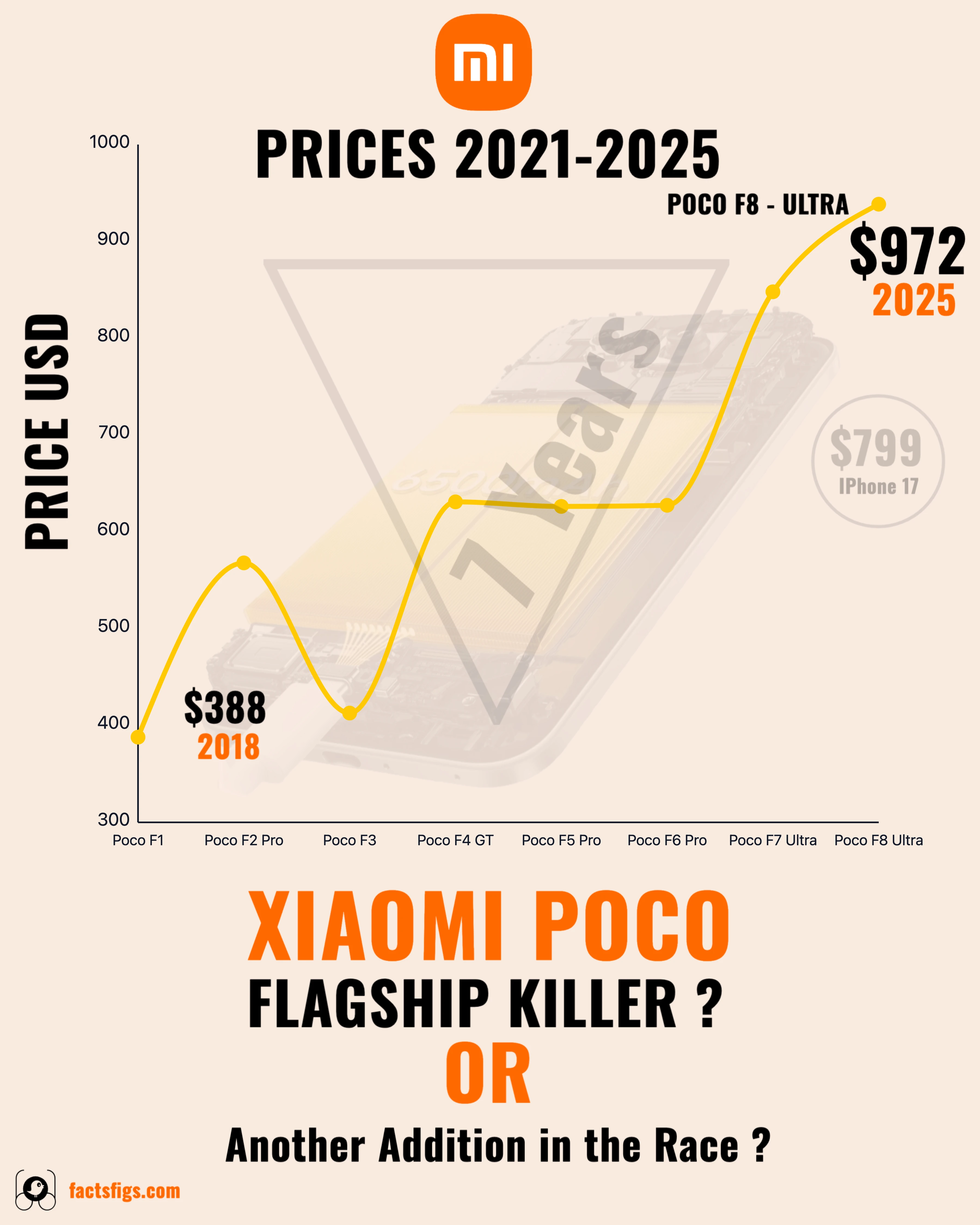
Poco's identity was built on flagship-tier chips at budget prices, starting with the $388 Poco F1 in 2018.
Eight generations later, the flagship-chip Poco F8 Ultra launched at $938 in November 2025 — up 142% in nominal dollars, and still up roughly 97% once Eurozone inflation is stripped out.
The unreleased Poco F9 Ultra is rumored, unconfirmed, at 'at least €999' — roughly $1,161 at 2026 exchange rates — a figure GSMArena itself calls an educated guess rather than a leak.
! What the Eight-Generation Record Actually Shows:
•
The Popular Belief:Poco's whole brand promise is 'flagship killer': the specs of a premium phone at a fraction of the price, the reputation the F1 built in 2018.
•
What Nominal Prices Did:Every generation carrying a true flagship-tier chip has cost more than the last, from $388 for the F1 in 2018 to $938 for the F8 Ultra in November 2025 — a 142% climb.
•
What Survives Inflation Adjustment:Converted into 2026 dollars, the F8 Ultra still costs roughly 97% more than the F1 did in its own time — a real increase, not just sticker-price drift, and unchanged whether the comparison is run in euros or dollars.
? The Numbers Behind the Question:
•
Poco F1, Aug 2018:$388 nominal — $492 in 2026 dollars
•
Poco F8 Ultra, Nov 2025:$938 nominal — $971 in 2026 dollars
•
Nominal CAGR, 2018–2025:+13.5% per year, compounded across seven generations
Poco's original pitch, a genuine flagship chip for a fraction of what Samsung or OnePlus charge, hasn't disappeared, but the fraction has grown. The 2018 F1 undercut its era's flagship phones by hundreds of dollars; the 2025 F8 Ultra sits much closer to what mainstream flagships cost outright. The price part of the 'killer' pitch has moved a long way from where it started.
Continue reading below for the full detailed article →
Overview
Why Poco's Reputation Rests on a Single Word: Killer
Poco's whole reputation rests on three words: flagship killer. When Xiaomi spun off the sub-brand in August 2018, the debut Poco F1 carried a genuine flagship chip, Qualcomm's Snapdragon 845, the same silicon inside Samsung's and OnePlus's top-tier phones that year, at a European launch price of €329 — worth $388 at that year's exchange rate. That combination, top-tier processor at a budget sticker price, is the entire premise the brand has built on for eight generations since. This story tracks the one Poco F-series device each year that actually carries that generation's true flagship-tier Snapdragon, at its base EU configuration and full post-early-bird launch MSRP, from the 2018 F1 through the 2025 F8 Ultra, with every price converted from its original EU euros into US dollars. Measured in the same money, adjusted for eight years of Eurozone inflation, the 'killer' part of the pitch has gotten a lot more expensive to buy. This is EU pricing only; Poco's largest market, India, and its intermittent US availability run on separate, non-comparable price structures and aren't part of this comparison.
The Three Numbers Behind Poco's Price Climb
Track only the Poco F-series device that actually carries each generation's true flagship-tier Snapdragon, at its base EU configuration, and the eight-generation record tells one consistent story: nominal prices climbed, the increase survives being converted into today's euros, and the pace of that climb has held remarkably steady since 2018. These are the three numbers that decide whether 'flagship killer' is still an honest description of the price.
142% Nominal Increase Since 2018
142%
The Poco F1 launched in Europe at €329 in August 2018 — $388 at that year's exchange rate — with a genuine flagship-tier Snapdragon 845 inside. The Poco F8 Ultra, the current holder of that same 'true flagship chip' title, launched at €830 in November 2025, worth $938 at 2025 rates. That's a $550 increase across seven generations, a 142% climb once both prices are measured in the dollars they were actually worth at the time.
97% Real Increase, Even After Inflation
97%
Convert both prices into 2026 dollars, using Eurozone HICP plus the 2026 EUR/USD rate, and the picture barely softens. The F1's $388 becomes $492 once eight years of inflation are stripped out; the F8 Ultra's $938 becomes $971. That's still a 97% real increase, the same 97% the euro-only comparison produces, since applying one current exchange rate to both figures scales them equally without changing the ratio between them.
13.5% Nominal CAGR, 2018–2025
13.5%/yr
Spread the 142% nominal increase evenly across the seven years between the F1 and the F8 Ultra and it works out to a compound annual growth rate of about 13.5%. That's a steady, sustained climb rather than a single big jump, the flagship-chip Poco has gotten measurably more expensive in nearly every generation, not just once.
Poco's Flagship-Chip Pricing, F1 to F8 Ultra
$388 · Poco F1's Launch Price in 2018 $388 The Snapdragon 845-powered F1 launched in Europe at €329 — worth $388 at 2018 exchange rates — the price that built Poco's flagship-killer reputation in the first place.
$938 · Poco F8 Ultra's Launch Price in 2025 $938 The Snapdragon 8 Elite Gen 5-powered F8 Ultra launched at €830 in November 2025 — $938 at that year's exchange rate — the most expensive flagship-chip Poco F-series phone in the dataset.
$1,161 · Rumored Floor for the Unreleased Poco F9 Ultra $1,161 A single unverified leak, which GSMArena itself calls more of an educated guess than a leak, puts the next-generation Poco F9 Ultra at 'at least €999' — roughly $1,161 at the 2026 EUR/USD rate — unconfirmed, and not part of the chart above.
The Original Pitch
How the Poco F1 Set a $388 Baseline in 2018
Xiaomi spun off Pocophone as its own line in August 2018 specifically to chase a flagship-at-a-discount position, and the F1 delivered on the pitch immediately: it launched in Europe at €329 — $388 at 2018 exchange rates — with a Snapdragon 845, the same chip Samsung's Galaxy S9 and OnePlus's 6 carried that year at two to three times the price, paired with a base 6GB/64GB configuration. GSMArena and Android Authority both covered the launch as a genuine value shock, and the 'flagship killer' label stuck to the phone almost immediately. This story tracks the same thing every year since: the single Poco F-series device that carries that generation's true flagship-tier Snapdragon, at its base EU configuration and official post-early-bird launch price, deliberately skipping cheaper 'vanilla' F-series models in years when a Pro, GT or Ultra variant carried the real flagship silicon instead. Everything that follows is measured against this baseline — $388 nominal in 2018 is worth $492 once eight years of Eurozone inflation and the 2026 dollar exchange rate are folded in, and that $492 figure, not the raw $388, is the number every later generation actually has to beat to count as a real increase.
The Climb
Why Every Generation After the F1 Cost More
The Poco F2 Pro, a rebadged Redmi K30 Pro carrying the Snapdragon 865, launched in May 2020 at €499 — $568 at that year's exchange rate — already 46% above the F1's sticker price. The 2021 Poco F3 is the weakest link in this methodology: Qualcomm's actual 2021 flagship chip was the Snapdragon 888, and Poco never shipped an SD888 F-series phone, so the F3's Snapdragon 870, essentially an overclocked SD865+, stands in as the closest available proxy, launching at €349 ($413), a genuine gap in the 'true flagship chip per generation' rule rather than a filled-in guess. From there the true flagship-chip line resumes: the Poco F4 GT brought the Snapdragon 8 Gen 1 in April 2022 at €599 ($631), and the Poco F5 Pro followed with the Snapdragon 8+ Gen 1 in May 2023 at €579 ($626), the first year-over-year nominal price drop in the series, while the Poco F6 Pro held nearly flat at €579.90 in May 2024 ($627) with the Snapdragon 8 Gen 2, two years where Poco's flagship-chip pricing barely moved. Then 2025 broke the pattern twice in eight months: the Poco F7 Ultra, the first Poco phone to carry the 'Ultra' name, launched in March at €749.99 — $848 at that year's rate — with the Snapdragon 8 Elite, a $220 jump on the F6 Pro, and the Poco F8 Ultra followed in November at €830 ($938) with the Snapdragon 8 Elite Gen 5, the highest confirmed launch price the flagship-chip F-series has ever carried.
The Real-Terms Check
Why Real Prices Still Nearly Doubled
Converting each nominal price into 2026 dollars is a two-step process, not a single blended rate: each generation's EUR price is first adjusted for Eurozone inflation into 2026 euros using ECB and Eurostat HICP figures, then converted to dollars at the 2026 EUR/USD exchange rate. The 2018, 2020, 2024 and 2025 inflation multipliers are directly published; the 2021 through 2023 multipliers are bridged using EU-27, rather than Eurozone-20, annual HICP averages, because a single-source Eurozone-specific cumulative figure for those years wasn't available. The two series are historically close but not identical, worth flagging rather than presenting as equally precise.
The real-terms line isn't a straight climb, either. Converted to 2026 dollars, the flagship-chip Poco actually got cheaper for two straight years: from the F4 GT's $780 in 2022 down to the F5 Pro's $708 in 2023 and the F6 Pro's $695.30 in 2024, roughly an 11% real-terms decline across those middle generations. Then the 2025 pair reversed it hard, the F7 Ultra's $877 and the F8 Ultra's $971 mark a 40% real-terms jump in under two years, more than undoing the earlier dip.
Net it all out and the endpoints still tell the headline story: the F1's $388 in 2018 money and the F8 Ultra's $938 in 2025 money work out to $492 and $971 once both sit in 2026 dollars, a 97% real increase — the same real-terms figure the euro-only comparison produces, since scaling every 2026-euro price by one current exchange rate doesn't change the ratio between them. The middle of the series wobbled; where it landed didn't.
The Poco F9 Ultra has not launched, and Xiaomi/POCO has not confirmed a price for it. What exists instead is a single German-source leak, reported by GSMArena on August 13, 2026, pegging the 12/256GB configuration at 'at least €999' — roughly $1,161 at the 2026 EUR/USD rate. GSMArena's own coverage describes that figure as more of an educated guess than an actual leak, language worth repeating rather than smoothing over into a confident number.
The device itself is real: per 91mobiles, it had cleared IMEI and regulatory certification, including Singapore's IMDA and Indonesia's TKDN, as of late July 2026, confirming it's nearing launch even though pricing remains unset. It's expected to carry an unconfirmed Snapdragon 8 Elite Gen 6.
If the €999 figure holds, converted at 2026 rates it would land around $1,161, the first Poco F-series phone ever to cross the four-figure dollar mark, and the sharpest single-generation jump in this entire eight-generation record, roughly 24% above the F8 Ultra's confirmed $938 in under a year. That's exactly why it's treated as a forecast rather than a data point here, and left out of the chart above.
The Full Data Table
All Eight Confirmed Poco F-Series Generations, 2018–2025
Every row is the one Poco F-series device that year carrying the true flagship-tier Snapdragon, at its base EU configuration and official post-early-bird launch price. The ninth row, the unreleased Poco F9 Ultra, is rumor only and excluded from the chart above.
1
Poco F1
Aug 2018
Snapdragon 845
$388
$492
Confirmed
First Poco F-series phone; EU launch at Xiaomi/POCOphone's Paris event (€329 nominal)
2
Poco F2 Pro
May 2020
Snapdragon 865
$568
$730
Confirmed
Rebadged Redmi K30 Pro (€499 nominal)
3
Poco F3
Mar 2021
Snapdragon 870
$413
$496
Confirmed
No true 2021 flagship chip (Snapdragon 888) ever shipped in the F-series; SD870 is the closest available data point (€349 nominal)
4
Poco F4 GT
Apr 2022
Snapdragon 8 Gen 1
$631
$780
Confirmed
Standard post-early-bird EU price (€599 nominal)
5
Poco F5 Pro
May 2023
Snapdragon 8+ Gen 1
$626
$708
Confirmed
Base 8/256GB configuration (€579 nominal)
6
Poco F6 Pro
May 2024
Snapdragon 8 Gen 2
$627
$695
Confirmed
Base 12/256GB configuration (€579.90 nominal)
7
Poco F7 Ultra
Mar 2025
Snapdragon 8 Elite
$848
$877
Confirmed
First Poco phone to carry the 'Ultra' name (€749.99 nominal)
8
Poco F8 Ultra
Nov 2025
Snapdragon 8 Elite Gen 5
$938
$971
Confirmed
Highest confirmed launch price in the series (€830 nominal)
9
Poco F9 Ultra
Not yet launched
Snapdragon 8 Elite Gen 6 (unconfirmed)
—
—
Rumored/Unconfirmed
GSMArena (13 Aug 2026) reports an unverified leak pegging price 'at least €999' (roughly $1,161 at the 2026 EUR/USD rate), calling it an educated guess rather than a leak; device cleared IMEI/regulatory certification in late July 2026 but has no confirmed price
Real prices convert nominal EU launch prices to 2026 US dollars in two steps: Eurozone HICP adjustment to 2026 euros, then conversion to dollars at the 2026 EUR/USD exchange rate; 2018, 2020, 2024 and 2025 inflation multipliers are directly sourced, 2021–2023 are bridged using EU-27 HICP annual averages. The Poco F9 Ultra row is rumor only.
Conclusion
The Verdict: The Flagship Killer Now Costs Flagship Money
In 2018, the Poco F1 lived up to its nickname without qualification: a flagship chip, at a price hundreds of dollars below what Samsung and OnePlus were charging for the same silicon. Seven generations later, the F8 Ultra's $938 sits in territory much closer to mainstream flagship pricing than to the budget-disruptor role the F1 played, and that's true whether the comparison uses nominal dollars, up 142%, or 2026 dollars, up 97%. That doesn't mean the value proposition is gone — Poco's flagship-chip phones still likely undercut equivalent Samsung or Apple flagships on a spec-for-spec basis, and this dataset doesn't test that comparison directly, only Poco's own price against its own past self. What it does establish is that the absolute floor for 'the flagship-chip Poco' has risen substantially, and the honest answer to whether Poco is 'still' a flagship killer on price terms is no, not by the F1's original standard. The scope here is EU pricing only, not India, Poco's largest market, or the US, where availability has been intermittent; both run on separate price structures that could tell a different story. And the next test arrives soon: if the Poco F9 Ultra's rumored 'at least €999' (roughly $1,161) holds, it would be the first Poco F-series phone to break four figures in either currency, extending a trend this data already shows clearly.
The data behind this story comes from per-generation launch coverage and official pricing pages for each Poco F-series device, including GSMArena, Notebookcheck, Android Authority, Liliputing and Neowin at the time of each launch, cross-checked against Xiaomi/POCO's own European pricing. All prices originate as official EU euro launch figures and are converted to US dollars using annual average EUR/USD exchange rates from exchange-rates.org and the Federal Reserve's FRED database (series AEXUSEU), applied per generation-year, with a 2026 year-to-date average rate used to convert the inflation-adjusted figures. Inflation adjustments to 2026 euros use Eurozone HICP figures from the ECB and Eurostat, sourced via officialdata.org for 2018, 2020, 2024 and 2025, and bridged for 2021–2023 using EU-27 HICP annual averages from Eurostat where a directly published Eurozone-specific figure wasn't available. The dataset is manually compiled from these public sources, and full credit for the underlying pricing, exchange-rate and inflation records goes to the outlets, financial data providers and statistical agencies that published them.
FactsFigs reviews, cleans, and cross-checks every source dataset before shaping it into a data story. Each visualization is created and designed in FactsFigs Design Studio — an internal tool developed and owned by FactsFigs — and is the original work of a FactsFigs author, not an AI-generated copy of any existing graphic. Individual assets within a visual may or may not be produced with AI tools, but the design of the visual itself is solely FactsFigs' own.
Figures are estimates at the time of publication, provided for information only — nothing here is financial advice or a guarantee of accuracy.
Last verified: 16 Aug 2026
The charts in this article were built with our own publishing system. See what it does →