About 128 years at today's output — and that figure has been shrinking
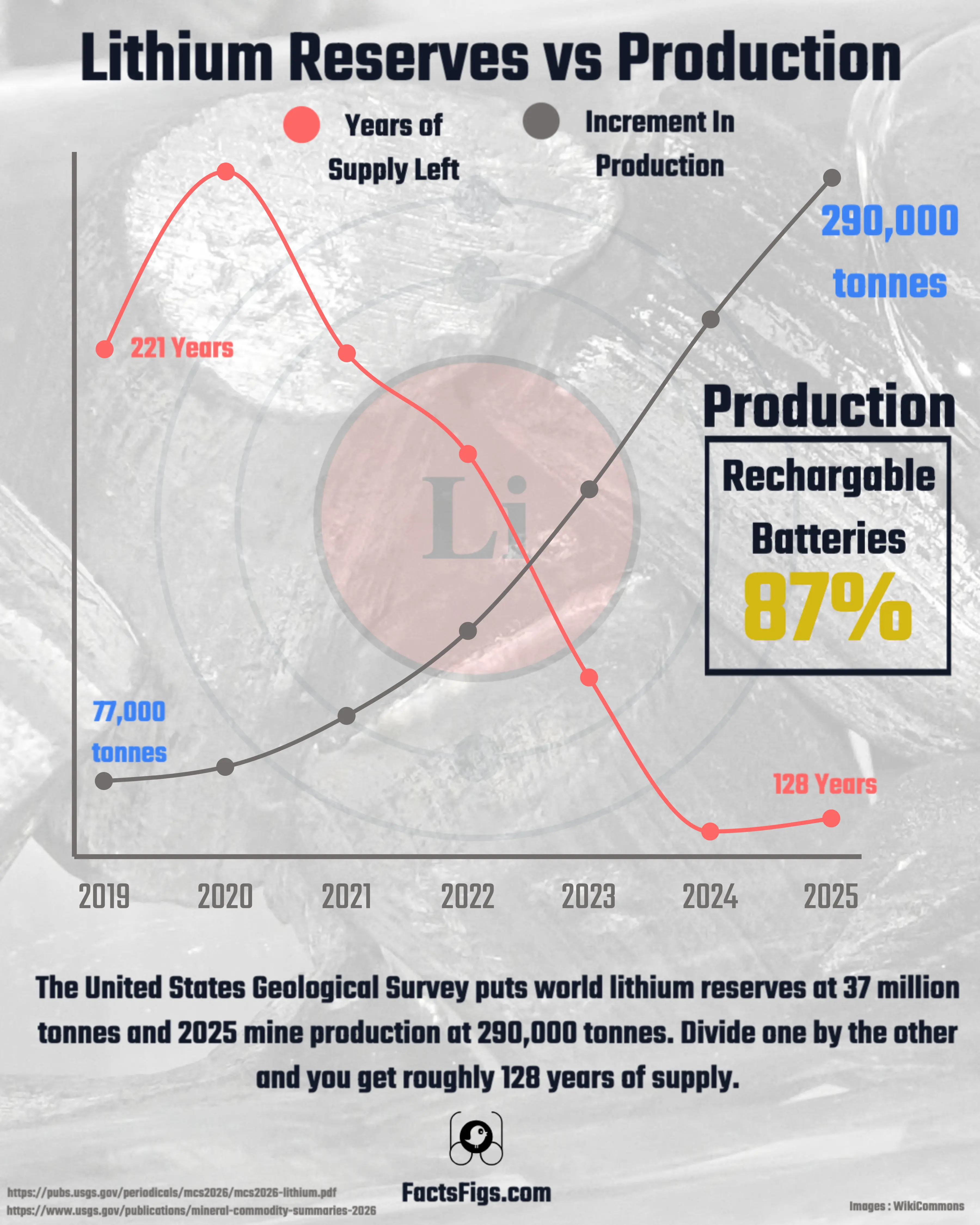
The United States Geological Survey puts world lithium reserves at 37 million tonnes and 2025 mine production at 290,000 tonnes. Divide one by the other and you get roughly 128 years of supply.
That number is far lower than it was in 2019, when the same calculation returned 221 years. What makes it strange is that the world has not been running short of lithium. Reserves more than doubled over those six years, from 17 million tonnes to 37 million.
Production simply grew faster. Output rose 277% while reserves rose 118%, so the clock moved closer even as the pile got bigger.
! What the Numbers Actually Say:
•
Reserves More Than Doubled:World lithium reserves rose from 17 million tonnes in the 2020 USGS edition to 37 million tonnes in the 2026 edition, a gain of 118% in six years. Identified resources, a looser measure, rose from 80 million tonnes to 150 million over the same span.
•
Production Grew Faster Still:Annual mine production went from 77,000 tonnes to 290,000 tonnes across the same editions, a rise of 277%. The single year from 2024 to 2025 accounted for a 31% jump, as capacity expansions landed in Argentina, Brazil, Canada, Chile, China, Mali and Zimbabwe.
•
So the Clock Moved Closer:Years of supply, calculated as reserves divided by that year's production, fell from 221 to 128 — a drop of 42%. Finding more lithium did not buy time, because consumption absorbed the new discoveries and then some.
? The Figures Behind the Answer:
•
Reserves, 2026 edition:37,000,000 tonnes of lithium content
•
Identified resources:150,000,000 tonnes — roughly four times reserves
•
Production, 2025:290,000 tonnes, up 31% on 2024
•
Consumption, 2025:263,000 tonnes, of which 88% went into batteries
The honest answer is neither that the world is running out of lithium nor that supply is limitless. We are finding it faster than ever and using it faster still, and the gap between those two rates is what the years-of-supply figure actually measures.
Continue reading below for the full detailed article →
Overview
Why the Answer Shrinks as We Find More
Ask how much lithium is left and you will get numbers ranging from a couple of decades to several centuries, which is a sign that the question is worse than the answers. A reserve is not a fixed physical quantity waiting to be counted. The USGS defines it as the portion of known deposits that can be extracted economically at current prices with current technology, which means the figure moves whenever prices move, exploration budgets change, or a company finishes drilling. Over seven editions the world reserve figure has more than doubled, and over the same seven editions the number of years those reserves represent has fallen by nearly half. Both things are true at once, and the reason they are both true is the interesting part.
The Three Numbers That Answer the Question
One figure gives the headline answer, and the other two explain why that answer keeps changing. Together they describe a world that is discovering lithium at record pace while consuming it at a faster one, which is why the supply horizon has been shortening through six consecutive years of rising reserve estimates.
128 Years of Reserves at 2025 Output
128 years
Dividing 37 million tonnes of reserves by 290,000 tonnes of 2025 mine production gives 127.6 years. Measured against consumption rather than production, which ran lower at 263,000 tonnes, the figure stretches to 141 years. Both assume demand never grows again, which is the assumption doing most of the work.
118% More Lithium on the Books Since 2019
+118%
World reserves climbed from 17 million tonnes to 37 million between the 2020 and 2026 USGS editions. The 2026 edition alone revised reserve figures upward for Argentina, Australia, Brazil, Canada, Chile, China, the United States and Zimbabwe, on the strength of company and government reports rather than any single discovery.
42% Shorter Supply Horizon Than in 2019
-42%
Years of supply fell from 221 to 128 across those same seven editions. Production rose 277% while reserves rose 118%, so each newly booked tonne was outpaced by the tonnes being dug up. The horizon shortened in five of the six year-on-year steps, pausing only between the 2025 and 2026 editions.
The Supply Horizon by the Numbers
Reserves booked 118 % growth37 million tonnes on the books in 2026, up from 17 million in 2020.
Lithium mined 277 % growth290,000 tonnes in 2025, against 77,000 tonnes in 2019.
Years of supply 42 % shorter128 years left at 2025 output, down from 221 six years earlier.
What a Reserve Actually Is
Reserves Measure Economics, Not Geology
The USGS draws a hard line between two quantities that get used interchangeably in headlines. Reserves are the part of a known deposit that can be mined economically at today's prices with today's technology. Identified resources are everything geologists have located, economic or not. In the 2026 edition those two figures are 37 million tonnes and 150 million tonnes respectively — the second is more than four times the first, and neither describes how much lithium exists in the Earth's crust.
This is why a reserve figure can rise without anyone finding a new deposit. When lithium carbonate prices ran from roughly $11,700 per tonne in 2021 to $63,700 in 2022, deposits that were uneconomic became economic, and exploration budgets that had been idle got spent. The 2026 edition credits its upward revisions for Argentina, Australia, Brazil, Canada, Chile, China, the United States and Zimbabwe to company and government reports, not to a single discovery.
Read that way, the reserve number is better understood as a measure of how hard the industry has looked than of what is physically there. Identified resources tell a similar story: 80 million tonnes in the 2020 edition, 150 million in the 2026 one, an 88% increase over a period in which no new continent appeared.
The Discovery Half
How the World Found 20 Million More Tonnes
Between the 2020 and 2026 editions of the Mineral Commodity Summaries, world lithium reserves went from 17 million tonnes to 37 million. That is an additional 20 million tonnes booked in six years — more than the entire world reserve figure stood at when the period began.
The increase did not arrive evenly. Reserves moved 17, 21, 22, 26, 28, 30 and then 37 million tonnes across the seven editions, with the largest single jump landing in the most recent one. Chile now carries 9.2 million tonnes and Australia 8.4 million, followed by China at 4.6 million and Argentina and the United States at 4.4 million each. A further 2.4 million tonnes sits under a grouped "other countries" line the USGS does not break out.
Exploration continues well beyond the countries currently producing. The 2026 edition lists brine projects in development or exploration across Argentina, Bolivia, Canada, Chile, China and the United States, and mineral-based projects in more than thirty countries including Austria, Ethiopia, Finland, Ghana, Serbia and the United Kingdom. Bolivia alone holds 23 million tonnes of identified resources without appearing in the production table at all.
The Consumption Half
Why the Clock Moved Closer Anyway
Mine production over the same seven editions went from 77,000 tonnes to 290,000 — a rise of 277%, against the 118% rise in reserves. That difference is the whole story. Each year the industry booked more lithium than it had the year before, and each year it dug up more than the booking had added.
The most recent step was the sharpest. Output rose 31% in a single year, from 222,000 tonnes in 2024 to 290,000 in 2025, as capacity expansions completed in Argentina, Brazil, Canada, Chile, China, Mali, the United States and Zimbabwe. Consumption followed at 263,000 tonnes, up roughly 20% on the 220,000 tonnes consumed in 2024.
What that lithium is for has narrowed sharply. Batteries now account for 88% of global end use, with ceramics and glass at 4%, lubricating greases at 2%, and everything else — air treatment, casting powders, medical uses — sharing the remaining 6%. Lithium demand is, to a first approximation, battery demand, which is why electric vehicle and grid storage growth transmits almost directly into the depletion arithmetic.
The Assumption Doing the Work
The Growth Rate Changes the Answer Completely
Every "years of supply" figure, including the 128 at the top of this piece, divides a stock by a single year's demand and then assumes that demand never changes again. Consumption grew about 20% between 2024 and 2025. Hold that rate and the arithmetic collapses: 37 million tonnes lasts roughly 18 years, not 128.
Softer assumptions land in between. At 5% annual growth the reserves run about 43 years; at 10%, about 28. Even identified resources, four times larger than reserves, only stretch to about 26 years under sustained 20% growth, because compounding demand consumes any fixed stock quickly once the rate is high enough.
None of these are forecasts, and no source consulted for this piece projects any of them. They are arithmetic, run to show how much of the headline answer is carried by an assumption rather than by geology. It is also why the range of numbers in public circulation is so wide: two people can use identical USGS figures, pick different growth rates, and honestly report answers a century apart.
The 37 million tonnes is not spread thinly. Five countries account for 85% of it, and the four smallest entries in the table — Brazil, Zimbabwe, Mali and Portugal — hold 4% between them. A further 2.4 million tonnes, more than Canada's entire holding, sits under a grouped "other countries" line the USGS does not break out at all.
That concentration matters for the supply horizon because reserves are booked country by country. When the 2026 edition added seven million tonnes in a single step, the revisions came from eight named countries reporting new company and government figures — not from a general improvement in how much lithium the world knows about. A supply estimate this concentrated moves when a handful of national reports move.
One gap in the count is worth stating plainly. American mine production is not published — the USGS suppresses it to protect company proprietary data — so every world output total in this piece, and therefore every years-of-supply figure resting on one, is calculated without it. The true horizon is a little shorter than the arithmetic above, by a margin nobody outside the companies concerned can put a number to.
And the reserve figure is not the whole endowment. Identified resources run to 150 million tonnes, four times reserves, with Bolivia alone holding 23 million of them and appearing nowhere in either column here. Whether those ever become reserves is a question about prices and technology, not about geology.
Reserves and mine production in tonnes of lithium content, from the 2026 Mineral Commodity Summaries. United States production is withheld by the USGS to protect company proprietary data, so the world production totals exclude it. Australia's reserve figure is reported as 8,400,000 tonnes; the same page notes that Joint Ore Reserves Committee-compliant reserves were 5,100,000 tonnes.
Country reserve figures sum slightly below the rounded world total of 37,000,000 tonnes because the USGS rounds each line independently.
The Verdict
So How Much Lithium Is Actually Left?
About 128 years of reserves at the rate the world mined lithium in 2025, or roughly 570 years if you count identified resources rather than reserves. Those are the defensible numbers, and both come from dividing a USGS figure by a USGS figure.
Neither is a countdown. The 128 assumes demand freezes at 2025 levels, which it has not done in any year of the past decade. Take the growth that actually occurred and the same reserves last under two decades. The truthful version of the answer is a range whose width is set by an assumption nobody can settle, not by anything geologists have measured.
What the seven editions do settle is the direction of the two underlying rates. The world found 20 million more tonnes of lithium in six years and still lost 93 years off its supply horizon. If that pattern is the one to watch, the question worth asking is not whether lithium runs out, but whether discovery can keep pace with a demand curve that is now, by weight, almost entirely batteries.
The data behind this story comes from the United States Geological Survey's Mineral Commodity Summaries, lithium chapter, read across seven consecutive annual editions from 2020 to 2026. Reserve, production, resource and consumption figures are all taken from those publications, which are in the public domain as United States Government works, and full credit for compiling and maintaining the series goes to the USGS National Minerals Information Center.
FactsFigs reviews, cleans, and cross-checks every source dataset before shaping it into a data story. Each visualization is created and designed in FactsFigs Design Studio — an internal tool developed and owned by FactsFigs — and is the original work of a FactsFigs author, not an AI-generated copy of any existing graphic. Individual assets within a visual may or may not be produced with AI tools, but the design of the visual itself is solely FactsFigs' own.
Figures are estimates at the time of publication, provided for information only — nothing here is financial advice or a guarantee of accuracy.
Last verified: 07 Sept 2026
The charts in this article were built with our own publishing system. See what it does →