
What Slang Do Developers Use Online? 57 Words Explained

By Saif Ur Rahman Published 27 Nov 2026 Updated 27 Nov 2026
Technology 1 views
FactsFigs
0 shares
FactsFigs Data Story
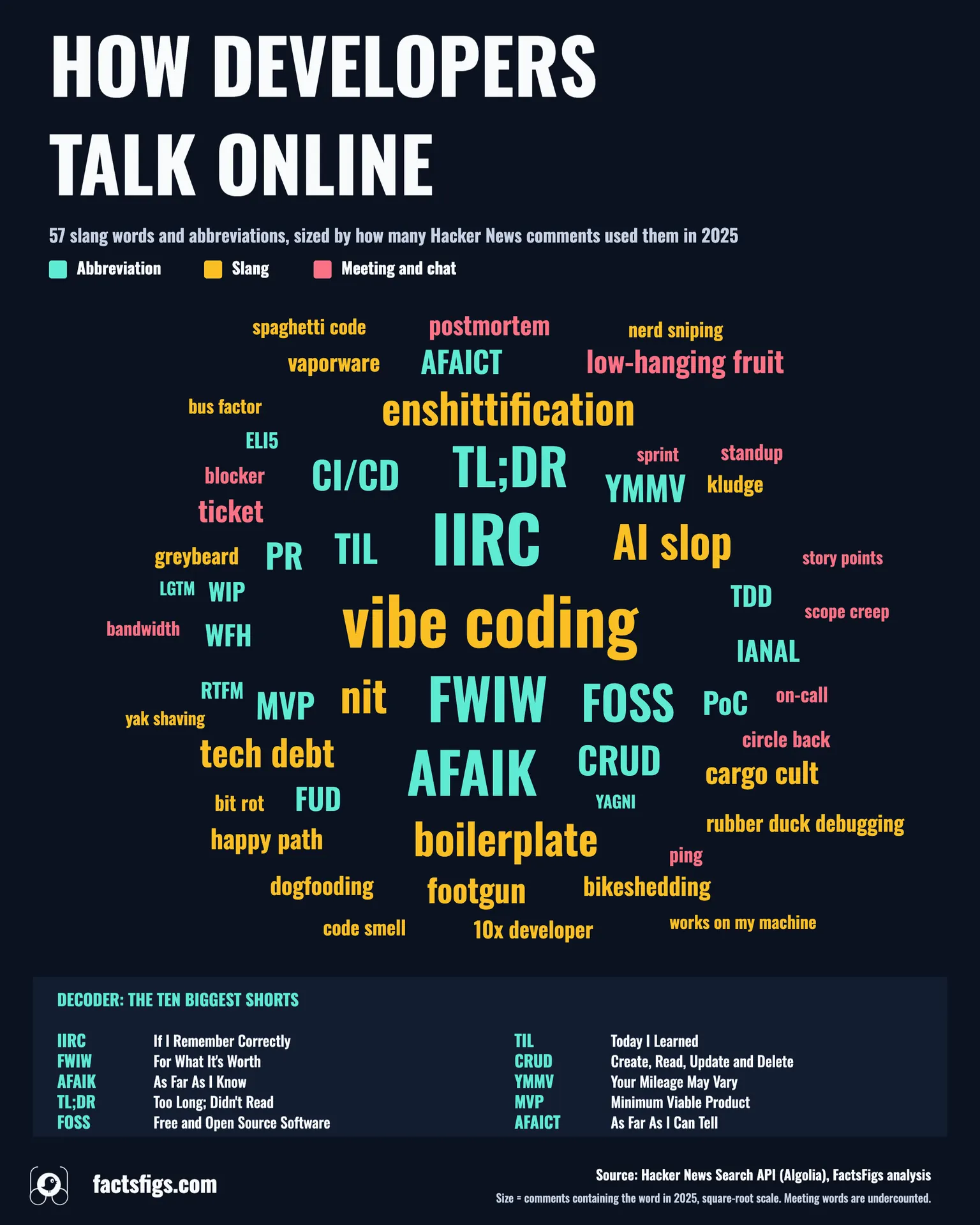
Word cloud of 57 developer slang words and abbreviations, each sized by how many Hacker News comments used it in 2025. The largest are vibe coding, IIRC, FWIW, AFAIK, TL;DR, FOSS, AI slop, nit, boilerplate and enshittification. Cyan words are abbreviations, amber words are slang and coral words are meeting and chat talk. Among the smallest are LGTM, YAGNI, story points, scope creep and yak shaving. A decoder panel below lists the long forms of the ten biggest abbreviations, such as IIRC for if I remember correctly.
FactsFigs

Facts & Figures

Visual Intelligence

TL;DR: What Slang Do Developers Use Online?

We explain 57 developer words and show how often Hacker News commenters used each one in 2025.

Developers write in shorthand that clients, managers and readers often cannot decode. IIRC means "if I remember correctly", LGTM means "looks good to me", a footgun is a feature that makes it easy to hurt yourself, and vibe coding is building software with an AI without reading the code closely. This post explains 57 such words in plain English, with the long form of every abbreviation. We sized each word by the number of Hacker News comments that used it in 2025. Only vibe coding, at 8,489 comments, beat the hedge IIRC, at 8,159. FWIW and AFAIK follow at 6,025 and 5,979. The words from meetings are small, and the measure undercounts them.

! Three Things to Know:

  • •
    57 Words · 6 Lists: Each word has a one-line meaning and an example of when it is used, grouped from hedges and code review to meeting talk.
  • •
    The Hedges · IIRC, FWIW, AFAIK: The biggest abbreviations are all ways of softening a claim.
  • •
    Meeting Words · Smallest Group: None reaches 1,100 comments, partly because the measure undercounts them.

? The Numbers Behind the Claim:

  • •
    Biggest word: vibe coding, 8,489 comments
  • •
    Biggest abbreviation: IIRC, 8,159 comments
  • •
    Median meeting word: 256 comments

On Hacker News in 2025 the loudest developer shorthand was the kind that admits doubt, and the only word that beat it was a brand new AI term. The words people imagine from meetings are far quieter online.

Continue reading below for the full detailed article →

Overview

How We Picked and Counted 57 Developer Words

Developers write in shorthand. A message might read "IIRC the PR is blocked, LGTM once CI/CD passes", and anyone outside the trade can read it three times and still not know what was said. We picked 57 slang words and abbreviations that developers use online and at work, from code review notes to meeting talk, and explained each one in plain English with its long form. Then we measured them. For each word we counted the Hacker News comments from calendar 2025 that contain it, using the site's public search service and the same exact-phrase search for every word. A comment counts once, however many times it uses the word. Size in the cloud follows the square root of that count, so the area a word covers matches how often it appeared. That gives a ranking of what developers talk about online. It is not a census of workplace speech. Hacker News is a forum where many software engineers, founders and AI watchers write long comments, and we did not count meetings, X, Reddit, Discord or GitHub. Below, the 57 words are grouped into six lists. Each gives the long form where there is one, what the word means in a sentence and an example of when someone would use it.

Three Numbers From the Count

The biggest word, the biggest abbreviation and the biggest meeting word, in Hacker News comments in 2025.

Biggest Word · vibe coding

8489 comments

Building software by describing it to an AI. The phrase had no comments in January 2025 and 23 in February.

Biggest Abbreviation · IIRC

8159 comments

If I remember correctly. A hedge that tells readers the writer is working from memory.

Biggest Meeting Word · low-hanging fruit

1010 comments

The easy wins to pick off first. No meeting or chat word in the cloud reaches 1,100 comments.

Developer Words by Group

  • Abbreviations · median 1,300 comments 22 words IIRC, FWIW, AFAIK, TL;DR and FOSS lead the group.
  • Slang · median 461 comments 23 words Vibe coding, AI slop, nit, boilerplate and enshittification lead the group.
  • Meeting and chat · median 256 comments 12 words Low-hanging fruit, ticket, postmortem, blocker and circle back lead the group.

Hedges and Forum Shorthand

These are the biggest abbreviations in the cloud: IIRC appeared in 8,159 Hacker News comments in 2025, FWIW in 6,025 and AFAIK in 5,979. Six of the ten warn the reader that the writer may be wrong or that the advice comes with no guarantee. We read that as caution mixed with politeness, but the counts show how often the words appear, not why.

  • IIRC: If I Remember Correctly: Added when quoting something from memory, to warn the reader it may be wrong. "IIRC the server was moved last year."
  • AFAIK: As Far As I Know: A hedge meaning this is all the writer knows, though there may be more. "AFAIK nobody has tried it on Windows."
  • AFAICT: As Far As I Can Tell: A hedge for the writer's best reading of the facts when they are not certain. "AFAICT the bug is in the parser."
  • FWIW: For What It's Worth: Introduces a small extra, take it or leave it, such as a personal experience. "FWIW it worked fine for me."
  • YMMV: Your Mileage May Vary: A warning that results may differ for other people, so the writer's experience is no promise. "Fixed it for me by rebooting, YMMV."
  • IANAL: I Am Not A Lawyer: A disclaimer added before an amateur opinion about a law or a licence. "IANAL but that licence looks strict."
  • TL;DR: Too Long; Didn't Read: A short summary put on top of something long so readers can skip the rest. "TL;DR: the migration is done."
  • TIL: Today I Learned: Announces a small fact the writer has only just found out. "TIL that the space bar is the biggest key."
  • ELI5: Explain Like I'm 5: A request to explain a hard idea in very simple words, as if to a small child. "ELI5: why is the build so slow?"
  • RTFM: Read The Manual: A curt reply telling someone the answer is in the instructions they did not read. The F is a rude word. "RTFM, it is in the first paragraph."

Code Review and Shipping

These show up where programmers propose, check and release changes. LGTM is one of the smallest words in the cloud at 138 comments, probably because it lives in code review tools more than in forum comments. PR is sized by the spelled-out phrase "pull request" (1,514 comments), because the two letters also mean public relations.

  • LGTM: Looks Good To Me: A reviewer's quick way of saying a proposed change is fine and may go ahead. "Read the diff, LGTM, merge it."
  • nit: Short for nitpick: A tiny, optional remark about polish in a review that the author need not fix. "Nit: extra space on line 12."
  • PR: Pull Request: A request to merge your changes into a shared project so teammates can review them first. "Opened a PR for the typo fix."
  • WIP: Work In Progress: A label on something unfinished, shared early so others can look and not yet ready to approve. "WIP: new pricing page, ignore the broken layout."
  • TDD: Test-Driven Development: A way of working where you write the checks first and then the code that passes them. "We do TDD, so the test came before the feature."
  • CI/CD: Continuous Integration and Continuous Delivery: The automatic pipeline that tests every change and delivers it to users, so releases become routine. "The CI/CD run failed again overnight."
  • YAGNI: You Aren't Gonna Need It: A reminder not to build features you only think you might want one day. "YAGNI, nobody has asked for that setting."
  • CRUD: Create, Read, Update and Delete: The four basic things most business apps do with stored data, also used jokingly for dull, routine apps. "It is just a CRUD app with a nice logo."
  • PoC: Proof of Concept: A rough, quick build made only to show an idea can work. "It is only a PoC, do not put it in production."
  • MVP: Minimum Viable Product: The smallest version of a product that real users can try and give feedback on. "Ship an MVP first and polish later."
  • FOSS: Free and Open Source Software: Software that is free to use and share and whose code is open. "We only ship FOSS licences here."

Code and Bug Slang

Informal words for what code is like and how it goes wrong. Boilerplate (2,983 comments) and tech debt (1,823) are the biggest, and a footgun (1,405) is the one most often quoted as a warning.

  • footgun: A feature that makes it easy to hurt yourself by accident. "That config flag is a footgun."
  • boilerplate: Repetitive standard code or text that has to be written again and again. "Half this file is boilerplate."
  • tech debt: Short for technical debt: the extra future work built up by taking quick, lower-quality shortcuts now. "Skipping the tests adds tech debt."
  • kludge: A clumsy, hurried fix that works for now but is not clean. "That fix is a kludge, but it works."
  • spaghetti code: Code whose logic is so tangled that nobody can follow it. "This module is spaghetti code, nobody dares touch it."
  • code smell: A hint in the code that something deeper may be wrong, though it is not an outright bug. "A 900-line function is a code smell."
  • bit rot: Software slowly breaking over time though nobody touched it, because everything around it changed. "Ten years untouched and it has bit rot."
  • happy path: The route through a program when everything goes right and nothing unexpected happens. "It works on the happy path, but not with empty input."
  • rubber duck debugging: Finding the cause of a bug by explaining the problem aloud to an object, such as a rubber duck. "I explained it to the duck and spotted the typo."
  • works on my machine: The classic defence when something fails for others but runs fine on the developer's own computer. "Works on my machine, must be your setup."

People and Culture Slang

Words developers use about each other, their habits and the companies they build for. Enshittification is the biggest at 2,815 comments, and yak shaving, at 148, is among the smallest.

  • bikeshedding: Arguing at length over a trivial detail everyone has an opinion on while the weighty issue goes unexamined. "We spent an hour bikeshedding the button colour."
  • cargo cult: Copying the outward ritual of something without understanding why it works. "Adding that config because everyone does is cargo cult."
  • nerd sniping: Hooking someone's attention with an interesting puzzle so they drop what they were doing. "That problem nerd sniped me for a whole weekend."
  • yak shaving: A chain of side-chores, each needed for the one before, that drags you far from your real task. "I wanted to fix a typo and ended up yak shaving all afternoon."
  • greybeard: A veteran programmer with decades of experience. "The greybeards remember when this was done in assembly."
  • 10x developer: A supposedly rare programmer ten times as productive as the average, now mostly a joke or a complaint about job ads. "The ad wants a 10x developer for the price of a junior."
  • bus factor: How many people would have to be hit by a bus before a project stalls, so a low number means too much rests on one person. "Our bus factor is one: only Sam knows the deploy."
  • dogfooding: A company using its own product for real work to find its flaws. "We are dogfooding the new editor internally."
  • vaporware: A product announced with fanfare that never ships. "That feature is vaporware, it was promised in 2019."
  • enshittification: A service getting steadily worse as its owner squeezes users and then business customers for profit. "The app's enshittification began with the ads."
  • FUD: Fear, Uncertainty and Doubt: Scare tactics that plant doubt about a rival product. "That comparison chart is pure FUD."

The Newest Words

Vibe coding is the biggest word in the cloud, at 8,489 comments, and AI slop follows at 3,215. AI slop is counted only through specific phrases, so its true use is higher than drawn.

  • vibe coding: Building software by describing what you want to an AI and accepting its output without reading the code closely. "Vibe coding a whole app on a Sunday."
  • AI slop: Low-effort, mass-produced AI-generated content. "The pull request was pure AI slop."

The newest words

Why Is Vibe Coding a Word That Needs a Date?

Vibe coding is partly a window effect. The phrase appeared in no comments in January 2025, in 23 in February, in 419 in March and in 678 in December. Its 2025 total reflects a word that spread during the year, and a count for 2026 would size it differently. For how developers feel about AI tools more broadly, see our post on how many of them use these tools.

Meeting and Team Talk

If you came for the words from your own meetings, they are the small ones: the 12 meeting and chat words have a median of 256 comments, against about 1,300 for the 22 abbreviations. For seven of them (ticket, blocker, standup, ping, on-call, bandwidth and sprint) we counted only work-specific phrases such as "sprint planning", so their sizes are floors.

  • standup: A very short daily team check-in where each person shares progress and problems. "Skipping standup today, I am travelling."
  • sprint: A short fixed work period, usually one to four weeks, with a set goal. "We will finish the login page this sprint."
  • story points: Points teams give a task to show its relative effort, instead of hours. "That ticket is five story points."
  • ticket: A logged job or problem in a tracking tool. "I opened a ticket for the broken export button."
  • blocker: Something that stops your work until someone removes it. "My only blocker is access to the staging server."
  • scope creep: Requirements slowly growing after work has started, without more time or money. "Adding a chat feature now is scope creep."
  • ping: To message someone briefly to get their attention. "Ping me when the files are uploaded."
  • on-call: Being the person who must respond if something breaks outside normal hours, usually in rotation. "I am on call this weekend."
  • bandwidth: Slang for how much spare capacity a person has for more work. "I do not have the bandwidth for another project."
  • circle back: A corporate phrase for returning to a topic later, often a polite way to postpone it. "Let us circle back on pricing next week."
  • low-hanging fruit: The easy wins to pick off first. "Let us start with the low-hanging fruit."
  • postmortem: A written review after an outage that looks at what happened and why, ideally without blame. "The postmortem is due on Friday."
  • WFH: Working From Home: Working from home instead of an office. "WFH today, the boiler engineer is coming."

The limits

What Do These Counts Not Show?

They show Hacker News comments in 2025 and nothing else. We did not measure X, Reddit, Discord, GitHub or meetings, so the cloud is what developers discuss online and not a census of workplace speech. We could not get the year's total comment count, so we show raw counts and not rates. For the slang of online play, see our guide to gaming abbreviations.

We left words out on purpose. IMO (18,651 comments), BTW, IMHO, TBH and FYI have clean counts, but they are everyday internet abbreviations and not developer words, and IMO alone would be 2.2 times the next word. Fifteen developer words appeared in fewer than 100 comments and were too rare to chart, including PTAL (2), EOD (34) and ETA (92). ACK and "ship it" could not be counted without mixing in everyday meanings.

TIL is also a spelling of "until", so its count runs a little high. The counts were taken on 27 Nov 2026 and can drift by a few if comments are later removed.

The glossary

All 57 Developer Words With Their Hacker News Counts

The meaning and an example line for each word are in the lists above. This table gives the long form, the group and the number of Hacker News comments from 2025 that contain the word, in order of that number.

vibe codingNot an abbreviationSlang8,489
IIRCIf I Remember CorrectlyAbbreviation8,159
FWIWFor What It's WorthAbbreviation6,025
AFAIKAs Far As I KnowAbbreviation5,979
TL;DRToo Long; Didn't ReadAbbreviation4,522
FOSSFree and Open Source SoftwareAbbreviation3,764
AI slopNot an abbreviationSlang3,215
nitShort for nitpickSlang3,014
boilerplateNot an abbreviationSlang2,983
enshittificationNot an abbreviationSlang2,815
TILToday I LearnedAbbreviation2,087
CI/CDContinuous Integration and Continuous DeliveryAbbreviation2,083
CRUDCreate, Read, Update and DeleteAbbreviation1,982
tech debtShort for technical debtSlang1,823
YMMVYour Mileage May VaryAbbreviation1,602
MVPMinimum Viable ProductAbbreviation1,554
PRPull RequestAbbreviation1,514
footgunNot an abbreviation (foot plus gun)Slang1,405
AFAICTAs Far As I Can TellAbbreviation1,087
FUDFear, Uncertainty and DoubtAbbreviation1,057

Showing 1-20 of 57

Page 1 of 3

Source: FactsFigs analysis of the Hacker News Search API. Counts for ticket, blocker, standup, ping, on-call, bandwidth, sprint and AI slop use work-specific phrases and are floors. PR is counted as the phrase pull request. TIL includes a few uses of the word until.

Data Source and Attribution

Hacker News Search API (Algolia)

Counts are FactsFigs' own calculation. For each word we queried the Hacker News Search API, which is run by Algolia, for comments posted between 1 January and 31 December 2025. We used an exact quoted phrase with no typo tolerance and no prefix matching, searched only the comment body, and counted each comment once however many times or in however many spellings it used the word. The queries were run on 27 Nov 2026. Only counts are published, with no comment text or usernames. Word size in the visual is the square root of the count. Meanings are in FactsFigs' own words and example lines are invented. The data was manually collected by FactsFigs, which is not affiliated with Hacker News, Y Combinator or Algolia.

FactsFigs reviews, cleans and cross-checks every source dataset before shaping it into a data story. Each visualization is created and designed in FactsFigs Design Studio, an internal tool developed and owned by FactsFigs, and is the original work of a FactsFigs author, not an AI-generated copy of any existing graphic. Individual assets within a visual may or may not be produced with AI tools, but the design of the visual itself is solely FactsFigs' own.

Figures are estimates at the time of publication, provided for information only. Nothing here is financial advice or a guarantee of accuracy.

Last verified: 27 Nov 2026

The charts in this article were built with our own publishing system. See what it does →